
By the end of this chapter, you will be able to:
Mastering these skills will help you create safe, tasty, and beautiful hot desserts that impress customers and build your confidence in the kitchen!
Preparing hot desserts in food and beverage operations demands strict adherence to safety protocols and proper use of personal protective equipment (PPE) to prevent accidents and injuries. In Kenyan hospitality and catering settings, such as hotels, restaurants, and institutional kitchens, understanding the types of PPE and occupational safety measures is essential to protect staff while maintaining high-quality food production standards. This chapter explores the critical protective gear and safety practices that safeguard workers in hot dessert preparation environments, ensuring compliance with national regulations and fostering a safe working culture.
Personal protective equipment (PPE) is the clothing and equipment worn by kitchen staff to protect themselves from injury and to protect food from contamination by the worker. Hot dessert preparation brings particular hazards: steam from puddings and poaching pans, hot ovens and baking trays, boiling sugar and caramel, hot oil for fritters and the open flame of flambé work, as well as wet floors and sharp tools. The standard kitchen uniform and its accessories are designed for these conditions, and the Occupational Safety and Health Act, 2007 requires employers to provide suitable PPE and workers to wear it. Example: a teachers' training college kitchen in Karuri, Kiambu County, inspects every trainee's full uniform at the door before a hot dessert practical begins.
Safety boots are closed, sturdy kitchen shoes with non-slip soles, and often steel or composite toe caps. They protect the feet from hot liquids, spilt caramel and oil, falling pans and knives, and they grip wet or greasy floors to prevent slips. They should be fully enclosed (never sandals or open shoes), comfortable for long hours of standing, easy to wipe clean and kept in good repair.
A side cloth is a thick, folded cotton cloth carried by the cook, usually tucked into the apron string. It is used dry to hold hot pans, pudding basins, baking trays and ramekins, and to lift lids from steamers. It must be kept dry, because a wet cloth conducts heat and causes burns. It is never used for wiping hands or surfaces, which would spread dirt, and it is changed when soiled.
The apron is worn over the jacket and trousers to protect the uniform and the body from hot splashes, spills and stains. Kitchen aprons are made of thick white cotton or polyester-cotton, cover the body from chest or waist to below the knee, and are tied securely with a quick-release knot so they can be removed fast if hot food is spilt on them. A clean apron is put on every shift and changed when dirty, and it is removed when leaving the kitchen.
The chef's jacket is a long-sleeved, double-breasted jacket of thick white cotton or polyester-cotton. The double layer of cloth across the chest protects against heat, steam and splashes from boiling syrup, and the two fronts can be reversed to hide a stain. Long sleeves protect the arms from burns when reaching into ovens. Cotton is preferred because it absorbs sweat and does not melt onto the skin as some synthetic fabrics can. The white colour shows dirt, so the jacket is changed when soiled.
The chef's hat (toque, skull cap or hat with a hairnet) covers the hair completely. Its main purpose is hygiene: it stops hair, dandruff and sweat from falling into food. It also absorbs sweat from the forehead in a hot kitchen. Disposable paper hats are thrown away after each shift, while cloth hats are laundered.
Chef's trousers are loose-fitting trousers of strong cotton or polyester-cotton, often in a black and white check or plain dark colour that hides small stains. Their loose fit lets air circulate and keeps hot liquids from soaking against the skin, and they are long enough to cover the top of the boots so spills run over the shoes, not into them. Where skirts are allowed, they are of the same material, knee length or longer and worn with closed shoes, and must not be so tight or flared as to hinder movement or catch on equipment.
The neck tie (necktie or neckerchief) is a triangular or folded cotton cloth worn around the neck. It absorbs sweat so it does not drip into food, and it protects the neck from heat and splashes. It is tied neatly, often in a colour that shows the wearer's rank, and is washed daily.
Kitchen gloves protect the hands and protect food. Different gloves are used for different tasks.
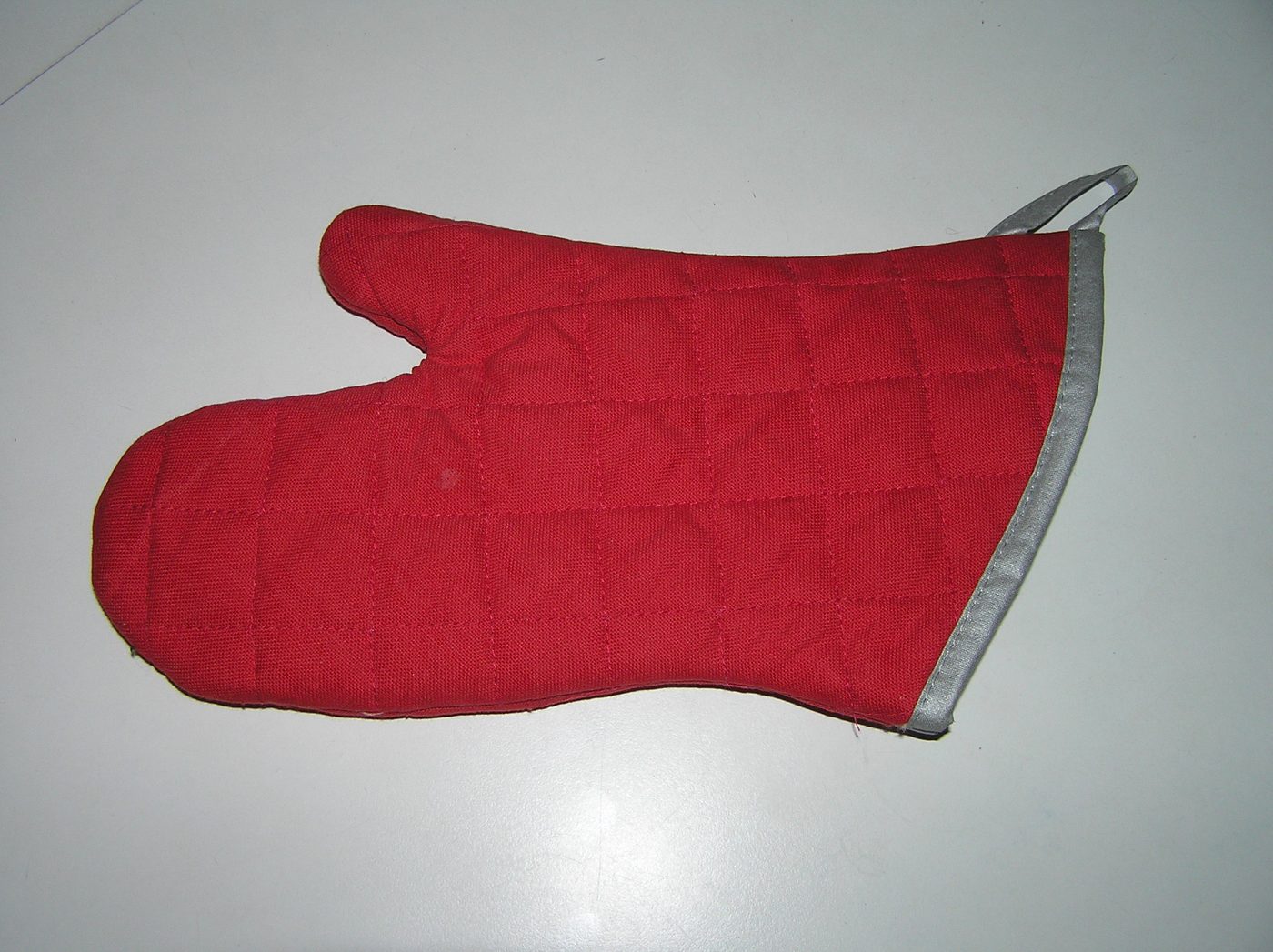
red heat-resistant glove for handling hot objects (Source: Wikimedia Commons)
Gloves never replace handwashing, and hands are washed before gloves are put on.
A face mask covers the nose and mouth to stop droplets from coughing, sneezing and talking from reaching food, which is important when plating and decorating desserts that will not be heated again. Masks are also worn where flour, icing sugar or cocoa dust is heavy, and a face shield gives extra protection from spitting hot sugar or oil. Disposable masks are changed when damp and never pulled down under the chin and then put back.
Create a free account to open more of this chapter.
Free: practical guides, quick cards, workplace scenarios and more.
Create a free accountThis chapter explored the preparation of hot desserts with a focus on safety, hygiene, and quality. It began by discussing the various types and uses of personal protective equipment essential for maintaining occupational safety and health in the kitchen environment. The chapter then examined the cleaning tools, equipment, and materials necessary for ensuring a clean workspace, emphasizing their correct application. An overview of kitchen tools and equipment specific to hot dessert preparation followed, alongside a detailed look at the ingredients used and how to assess their freshness and quality in line with HACCP principles. The process of preparing hot desserts was outlined together with hygiene practices covering both personal and food hygiene to prevent contamination. Different types of hot desserts and their production methods were described, including guidelines for quality assessment of the finished products. Finally, the chapter addressed the presentation of hot desserts and concluded with procedures for cleaning tools, equipment, work surfaces, floors, and proper waste disposal to maintain a safe and hygienic kitchen.
Type: Individual
| Tools & Equipment | Materials |
|---|---|
| Hot plate or stove | Kitchen safety PPE (chef coat, apron, non-slip closed shoes, heat resistant gloves) |
| Mixing bowls | Hairnet |
| Measuring jug | Face mask |
| Whisk | Apron |
| Knife | |
| Cutting board | |
| Serving plates | |
| Waste bin with lid |
| S/N | Item | Quantity |
|---|---|---|
| 1 | Kitchen safety PPE (chef coat, apron, non-slip closed shoes, heat resistant gloves) | 1 set per Candidate |
| 2 | Hairnet | 1 per Candidate |
| 3 | Face mask | 1 per Candidate |
| 4 | Fire blanket | 1 per 5 Candidates |
| 5 | First aid kit | 1 per 5 Candidates |
| 6 | Hot plate or stove | 1 per Candidate |
| 7 | Mixing bowls | 2 per Candidate |
| 8 | Measuring jug | 1 per Candidate |
| 9 | Whisk | 1 per Candidate |
| 10 | Knife | 1 per Candidate |
| 11 | Cutting board | 1 per Candidate |
| 12 | Serving plates | 4 per Candidate |
| 13 | Waste bin with lid | 1 per Candidate |
| 14 | Fire extinguisher | 1 per 5 Candidates |
| 15 | Apron | 1 per Candidate |
| 16 | Hand washing station with soap and sanitizer | 1 per Candidate |
| Items to be Evaluated | Marks Available | Marks Obtained | Comments |
|---|---|---|---|
| TASK 1: Implement Occupational Safety and Health Measures | |||
| Selected and wore appropriate PPE correctly (chef coat, apron, non-slip shoes, hairnet, face mask, heat resistant gloves) (Award 1 mark for each correctly worn PPE item up to 3 marks) | 3 | ||
| Demonstrated correct hand hygiene before and during the preparation (hand washing and sanitizing) (Award 2 marks for proper hand hygiene procedure) | 2 | ||
| Ensured workstation and equipment were clean and organized before starting (Award 1 mark for clean and organized workstation) | 1 | ||
| Handled kitchen tools safely (e.g., knife handling, avoiding cross contamination) (Award 2 marks for safe handling of tools and hygiene) | 2 | ||
| Applied safe hot dessert cooking practices (use of heat resistant gloves, careful handling of hot equipment) (Award 3 marks for correct use of heat protection and safe handling) | 3 | ||
| Demonstrated proper waste disposal and maintained clean environment during and after preparation (Award 2 marks for proper waste disposal and environmental hygiene) | 2 | ||
| Identified and demonstrated correct use of fire safety equipment (fire blanket, fire extinguisher) (Award 2 marks for correct identification and demonstration) | 2 | ||
| Reported any hazards or unsafe conditions observed during the task (Award 1 mark for hazard identification and reporting) | 1 | ||
| Sub-Total | 16 | ||
| PRODUCT CHECKLIST | |||
| Correct and consistent use of PPE throughout the dessert preparation process (Award 3 marks for consistent PPE use) | 3 | ||
| Maintained a clean, safe, and hazard-free work environment during the entire task (Award 3 marks for work environment hygiene and safety) | 3 | ||
| Demonstrated safe handling of hot desserts and equipment without injury or unsafe practice (Award 3 marks for safe handling and no accidents) | 3 | ||
| Sub-Total | 9 | ||
| GRAND TOTAL | 25 | ||
Type: Individual
| Tools & Equipment | Materials |
|---|---|
| Stainless steel mixing bowls | Dishwashing liquid detergent |
| Whisks | Hot water supply |
| Measuring jugs (500ml) | |
| Saucepans (1.5 Litre) | |
| Wooden spoons | |
| Cleaning cloths | |
| Scrubbing brushes | |
| Rubber gloves | |
| Drying rack | |
| Waste bin with liner |
| S/N | Item | Quantity |
|---|---|---|
| 1 | Stainless steel mixing bowls | 2 Pcs per Candidate |
| 2 | Whisks | 1 Pc per Candidate |
| 3 | Measuring jugs (500ml) | 1 Pc per Candidate |
| 4 | Saucepans (1.5 Litre) | 1 Pc per Candidate |
| 5 | Wooden spoons | 1 Pc per Candidate |
| 6 | Cleaning cloths | 3 Pcs per Candidate |
| 7 | Scrubbing brushes | 1 Pc per Candidate |
| 8 | Dishwashing liquid detergent | 50 ml per Candidate |
| 9 | Hot water supply | Adequate per Candidate |
| 10 | Rubber gloves | 1 Pair per Candidate |
| 11 | Drying rack | 1 Pc per Candidate |
| 12 | Waste bin with liner | 1 Pc per Candidate |
| Items to be Evaluated | Marks Available | Marks Obtained | Comments |
|---|---|---|---|
| TASK 1: Cleaning kitchen tools and equipment | |||
| Wears clean and appropriate PPE including rubber gloves (Award 1 mark if candidate wears gloves and appropriate attire before cleaning) | 1 | ||
| Disassembles tools and equipment where applicable for thorough cleaning (Award 1 mark if candidate disassembles and inspects tools before cleaning) | 1 | ||
| Removes visible food residues from tools and equipment before washing (Award 1 mark for each correctly cleaned item: mixing bowls, saucepans) | 2 | ||
| Uses correct quantity of dishwashing liquid and hot water to wash tools (Award 1 mark if detergent and water are used appropriately) | 1 | ||
| Cleans tools and equipment thoroughly using scrubbing brushes and cloths (Award 1 mark each for effective cleaning of at least two types of tools) | 2 | ||
| Rinses tools and equipment properly to remove soap residues (Award 1 mark if tools are rinsed with clean water) | 1 | ||
| Dries tools and equipment using drying racks or clean cloths (Award 1 mark if drying is done hygienically) | 1 | ||
| Disposes of waste and dirty water properly in waste bin and designated area (Award 1 mark if waste disposal is done correctly) | 1 | ||
| Stores cleaned tools and equipment in designated clean areas (Award 1 mark if tools are stored properly after cleaning) | 1 | ||
| Sub-Total | 11 | ||
| PRODUCT CHECKLIST | |||
| All kitchen tools and equipment are visibly clean with no food residues (Award 1 mark for each category: bowls, saucepans, utensils) | 3 | ||
| Tools and equipment are dry and stored correctly (Award 2 marks if all items are dry and stored hygienically) | 2 | ||
| Sub-Total | 5 | ||
| GRAND TOTAL | 16 | ||
At the start of this chapter we promised you would be able to:
Tick each one you can genuinely do.
So, are you there yet?
You're competent when you can confidently do 50% or more of what this chapter promised.
Sign in to record how you're doing.