Construction metal products are fundamental to civil engineering projects, providing structural strength, durability, and aesthetic appeal in building and infrastructure works. Selecting the right metal products requires careful consideration of their mechanical properties, corrosion resistance, availability, and cost-effectiveness within the Kenyan construction environment. This chapter focuses on the principles guiding the selection of construction metals, equipping professionals with the knowledge to make informed decisions that enhance project quality and longevity.
5.1 Metal Products Selection
Metal product selection is a critical phase in civil engineering design and construction. In Kenya, where environmental conditions such as humidity, temperature variation, and industrial pollution vary widely, choosing metals that meet performance requirements while considering local availability and budget constraints is essential. Proper selection minimizes maintenance costs and structural failures, ensuring compliance with Kenyan standards and sustainability goals.
5.1.1 Definitions
Understanding the basic terms used for metals and metal products allows engineers, technicians and suppliers to specify, order, test and discuss materials accurately. A metal is a chemical element, or a mixture of elements, that is usually hard, shiny, a good conductor of heat and electricity, and can be shaped by hammering, rolling or drawing without breaking. Most metals used in construction are alloys, made by combining a base metal with other elements to improve strength, corrosion resistance or workability, and they are supplied as metal products such as bars, sections, sheets, tubes, wires and fixings. Example: when a contractor building a dormitory for a secondary school in Embu ordered "Y12 high-yield deformed bars" and "mild steel angle sections", the supplier knew exactly which steel grade, form and size to deliver because the terms were used correctly.
Key Terms Used for Metals
- Ore: A natural rock or mineral from which a metal can be extracted economically, such as iron ore or bauxite for aluminium.
- Ferrous metal: A metal that contains iron as its main element, such as cast iron, wrought iron and steel.
- Non-ferrous metal: A metal that contains little or no iron, such as aluminium, copper, zinc and lead.
- Alloy: A mixture of a metal with one or more other elements, such as steel (iron and carbon) or brass (copper and zinc).
- Steel: An alloy of iron with a small amount of carbon, usually less than about 2%, and sometimes other elements.
- Cast iron: An iron alloy with a high carbon content, about 2% to 4.5%, which is hard and brittle and is shaped by casting.
- Wrought iron: Almost pure iron with very little carbon, which is tough and malleable and was formerly used for decorative work.
- Corrosion: The gradual destruction of a metal by chemical reaction with its environment, such as the rusting of steel.
- Galvanising: Coating steel with zinc to protect it from corrosion.
Terms Describing Properties of Metals
- Tensile strength: The maximum pulling stress a metal can withstand before breaking.
- Yield strength: The stress at which a metal begins to deform permanently, used in structural design.
- Ductility: The ability of a metal to be stretched into wire or deform considerably before breaking.
- Malleability: The ability of a metal to be hammered or rolled into thin sheets without cracking.
- Hardness: The resistance of a metal to scratching, indentation and wear.
- Toughness: The ability of a metal to absorb energy and resist fracture under sudden impact.
- Fatigue: Failure of a metal under repeated or fluctuating loads at stresses below its normal strength.
- Weldability: The ease with which a metal can be joined by welding without defects.
- Conductivity: The ability of a metal to conduct heat and electricity.
Terms Describing Metal Products
- Bars and rods: Long solid products of round, square or other cross-sections, such as reinforcement bars.
- Rolled sections: Long products with shaped cross-sections, such as I-beams, channels, angles and tees.
- Plates and sheets: Flat products, with plates being thicker and sheets thinner, used for cladding, roofing and fabrication.
- Tubes and hollow sections: Hollow round, square or rectangular products used for columns, trusses, handrails and pipes.
- Wire and mesh: Thin drawn metal and welded or woven grids used for reinforcement, fencing and plaster backing.
- Fasteners and fixings: Bolts, nuts, screws, nails and anchors used to join and fix components.
5.1.2 Types of metals
Metal products in civil engineering encompass a variety of forms and alloys, each suited to specific structural or architectural functions.
Metals used in construction are classified into two main groups: ferrous metals, which contain iron as their main element, and non-ferrous metals, which contain little or no iron. Ferrous metals, mainly steel and cast iron, are strong and relatively cheap and form the bulk of structural metalwork, but most rust unless protected. Non-ferrous metals such as aluminium, copper and zinc are generally lighter or more corrosion resistant and are used for roofing, cladding, windows, plumbing, electrical work and protective coatings. Example: in a new branch of a bank in Nyeri, structural steel formed the roof frame, aluminium was used for the shopfront and windows, copper for the electrical wiring and galvanised steel for the security grilles.
Ferrous Metals
| Metal |
Approximate carbon content |
Main properties |
Typical construction uses |
| Wrought iron |
Less than 0.08% |
Tough, malleable, corrosion resistant compared with mild steel |
Decorative gates, grilles and restoration work |
| Mild (low carbon) steel |
About 0.15% to 0.25% |
Ductile, weldable, good strength, rusts if unprotected |
Structural sections, plain bars, roofing sheets, door frames |
| Medium carbon steel |
About 0.25% to 0.6% |
Stronger and harder, less ductile |
Rails, machine parts, bolts |
| High carbon steel |
About 0.6% to 1.5% |
Very hard and strong, brittle |
Tools, springs, cutting edges, high-tensile wire |
| High-yield (high tensile) steel |
Low carbon with alloying or special processing |
High yield strength with adequate ductility |
Deformed reinforcement bars, prestressing strand |
| Stainless steel |
Low carbon with at least about 10.5% chromium |
Excellent corrosion resistance |
Handrails, sinks, cladding, fixings in coastal areas |
| Cast iron |
About 2% to 4.5% |
Hard, brittle, strong in compression, good castability |
Manhole covers, gratings, pipes and fittings |
Non-Ferrous Metals
| Metal |
Main properties |
Typical construction uses |
| Aluminium |
Light, corrosion resistant, easily extruded |
Window and door frames, roofing, cladding, curtain walls |
| Copper |
Excellent conductor, corrosion resistant, ductile |
Electrical cables, water pipes, earthing, roofing |
| Zinc |
Corrosion resistant, protects steel sacrificially |
Galvanising coatings, roofing and flashings |
| Lead |
Very dense, soft, malleable, corrosion resistant |
Flashings, radiation shielding (lead use is restricted for water supply) |
| Brass (copper and zinc) |
Attractive, corrosion resistant, easily machined |
Door and window fittings, taps, valves |
| Bronze (copper and tin) |
Strong, corrosion and wear resistant |
Bearings, plaques, sculptures, marine fittings |
| Tin |
Corrosion resistant, low melting point |
Solder and coatings on steel |
Ferrous and Non-Ferrous Metals Compared
| Feature |
Ferrous metals |
Non-ferrous metals |
| Main element |
Iron |
Other metals such as aluminium, copper, zinc |
| Magnetism |
Mostly magnetic |
Mostly non-magnetic |
| Corrosion |
Most rust unless protected |
Generally more corrosion resistant |
| Weight |
Generally heavier |
Often lighter, such as aluminium |
| Strength and cost |
High strength, relatively cheap |
Lower strength in many cases, often more expensive |
| Main uses |
Structural frames, reinforcement, heavy components |
Finishes, roofing, windows, plumbing, electrical work |
Structural Steel
- Mild Steel Sections: Widely used in beams, columns, and trusses due to good strength and ductility.
- High-Strength Steel: Employed in bridges and heavy-load bearing structures requiring enhanced load capacity.
- Steel Plates: Used in flooring and cladding where flat, strong surfaces are needed.
Reinforcement Steel Bars (Rebar)
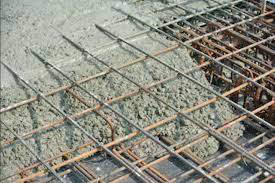
Steel reinforcement bars (rebar) arranged in a grid pattern within con (Source: Untitled (20))
- Deformed Bars: Provide mechanical anchorage in concrete, enhancing structural integrity in foundations and slabs.
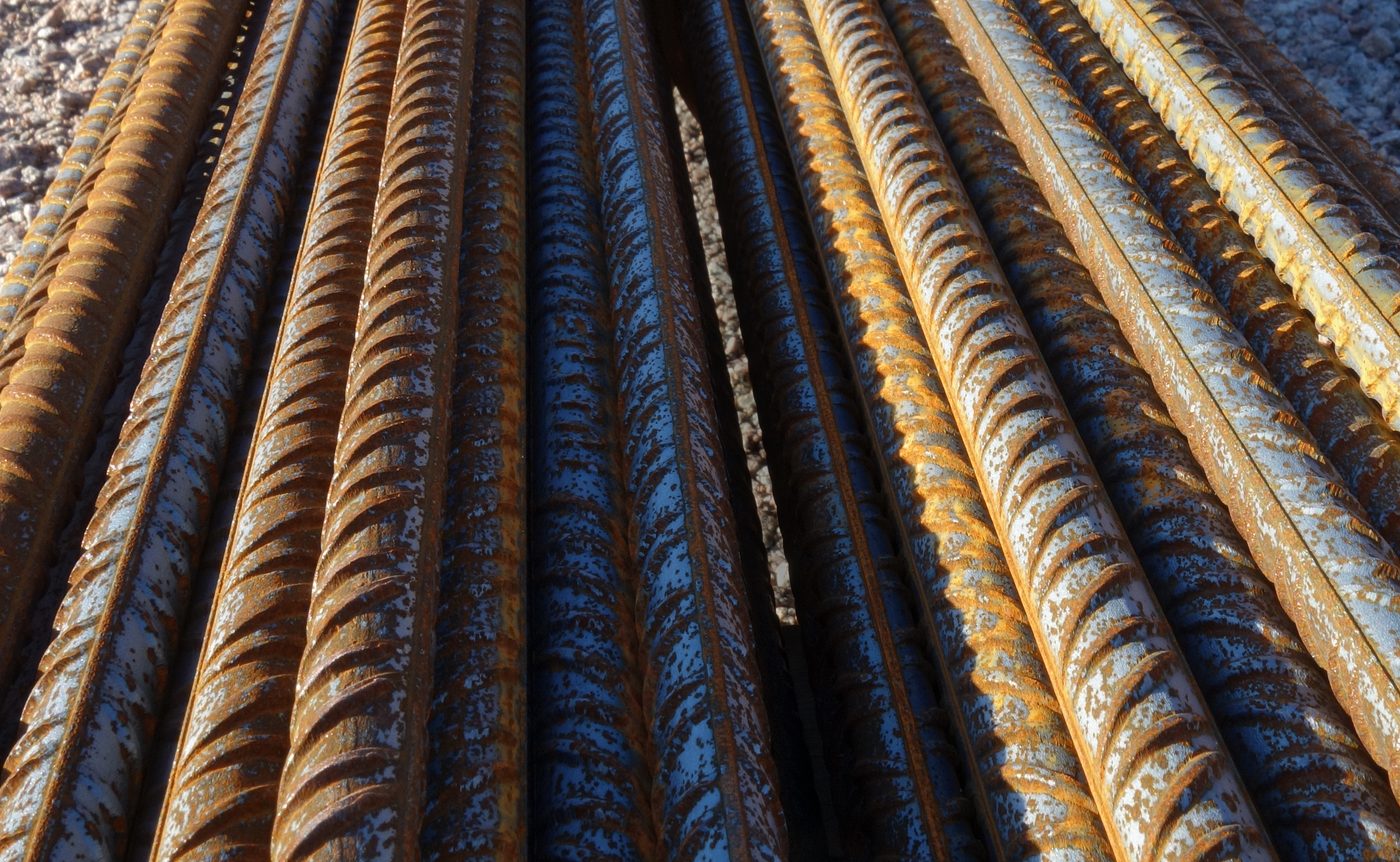
Close-up of deformed steel bars for construction (Source: Wikimedia Commons)
- Mild Steel Bars: Used in non-critical reinforcement where ductility is prioritized.
Stainless Steel
- Grades 304 and 316: Used in environments prone to corrosion such as chemical plants and coastal infrastructure.
- Architectural Applications: Provides aesthetic finishes in hotels and commercial buildings.
Aluminium
- Lightweight and Corrosion-Resistant: Suitable for window frames, roofing sheets, and facades.
- Non-Structural Uses: Often chosen for elements requiring low weight and moderate strength.
Galvanized Steel
- Corrosion Protection: Coated with zinc to prevent rusting, commonly used in water tanks, fencing, and roofing.
- Cost-Effective Alternative: Balances durability with affordability in many county government projects.
5.1.3 Factors Influencing Metal Product Selection
Selecting metal products involves evaluating multiple factors that affect the performance and suitability of metals in construction. Engineers must balance technical requirements with economic and environmental considerations.
Mechanical Properties
- Strength: Metals must possess adequate tensile, compressive, and shear strength to withstand loads. For example, steel used in Nairobi County office buildings must support both dead and live loads without deformation.
- Ductility: Metals with good ductility, such as mild steel, allow some deformation before failure, providing safety margins during events like earthquakes.
- Hardness: This property influences wear resistance. Reinforcement bars in roads and bridges require hardness to resist abrasion from traffic loads.
- Toughness: Tough metals absorb energy without fracturing, critical in structures exposed to dynamic loads such as industrial warehouses.
- Fatigue Resistance: Metals must endure repeated loading cycles. For instance, metal components in Nairobi’s airport terminals face continuous vibration and must resist fatigue failure.
Corrosion Resistance
- Environmental Exposure: Coastal regions like Mombasa expose metals to salt-laden air, accelerating corrosion, thus stainless steel or galvanized steel is preferred.
- Protective Coatings: Some metals are selected based on their ability to be coated with anti-corrosion paints or galvanization.
- Longevity Requirements: For long-lasting infrastructure such as county government water tanks, corrosion-resistant metals are essential to reduce maintenance.
Availability and Cost
- Local Supply: Metals readily available from Kenyan suppliers reduce lead times and transportation costs.
- Budget Constraints: Projects with limited funding may prioritize cost-effective metals like mild steel over expensive alloys.
- Lifecycle Cost: Selection considers not only initial cost but maintenance and replacement expenses over the structure’s lifespan.
Fabrication and Ease of Installation
- Workability: Metals that are easier to cut, weld, or bend simplify onsite fabrication, as seen in school construction projects where skilled labor may be limited.
- Standard Sizes and Shapes: Availability of standard metal profiles like I-beams, angles, and sheets reduces wastage and speeds construction.
- Weight Considerations: Lightweight metals reduce foundation loads, important in high-rise buildings in Nairobi’s central business district.
Compliance and Standards
- Kenya Bureau of Standards (KEBS): Metals must meet KEBS specifications to ensure quality and safety.
- International Codes: For projects funded by international agencies, metals must comply with codes such as ASTM or ISO.
- Sustainability Certifications: Increasingly, environmental impact and recyclability of metals influence selection decisions.
5.1.4 Criteria for Metal Product Selection in Kenyan Construction Projects
The decision-making process for metal selection integrates technical performance with project-specific requirements and the local context.
Structural Requirements
- Load Types and Magnitude: Metals must be selected to safely carry anticipated loads including dead, live, wind, and seismic forces.
- Span and Shape: Long-span roofs or bridges require metals with high strength-to-weight ratios.
- Connection Methods: Compatibility with welding, bolting, or riveting affects metal choice.
Environmental Conditions
- Climatic Factors: Coastal humidity, highland temperature variations, and urban pollution influence corrosion rates.
- Exposure to Chemicals: Industrial sites require metals resistant to chemical attack.
Economic Considerations
- Initial Cost vs. Lifecycle Cost: Balancing upfront expenditure against maintenance and replacement costs optimizes project budgets.
- Availability of Skilled Labor: Metals requiring specialized installation may increase labor costs.
Sustainability and Regulatory Compliance
- Recyclability: Preference for metals that can be recycled reduces environmental impact.
- Adherence to KEBS and Environmental Regulations: Ensures legal compliance and safety.
Project Timeline
- Lead Time for Procurement: Locally available metals reduce delays.
- Fabrication Time: Metals that simplify onsite work accelerate project completion.
5.1.5 Evaluation and Testing of Metal Products Before Selection
Before finalizing metal product choices, testing and evaluation ensure conformity to required standards and suitability for intended use.
Mechanical Testing
- Tensile Testing: Determines ultimate strength and elongation to verify manufacturer claims.
- Hardness Testing: Assesses resistance to indentation or wear.
- Impact Testing: Measures toughness, especially for metals used in dynamic load conditions.
Chemical Composition Analysis
- Spectrometry: Confirms alloy content to ensure corrosion resistance and mechanical properties.
- Compliance Verification: Matches chemical profile with standards such as KEBS or ASTM.
Dimensional and Visual Inspection
- Dimensional Accuracy: Verifies that metal sections conform to specified dimensions to ensure fit and structural integrity.
- Surface Quality: Checks for defects like cracks, rust, or scaling that could affect performance.
Non-Destructive Testing (NDT)
- Ultrasonic Testing: Detects internal flaws without damaging the metal.
- Radiographic Testing: Used for weld inspection in structural steel components.
Supplier Certification and Traceability
- Quality Assurance Documentation: Ensures metals come from certified manufacturers.
- Traceability Records: Important for accountability and future maintenance planning.
Practice Questions
-
Explain five mechanical properties that influence the selection of metal products in civil engineering projects and why each is important. (10 marks)
-
Discuss how environmental conditions in Kenya affect the choice of metal products for construction. Provide examples. (10 marks)
-
Identify and explain six criteria that should be considered when selecting metal products for a county government office building. (12 marks)
-
Describe four types of tests performed on metal products before selection and explain their significance. (8 marks)
The rest of this chapter
🔒Create a free account to open more of this chapter.
Free: practical guides, quick cards, workplace scenarios and more.
Create a free account 🔒5.2 Properties of metals
Metals used in civil engineering construction in Kenya must possess specific properties to ensure durability, safety, and functionality of structures. Understanding these properties helps engineers select appropriate metals for various applications such as rei…
🔒5.3 Applications of Metal Products
In Kenya's civil engineering sector, metal products form the backbone of many structural and infrastructural projects. Their versatility, strength, and durability make them indispensable for building bridges, commercial buildings, and water supply systems. Und…
Chapter Summary
This chapter explored the selection of metal products in construction, emphasizing the importance of choosing appropriate metals based on project requirements and environmental conditions. It detailed key properties of metals, beginning with texture, which affects surface finish and bonding, followed by colour, which influences aesthetic decisions and corrosion detection. The density of metals was discussed in relation to weight considerations and structural load. Strength was examined as a crucial factor determining a metal's suitability for load-bearing applications. Fire resistance highlighted metals’ behaviour under high temperatures and their contribution to building safety. Sound insulation properties were also considered, particularly in relation to noise control in construction environments. Finally, the chapter reviewed various practical applications of metal products, illustrating how these properties guide their use across different construction scenarios.
Self-Assessment
🔒 PDFDownload this self-assessment, with answers
A. Written Assessment
- What are the primary factors to consider when selecting metal products for a civil engineering project? (3 marks)
- Which property of metal determines its ability to withstand deformation under load? (1 mark)
🔒20 more in this section.
Chapter Examination Questions
🔒 PDFDownload these examination questions, with worked answers
SECTION A (40 Marks) - Answer ALL Questions
- Explain the key considerations when selecting metal products for the construction of a multi-storey office building in Nairobi. (4 marks)
- Describe how the texture of a metal influences its suitability for use in structural components. (4 marks)
🔒18 more in this section.
Chapter Practical Activities
Practical 1: Identify and select appropriate metal products for construction applications
Civil Engineering · Level 6
Construction Materials Science II
PRACTICAL ASSESSMENT
TIME: 4 HOURS
⬇ PDFCandidate Instructions (Candidate Tool)
Type: Individual
INSTRUCTIONS TO CANDIDATE:
1. You are required to perform the following task:
i. Inspect and select appropriate metal products including steel rods, mild steel sheets, galvanized iron sheets, and aluminum profiles for construction applications as per the given specification sheet.
2. You have been provided with the following resources for the practical task:
| Tools & Equipment | Materials |
|---|
| Metal measuring tape | Steel rods (Y12, Y16) |
| Vernier caliper | Mild steel sheets 2mm thick |
| Metal file | Galvanized iron sheets 1.5mm thick |
| Marking chalk | Aluminum profiles 20mm x 40mm |
| Notebook and pen | |
⬇ PDFResources Required (Cutting List)
| S/N | Item | Quantity |
|---|
| 1 | Steel rods (Y12, Y16) | 5 pcs per Candidate |
| 2 | Mild steel sheets 2mm thick | 2 sheets per Candidate |
| 3 | Galvanized iron sheets 1.5mm thick | 2 sheets per Candidate |
| 4 | Aluminum profiles 20mm x 40mm | 3 pcs per Candidate |
| 5 | Metal measuring tape | 1 pc per Candidate |
| 6 | Vernier caliper | 1 pc per 3 Candidates |
| 7 | Metal file | 1 pc per Candidate |
| 8 | Marking chalk | 1 pc per Candidate |
| 9 | Protective gloves | 1 pair per Candidate |
| 10 | Safety boots | 1 pair per Candidate |
| 11 | Overall | 1 pc per Candidate |
| 12 | Inspection checklist forms | 1 set per Candidate |
| 13 | Notebook and pen | 1 set per Candidate |
⬇ PDFAssessor Guide
| Items to be Evaluated | Marks Available | Marks Obtained | Comments |
|---|
| TASK 1: Safety and Preparation |
Wore PPE (Overall, Safety boots, Gloves)
(Award 3 marks or zero) | 3 | | |
Collected all necessary tools and materials
(Award 2 marks or zero) | 2 | | |
| Sub-Total | 5 | | |
| TASK 2: Inspection and Measurement |
Measured steel rods diameter and length accurately
(Award 4 marks or zero) | 4 | | |
Measured thickness of mild steel sheets accurately
(Award 3 marks or zero) | 3 | | |
Measured thickness of galvanized iron sheets accurately
(Award 3 marks or zero) | 3 | | |
Measured dimensions of aluminum profiles accurately
(Award 3 marks or zero) | 3 | | |
Marked defective or unsuitable metal products correctly
(Award 3 marks or zero) | 3 | | |
| Sub-Total | 16 | | |
| TASK 3: Selection and Reporting |
Selected metal products according to application criteria
(Award 5 marks or zero) | 5 | | |
Completed inspection checklist accurately
(Award 4 marks or zero) | 4 | | |
Prepared clear and concise report of findings
(Award 5 marks or zero) | 5 | | |
| Sub-Total | 14 | | |
| PRODUCT CHECKLIST |
Inspection checklist completed and signed
(Award 3 marks or zero) | 3 | | |
Report includes correct identification of metal products with dimensions
(Award 4 marks or zero) | 4 | | |
Selected metal products conform to specified dimensions: steel rods Ø12mm and Ø16mm, sheets thickness 2mm/1.5mm, aluminum profiles 20mm x 40mm
(Award 8 marks or zero) | 8 | | |
| Sub-Total | 15 | | |
| GRAND TOTAL | 50 | | |
ASSESSMENT OUTCOME: ☐ Competent ☐ Not Yet Competent (competent if at least 50%)
Practical 2: Test and compare metal texture and colour of samples
Civil Engineering · Level 6
Construction Materials Science II
PRACTICAL ASSESSMENT
TIME: 4 HOURS
⬇ PDFCandidate Instructions (Candidate Tool)
Type: Individual
INSTRUCTIONS TO CANDIDATE:
1. You are required to perform the following task:
i. Test and record texture and colour variations of four metal sample plates each measuring 150mm x 150mm.
2. You have been provided with the following resources for the practical task:
| Tools & Equipment | Materials |
|---|
| Magnifying glass 10x | Metal sample plates (Stainless Steel, Aluminium, Mild Steel, Copper) |
| Microscope | Colour chart (RAL or equivalent) |
| Metal surface cleaning cloth | |
| Notebook and pen | |
⬇ PDFResources Required (Cutting List)
| S/N | Item | Quantity |
|---|
| 1 | Metal sample plates (Stainless Steel, Aluminium, Mild Steel, Copper) | 4 pcs per Candidate |
| 2 | Magnifying glass 10x | 1 pc per Candidate |
| 3 | Colour chart (RAL or equivalent) | 1 pc per Candidate |
| 4 | Microscope (bench type or portable) | 1 pc per 5 Candidates |
| 5 | Metal surface cleaning cloth | 2 pcs per Candidate |
| 6 | Notebook and pen | 1 pc each per Candidate |
| 7 | PPE (Safety gloves, overall, safety boots) | 1 set per Candidate |
⬇ PDFAssessor Guide
| Items to be Evaluated | Marks Available | Marks Obtained | Comments |
|---|
| TASK 1: Preparation and Safety |
Wore PPE (Safety gloves, overall, safety boots)
(Award 3 marks or zero) | 3 | | |
Collected all required tools and metal samples
(Award 2 marks or zero) | 2 | | |
Cleaned metal sample surfaces properly before examination
(Award 2 marks or zero) | 2 | | |
| Sub-Total | 7 | | |
| TASK 2: Texture Examination |
Used magnifying glass and microscope correctly to examine texture
(Award 4 marks or zero) | 4 | | |
Identified and described texture variations on each metal sample
(Award 5 marks or zero) | 5 | | |
Recorded texture findings accurately in the notebook
(Award 4 marks or zero) | 4 | | |
| Sub-Total | 13 | | |
| TASK 3: Colour Comparison |
Compared metal sample colours against the provided colour chart
(Award 4 marks or zero) | 4 | | |
Noted colour variations and suitability for aesthetic use
(Award 4 marks or zero) | 4 | | |
Recorded colour comparison results accurately
(Award 3 marks or zero) | 3 | | |
| Sub-Total | 11 | | |
| PRODUCT CHECKLIST |
Complete and clear records of texture characteristics for all four metal samples
(Award 6 marks or zero) | 6 | | |
Complete and clear records of colour comparison for all four metal samples
(Award 6 marks or zero) | 6 | | |
Logical conclusion on suitability of each metal based on texture and colour
(Award 5 marks or zero) | 5 | | |
| Sub-Total | 17 | | |
| GRAND TOTAL | 48 | | |
ASSESSMENT OUTCOME: ☐ Competent ☐ Not Yet Competent (competent if at least 50%)
🔒Measure and Calculate Density of Metal SamplesPractical 3
🔒Conduct Tensile and Bending Strength Tests on Metal SamplesPractical 4
🔒Evaluate Fire Resistance of Metal Samples 300mm x 300mm x 10mmPractical 5
🔒Assess Sound Insulation Properties of Metal PanelsPractical 6
🔒Prepare and assemble metal framing samples for construction demonstrationPractical 7
🔒Set out and mark positions for metal product installation on sitePractical 8
🔒Compare Physical Properties of Various MetalsPractical 9
🔒Apply finishing techniques on a 300mm x 200mm metal platePractical 10
