Construction clay products are fundamental to civil engineering projects across Kenya, from affordable housing developments in rural areas to high-end commercial buildings in Nairobi. Understanding the selection and properties of clay products enables engineers and builders to optimize structural integrity, durability, and cost-effectiveness. This chapter addresses how to apply clay products effectively, focusing on their types, selection criteria, and critical physical and mechanical properties relevant to construction.
4.1 Clay Products Selection
Selecting appropriate clay products is essential for ensuring the performance and longevity of structures. Kenyan civil engineers must consider local availability, environmental conditions, and intended use when choosing clay materials. This section explores the variety of clay products used in construction and the critical criteria guiding their selection.
4.1.1 Types of Clay Products in Construction
Clay products in construction come in various forms, each suited to specific structural and architectural purposes. Understanding these types allows engineers to match product characteristics to project requirements.
4.1.1.1 Bricks
- Bricks: The most widely used clay product, bricks are manufactured by molding clay and firing it at high temperatures. They provide good compressive strength and thermal insulation, making them suitable for walls and partitions in buildings such as schools and hospitals.
Clay bricks are small rectangular walling units made by shaping prepared clay, drying it and firing it in a kiln or clamp at temperatures of roughly 900 °C to 1,100 °C, which turns the clay into a hard, durable ceramic. Their quality depends on the clay, the moulding method and especially the firing, because under-burnt bricks are soft and absorb water while well-burnt bricks are hard, strong and ring clearly when struck. Bricks are selected according to class, strength, water absorption, appearance and size accuracy, and simple field tests help the builder reject poor bricks before use. Example: a contractor building staff houses for a mission hospital in Kapsabet tested samples from three local brick makers for water absorption and soundness and bought only from the yard whose bricks passed, avoiding the damp walls seen in older houses.
Classes and Forms of Clay Bricks
- Common bricks: General-purpose bricks for walls that will be plastered, where appearance is less important.
- Facing bricks: Bricks with a uniform colour and texture for exposed walls.
- Engineering bricks: Dense, strong bricks with very low water absorption for foundations, manholes, retaining walls and damp conditions.
- Solid bricks: Bricks with no holes or only a shallow frog, used where full bearing is needed.
- Perforated bricks: Bricks with holes through them, which are lighter, dry and fire more evenly, and give a good mortar key.
- Hollow bricks: Bricks with large cavities, used in lighter partitions with better thermal insulation.
Typical Properties of Clay Bricks
| Property |
Typical value or requirement |
| Standard size |
About 215 × 102.5 × 65 mm (locally made bricks vary) |
| Compressive strength, common bricks |
About 5 to 20 N/mm² |
| Compressive strength, engineering bricks |
50 N/mm² or more |
| Water absorption, common bricks |
Generally not more than about 20% by mass |
| Water absorption, engineering bricks |
About 4.5% to 7% by mass or less |
| Density |
About 1,800 to 2,000 kg/m³ |
Qualities of Good Bricks
- Uniform size and shape: Good bricks have straight edges, sharp corners and consistent dimensions for even joints.
- Well burnt: They have a uniform colour and give a clear metallic ring when two bricks are struck together.
- Hard surface: A fingernail should not scratch a good brick.
- Adequate strength: A good brick should not break when dropped flat from about 1 m onto hard ground.
- Low water absorption: Good bricks absorb little water, reducing dampness and decay.
- Free from defects: Good bricks have no cracks, lumps of lime, stones or soluble salts that cause efflorescence.
Steps for Field Testing Bricks
- Take a random sample: Pick bricks from different parts of the stack, not only from the top.
- Check dimensions: Lay 20 bricks end to end and compare the total length with the expected value to check size consistency.
- Inspect appearance: Look for cracks, warping, chipped corners and uneven colour.
- Carry out the soundness test: Strike two bricks together and listen for a clear ringing sound.
- Carry out the hardness test: Try to scratch the surface with a fingernail.
- Carry out the drop test: Drop a brick flat from about 1 m onto hard ground and check that it does not break.
- Carry out the water absorption test: Weigh dry bricks, soak them in water for 24 hours and weigh them again.
- Check for efflorescence: Stand a brick in a little water for a few days and look for white salt deposits as it dries.
Worked Example: Water Absorption of a Brick
A dry brick weighs 2.80 kg. After soaking in water for 24 hours it weighs 3.22 kg. Calculate its water absorption.
Water absorption = ((Wet mass - Dry mass) ÷ Dry mass) × 100
Water absorption = ((3.22 - 2.80) ÷ 2.80) × 100
Water absorption = (0.42 ÷ 2.80) × 100
Water absorption = 15%
At 15%, the brick is acceptable as a common brick but not as an engineering brick.
4.1.1.2 Tiles
- Tiles: Clay tiles, including roofing and floor tiles, offer durability and aesthetic appeal. In counties like Mombasa with high rainfall, clay roofing tiles protect structures from water ingress and promote ventilation.
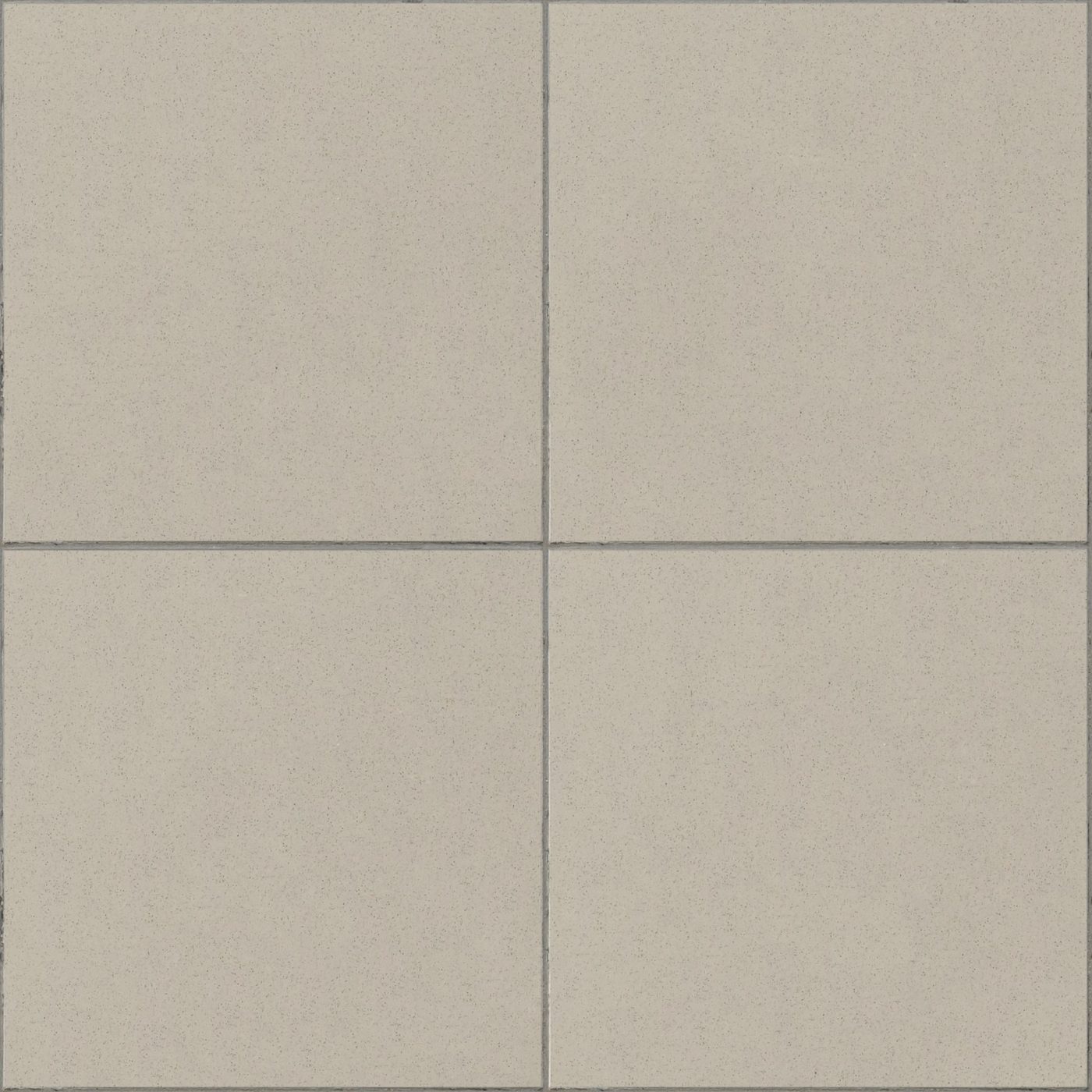
Four square ceramic tiles arranged in a grid (Source: Wikimedia Commons)
Clay tiles are thin, flat or shaped units made from fired clay and used to cover roofs, floors and walls. Roofing tiles are designed to overlap or interlock to shed rainwater, while floor and wall tiles provide hard, durable, easy-to-clean surfaces, either unglazed or with a glazed, glass-like coating. Tiles must be selected for strength, low water absorption, resistance to wear and slipping, and appearance, according to where they will be used. Example: a hotel in Lamu used red clay roofing tiles on its new cottages to match the traditional coastal architecture, and unglazed terracotta floor tiles on the verandahs for their natural, slip-resistant finish.
Types of Clay Tiles
| Type |
Description |
Typical use |
| Interlocking (Marseille) roofing tiles |
Pressed tiles with grooves that interlock at the sides and ends |
Pitched roofs of houses, schools and institutions |
| Spanish or S-pan roofing tiles |
Curved tiles that overlap to form channels |
Decorative pitched roofs with a Mediterranean appearance |
| Plain roofing tiles |
Small flat tiles laid in double overlap |
Steep pitched roofs |
| Ridge and hip tiles |
Curved or angled tiles |
Covering ridges and hips of tiled roofs |
| Quarry tiles |
Dense, unglazed, hard-wearing floor tiles |
Kitchens, workshops, corridors and verandahs |
| Terracotta floor tiles |
Unglazed, porous tiles with a natural reddish finish |
Verandahs, homes and decorative floors |
| Glazed ceramic floor and wall tiles |
Clay body with a glazed surface |
Bathrooms, kitchens, hospitals and offices |
| Porcelain tiles |
Very dense, fired at high temperature, very low absorption |
High-traffic floors, outdoor areas and wet areas |
Qualities of Good Clay Tiles
- Uniform shape and size: Tiles should fit together accurately for watertight roofs and level floors.
- Low water absorption: Roofing tiles should not soak up water, which adds weight and causes leaks.
- Adequate strength: Tiles must resist breaking under foot traffic, workers on roofs and handling.
- Wear and slip resistance: Floor tiles should resist abrasion and give a safe grip, especially in wet areas.
- Freedom from defects: Good tiles have no cracks, warping, pinholes or crazing of the glaze.
- Colour consistency: Tiles from the same batch should match in colour and shade.
Steps in Fixing Interlocking Clay Roofing Tiles
- Check the roof structure: Confirm that rafters are strong enough for the weight of the tiles and that the pitch suits the tile type.
- Fix the underlay: Lay a waterproof underlay over the rafters with proper overlaps.
- Set out and fix battens: Mark batten spacing according to the tile gauge and nail battens level and parallel.
- Load tiles on the roof: Distribute tiles evenly across the roof to avoid overloading one area.
- Lay the eaves course: Start at the eaves, laying the first course straight and projecting correctly into the gutter.
- Lay subsequent courses: Lay tiles upwards course by course, interlocking them and hooking their nibs over the battens.
- Fix tiles securely: Nail or clip tiles as specified, especially at edges and in windy locations.
- Fix ridge and hip tiles: Bed or clip ridge and hip tiles and seal them against water entry.
- Inspect the roof: Check for broken, loose or misaligned tiles and replace them.
4.1.1.3 Ceramic and terracotta products
- Earthenware: This includes decorative and functional items such as terracotta elements used in facades and landscaping, providing a natural finish and cultural resonance in public buildings.
Ceramic products are items made from clay and other minerals shaped and fired at high temperatures to become hard and durable, and they range from porous earthenware to dense, glass-like porcelain. Terracotta, meaning "baked earth", is a type of earthenware fired at relatively low temperatures, usually unglazed, with a characteristic reddish-brown colour, and it is used for decorative blocks, facade panels, floor tiles, pots and roof tiles. The firing temperature and type of clay determine how porous, strong and water resistant each product is, and therefore where it can be used. Example: a county museum in Kisumu used terracotta breeze blocks to screen its new gallery windows, providing shade and ventilation while giving the building a warm, natural appearance.
Ceramic Products Compared
| Product |
Firing temperature (approximate) |
Porosity |
Typical uses |
| Terracotta |
About 900 °C to 1,000 °C |
High, porous |
Decorative blocks, facade panels, pots, floor and roof tiles |
| Earthenware |
About 1,000 °C to 1,150 °C |
Moderate to high, usually glazed for use with water |
Wall tiles, decorative items, some sanitary fittings |
| Stoneware |
About 1,150 °C to 1,300 °C |
Low, dense |
Drain pipes, floor tiles, chemical-resistant products |
| Porcelain and vitreous china |
About 1,200 °C to 1,400 °C |
Very low, almost non-absorbent |
Sanitary ware, porcelain tiles, electrical insulators |
Uses of Ceramic and Terracotta Products in Construction
- Sanitary ware: Wash basins, toilets, urinals and sinks are made from vitreous china because it is non-absorbent and easy to clean.
- Wall and floor tiles: Glazed ceramic and porcelain tiles provide hygienic, durable surfaces in kitchens, bathrooms and hospitals.
- Decorative facade elements: Terracotta panels, cornices and grilles add character to building facades.
- Ventilation and screen blocks: Perforated terracotta blocks provide shading, privacy and natural ventilation.
- Drainage pipes and fittings: Vitrified clay pipes resist chemical attack from sewage.
- Landscaping items: Terracotta pots, edging and pavers are used in gardens and courtyards.
Handling and Care of Ceramic and Terracotta Products
- Handle carefully: Ceramics are brittle and chip or crack if dropped or knocked.
- Store properly: Keep products in their packaging, upright or stacked as directed, on firm ground.
- Seal porous terracotta: Apply sealers to terracotta in wet or dirty areas to prevent staining and moisture absorption.
- Use suitable adhesives and grouts: Fix tiles and panels with products recommended for the material and location.
- Clean with mild products: Avoid strong acids and abrasive cleaners that damage glazes and surfaces.
4.1.1.4 Clay Blocks
- Blocks: Larger than bricks, clay blocks are gaining popularity for load-bearing walls due to their size and reduced mortar joints, which speed up construction in projects like affordable housing units.
4.1.1.5 Clay Pipes
- Pipes: Clay pipes are traditionally used in drainage and sewage systems because of their resistance to chemical corrosion, particularly in urban infrastructure managed by Nairobi City Water and Sewerage Company.
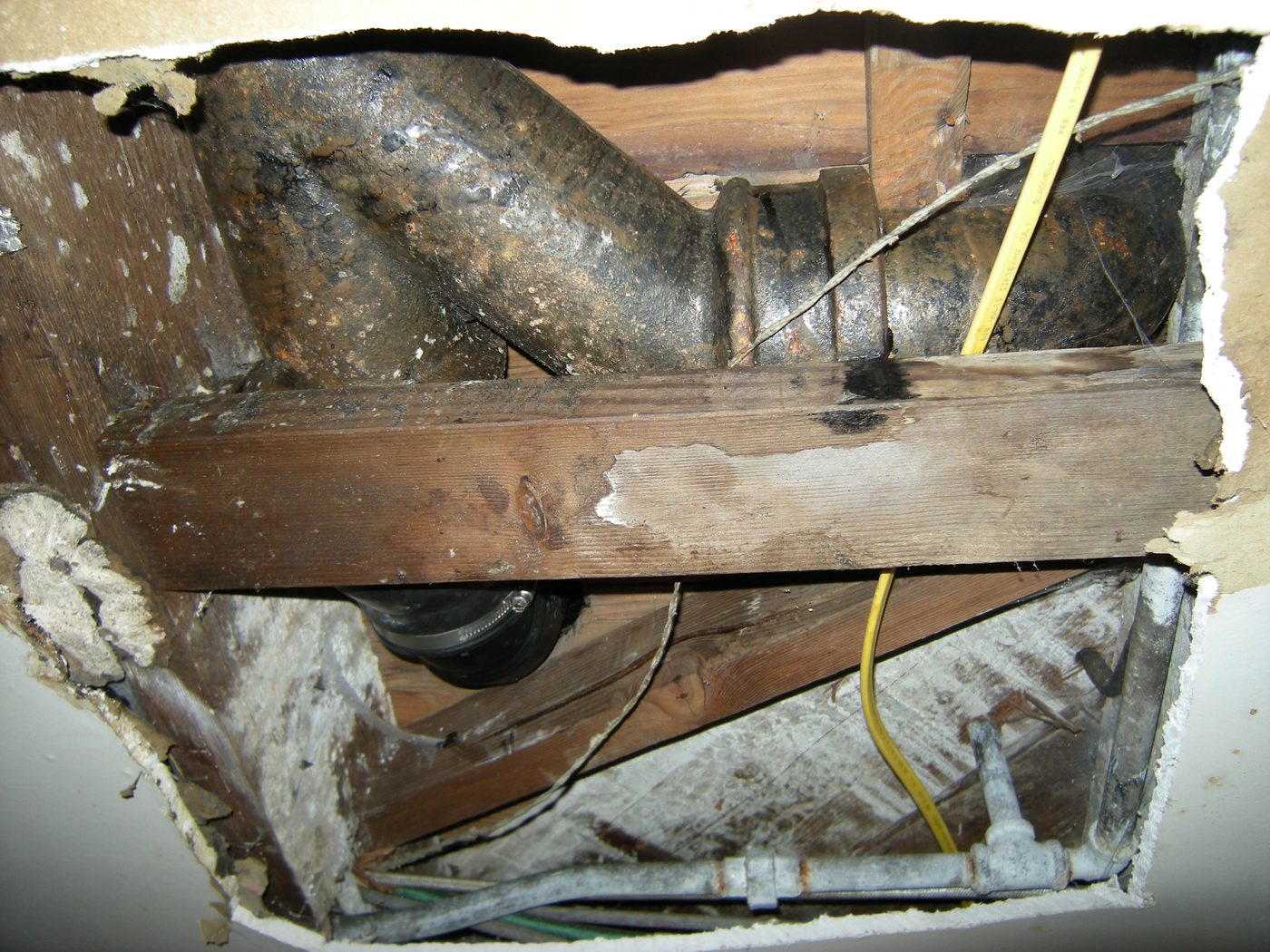
Exposed pipes inside a wall cavity (Source: Wikimedia Commons)
4.1.2 Selection Criteria for Clay Products
Choosing the right clay product involves evaluating multiple factors that affect performance, cost, and sustainability. These criteria ensure the material aligns with project demands and environmental conditions.
Key Criteria for Selection
- Strength Requirements: Structural components like load-bearing walls demand clay products with high compressive strength, verified through standardized testing as applied in county government office constructions.
- Durability: The product must withstand local weather conditions, including heavy rains and temperature fluctuations common in Kenya’s diverse climates, to avoid frequent repairs or replacements.
- Porosity and Water Absorption: Low porosity clay products resist water penetration, reducing risks of dampness and efflorescence in buildings such as hotels and hospitals.
- Thermal Insulation: Clay products with good insulating properties help regulate indoor temperatures, reducing energy consumption in office blocks and residential units.
- Cost and Availability: Local sourcing of clay products reduces transport costs and supports the regional economy, a practice encouraged in public works projects funded by the National Treasury.
Additional Selection Criteria
- Appearance: Colour, texture and finish must suit the architectural design, especially for exposed bricks, terracotta and tiles.
- Dimensional accuracy: Products with consistent sizes give neat joints, less mortar and faster laying.
- Fire resistance: Fired clay products are non-combustible and suit walls and roofs requiring fire safety.
- Chemical resistance: Products for drainage and industrial areas must resist acids, alkalis and sewage.
- Compliance with standards: Products should meet the relevant KEBS standards and the project specification.
- Sustainability: Products from responsibly managed clay pits and efficient kilns reduce environmental harm.
Steps for Selecting Clay Products for a Project
- Define the application: Identify where the product will be used, such as load-bearing walls, roofs, floors or drainage.
- Review the specification: Note the required strength, absorption, size, finish and standards.
- Assess site conditions: Consider rainfall, humidity, salt exposure, ground moisture and traffic.
- Identify suppliers: List suppliers who can provide the product in the required quantity and time.
- Obtain samples and test certificates: Request samples and laboratory results for strength and absorption.
- Carry out tests: Conduct field or laboratory tests on samples to confirm quality.
- Compare costs: Compare total costs, including transport, wastage and laying.
- Approve and order: Obtain approval from the engineer or client and place the order with agreed quality requirements.
- Inspect deliveries: Check each delivery for quantity, quality and damage before accepting it. Example: a SACCO building rental units in Kakamega rejected a delivery of roofing tiles after inspection showed many cracked and warped tiles.
The rest of this chapter
🔒Create a free account to open more of this chapter.
Free: practical guides, quick cards, workplace scenarios and more.
Create a free account 🔒4.2 Clay Products Properties
Clay products’ performance depends on their physical, mechanical, and durability characteristics. Engineers must understand these properties to predict how materials behave under load, exposure, and over time. Physical properties influence how clay products in…
Chapter Summary
This chapter focused on the application of construction clay products, beginning with an exploration of the various types commonly used in building projects, including bricks, tiles, and ceramic and terracotta products. It then examined the important criteria for selecting clay products based on their suitability for specific construction needs. The discussion moved on to the physical properties of clay products, such as density, weight, thermal and acoustic insulation capabilities, and water absorption, which influence their performance in different environments. Mechanical properties were analyzed next, highlighting the significance of compressive strength as well as bending and tensile strength for structural integrity. The chapter concluded with a detailed look at the durability and weathering characteristics of clay products, including their resistance to freeze-thaw cycles, chemical attacks, and fire, all of which determine their longevity and safety in construction applications.
Self-Assessment
🔒 PDFDownload this self-assessment, with answers
A. Written Assessment
- Identify three common types of clay products used in civil engineering construction. (3 marks)
- Explain why compressive strength is critical when selecting clay bricks for load-bearing walls. (2 marks)
🔒20 more in this section.
Chapter Examination Questions
🔒 PDFDownload these examination questions, with worked answers
SECTION A (40 Marks) - Answer ALL Questions
- Identify three types of clay bricks commonly used in Kenyan construction projects and explain one advantage of each type. (4 marks)
- Explain how thermal insulation properties of clay tiles contribute to energy efficiency in buildings in Nairobi’s climate. (4 marks)
🔒18 more in this section.
Chapter Practical Activities
Practical 1: Identify and select suitable clay products for wall construction
Civil Engineering · Level 6
Construction Materials Science II
PRACTICAL ASSESSMENT
TIME: 4 HOURS
⬇ PDFCandidate Instructions (Candidate Tool)
Type: Individual
INSTRUCTIONS TO CANDIDATE:
1. You are required to perform the following task:
i. Identify and select suitable clay bricks, blocks, and roofing tiles for wall construction according to specified quality and dimensional requirements.
2. You have been provided with the following resources for the practical task:
| Tools & Equipment | Materials |
|---|
| Measuring tape | Clay bricks |
| Moisture meter | Clay roofing tiles |
| Caliper | Clay blocks |
| Mason's hammer | |
| Hand lens (magnifying glass) | |
| Notebook and pen | |
⬇ PDFResources Required (Cutting List)
| S/N | Item | Quantity |
|---|
| 1 | Clay bricks | 30 Pcs per Candidate |
| 2 | Clay roofing tiles | 20 Pcs per Candidate |
| 3 | Clay blocks | 15 Pcs per Candidate |
| 4 | Measuring tape | 1 Pc per Candidate |
| 5 | Moisture meter | 1 Pc per 3 Candidates |
| 6 | Caliper | 1 Pc per Candidate |
| 7 | Mason's hammer | 1 Pc per Candidate |
| 8 | Hand lens (magnifying glass) | 1 Pc per Candidate |
| 9 | PPEs (Safety boots, Gloves, Overall) | 1 Set per Candidate |
| 10 | Notebook and pen | 1 Set per Candidate |
⬇ PDFAssessor Guide
| Items to be Evaluated | Marks Available | Marks Obtained | Comments |
|---|
| TASK 1: Preparation and Safety |
Wore PPE (Safety boots, Gloves, Overall)
(Award 3 marks or zero) | 3 | | |
Collected all necessary tools and materials
(Award 2 marks or zero) | 2 | | |
Observed environmental safety and safe use of tools
(Award 1 mark or zero) | 1 | | |
| Sub-Total | 6 | | |
| TASK 2: Inspection and Selection of Clay Products |
Measured dimensions of clay bricks and blocks using measuring tape and caliper
(Award 4 marks or zero) | 4 | | |
Checked moisture content of clay products using moisture meter
(Award 3 marks or zero) | 3 | | |
Physically inspected clay bricks, blocks, and tiles for defects (cracks, warping, uniformity) using mason's hammer and hand lens
(Award 5 marks or zero) | 5 | | |
Selected suitable clay products based on inspection criteria and construction requirements
(Award 4 marks or zero) | 4 | | |
Recorded observations and reasons for selection in notebook
(Award 3 marks or zero) | 3 | | |
| Sub-Total | 19 | | |
| PRODUCT CHECKLIST |
Selected clay bricks with dimensions approximately 230mm x 110mm x 75mm (+/- 2mm)
(Award 3 marks or zero) | 3 | | |
Selected clay blocks with dimensions approximately 440mm x 215mm x 100mm (+/- 2mm)
(Award 3 marks or zero) | 3 | | |
Selected clay roofing tiles uniform in shape, size, and free from cracks
(Award 3 marks or zero) | 3 | | |
Clay products meet moisture content requirements (not exceeding 12%)
(Award 3 marks or zero) | 3 | | |
Selection report is clear, complete, and accurately recorded
(Award 4 marks or zero) | 4 | | |
| Sub-Total | 16 | | |
| GRAND TOTAL | 41 | | |
ASSESSMENT OUTCOME: ☐ Competent ☐ Not Yet Competent (competent if at least 50%)
Practical 2: Differentiate and Categorize Construction Clay Products
Civil Engineering · Level 6
Construction Materials Science II
PRACTICAL ASSESSMENT
TIME: 4 HOURS
⬇ PDFCandidate Instructions (Candidate Tool)
Type: Individual
INSTRUCTIONS TO CANDIDATE:
1. You are required to perform the following task:
i. Sort and categorize clay bricks, roof tiles, terracotta wall tiles, and ceramic floor tiles by type and intended construction use, recording their standard dimensions.
2. You have been provided with the following resources for the practical task:
| Tools & Equipment | Materials |
|---|
| Tape measure | Clay bricks |
| Mason's hammer | Clay roof tiles |
| Brush | Terracotta wall tiles |
| Notebook and pen | Ceramic floor tiles |
⬇ PDFResources Required (Cutting List)
| S/N | Item | Quantity |
|---|
| 1 | Clay bricks (standard size 230mm x 110mm x 75mm) | 10 Pcs per Candidate |
| 2 | Clay roof tiles (standard size 420mm x 330mm) | 5 Pcs per Candidate |
| 3 | Terracotta wall tiles (standard size 200mm x 200mm) | 8 Pcs per Candidate |
| 4 | Ceramic floor tiles (standard size 300mm x 300mm) | 6 Pcs per Candidate |
| 5 | Notebook and pen | 1 Pc per Candidate |
| 6 | Tape measure | 1 Pc per Candidate |
| 7 | Safety boots | 1 Pc per Candidate |
| 8 | Overall | 1 Pc per Candidate |
| 9 | Gloves | 1 Pair per Candidate |
| 10 | Mason's hammer | 1 Pc per Candidate |
| 11 | Brush | 1 Pc per Candidate |
⬇ PDFAssessor Guide
| Items to be Evaluated | Marks Available | Marks Obtained | Comments |
|---|
| TASK 1: Prepare and Wear PPE |
Wore safety boots, overall, and gloves correctly
(Award 3 marks or zero) | 3 | | |
| Sub-Total | 3 | | |
| TASK 2: Collect Tools and Clay Products |
Collected all required clay products and tools as per cutting list
(Award 3 marks or zero) | 3 | | |
| Sub-Total | 3 | | |
| TASK 3: Measure and Identify Clay Products |
Measured dimensions of clay bricks accurately (230mm x 110mm x 75mm)
(Award 4 marks or zero) | 4 | | |
Measured dimensions of clay roof tiles accurately (420mm x 330mm)
(Award 3 marks or zero) | 3 | | |
Measured dimensions of terracotta wall tiles accurately (200mm x 200mm)
(Award 3 marks or zero) | 3 | | |
Measured dimensions of ceramic floor tiles accurately (300mm x 300mm)
(Award 3 marks or zero) | 3 | | |
| Sub-Total | 13 | | |
| TASK 4: Categorize and Record Clay Products |
Correctly categorized clay bricks as load-bearing units
(Award 4 marks or zero) | 4 | | |
Correctly categorized clay roof tiles for roofing
(Award 3 marks or zero) | 3 | | |
Correctly categorized terracotta tiles for wall finishes
(Award 3 marks or zero) | 3 | | |
Correctly categorized ceramic tiles for floor finishes
(Award 3 marks or zero) | 3 | | |
Recorded all measurements and categories clearly and legibly in notebook
(Award 3 marks or zero) | 3 | | |
| Sub-Total | 16 | | |
| TASK 5: Clean Up Work Area |
Cleaned and returned tools and unused materials properly
(Award 3 marks or zero) | 3 | | |
Disposed of waste according to site safety and environmental standards
(Award 3 marks or zero) | 3 | | |
| Sub-Total | 6 | | |
| PRODUCT CHECKLIST |
Clay bricks measured within ±5mm of standard dimensions 230mm x 110mm x 75mm
(Award 4 marks or zero) | 4 | | |
Clay roof tiles measured within ±5mm of standard dimensions 420mm x 330mm
(Award 3 marks or zero) | 3 | | |
Terracotta wall tiles measured within ±5mm of standard dimensions 200mm x 200mm
(Award 3 marks or zero) | 3 | | |
Ceramic floor tiles measured within ±5mm of standard dimensions 300mm x 300mm
(Award 3 marks or zero) | 3 | | |
Categorization matches intended use for each clay product type
(Award 5 marks or zero) | 5 | | |
| Sub-Total | 18 | | |
| GRAND TOTAL | 59 | | |
ASSESSMENT OUTCOME: ☐ Competent ☐ Not Yet Competent (competent if at least 50%)
🔒Test Density and Weight of Clay BricksPractical 3
🔒Evaluate Thermal Insulation Properties of Clay TilesPractical 4
🔒Assess Acoustic Insulation of Ceramic Clay ProductsPractical 5
🔒Measure Water Absorption of Clay BricksPractical 6
🔒Test Compressive Strength of Clay BricksPractical 7
🔒Determine bending and tensile strength of clay tilesPractical 8
🔒Evaluate Durability and Weathering Resistance of Clay ProductsPractical 9
🔒Test Freeze-Thaw Resistance of Clay BricksPractical 10
🔒Assess Chemical Resistance of Clay ProductsPractical 11
🔒Test Fire Resistance of Clay Bricks and Tiles 230mm x 115mm x 75mmPractical 12
🔒Prepare and Lay Clay Bricks for a Sample Wall 1200mm x 900mm x 1150mmPractical 13
🔒Cut and Fix Clay Tiles on a Flat SurfacePractical 14
🔒Fabricate and Install Ceramic Terracotta Decorative Elements on a Model WallPractical 15
