
Surface finishing operations are essential in fabrication processes to improve the appearance, durability, and functionality of manufactured products. In Kenya's diverse industries, from county hospitals to retail businesses, proper surface finishing ensures that fabricated components meet quality standards and resist wear and corrosion. Mastery of these operations enhances product value and extends service life, which is critical in environments such as university workshops or agricultural cooperatives where equipment longevity impacts operational costs.
Grinding is a fundamental surface finishing process that uses an abrasive wheel to remove material from a workpiece, producing a smooth surface or achieving precise dimensions. It is widely applied across various sectors in Kenya, such as in county government workshops maintaining machinery or in hotel maintenance departments refurbishing metal fixtures. Understanding grinding principles and techniques enables technicians to deliver high-quality finishes that meet functional and aesthetic requirements.
Grinding involves the use of a rotating abrasive wheel to shear off small chips from the surface of a workpiece, producing a finer finish and tighter tolerances than other machining operations. The abrasive grains on the wheel act as cutting edges, each removing minute amounts of material through micro-cutting or ploughing actions.
Grinding operates through a combination of mechanical abrasion and frictional forces. For example, in a county referral hospital’s maintenance workshop, grinding is used to refurbish surgical instrument handles, requiring careful control to avoid overheating that could weaken the metal.
Different grinding methods serve varied purposes, from rough material removal to fine finishing. Kenyan industries such as agricultural cooperatives use specific grinding techniques to maintain farm machinery parts, while SACCO offices might utilize precision grinding for custom metal fittings in security installations.
Each method adapts to the shape and size of the workpiece and the finish required. For instance, surface grinding is extensively applied in schools' technical workshops to prepare flat metal plates for fabrication projects.
Grinding operations require specialized machines and abrasive wheels tailored to the material and finish desired. In Kenya’s diverse workplaces, from university engineering departments to county government maintenance units, selecting appropriate equipment ensures safety and efficiency.
| Name | Specification | Use |
|---|---|---|
| Surface Grinder | Table size 300x150 mm, wheel diameter 200 mm | Produces flat surfaces on metal workpieces |
| Cylindrical Grinder | Max workpiece length 600 mm, wheel diameter 250 mm | Shapes cylindrical surfaces externally or internally |
| Bench Grinder | Wheel diameter 150 mm, motor power 1 HP | General-purpose grinding and sharpening |
| Diamond Wheel | Bonded with synthetic diamond abrasive | Grinding hard materials like carbide or ceramics |
| Grinding Wheel Dresser | Diamond-tipped tool for wheel conditioning | Restores wheel profile and sharpness |
Grinding machines must be equipped with guards and coolant systems to enhance safety and process control. For example, a retail business workshop uses bench grinders with water drip coolant to prevent overheating of small metal parts.
Effective grinding requires proper techniques to achieve desired finishes while maintaining operator safety. In Kenyan institutions like county hospitals, adherence to safety protocols during grinding prevents accidents and ensures consistent quality.
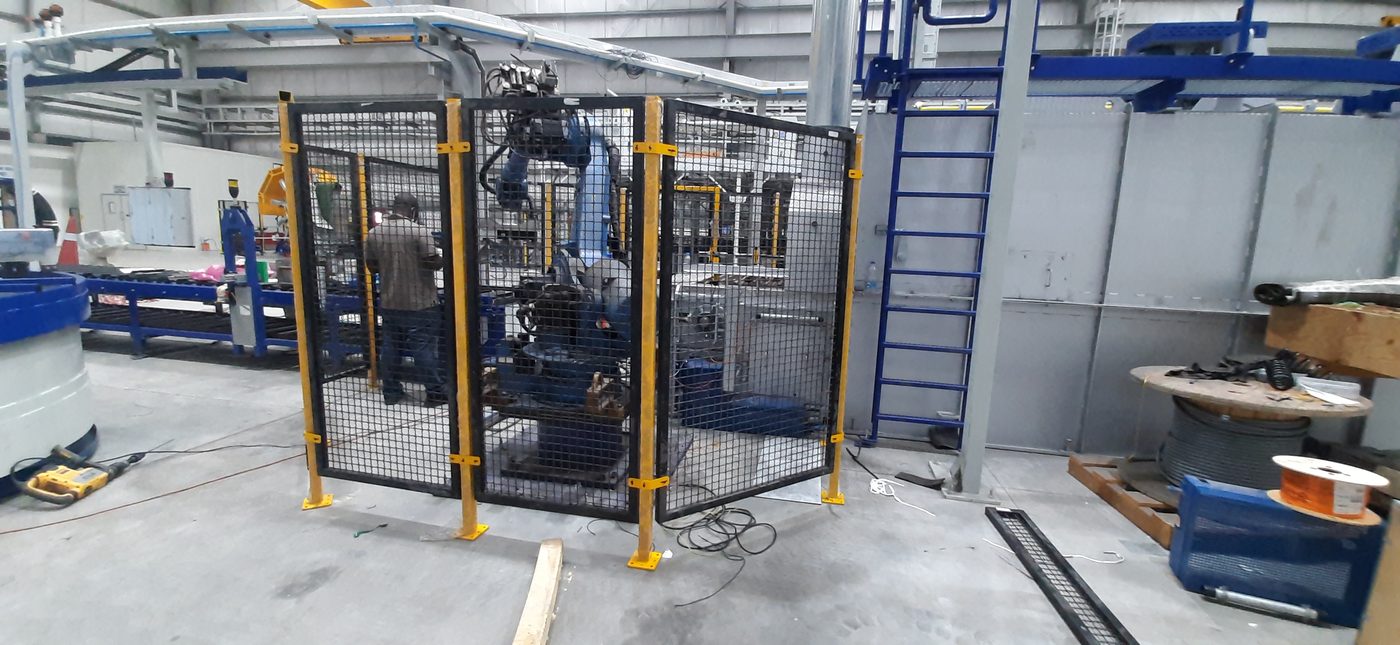
Industrial machine guard enclosing equipment (Source: Wikipedia (Machine guarding))
Create a free account to open more of this chapter.
Free: practical guides, quick cards, workplace scenarios and more.
Create a free accountThis chapter has explored key surface finishing operations essential in fabrication processes. It began with grinding, which involves the removal of material from a workpiece to achieve a desired surface texture or dimension through abrasive action. The discussion then moved to surface polishing, a technique that smooths and enhances the appearance of a material by eliminating fine scratches and imperfections. Finally, the chapter covered surface painting, which provides both protective and aesthetic benefits by applying coatings that prevent corrosion and improve visual appeal. Each of these processes plays a crucial role in preparing fabricated components for their intended use, ensuring durability, functionality, and quality. Understanding the principles and applications of grinding, polishing, and painting equips students with practical skills vital for the fabrication industry.
Type: Individual
| Tools & Equipment | Materials |
|---|---|
| Bench grinder machine | Mild steel plate (200 mm x 150 mm x 10 mm thick) |
| Clamping vice | Grinding wheel (medium grit, 150 mm diameter) |
| Steel rule | Safety goggles |
| Marker pen | Leather gloves |
| Wire brush | Dust mask |
| Cleaning rag |
| S/N | Item | Quantity |
|---|---|---|
| 1 | Mild steel plate (200 mm x 150 mm x 10 mm thick) | 1 Pc per Candidate |
| 2 | Bench grinder machine | 1 Pc per 3 Candidates |
| 3 | Grinding wheel (medium grit, 150 mm diameter) | 1 Pc per Candidate |
| 4 | Safety goggles | 1 Pair per Candidate |
| 5 | Leather gloves | 1 Pair per Candidate |
| 6 | Dust mask | 1 Pc per Candidate |
| 7 | Clamping vice | 1 Pc per Candidate |
| 8 | Steel rule | 1 Pc per Candidate |
| 9 | Marker pen | 1 Pc per Candidate |
| 10 | Wire brush | 1 Pc per Candidate |
| 11 | Cleaning rag | 1 Pc per Candidate |
| Items to be Evaluated | Marks Available | Marks Obtained | Comments |
|---|---|---|---|
| TASK 1: Preparation and Safety | |||
| Wore safety goggles correctly (Award 1 or 0) | 1 | ||
| Wore leather gloves correctly (Award 1 or 0) | 1 | ||
| Wore dust mask correctly (Award 1 or 0) | 1 | ||
| Clamped the steel plate securely in the vice (Award 1 or 0) | 1 | ||
| Checked grinding wheel condition and guard before use (Award 1 or 0) | 1 | ||
| Sub-Total | 5 | ||
| TASK 2: Grinding Process | |||
| Started the grinder machine correctly (Award 1 or 0) | 1 | ||
| Applied grinding wheel evenly on the plate surface (Award 1 or 0) | 1 | ||
| Maintained consistent pressure and motion during grinding (Award 1 or 0) | 1 | ||
| Avoided overheating the metal surface (checked by touch or colour) (Award 1 or 0) | 1 | ||
| Switched off the grinder machine correctly after use (Award 1 or 0) | 1 | ||
| Sub-Total | 5 | ||
| TASK 3: Finishing and Housekeeping | |||
| Cleaned the ground surface using a wire brush (Award 1 or 0) | 1 | ||
| Measured and checked surface smoothness with steel rule (Award 1 or 0) | 1 | ||
| Returned tools and unused materials to the store (Award 1 or 0) | 1 | ||
| Disposed of grinding dust and waste as per workplace procedure (Award 1 or 0) | 1 | ||
| Sub-Total | 4 | ||
| PRODUCT CHECKLIST | |||
| Surface finish is smooth and even over entire 200 mm x 150 mm area (Award 4 or 0) | 4 | ||
| No visible grinding marks, gouges or uneven patches on the plate surface (Award 3 or 0) | 3 | ||
| Dimensions of plate remain within ±1 mm tolerance after grinding (Award 3 or 0) | 3 | ||
| Sub-Total | 10 | ||
| GRAND TOTAL | 24 | ||
Type: Individual
| Tools & Equipment | Materials |
|---|---|
| Polishing machine with buffing wheel | Mild steel rectangular bar 100 mm x 50 mm x 10 mm thick |
| Bench vice | Assorted polishing compounds (coarse, medium, fine) |
| Steel rule | |
| File set (flat and half-round) | |
| Marker pen | |
| Hand polishing cloths |
| S/N | Item | Quantity |
|---|---|---|
| 1 | Mild steel rectangular bar 100 mm x 50 mm x 10 mm thick | 1 Pc per Candidate |
| 2 | Polishing machine with buffing wheel | 1 Pc per 3 Candidates |
| 3 | Assorted polishing compounds (coarse, medium, fine) | 1 set per Candidate |
| 4 | Hand polishing cloths | 2 Pcs per Candidate |
| 5 | Bench vice | 1 Pc per 3 Candidates |
| 6 | Safety goggles | 1 Pc per Candidate |
| 7 | Leather gloves | 1 Pair per Candidate |
| 8 | Dust mask | 1 Pc per Candidate |
| 9 | Steel rule | 1 Pc per Candidate |
| 10 | File set (flat and half-round) | 1 Set per Candidate |
| 11 | Marker pen | 1 Pc per Candidate |
| Items to be Evaluated | Marks Available | Marks Obtained | Comments |
|---|---|---|---|
| TASK 1: Adhere to safety procedures | |||
| Wore safety goggles correctly (Award 1 or 0 mark) | 1 | ||
| Wore leather gloves correctly (Award 1 or 0 mark) | 1 | ||
| Wore dust mask correctly (Award 1 or 0 mark) | 1 | ||
| Ensured work area is clean and free of hazards before starting (Award 1 or 0 mark) | 1 | ||
| Sub-Total | 4 | ||
| TASK 2: Prepare the metal component for polishing | |||
| Measured and marked the mild steel bar to confirm dimensions (Award 1 or 0 mark) | 1 | ||
| Removed sharp edges and burrs using files (Award 1 or 0 mark) | 1 | ||
| Secured the metal bar properly in the bench vice (Award 1 or 0 mark) | 1 | ||
| Sub-Total | 3 | ||
| TASK 3: Perform polishing operation | |||
| Selected appropriate polishing compound for initial coarse polishing (Award 1 or 0 mark) | 1 | ||
| Operated polishing machine safely and correctly (Award 1 or 0 mark) | 1 | ||
| Polished the metal surface evenly over entire area (Award 1 or 0 mark) | 1 | ||
| Used subsequent finer polishing compounds to achieve smooth finish (Award 1 or 0 mark) | 1 | ||
| Used hand polishing cloth to refine surface finish (Award 1 or 0 mark) | 1 | ||
| Sub-Total | 5 | ||
| TASK 4: Perform housekeeping | |||
| Turned off polishing machine correctly after use (Award 1 or 0 mark) | 1 | ||
| Cleaned work area and removed metal dust/debris (Award 1 or 0 mark) | 1 | ||
| Returned tools and unused materials to the store (Award 1 or 0 mark) | 1 | ||
| Sub-Total | 3 | ||
| PRODUCT CHECKLIST | |||
| Metal bar dimensions: length 100 mm ± 1 mm, width 50 mm ± 1 mm, thickness 10 mm ± 0.5 mm (Award 1 mark for each dimension correct within tolerance) | 3 | ||
| Surface finish is smooth and reflective with no visible scratches or uneven areas (Award 4 or 0 marks) | 4 | ||
| Edges are smooth and free from burrs (Award 2 or 0 marks) | 2 | ||
| Sub-Total | 9 | ||
| GRAND TOTAL | 24 | ||