
By the end of this chapter, you will be able to:
Mastering these skills will help you work confidently with electrical components and make smart decisions in real-world electrical and electronics projects.
Cells and batteries are fundamental components in modern electrical and electronic systems used across diverse Kenyan industries. Understanding their principles is essential for professionals in healthcare facilities, educational institutions, financial organizations, and agricultural cooperatives, among others. This chapter explores the nature of cells and batteries, focusing on their role in energy storage and conversion, which supports uninterrupted power supply in critical applications like hospital equipment, banking systems, and farm irrigation controls.
The study of cells and batteries begins with grasping their basic function as devices that convert chemical energy into electrical energy. This conversion enables portable and stationary power sources essential in everyday operations across sectors such as county government offices and retail businesses. The ability to supply reliable energy determines the efficiency and continuity of services in these environments.
A cell is the simplest form of an electrochemical device that generates electrical energy from chemical reactions. It consists of two electrodes, an anode and a cathode, immersed in an electrolyte, which facilitates the flow of ions. In practical settings, such as in a county referral hospital, cells power portable medical devices, providing mobility and flexibility in patient care.
Anode: The negative electrode where oxidation occurs, releasing electrons into the external circuit.
Cathode: The positive electrode where reduction takes place, accepting electrons from the external circuit.
Electrolyte: A medium that allows ionic movement, enabling the chemical reaction between electrodes.
Separator: Prevents direct contact between electrodes while allowing ionic flow.
External Circuit: Connects the electrodes, enabling electron flow that powers devices.
Batteries are assemblies of one or more cells connected in series or parallel to provide the desired voltage and current. They differ in construction, chemistry, and application, ranging from small button cells in watches used by university lecturers to large lead-acid batteries in backup power systems at banks.
Primary Batteries: Non-rechargeable cells designed for single-use applications, such as alkaline batteries in remote controls.
Secondary Batteries: Rechargeable batteries like lithium-ion used in laptops at TVET colleges.
Lead-Acid Batteries: Common in backup power systems at county government offices due to their reliability and cost-effectiveness.
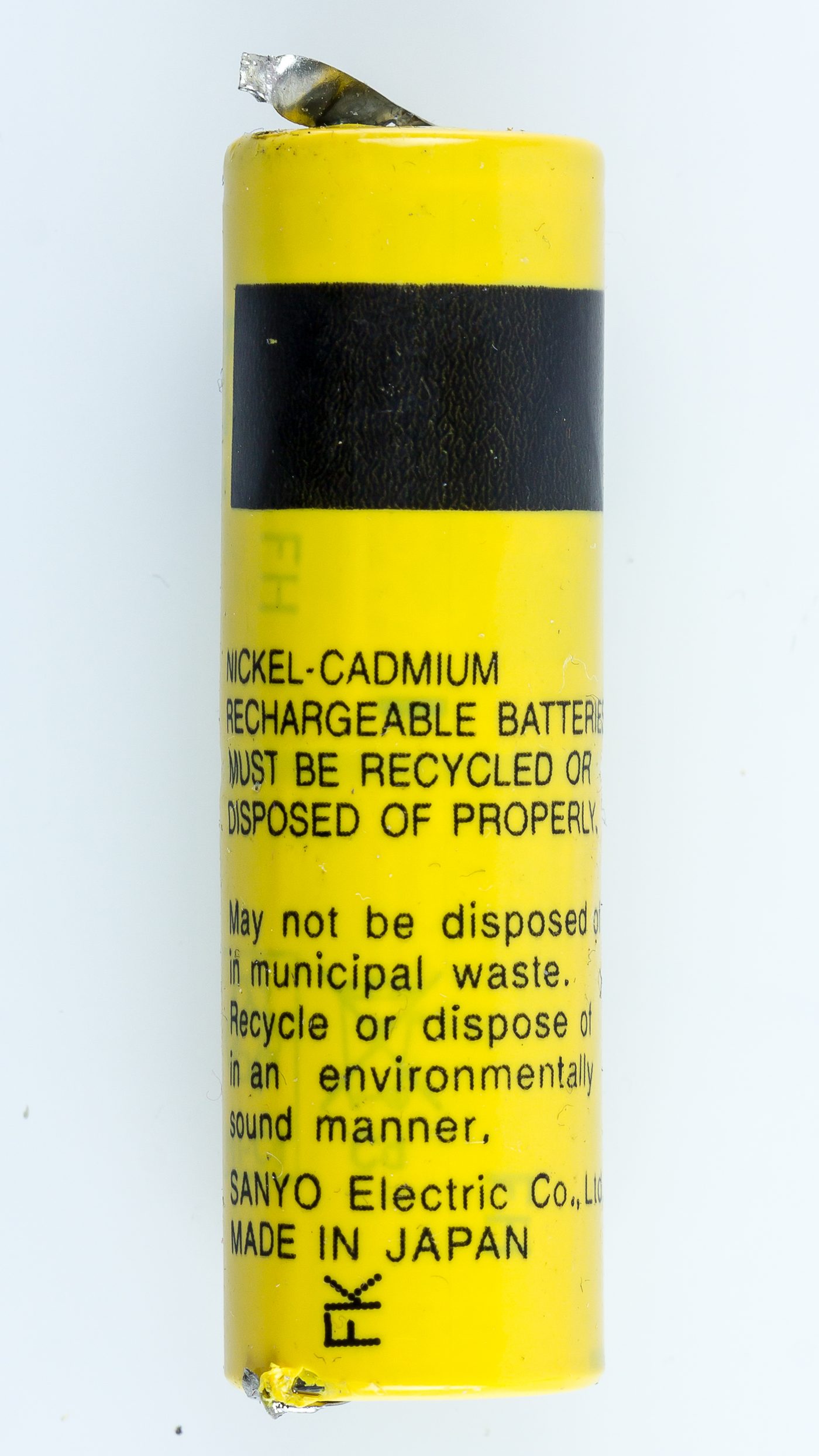
Nickel-cadmium rechargeable battery cell (Source: Wikimedia Commons)
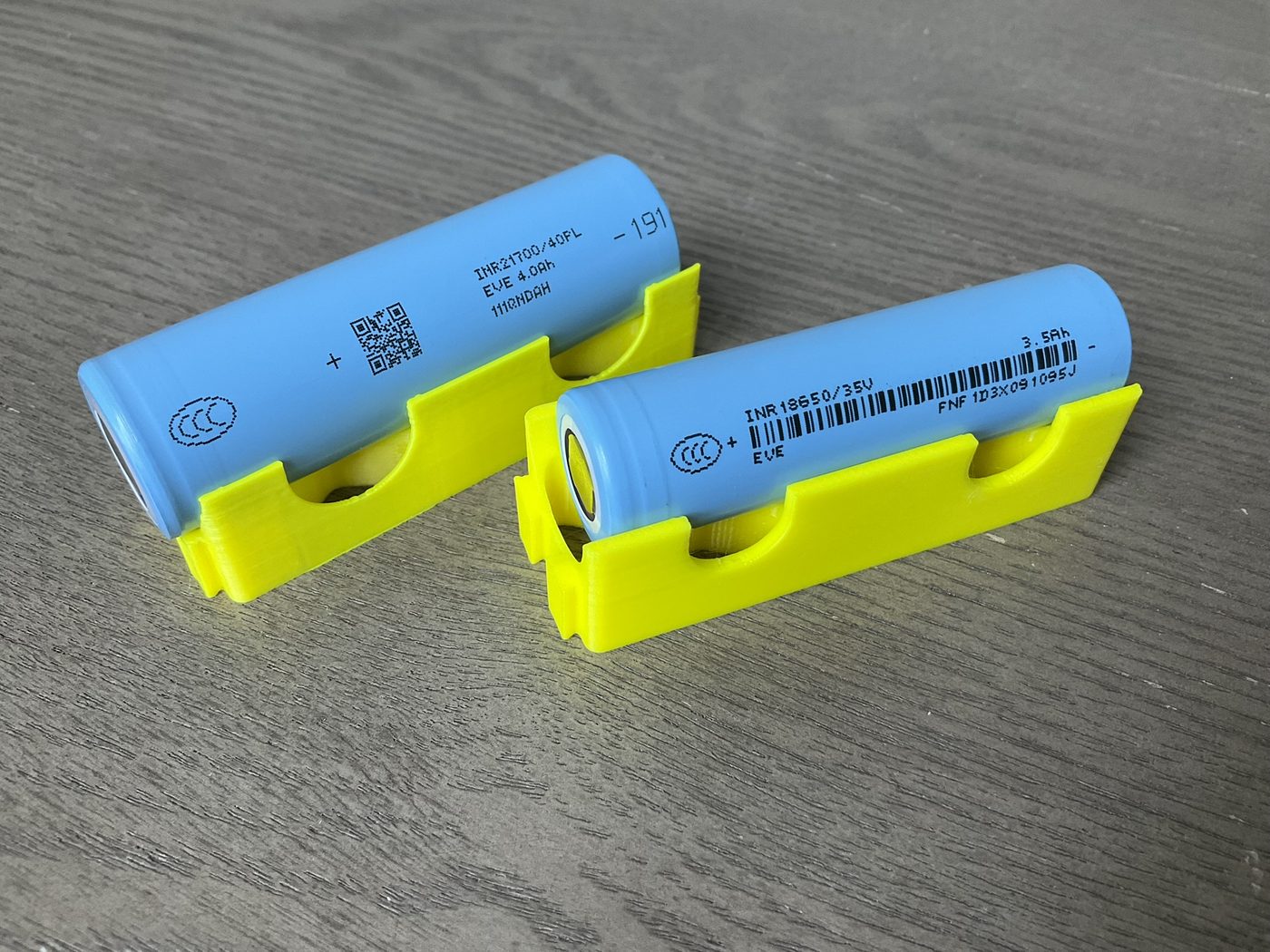
Two cylindrical lithium-ion batteries (Source: Wikimedia Commons)
Voltage is the electric potential difference generated by a cell or battery, while capacity measures the total charge a battery can deliver over time. For example, in a retail business, selecting a battery with sufficient voltage and capacity ensures that point-of-sale systems operate without interruption during power outages.
Cells and batteries enable critical functions across multiple sectors. In a cooperative society, batteries power mobile banking devices, facilitating financial inclusion. In schools, battery-powered computers support digital learning, while in agriculture, batteries operate irrigation controllers, optimizing water use.
Create a free account to open more of this chapter.
Free: practical guides, quick cards, workplace scenarios and more.
Create a free accountThis chapter introduced the fundamental concepts of cells and batteries, highlighting their role in energy storage through electrochemical processes. It explained key electrical properties such as voltage, current, capacity, and energy density, alongside the electromotive force and internal resistance intrinsic to cells. The electrochemical principles of redox reactions and electrode potentials were explored, detailing the components of a cell including the anode, cathode, electrolyte, and separator. Distinctions between primary and secondary cells were made, with detailed examinations of common primary cells like zinc-carbon and alkaline types, their performance, and environmental considerations. Secondary cells such as lead-acid, nickel-cadmium, nickel-metal hydride, and lithium-ion batteries were discussed with emphasis on their chemistry, applications, charging cycles, and safety. Battery performance factors including capacity, life cycle influences, internal resistance, and degradation were covered, along with methods for measuring and testing battery health. The chapter concluded by exploring diverse applications of batteries in consumer electronics, automotive systems, renewable energy, and specialized fields, before addressing the environmental impact of battery disposal and recycling processes, including regulatory frameworks and emerging eco-friendly technologies.
Type: Individual
| Tools & Equipment | Materials |
|---|---|
| Screwdriver | Zinc cylindrical container (anode) |
| Voltmeter (0-3V DC) | Carbon rod (cathode) |
| Connecting wires with alligator clips | Ammonium chloride paste (electrolyte) |
| Paper separator | |
| Insulating tape |
| S/N | Item | Quantity |
|---|---|---|
| 1 | Zinc cylindrical container (anode) | 1 Pc per Candidate |
| 2 | Carbon rod (cathode) | 1 Pc per Candidate |
| 3 | Ammonium chloride paste (electrolyte) | 50 g per Candidate |
| 4 | Paper separator | 2 sheets per Candidate |
| 5 | Insulating tape | 1 roll per 5 Candidates |
| 6 | Connecting wires with alligator clips | 1 set per Candidate |
| 7 | Voltmeter (0-3V DC) | 1 per 5 Candidates |
| 8 | Screwdriver | 1 per Candidate |
| 9 | Plastic gloves | 1 pair per Candidate |
| 10 | Safety goggles | 1 pair per Candidate |
| 11 | Workbench with lighting | 1 per 3 Candidates |
| Items to be Evaluated | Marks Available | Marks Obtained | Comments |
|---|---|---|---|
| TASK 1: Safety and Preparation | |||
| Wore plastic gloves correctly (Award 1 or 0 mark) | 1 | ||
| Wore safety goggles correctly (Award 1 or 0 mark) | 1 | ||
| Prepared workbench and materials in organized manner (Award 1 or 0 mark) | 1 | ||
| Sub-Total | 3 | ||
| TASK 2: Assembly of Zinc-Carbon Cell | |||
| Placed carbon rod centrally inside zinc container (Award 2 or 0 marks) | 2 | ||
| Inserted paper separator correctly between anode and cathode (Award 2 or 0 marks) | 2 | ||
| Applied ammonium chloride paste uniformly as electrolyte (Award 2 or 0 marks) | 2 | ||
| Sealed the cell properly using insulating tape (Award 2 or 0 marks) | 2 | ||
| Connected wires to anode and cathode terminals securely (Award 1 or 0 mark) | 1 | ||
| Sub-Total | 9 | ||
| TASK 3: Identification and Testing | |||
| Identified and named the anode (zinc container) (Award 1 or 0 mark) | 1 | ||
| Identified and named the cathode (carbon rod) (Award 1 or 0 mark) | 1 | ||
| Identified and named the electrolyte (ammonium chloride paste) (Award 1 or 0 mark) | 1 | ||
| Identified and named the separator (paper) (Award 1 or 0 mark) | 1 | ||
| Measured and recorded cell voltage correctly using voltmeter (Award 2 or 0 marks) | 2 | ||
| Sub-Total | 6 | ||
| TASK 4: Housekeeping | |||
| Cleaned work area and disposed of waste as per workplace procedures (Award 1 or 0 mark) | 1 | ||
| Returned tools and unused materials to the store (Award 1 or 0 mark) | 1 | ||
| Sub-Total | 2 | ||
| PRODUCT CHECKLIST | |||
| Zinc-carbon cell assembled with correct component placement and sealing (Award 5 or 0 marks) | 5 | ||
| Physical identification of anode, cathode, electrolyte, and separator is accurate (Award 5 or 0 marks) | 5 | ||
| Measured voltage within expected range of 1.4 ± 0.1 Volts (Award 4 or 0 marks) | 4 | ||
| Sub-Total | 14 | ||
| GRAND TOTAL | 34 | ||
Type: Individual
| Tools & Equipment | Materials |
|---|---|
| Digital multimeter (DC voltage and current measurement) | Alkaline AA cell |
| Connecting wires with crocodile clips | Zinc-Carbon AA cell |
| Breadboard or test terminal block | Lithium primary CR2032 cell |
| Resistor 10 Ω ±5% 1W |
| S/N | Item | Quantity |
|---|---|---|
| 1 | Alkaline AA cell | 1 Pc per Candidate |
| 2 | Zinc-Carbon AA cell | 1 Pc per Candidate |
| 3 | Lithium primary CR2032 cell | 1 Pc per Candidate |
| 4 | Digital multimeter (DC voltage and current measurement) | 1 Pc per 3 Candidates |
| 5 | Resistor 10 Ω ±5% 1W | 2 Pcs per Candidate |
| 6 | Connecting wires with crocodile clips | 1 Set per Candidate |
| 7 | Breadboard or test terminal block | 1 Pc per Candidate |
| 8 | Safety gloves | 1 Pair per Candidate |
| 9 | Safety goggles | 1 Pc per Candidate |
| Items to be Evaluated | Marks Available | Marks Obtained | Comments |
|---|---|---|---|
| TASK 1: Safety and Setup | |||
| Wore safety gloves (Award 1 or 0 mark) | 1 | ||
| Wore safety goggles (Award 1 or 0 mark) | 1 | ||
| Set up the test circuit correctly with resistor load (Award 2 or 0 marks) | 2 | ||
| Connected the digital multimeter correctly to measure voltage (Award 2 or 0 marks) | 2 | ||
| Connected the digital multimeter correctly to measure current (Award 2 or 0 marks) | 2 | ||
| Sub-Total | 8 | ||
| TASK 2: Measurement and Data Recording | |||
| Measured and recorded open circuit voltage of each cell (Award 1 mark per cell or zero) | 3 | ||
| Measured and recorded voltage across the 10 Ω resistor for each cell (Award 1 mark per cell or zero) | 3 | ||
| Measured and recorded current through the 10 Ω resistor for each cell (Award 1 mark per cell or zero) | 3 | ||
| Sub-Total | 9 | ||
| TASK 3: Test Completion and Housekeeping | |||
| Switched off and stored the digital multimeter properly (Award 1 or 0 mark) | 1 | ||
| Disconnected and stored all test equipment and cells safely (Award 1 or 0 mark) | 1 | ||
| Disposed of or stored used cells according to safety procedures (Award 1 or 0 mark) | 1 | ||
| Sub-Total | 3 | ||
| PRODUCT CHECKLIST | |||
| Recorded open circuit voltages for all three cells within ±0.05 V accuracy (Award 1 mark per cell or zero) | 3 | ||
| Recorded voltage across load resistor for all three cells within ±0.05 V accuracy (Award 1 mark per cell or zero) | 3 | ||
| Recorded current through load resistor for all three cells within ±0.01 A accuracy (Award 1 mark per cell or zero) | 3 | ||
| Completed a brief comparison report of cell performance based on recorded data (Award 3 or 0 marks) | 3 | ||
| Sub-Total | 12 | ||
| GRAND TOTAL | 32 | ||
At the start of this chapter we promised you would be able to:
Tick each one you can genuinely do.
So, are you there yet?
You're competent when you can confidently do 50% or more of what this chapter promised.
Sign in to record how you're doing.