Sanitary appliances installation requires a thorough understanding of the range of tools and equipment essential for effective and safe fitting. Professionals working in diverse sectors such as county hospitals, universities, banks, and hotels must be adept at using these tools to ensure that sanitary fixtures like basins, toilets, and sinks are installed correctly and function optimally. This chapter introduces the fundamental tools used in sanitary appliance installation, detailing their specifications, applications, and handling to prepare diploma students for practical workplace demands across Kenyan industries.
3.1 Sanitary appliances installation tools and equipment
3.1.1 Adjustable Wrench
The adjustable wrench is a versatile hand tool widely used in sanitary appliance installation for gripping and turning nuts and bolts of various sizes. Its adjustable jaw allows it to fit different fastener sizes, reducing the need for multiple wrenches on site.
| Name |
Specification |
Use |
| Adjustable Wrench |
Jaw opening adjustable up to 30mm |
Tightening and loosening nuts and bolts of various sizes |
- The adjustable wrench is essential for plumbing tasks where fasteners vary in size, such as securing taps or pipe fittings at a county government office.
- Its ability to adjust quickly reduces downtime when switching between different fixtures during installation.
- Maintenance involves keeping the jaw mechanism clean and lubricated to ensure smooth adjustment.
- Users must apply force carefully to avoid rounding bolt heads, which can complicate future maintenance.
- It is often used in confined spaces where larger fixed wrenches cannot fit, such as under sinks in university laboratories.
3.1.2 Pipe Wrench
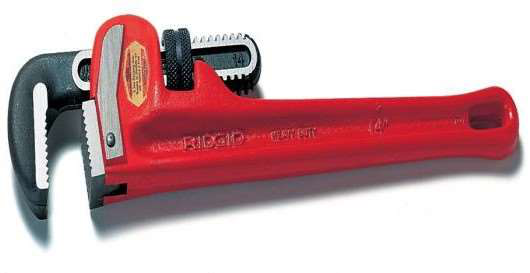
A red pipe wrench (Source: INSTALL DRAINAGE SYSTEM NOTES )
| Name |
Specification |
Use |
| Pipe Wrench |
Jaw opening adjustable up to 50mm |
Turning and holding pipes during installation or removal |
- The serrated jaws of the pipe wrench provide a strong grip on round surfaces, preventing slippage during pipe installation in hospital plumbing systems.
- Its adjustable design accommodates different pipe diameters, commonly used when fitting drainage pipes in retail business premises.
- Proper use requires applying force in the direction that tightens the grip, enhancing safety and efficiency.
- Regular inspection of jaw teeth is necessary to avoid slipping and damage to pipes.
- The pipe wrench is heavier than other wrenches; thus, users should ensure a firm grip to prevent accidents in busy workshop environments.
3.1.3 Basin Wrench
The basin wrench is a specialized tool designed for tightening and loosening nuts located in hard-to-reach areas behind basins and sinks.
| Name |
Specification |
Use |
| Basin Wrench |
Long handle with pivoting jaw |
Accessing and tightening nuts in confined spaces behind basins |
- The basin wrench’s pivoting jaw enables it to reach nuts that are otherwise inaccessible with standard wrenches, such as under sinks in county hospitals.
- Its long handle provides leverage, allowing technicians to work efficiently in cramped spaces commonly found in university washrooms.
- The tool’s design minimizes the risk of damaging delicate basin fixtures during installation or maintenance.
- Regular cleaning of the pivot joint ensures smooth operation and durability.
- It is particularly useful when installing taps or water supply lines where space constraints prevent the use of other tools.
3.1.4 Screwdrivers (Flathead and Phillips)
Screwdrivers are fundamental tools in sanitary appliance installation, used for driving screws that secure fixtures and fittings.
| Name |
Specification |
Use |
| Flathead Screwdriver |
Blade width varies (3-10mm) |
Driving screws with a straight, flat slot |
| Phillips Screwdriver |
Cross-shaped blade sizes (PH1-PH3) |
Driving screws with a cross-shaped slot |
- Flathead screwdrivers are used for screws with single straight slots, common in securing cover plates on water meters at SACCO offices.
- Phillips screwdrivers accommodate cross-shaped screws, providing better grip and torque for fittings in hotel washroom installations.
- Choosing the correct screwdriver size prevents stripping screw heads, which can delay installations in busy retail outlets.
- Screwdriver handles should be ergonomically designed to reduce hand fatigue during prolonged use.
- Maintaining sharp and undamaged blades enhances efficiency and safety during installation tasks.
3.1.5 Hacksaw
The hacksaw is a hand tool equipped with a fine-toothed blade used for cutting metal and plastic pipes to required lengths during sanitary installations.
| Name |
Specification |
Use |
| Hacksaw |
Frame length approx. 300mm, blade with 18-32 teeth per inch |
Cutting metal and plastic pipes to size |
- Hacksaws are indispensable when adjusting pipe lengths to fit specific installation layouts in county government offices.
- Selecting the appropriate blade type (fine or coarse teeth) is crucial depending on the pipe material, such as PVC pipes in schools or metal pipes in clinics.
- Proper technique involves steady, controlled strokes to ensure straight cuts and reduce blade wear.
- Maintaining blade tension and replacing dull blades preserves cutting efficiency.
- Using a hacksaw requires protective gear to guard against metal shards and injury during hospital plumbing renovations.
3.1.6 Pipe Cutter
Pipe cutters provide a cleaner, more precise method of cutting pipes than hacksaws, especially for copper and plastic pipes used in sanitary installations.
| Name |
Specification |
Use |
| Pipe Cutter |
Adjustable cutting wheel with rollers |
Cutting copper and plastic pipes accurately |
- Pipe cutters are preferred in hotel plumbing installations where neat, burr-free cuts improve joint sealing and appearance.
- The tool works by clamping around the pipe and rotating to gradually cut through, reducing the risk of pipe deformation.
- Regular maintenance includes cleaning cutting wheels and lubricating moving parts to ensure smooth operation.
- Using a pipe cutter speeds up installation of supply lines in university dormitories by reducing the need for finishing cuts.
- It is safer and less physically demanding than hacksaws, which benefits technicians in retail business settings.
3.1.7 Plumber's Tape (Thread Seal Tape)
Plumber’s tape, commonly known as thread seal tape, is a thin film used to seal pipe threads and prevent leaks in threaded pipe connections.
| Name |
Specification |
Use |
| Plumber’s Tape |
PTFE tape, 12mm wide, 5-10m length |
Sealing threaded pipe joints to prevent leaks |
- The tape is wrapped around male threads before connecting pipes, creating a watertight seal essential in hospital water supply systems.
- It resists corrosion and withstands high water pressure, making it suitable for installations in county referral hospitals.
- Proper application involves wrapping tape clockwise around threads 3-5 times to ensure full coverage.
- Using tape minimizes the need for additional sealants, speeding up installation in busy bank facilities.
- Incorrect application, such as overlapping or insufficient wrapping, can cause leaks and costly repairs in cooperative societies’ plumbing.
3.1.8 Silicone Sealant and Caulking Gun
Silicone sealant is a flexible, waterproof compound used to seal joints and gaps in sanitary fixtures, applied using a caulking gun for precision.
| Name |
Specification |
Use |
| Silicone Sealant |
Waterproof, flexible, mold-resistant |
Sealing joints around sinks, baths, and toilets |
| Caulking Gun |
Manual or pneumatic, holds standard sealant cartridges |
Applying silicone sealant precisely and evenly |
- Silicone sealants prevent water ingress around sanitary appliances, protecting wall and floor finishes in hotel bathrooms.
- The caulking gun allows controlled dispensing, ensuring a neat, continuous bead that enhances both function and aesthetics in university washrooms.
- Sealants are mold-resistant, important in humid environments like county hospital wards.
- Proper surface preparation before application is essential for adhesion and durability.
- Sealant joints require curing time, so scheduling installations appropriately avoids premature water exposure in retail outlets.
3.1.9 Plumber's Putty
Plumber’s putty is a pliable sealing compound used to create watertight seals around fixtures such as drain covers and faucets.
| Name |
Specification |
Use |
| Plumber’s Putty |
Soft, malleable, non-hardening compound |
Sealing joints between fixtures and surfaces to prevent leaks |
- Putty is commonly used in kitchen sinks at county government offices to seal drain flanges securely.
- Its pliability allows easy shaping and repositioning during installation.
- Unlike silicone, plumber’s putty does not harden, facilitating future fixture removal for maintenance in hotel kitchens.
- It should not be used on porous surfaces like marble as it may cause staining, important consideration for university facilities.
- Proper application involves rolling the putty into a rope and pressing it evenly to avoid gaps or lumps.
3.1.10 Tape Measure
A tape measure is a flexible ruler used to take precise measurements critical for fitting sanitary appliances and pipes accurately.
| Name |
Specification |
Use |
| Tape Measure |
5m to 10m length, steel blade |
Measuring lengths and distances for accurate installation |
- Accurate measurements prevent costly mistakes in pipe cutting and fixture placement, vital in county referral hospitals.
- Tape measures with locking mechanisms allow users to hold measurements securely during marking.
- Metric units are standard in Kenya, ensuring compatibility with building plans in retail business premises.
- Maintenance includes retracting the tape fully to avoid kinks and cleaning to remove dirt that could affect accuracy.
- Using tape measures efficiently speeds up installation tasks in busy university maintenance departments.
3.1.11 Spirit Level
The spirit level is an instrument used to check the horizontal or vertical alignment of sanitary appliances to ensure correct installation.
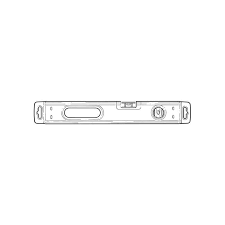
A spirit level (Source: PLUMBING THEORY NOTES)
| Name |
Specification |
Use |
| Spirit Level |
Bubble vial in a frame, lengths vary from 200mm to 600mm |
Checking level and plumb of fixtures |
- Ensuring basins and toilets are level prevents improper drainage and water pooling in hotel bathrooms.
- The bubble vial indicates when a surface is perfectly horizontal or vertical, critical in fitting sinks at SACCO offices.
- Spirit levels come in various sizes to suit different installation scales, including compact ones for tight spaces.
- Calibration checks are necessary to maintain accuracy, especially in university building maintenance.
- Proper leveling enhances the longevity and functionality of sanitary appliances by reducing strain on joints.
3.1.12 Drill and Drill Bits
Drills are power tools used to create holes for mounting brackets and fixtures, with various drill bits selected based on material type.
| Name |
Specification |
Use |
| Electric Drill |
Variable speed, corded or cordless |
Drilling holes in walls, tiles, and pipes |
| Drill Bits |
Masonry, wood, metal bits in assorted sizes |
Creating holes for screws and anchors |
- Drills facilitate secure fixing of sanitary appliances such as wall-mounted basins in county government offices.
- Using the correct drill bit prevents damage to tiles or concrete surfaces in hospital washrooms.
- Variable speed control allows precise drilling to avoid cracking delicate surfaces in university laboratories.
- Regular cleaning and sharpening of drill bits maintain efficiency and safety.
- Cordless drills offer mobility advantages, especially in large retail outlets with multiple installation points.
3.1.13 Hole Saw Kit
Hole saw kits consist of circular saw blades attached to a drill, designed to cut large diameter holes in walls or panels for pipe passage.
| Name |
Specification |
Use |
| Hole Saw Kit |
Assorted diameters from 20mm to 100mm |
Cutting holes for pipes, taps, and cable entry |
- Hole saws are essential for creating clean openings in bathroom walls for sanitary pipe installations in county hospitals.
- Multiple sizes allow adaptation to different pipe diameters encountered in school plumbing systems.
- Using a pilot drill in the center ensures accuracy and prevents wandering during cutting.
- Proper lubrication and slow drilling speed reduce heat and wear on blades in hotel projects.
- Hole saw kits improve efficiency and finish quality compared to manual cutting methods.
3.1.14 Bucket and Sponge
Buckets and sponges are basic but vital cleaning tools used during and after sanitary appliance installation to manage water spills and clean surfaces.
| Name |
Specification |
Use |
| Bucket |
Plastic or metal, 10-20 liters |
Carrying water and collecting waste water |
| Sponge |
Absorbent, non-abrasive |
Cleaning surfaces and wiping excess sealant |
- Buckets collect water during pipe testing and flushing in county referral hospitals to maintain a clean work environment.
- Sponges remove excess silicone or plumber’s putty residues from fixtures, enhancing installation aesthetics in university dormitories.
- Using clean water and sponges prevents contamination of sanitary areas in retail business washrooms.
- Buckets should be cleaned regularly to avoid bacterial growth, important in health-sensitive environments.
- These tools support hygiene and professionalism expected in hotel maintenance teams.
3.1.15 Pliers
Pliers are multi-purpose hand tools used for gripping, twisting, cutting wires, and bending small pipes or fittings.
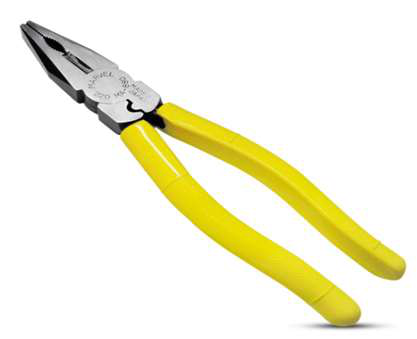
A pair of combination pliers (Source: PLUMB 5 LEARNING GUIDE-1 (1))
| Name |
Specification |
Use |
| Pliers |
Jaw width varies, insulated handles available |
Gripping, cutting wires, bending small parts |
- Pliers are used to adjust small pipe clamps or bend copper pipe ends during sanitary installations in cooperative societies.
- Insulated handles protect users from electrical shocks when working near electrical installations in banks.
- Their cutting jaws facilitate trimming of pipe ties or wires securing fixtures in county government offices.
- Maintaining pliers involves cleaning and lubricating the pivot joint to ensure smooth operation.
- Pliers provide fine control in tight spaces where larger tools cannot be used, such as under sinks in hospitals.
3.1.16 Teflon Tape
Teflon tape is a type of thread seal tape made from polytetrafluoroethylene, used specifically to ensure leak-proof threaded joints.
| Name |
Specification |
Use |
| Teflon Tape |
White, 12mm wide, 5-10m length |
Sealing threaded pipe joints to prevent leaks |
- Teflon tape is frequently applied on water supply pipe threads in county referral hospitals to enhance sealing.
- It is chemically inert and withstands high temperatures and pressures, suitable for various sanitary applications in hotels.
- Proper wrapping technique involves overlapping layers to create a tight seal without excess material.
- Using Teflon tape reduces the need for liquid sealants, speeding up installations in university facilities.
- Incorrect use can cause leaks or thread damage, emphasizing the need for training in SACCO maintenance teams.
3.1.17 Allen Keys (Hex Wrench Set)
Allen keys, or hex wrenches, are L-shaped tools used to drive bolts and screws with hexagonal sockets, common in modern sanitary fittings.
| Name |
Specification |
Use |
| Allen Keys |
Set of various sizes (1.5mm to 10mm) |
Tightening or loosening hex socket bolts and screws |
- Many contemporary taps and sanitary fixtures in banks and retail stores use hex socket fasteners requiring Allen keys for installation.
- The compact design allows use in confined spaces such as behind basins in county government offices.
- Allen keys provide precise torque control, reducing the risk of over-tightening and damage to fittings.
- Keeping a complete set ensures compatibility with a range of fixtures encountered during maintenance.
- Allen keys are durable and require minimal maintenance, making them reliable for frequent use in hotel maintenance.
3.1.18 Rubber Mallet
A rubber mallet is a hammer with a soft rubber head used to apply force without damaging surfaces or fixtures.
| Name |
Specification |
Use |
| Rubber Mallet |
Head diameter approx. 50mm, wooden or fiberglass handle |
Tapping fixtures into place without surface damage |
- Rubber mallets are ideal for seating sanitary appliances gently, such as positioning ceramic basins in university washrooms.
- They prevent chipping or cracking fragile materials compared to metal hammers.
- The tool is used to adjust pipe joints and fittings without deforming metal components in cooperative society plumbing.
- Handles should be checked regularly for cracks to maintain safety.
- Rubber mallets support precision work in sensitive installations where aesthetics are important, like hotel bathrooms.
3.1.19 Ball Hammer
A ball hammer is a heavy hammer with a rounded head used primarily for shaping metal and driving chisels during pipe fitting.
| Name |
Specification |
Use |
| Ball Hammer |
Weight 500g to 1kg, steel head |
Shaping pipes and driving chisels during installation |
- Ball hammers are used to shape copper pipes during sanitary installations in retail business premises to fit bends without kinking.
- The rounded head allows controlled impact, minimizing damage compared to flat-faced hammers.
- Skilled use is necessary to avoid deforming pipes or fixtures, important in hospital plumbing systems.
- Regular cleaning and handle inspection enhance longevity and safety.
- This tool is less common but invaluable for custom pipe bending and adjustments on-site.
3.1.20 Pipe Bender (for Copper Pipes)
Pipe benders are mechanical tools designed to bend copper pipes accurately without collapsing or kinking.
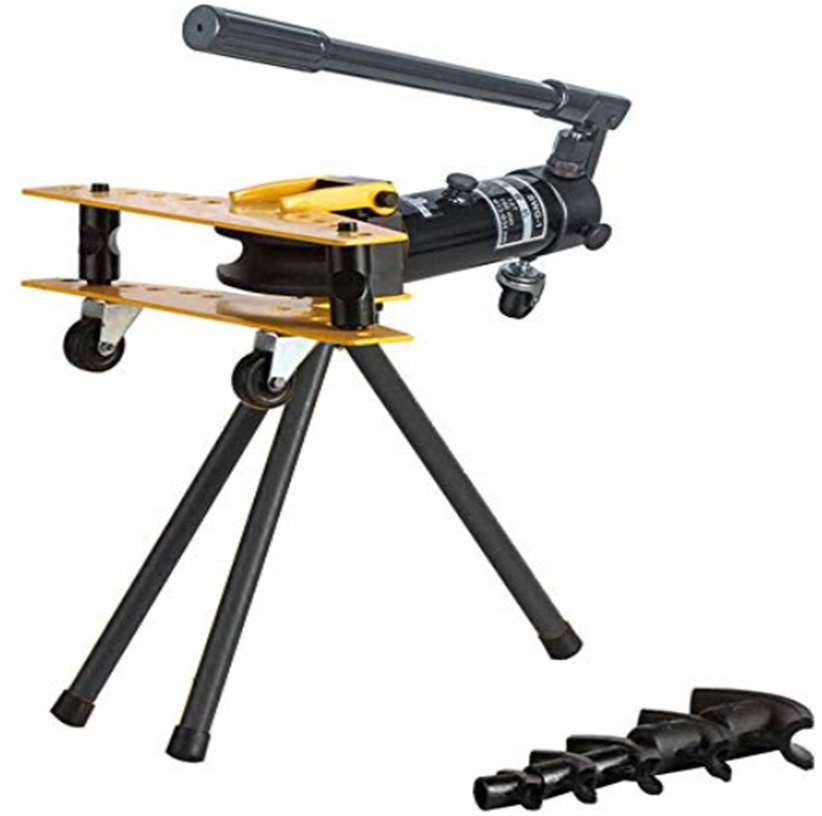
A hydraulic pipe bender (Source: PLUMB 5 LEARNING GUIDE-1 (1))
| Name |
Specification |
Use |
| Pipe Bender |
Manual or hydraulic, various sizes for pipe diameters |
Bending copper pipes to required angles during installation |
- Pipe benders ensure smooth, precise bends in copper piping systems installed in county government offices, preserving flow efficiency.
- Using a pipe bender reduces the need for pipe fittings, lowering potential leak points in university plumbing systems.
- The tool operates by clamping the pipe and applying uniform pressure to achieve the desired bend radius.
- Proper technique and pipe support prevent deformation and ensure compliance with installation standards.
- Maintenance includes cleaning and lubricating moving parts to ensure smooth operation during frequent use in SACCO maintenance.
Practice Questions
-
Describe the main uses of an adjustable wrench and a pipe wrench in sanitary appliance installation, highlighting their differences. (6 marks)
-
Explain how plumber’s tape is applied and why it is important when connecting threaded pipes in sanitary installations. (5 marks)
-
List and describe five safety or maintenance considerations when using a drill and drill bits during sanitary appliance installation. (10 marks)
-
Discuss the advantages of using a pipe cutter over a hacksaw for cutting copper pipes in a hotel plumbing system. (6 marks)
-
Outline the steps involved in using a caulking gun to apply silicone sealant around a basin. (8 marks)
The rest of this chapter
🔒Create a free account to open more of this chapter.
Free: practical guides, quick cards, workplace scenarios and more.
Create a free account 🔒3.2 Setting out Sanitary Appliances
Setting out sanitary appliances is a critical phase in plumbing installations that ensures appliances are correctly positioned and aligned according to architectural plans and functional requirements. In Kenya, whether installing in a county referral hospital,…
🔒3.3 Install Sanitary Appliances
The installation of sanitary appliances requires skillful mounting, secure connections to water supply and drainage systems, and effective sealing to prevent leaks and contamination. Proper installation at places like county hospitals or retail outlets guarant…
🔒3.4 Functionality Tests for Sanitary Appliances
Functionality testing is a critical phase in the installation of sanitary appliances to ensure they operate efficiently and safely. In Kenya's diverse professional environments such as hospitals, schools, county offices, and hotels, properly functioning sanita…
Chapter Summary
This chapter provided an in-depth overview of the essential tools and equipment required for fixing sanitary appliances, covering items such as wrenches, screwdrivers, pipe cutters, sealants, and measuring instruments. It then detailed the critical steps involved in setting out sanitary appliances, emphasizing the importance of accurate positioning and marking to ensure proper installation. The process of installing sanitary appliances was explained comprehensively, including mounting, connecting water supply and drainage systems, and applying effective sealing techniques. Furthermore, the chapter highlighted various functionality tests necessary to verify the proper operation of the installed appliances, such as water supply checks, flush tests, and drainage tests. Additional testing methods covered included leak detection, water pressure assessment, temperature control verification, and overflow prevention measures. Together, these topics provided a complete framework for the professional installation and commissioning of sanitary appliances in diverse settings.
Self-Assessment
🔒 PDFDownload this self-assessment, with answers
A. Written Assessment
- What is the primary use of an adjustable wrench in sanitary appliance installation? (2 marks)
- Describe the difference between a pipe wrench and a basin wrench. (3 marks)
🔒20 more in this section.
Chapter Examination Questions
🔒 PDFDownload these examination questions, with worked answers
SECTION A (40 Marks) - Answer ALL Questions
- Explain the primary function of an adjustable wrench when installing sanitary appliances at a county hospital. (4 marks)
- Describe how a basin wrench differs from a pipe wrench in terms of design and typical use. (4 marks)
🔒18 more in this section.
Chapter Practical Activities
Practical 1: Use adjustable and pipe wrenches to tighten and loosen 1/2-inch pipe fittings
Plumbing · Level 5
Sanitary Appliances Installation I
PRACTICAL ASSESSMENT
TIME: 4 HOURS
⬇ PDFCandidate Instructions (Candidate Tool)
Type: Individual
INSTRUCTIONS TO CANDIDATE:
1. You are required to perform the following task:
i. Tighten and loosen 1/2-inch galvanized steel pipe fittings assembling a 1 meter pipe run using adjustable and pipe wrenches.
2. You have been provided with the following resources for the practical task:
| Tools & Equipment | Materials |
|---|
| Adjustable wrench | 1/2-inch galvanized steel pipe |
| Pipe wrench 14 inch | 1/2-inch galvanized steel pipe fittings |
| Teflon tape |
| Pipe joint compound |
| PPE |
⬇ PDFResources Required (Cutting List)
| S/N | Item | Quantity |
|---|
| 1 | Adjustable wrench | 1 Pc per Candidate |
| 2 | Pipe wrench 14 inch | 1 Pc per Candidate |
| 3 | 1/2-inch galvanized steel pipe fittings (elbows, unions, nipples) | 5 Pcs per Candidate |
| 4 | 1/2-inch galvanized steel pipe - 1 meter | 1 m per Candidate |
| 5 | Teflon tape roll | 1 Roll per Candidate |
| 6 | Pipe joint compound | 1 Tube per Candidate |
| 7 | PPE (safety boots, gloves, goggles) | Full gear per Candidate |
⬇ PDFAssessor Guide
| Items to be Evaluated | Marks Available | Marks Obtained | Comments |
|---|
| TASK 1: Use of adjustable and pipe wrenches |
Used personal protective equipment correctly (boots, gloves, goggles)
(Award 2 marks for full PPE worn or zero) | 2 | | |
Interpreted working drawing and arranged pipe and fittings accordingly
(Award 1 mark or zero) | 1 | | |
Applied Teflon tape and pipe joint compound correctly on male threads
(Award 2 marks for correct application or zero) | 2 | | |
Used adjustable wrench correctly to tighten fittings without damaging pipe
(Award 3 marks for correct use or zero) | 3 | | |
Used pipe wrench correctly to loosen fittings without damaging pipe
(Award 3 marks for correct use or zero) | 3 | | |
Ensured fittings are firmly fixed and leak-proof by correct wrench application
(Award 2 marks for firm fixing or zero) | 2 | | |
| Sub-Total | 13 | | |
| PRODUCT CHECKLIST |
Assembled pipe run length is 1000 mm ±5 mm
(Award 2 marks for correct length or zero) | 2 | | |
Pipe fittings are properly tightened with no visible damage or overtightening
(Award 3 marks for proper tightening or zero) | 3 | | |
Pipe joints are leak-proof upon testing
(Award 5 marks for no leaks or zero) | 5 | | |
| Sub-Total | 10 | | |
| GRAND TOTAL | 23 | | |
ASSESSMENT OUTCOME: ☐ Competent ☐ Not Yet Competent (competent if at least 50%)
Practical 2: Installation and adjustment of basin fittings using basin wrench and pliers
Plumbing · Level 5
Sanitary Appliances Installation I
PRACTICAL ASSESSMENT
TIME: 4 HOURS
⬇ PDFCandidate Instructions (Candidate Tool)
Type: Individual
INSTRUCTIONS TO CANDIDATE:
1. You are required to perform the following task:
i. Install and adjust basin fittings including taps and waste pipe on a wash hand basin 500mm wide x 400mm deep.
2. You have been provided with the following resources for the practical task:
| Tools & Equipment | Materials |
|---|
| Basin wrench | Wash hand basin (complete set) |
| Pliers | Flexible tap connector 1/2 inch |
| Basin pillar taps (pair) |
| Basin waste pipe 1 1/4 inch |
| Basin waste plug and chain |
| Wall plugs and screws 1/2 inch |
| Silicone sealant 300 ml tube |
| Personal Protective Equipment (PPE) full gear |
⬇ PDFResources Required (Cutting List)
| S/N | Item | Quantity |
|---|
| 1 | Basin wrench | 1 Pc per Candidate |
| 2 | Pliers | 1 Pc per Candidate |
| 3 | Wash hand basin (complete set) | 1 Set per Candidate |
| 4 | Flexible tap connector 1/2 inch | 2 Pcs per Candidate |
| 5 | Basin pillar taps (pair) | 1 Pair per Candidate |
| 6 | Basin waste pipe 1 1/4 inch | 350 mm per Candidate |
| 7 | Basin waste plug and chain | 1 Set per Candidate |
| 8 | Wall plugs and screws 1/2 inch | 6 Pcs per Candidate |
| 9 | Silicone sealant 300 ml tube | 1 Tube per Candidate |
| 10 | Personal Protective Equipment (PPE) full gear | 1 Set per Candidate |
⬇ PDFAssessor Guide
| Items to be Evaluated | Marks Available | Marks Obtained | Comments |
|---|
| TASK 1: Preparation and PPE |
Used personal protective equipment in line with occupational safety and health regulations (overall PPE and safety boots)
(Award 2 marks for full PPE worn or zero) | 2 | | |
Interpreted the working drawing correctly for basin fitting installation
(Award 1 mark or zero) | 1 | | |
| Sub-Total | 3 | | |
| TASK 2: Identification and measurement |
Identified materials required for fixing the basin fittings (taps, flexible connectors, waste pipe, plugs)
(Award 1 mark for each correct identification up to 2 marks) | 2 | | |
Measured and marked correct positions for basin taps and waste pipe as per drawing
(Award 2 marks for accurate measurement and marking or zero) | 2 | | |
| Sub-Total | 4 | | |
| TASK 3: Installation using basin wrench and pliers |
Used basin wrench correctly to fix basin taps in tight spaces
(Award 3 marks for correct use or zero) | 3 | | |
Used pliers to tighten and adjust fittings without damaging components
(Award 3 marks for correct use or zero) | 3 | | |
Applied silicone sealant neatly around basin edges and fittings
(Award 2 marks for neat application or zero) | 2 | | |
| Sub-Total | 8 | | |
| TASK 4: Testing and finishing |
Tested functionality of taps and waste plug, ensuring no leaks
(Award 3 marks for no leaks or zero) | 3 | | |
Corrected any faults found during testing
(Award 2 marks for correcting faults or zero) | 2 | | |
Cleaned and stored tools and equipment as per manufacturers' instructions
(Award 2 marks for proper cleaning and storage or zero) | 2 | | |
Disposed of waste materials properly
(Award 2 marks for proper waste disposal or zero) | 2 | | |
| Sub-Total | 9 | | |
| PRODUCT CHECKLIST |
Finished basin installation checked for firm fitting, correct height (450mm from floor to basin rim), levelness, and correct fitting alignment
(Award 5 marks for all correct or zero) | 5 | | |
Waste pipe and plug fitted correctly and functioning
(Award 3 marks for correct fitting and function or zero) | 3 | | |
Taps installed without damage and operate smoothly
(Award 3 marks for proper installation and operation or zero) | 3 | | |
| Sub-Total | 11 | | |
| GRAND TOTAL | 35 | | |
ASSESSMENT OUTCOME: ☐ Competent ☐ Not Yet Competent (competent if at least 50%)
🔒Cutting Pipes Accurately Using Hacksaw and Pipe CutterPractical 3
🔒Seal pipe threads using plumber's tape and Teflon tape for leak-proof jointsPractical 4
🔒Apply silicone sealant and plumber's putty to seal sanitary appliance jointsPractical 5
🔒Measurement and leveling for sanitary appliance installationPractical 6
🔒Drilling and Hole Preparation for Sanitary Appliance InstallationPractical 7
🔒Use of Rubber Mallet and Ball Hammer to Fix Sanitary AppliancesPractical 8
🔒Bend Copper Pipes to 90 and 45 Degrees Using a Pipe BenderPractical 9
🔒Assemble and tighten sanitary fixture using Allen keysPractical 10
🔒Setting out and marking installation points for a sitting type water closet and cisternPractical 11
🔒Connect Water Supply Pipes to Drainage System with Proper Alignment and SealingPractical 12
🔒Seal sanitary appliance joints on a water closet installationPractical 13
🔒Conduct functionality and leak tests on installed sanitary appliancesPractical 14
