
By the end of this chapter, you will be able to:
These skills are essential because they help you ensure materials meet quality standards, keeping construction projects safe and successful.
Compiled by: Faith Achieng
Construction materials form the foundation of all civil engineering projects, influencing structural integrity, durability, and cost-effectiveness. Understanding the sources of these materials is essential for professionals tasked with material selection, procurement, and quality control in Kenya’s dynamic construction sector. This chapter examines the various origins of construction materials, highlighting natural, manufactured, and recycled sources, to equip engineers with comprehensive knowledge for sustainable and efficient project execution.
The origin of construction materials significantly affects their properties, availability, environmental impact, and cost. In Kenya, sourcing construction materials involves balancing local availability, quality standards, and sustainability concerns. Construction professionals must evaluate whether materials come directly from nature, are artificially produced, or reclaimed from previous constructions to make informed choices that optimize project outcomes.
Natural sources refer to materials extracted directly from the earth without significant alteration. These materials have been used for centuries due to their availability and inherent properties suited for construction.
Natural construction materials encompass a range of substances including aggregates, stones, clay, and timber. Aggregates such as sand and gravel are commonly sourced from riverbeds and quarries within Kenya’s Rift Valley and coastal regions. Stones like granite and basalt, found in areas like Machakos and Kisii, provide strong, durable building blocks. Clay, used in brick-making, is abundant in regions like Mombasa and Nakuru. Timber sourced from indigenous forests in Mount Kenya and Mau offers structural elements but requires sustainable harvesting practices.
Natural materials typically exhibit variability in composition and strength, depending on their geological formation. For example, sand from riverbeds may have different grain sizes affecting concrete workability. Stone hardness varies, influencing its suitability for load-bearing structures. Natural timber contains moisture and organic matter that affect durability and susceptibility to pests. These characteristics dictate specific testing and treatment before use in construction.
Natural materials are often cost-effective due to local availability and minimal processing requirements. Their ecological footprint can be lower when sourced responsibly, supporting sustainable construction practices. Materials like stone and timber offer excellent thermal properties, beneficial in Kenya’s diverse climate zones. Additionally, natural aggregates provide essential bulk and strength in concrete and road construction, crucial for infrastructure projects such as county road networks.
Extraction of natural materials can lead to environmental degradation, including habitat destruction and soil erosion. Variability in quality requires stringent testing to ensure compliance with Kenya Bureau of Standards (KEBS) regulations. Transportation challenges from remote quarry sites to urban construction zones increase costs and carbon emissions. Over-reliance on natural timber has led to deforestation concerns, prompting stricter forestry management policies.
Manufactured construction materials undergo industrial processes to enhance their properties, uniformity, and performance. These materials are integral to modern construction, offering standardized quality and specialized functions.
Concrete blocks, cement, steel reinforcement bars, and glass are among the most prevalent manufactured materials. Cement production is centered around plants in Athi River and Mombasa, where raw materials are processed into Portland cement. Steel reinforcement bars are produced in Nairobi and Nakuru, providing tensile strength critical for reinforced concrete structures. Concrete blocks, manufactured in factories throughout Kenya, offer modular building units with consistent dimensions. Glass used in windows and facades is imported and locally fabricated to meet design specifications.
Manufacturing processes improve material properties such as strength, durability, and resistance to weathering. For instance, cement is chemically engineered to achieve optimal hydration and setting times suitable for Kenya’s climatic conditions. Steel bars undergo heat treatment to enhance tensile strength and ductility, essential for earthquake-resistant structures. Manufactured bricks and blocks have controlled porosity, resulting in better insulation and moisture resistance compared to traditional fired clay bricks.
The uniformity of manufactured materials simplifies design and quality control, reducing construction errors and delays. Their availability in standard sizes and grades facilitates faster construction and cost estimation. Manufactured materials often comply with national and international standards, ensuring safety and longevity. For example, the use of KEBS-certified steel bars in Nairobi County’s public buildings guarantees structural integrity and public safety.
While manufacturing consumes energy and resources, advances in technology aim to reduce carbon emissions and waste. Local manufacturing supports economic growth by creating jobs and reducing reliance on imports. However, the cost of manufactured materials can be higher than natural alternatives, influencing project budgets, especially in rural or low-income areas. Engineers must balance performance requirements with environmental impact and cost-efficiency.
Recycled construction materials are derived from waste products or demolished structures, repurposed to reduce environmental impact and conserve resources. Their use is gaining traction in Kenya’s construction industry as part of sustainable development initiatives.
Common recycled materials include crushed concrete, reclaimed timber, recycled steel, and plastic composites. Crushed concrete from demolition sites is reused as aggregate in road base layers and non-structural concrete. Reclaimed timber finds application in formwork, scaffolding, and interior finishes. Recycled steel scrap is melted and reformed into new reinforcement bars. Plastic waste is increasingly processed into durable construction products such as roofing tiles and insulation panels.
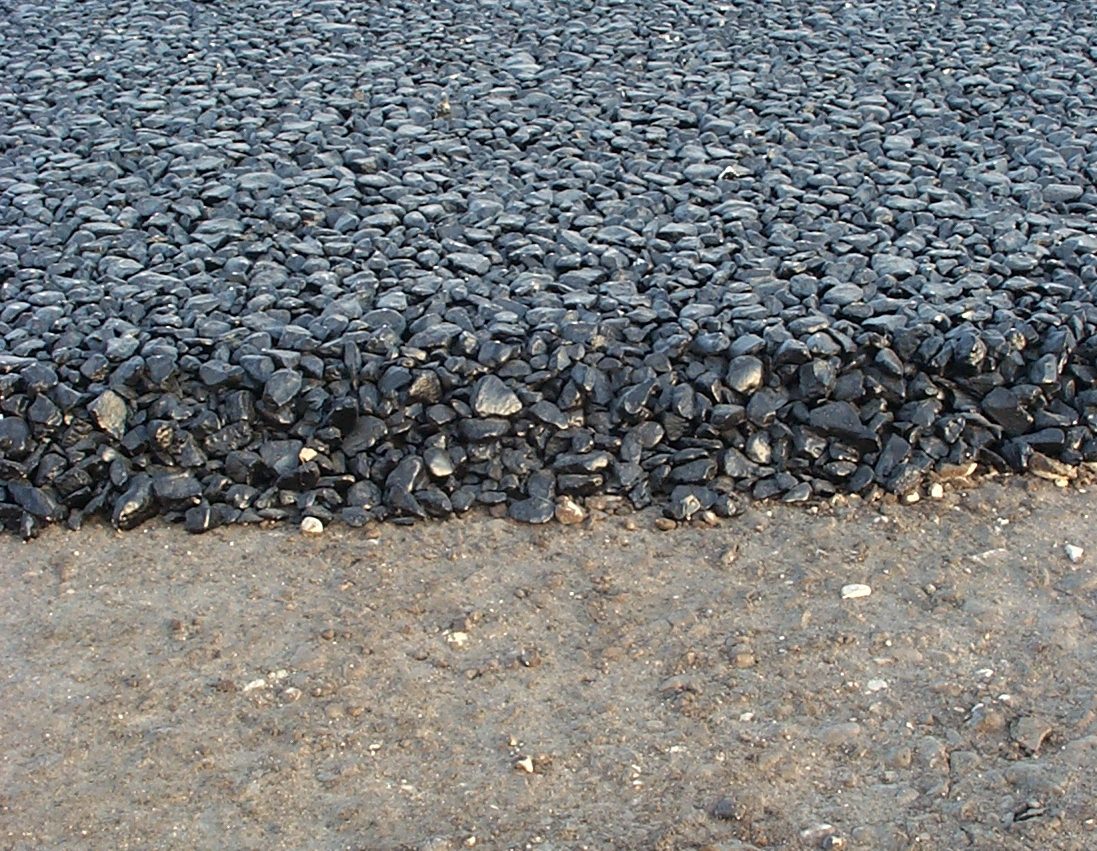
Layer of reclaimed asphalt pavement aggregate (Source: Wikimedia Commons)
Using recycled materials reduces landfill waste and the demand for virgin resources, aligning with Kenya’s Vision 2030 environmental goals. Recycled aggregates lower construction costs by substituting expensive natural materials without compromising quality in certain applications. Incorporation of recycled steel and timber supports circular economy principles, extending the life cycle of materials. Recycling also reduces energy consumption associated with raw material extraction and manufacturing.
Recycled materials may exhibit inconsistent quality and require rigorous testing to meet safety standards. Contamination and degradation from previous use can affect material performance, necessitating careful sorting and processing. Limited local infrastructure and technology for recycling construction waste restrict widespread adoption. Some recycled products, such as plastic composites, are yet to gain full acceptance due to concerns over durability and fire resistance.
Counties like Kisumu and Nakuru have started integrating recycled aggregates in road construction projects, demonstrating cost savings and environmental benefits. Urban redevelopment in Nairobi frequently employs reclaimed timber in temporary structures and interior design. The Kenya Green Building Society promotes recycling as part of sustainable building certification, encouraging contractors to incorporate recycled materials in public and private projects.
Explain five characteristics of natural construction materials and how they influence their use in Kenyan civil engineering projects. (10 marks)
Discuss the benefits and challenges of using manufactured materials in construction, providing examples relevant to Kenya. (10 marks)
Describe four types of recycled construction materials and evaluate their potential impact on sustainable construction practices in Kenya. (10 marks)
Outline six steps a civil engineer should take to assess the suitability of recycled materials for a road construction project in a Kenyan county. (12 marks)
Create a free account to open more of this chapter.
Free: practical guides, quick cards, workplace scenarios and more.
Create a free accountThis chapter explored the various sources of construction materials, distinguishing among natural sources, manufactured products, and recycled materials, highlighting their relevance in building projects. It then examined sampling procedures, emphasizing their purpose in ensuring material quality and the different types of sampling methods employed. The discussion extended to the specific tools and equipment used for collecting samples, detailing their types and appropriate applications. Attention was given to aligning sampling activities with project requirements by understanding the unique demands of each job and customizing sampling plans accordingly while maintaining quality control and assurance standards. The chapter also covered the analysis of samples through laboratory testing methods, focusing on how to interpret test results accurately. Finally, it addressed the importance of comparing findings against industry standards and specifications and the proper reporting and documentation of these results to support construction quality and compliance.
Type: Individual
| Tools & Equipment | Materials |
|---|---|
| Safety boots | Natural construction materials |
| Overall | Manufactured construction materials |
| Helmet | Recycled construction materials |
| Gloves | |
| Inspection tray | |
| Notepad and pen |
| S/N | Item | Quantity |
|---|---|---|
| 1 | Safety boots | 1 Pc per Candidate |
| 2 | Overall | 1 Pc per Candidate |
| 3 | Helmet | 1 Pc per Candidate |
| 4 | Gloves | 1 Pair per Candidate |
| 5 | Sample set of natural construction materials (e.g. river sand, gravel, clay soil) | 2 kg per Candidate |
| 6 | Sample set of manufactured construction materials (e.g. cement blocks, bricks, steel rods) | 5 Pcs per Candidate |
| 7 | Sample set of recycled construction materials (e.g. crushed concrete, recycled bricks, reclaimed timber) | 3 kg per Candidate |
| 8 | Inspection tray | 1 Pc per Candidate |
| 9 | Notepad and pen | 1 Pc per Candidate |
| Items to be Evaluated | Marks Available | Marks Obtained | Comments |
|---|---|---|---|
| TASK 1: Safety and Preparation | |||
| Wore PPEs (Safety boots, Overall, Helmet, Gloves) (Award 4 marks or zero) | 4 | ||
| Organized the samples on the inspection tray systematically (Award 3 marks or zero) | 3 | ||
| Recorded initial observations and characteristics of samples (Award 3 marks or zero) | 3 | ||
| Sub-Total | 10 | ||
| TASK 2: Material Identification and Classification | |||
| Correctly identified natural materials (e.g. river sand, gravel, clay soil) (Award 2 marks for each correct identification x3 = 6 marks) | 6 | ||
| Correctly identified manufactured materials (e.g. cement blocks, bricks, steel rods) (Award 2 marks for each correct identification x3 = 6 marks) | 6 | ||
| Correctly identified recycled materials (e.g. crushed concrete, recycled bricks, reclaimed timber) (Award 2 marks for each correct identification x3 = 6 marks) | 6 | ||
| Accurately classified each material under the correct source category (Award 6 marks or zero) | 6 | ||
| Sub-Total | 24 | ||
| TASK 3: Reporting | |||
| Prepared a clear and comprehensive report summarizing the materials identified and their classifications (Award 6 marks or zero) | 6 | ||
| Maintained a clean working environment and properly handled materials after inspection (Award 4 marks or zero) | 4 | ||
| Sub-Total | 10 | ||
| PRODUCT CHECKLIST | |||
| Correct classification of all materials into natural, manufactured, and recycled categories (Award 5 marks per category correctly classified x3 = 15 marks) | 15 | ||
| Sub-Total | 15 | ||
| GRAND TOTAL | 59 | ||
Type: Individual
| Tools & Equipment | Materials |
|---|---|
| Weighing Balance | Aggregate |
| Sampling scoops | Sand |
| Marking pens | Cement |
| Notebook and pen | Sample containers |
| S/N | Item | Quantity |
|---|---|---|
| 1 | PPEs (Overall, Safety boots, Gloves, Helmet) | 1 set per Candidate |
| 2 | Weighing Balance | 1 Pc per Candidate |
| 3 | Sampling scoops | 1 Pc per 5 Candidates |
| 4 | Clean sample containers (plastic bags or jars) | 3 per Candidate |
| 5 | Marking pens and labels | 1 set per Candidate |
| 6 | Construction materials for sampling (aggregate, sand, cement) | 2 kg each per Candidate |
| 7 | Notebook and pen | 1 set per Candidate |
| Items to be Evaluated | Marks Available | Marks Obtained | Comments |
|---|---|---|---|
| TASK 1: Safety and Preparation | |||
| Wore full PPE (Overall, Safety boots, Gloves, Helmet) (Award 4 marks or zero) | 4 | ||
| Prepared clean sampling containers and labelled them correctly (Award 3 marks or zero) | 3 | ||
| Selected appropriate sampling tools and materials (Award 3 marks or zero) | 3 | ||
| Sub-Total | 10 | ||
| TASK 2: Sampling Procedures | |||
| Carried out random sampling of aggregate from stockpile using scoop (Award 5 marks or zero) | 5 | ||
| Performed quartering method to reduce sample size correctly (Award 5 marks or zero) | 5 | ||
| Collected sand sample following correct sampling technique (Award 5 marks or zero) | 5 | ||
| Collected cement sample from bag using proper procedure (Award 5 marks or zero) | 5 | ||
| Sub-Total | 20 | ||
| TASK 3: Sample Handling and Documentation | |||
| Weighed each sample accurately using the balance (Award 5 marks or zero) | 5 | ||
| Sealed and labelled samples properly with date and description (Award 5 marks or zero) | 5 | ||
| Recorded sampling details clearly and legibly in notebook (Award 5 marks or zero) | 5 | ||
| Sub-Total | 15 | ||
| PRODUCT CHECKLIST | |||
| Samples collected are representative and correctly labelled (Award 5 marks or zero) | 5 | ||
| Sample weights correspond to approximately 2 kg per material (Award 5 marks or zero) | 5 | ||
| Documentation is complete and accurate (Award 5 marks or zero) | 5 | ||
| Sub-Total | 15 | ||
| GRAND TOTAL | 60 | ||
At the start of this chapter we promised you would be able to:
Tick each one you can genuinely do.
So, are you there yet?
You're competent when you can confidently do 50% or more of what this chapter promised.
Sign in to record how you're doing.