Horticulture  ·  Level 6
Ornamental Plants Production
Chapter 1: Prepare ornamental plants planting materials
📚 6 Topics
⚑ What you will be able to do

By the end of this chapter, you will be able to:

  • Wear the correct personal protective equipment safely and follow all safety procedures.
  • Select the best nursery site based on the farm layout for optimal plant growth.
  • Perform soil analysis of the nursery site accurately using the correct procedure.
  • Assemble the tools, equipment, and materials needed for planting and nursery tasks correctly.
  • Prepare the nursery according to the specific agronomic needs of ornamental plants.
  • Raise healthy ornamental planting materials in the nursery by following the right procedures.
  • Manage the ornamental plant nursery effectively by applying proper agronomic practices.
  • Handle waste safely and properly according to work requirements to maintain a clean environment.
  • Carry out gapping, training, pruning, and crop protection practices correctly following agronomic standards.

Mastering these skills will help you grow beautiful, healthy ornamental plants and become a confident professional in the trade!

Compiled by: George Oyugi

Ornamental plants form a vital segment of Kenya’s horticultural industry, contributing significantly to environmental beautification, tourism, and urban landscaping. Successful propagation and establishment of these plants depend heavily on the quality of planting materials, which are primarily produced in nurseries. This chapter focuses on the critical aspects of preparing ornamental plants planting materials, beginning with selecting an appropriate nursery site. Proper site selection ensures optimal growth conditions, cost-efficiency, and sustainability of nursery operations.

1.1 Nursery site selection

Nursery site selection is a foundational step in ornamental plant production. It determines the quality and quantity of planting materials, affecting overall productivity and profitability. In Kenya, where climatic and soil conditions vary widely, careful consideration of multiple factors is essential to establish a functional nursery. This section explores the definition of ornamental plants, the importance of selecting a suitable nursery site, the factors influencing site choice, and the tools, equipment and materials necessary for nursery establishment.

1.1.1 Definition of ornamental plants

Ornamental plants are species cultivated primarily for decorative purposes due to their aesthetic appeal rather than for food or industrial use. These plants enhance the visual environment of homes, offices, public spaces, and gardens through their flowers, foliage, form, or fragrance.

Nature and characteristics of ornamental plants

  • Aesthetic value: Ornamental plants are valued for their beauty, including colourful flowers, attractive foliage, or unique shapes, which improve urban and rural landscapes.
  • Diversity: They encompass a wide range of species including flowering plants, shrubs, climbers, succulents, and trees, adapted to the various Kenyan climates from the highlands to the coast.
  • Non-food use: Unlike crops grown for consumption, ornamental plants serve purposes such as landscaping, shade, screening and cultural decoration.
  • Propagation methods: They are propagated through seeds, cuttings, grafting, splits, suckers or tissue culture to maintain desirable traits.
  • Economic importance: Ornamental horticulture generates income for nurseries, landscapers, and exporters, especially around large urban centres where demand for landscaping is high.

Role in Kenya's environment and economy

Ornamental plants contribute to Kenya's urban aesthetics and tourism appeal, supporting livelihoods in sectors like hospitality and retail. For example, a tourist hotel buys potted palms, hedges and flowering shrubs to decorate its gardens and reception areas, while county governments invest in public parks to improve citizen well-being.

1.1.2 Importance of nursery site selection

Selecting the right site for a nursery is a strategic decision that influences plant survival, growth rates, and operational costs. A well-chosen site reduces risks related to pests, diseases, and environmental stresses, ensuring consistent production of high-quality planting materials.

Benefits of proper nursery site selection

  • Optimal growing conditions: Ensures adequate sunlight, water availability, and suitable soil to promote healthy plant development.
  • Cost efficiency: Minimises expenses related to irrigation, pest control, and soil amendments by leveraging natural site advantages.
  • Accessibility: Facilitates easy transportation of inputs and distribution of planting materials, which is critical for nurseries supplying towns and cities.
  • Pest and disease management: Reduces exposure to vectors by avoiding proximity to contaminated sites or problematic vegetation.
  • Environmental sustainability: Supports conservation of natural resources by choosing sites that minimise soil erosion and water wastage.

Impacts on nursery productivity

A good site shows its value in the numbers a nursery manager tracks: how many seedlings survive, how fast they grow and how many reach the buyer in good condition. A nursery on a waterlogged or shaded patch, for example, loses seedlings to damping-off and produces weak, leggy plants that sell poorly.

  • Higher survival rate: Well-drained soil and a steady water supply reduce losses of seedlings, splits and suckers after planting.
  • Uniform growth: Even sunlight and level ground give plants of similar size, which makes grading and selling easier.
  • Shorter production time: Plants that are not stressed by wind, drought or poor soil reach a saleable size sooner, so more batches can be produced in a year.
  • Lower input costs: Less water, fertiliser and chemical use is needed when the site already provides suitable conditions.
  • Better quality and price: Healthy, well-formed plants attract higher prices from landscapers, hotels and individual buyers, which raises income in Ksh per batch.

1.1.3 Factors considered when siting a nursery

Choosing a nursery location requires a comprehensive evaluation of environmental, logistical, and economic factors to ensure viability and sustainability. These factors interplay to create an environment conducive to ornamental plant propagation.

Environmental factors

  • Climate: Temperature, rainfall patterns, and humidity levels affect plant growth. For example, a nursery in a cool highland area can grow many temperate flowers in the open, whereas a coastal nursery must manage higher humidity and fungal diseases.
  • Soil quality: Soil texture, fertility, pH, and drainage impact root development and nutrient availability. Sandy loam soils with good drainage are ideal for seedbeds.
  • Water availability: Reliable water sources such as boreholes, rivers or piped water are essential for irrigation, especially during dry seasons in drier areas.
  • Topography: Flat or gently sloping land is preferred to facilitate water drainage and ease construction of nursery infrastructure. Steep slopes cause erosion and low-lying hollows collect water.
  • Sunlight and wind: The site should receive adequate light for most of the day, and be protected from strong winds that dry out and damage young plants. A windbreak of trees or hedge on the windward side helps.
  • Surrounding vegetation: Avoid sites close to diseased crops or weeds that harbour pests, and avoid places with large trees whose roots and shade interfere with the beds.

Logistical and economic factors

  • Accessibility: Proximity to roads and markets reduces transportation costs and improves supply chain efficiency.
  • Land size and ownership: Adequate space is necessary for expansion and diversified plant production; ownership status must be clear to avoid disputes.
  • Environmental regulations: Compliance with county and national environmental laws ensures sustainable operations.
  • Security: Protection against theft and vandalism is crucial, particularly in peri-urban areas with higher risks.
  • Labour and power: Nearness to a supply of workers and, where needed, electricity for pumps or lighting lowers running costs.

1.1.4 Tools, equipment and materials used

The effective establishment and management of a nursery require specific tools and equipment to clear and prepare the site, prepare planting materials, maintain seedlings, and manage the nursery environment. These resources enhance efficiency and quality control in ornamental plant production. The planting materials listed here (seeds, splits and suckers) are also part of the resources a nursery must plan for when choosing its site.

Name Specification Use
Panga Steel blade about 40 to 50 cm long, wooden handle Cutting bush, stakes and shrubs when clearing the site
Jembe (hoe) Steel blade, wooden handle, 1 m length Digging, soil preparation and weed control
Slasher Long steel blade, wooden handle about 1 m Cutting grass and light bush
Rake Steel tines, long wooden handle Levelling soil and removing debris
Pruning shears Stainless steel blades, ergonomic handles Cutting and shaping plants, removing dead parts
Watering can 10 to 15 litre capacity, plastic or metal Manual watering of seedlings and young plants
Nursery trays Plastic, 72 to 128 cell size Seed sowing and seedling propagation
Soil sieve Mesh size 5 to 10 mm, hand-held or frame mounted Removing debris and stones from soil
Propagation bags Polyethylene, 30 x 40 cm Growing seedlings before transplanting

Care of other nursery tools and equipment

  • Pruning shears: Regularly sharpen and sterilise blades to prevent disease transmission.
  • Watering can: Clean after use to avoid algae build-up; store in shade to prolong life.
  • Nursery trays: Wash and disinfect between sowing cycles to reduce fungal infections.
  • Soil sieve: Clean mesh after use to maintain efficiency; store indoors to prevent rust.
  • Propagation bags: Reuse carefully, and discard torn bags, which let media spill and roots dry out.

1.1.4.1 Panga

The panga is a heavy, single-edged steel blade with a wooden handle. On a new nursery site it is used first, to cut down bush, small trees and thick shrubs so that the land can be measured and cleared. Example: a trainee clearing a half-acre plot covered with lantana and thorn bushes uses the panga to cut stems close to the ground before the roots are dug out.

  • Site clearing: Cuts woody bush and small trees that would shade or crowd the seedbeds.
  • Stake preparation: Cuts and sharpens stakes and pegs used to mark bed boundaries and support tall seedlings.
  • Trimming: Removes branches from trees that overhang the site.
  • Sharpening: Keep the edge sharp with a file, since a blunt panga needs more force and slips easily.
  • Safe use: Cut away from the body, wear boots and gloves, and keep the blade in a sheath or hung when not in use.

1.1.4.2 Jembe

The jembe is the Kenyan hoe, with a flat steel blade fixed to a long wooden handle. It is the main tool for digging, breaking soil clods, making drainage channels and removing weeds. Example: after clearing, a nursery worker uses a jembe to dig a shallow drainage channel along the lower edge of the site so that rain water does not collect around the beds.
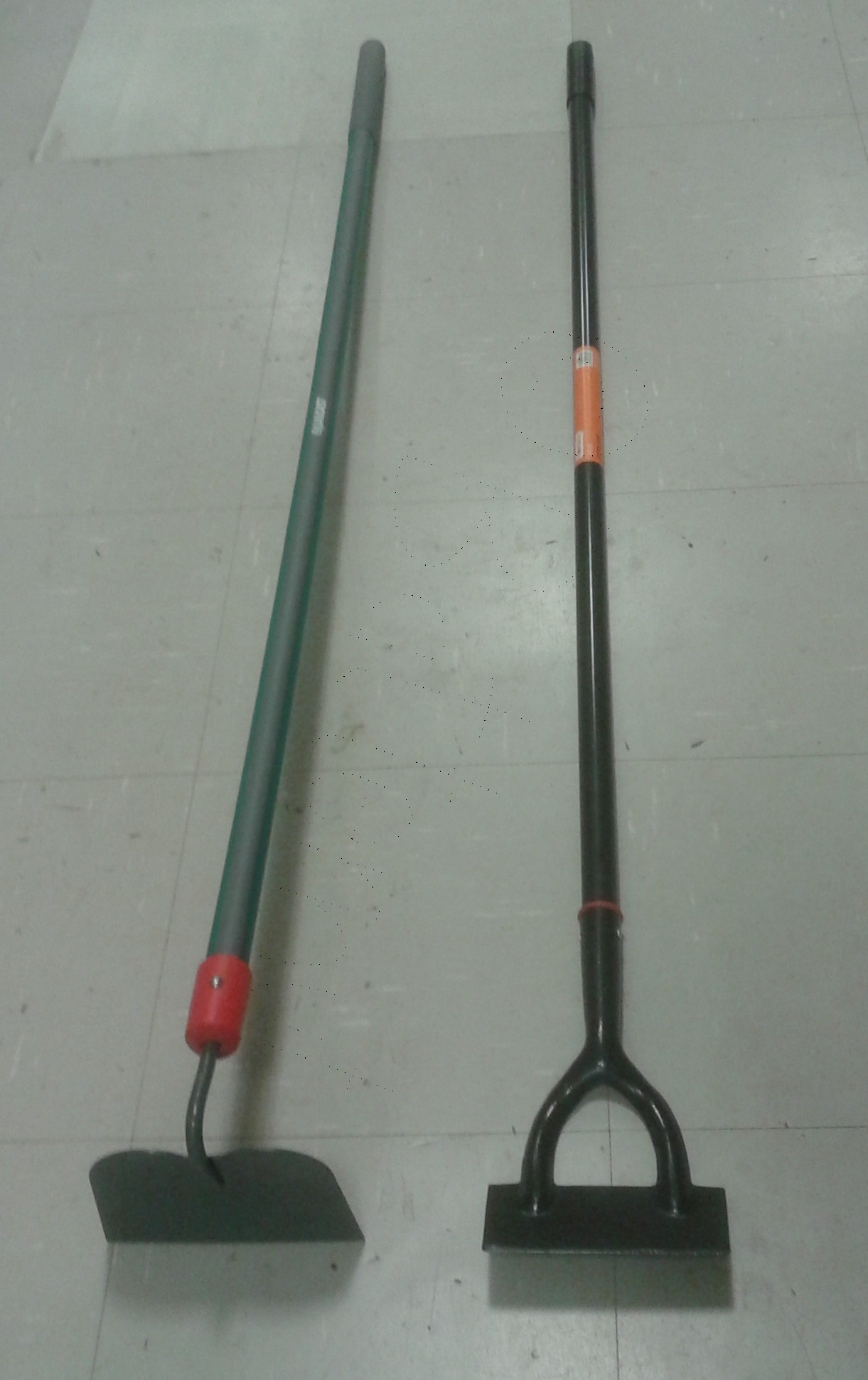
  • Digging and tilling: Loosens soil to the depth needed for beds and makes planting holes.
  • Drainage channels: Opens furrows that carry away excess water from the site.
  • Weed control: Cuts weeds at the root before sowing and between beds.
  • Mixing media: Turns and mixes soil, sand and manure when preparing potting mixtures.
  • Care: Keep the blade sharp and the handle free from splinters; store in a dry place to prevent corrosion.

Two garden hoes with long handles
Two garden hoes with long handles (Source: Wikimedia Commons)

1.1.4.3 Slashers

A slasher is a long-handled tool with a flat or slightly curved blade used to cut grass and soft weeds in a sweeping motion. It covers large areas faster than a panga and leaves the stubble short. Example: before levelling a site covered with kikuyu grass, workers slash the grass low so that the jembe can turn the sod easily.

  • Grass cutting: Clears tall grass and weeds from the site, paths and fence lines.
  • Maintenance: Keeps the nursery surroundings short, which reduces hiding places for pests such as snakes and rodents.
  • Sweeping stroke: Swing in a controlled arc with feet apart and other workers kept at a safe distance.
  • Sharpening: Sharpen the cutting edge regularly with a file to keep a clean cut.
  • Storage: Wipe off sap and soil after use, and hang the tool in a dry place.

1.1.4.4 Rake

A rake has a row of steel or strong metal tines fixed to a head on a long handle. After digging, it levels the soil surface, breaks small clods and pulls together stones, roots and dry weeds. Example: a seedbed for marigolds is raked to a fine, level tilth so that small seeds are sown at an even depth.

  • Levelling: Gives beds and paths an even surface so that water spreads uniformly.
  • Debris removal: Gathers stones, roots and weed residues that would interfere with seedlings.
  • Fine tilth: Breaks small lumps for seedbeds and covers sown seed lightly.
  • Collecting: Gathers cut grass and leaves for the compost heap.
  • Care: Clean soil from the tines after use and store with the tines facing down or hung on a wall to prevent injury.

1.1.4.5 Seeds

Seeds are a widely used planting material for annual and many perennial ornamentals and give many plants cheaply. They must come from a reliable source and be true to type, healthy and viable. Example: marigold, cosmos and zinnia seed is sown in nursery trays or beds, and a nursery planning to produce them needs a sheltered, well-lit site with clean water.

  • Source: Buy certified or reliable seed from a trusted supplier, or collect from healthy mother plants.
  • Viability: Check the packet date and germination ability; old seed gives poor stands.
  • Quality: Seed should be clean, free of pests and disease, and uniform in size.
  • Storage: Keep seed cool, dry and in labelled containers or envelopes away from rodents and insects.
  • Site link: A site with enough light, moderate temperature and clean water suits seed germination and early growth.

1.1.4.6 Splits

Splits are sections of a clump-forming plant, each with roots and shoots, separated from the parent plant and planted as new individuals. This is vegetative propagation, so the new plants are identical to the parent. Example: a mature clump of agapanthus or canna is dug up and divided into several pieces, each with a growing point and healthy roots.

  • Suitable plants: Clump-forming ornamentals such as agapanthus, canna and some grasses and ferns.
  • Selection: Use healthy, vigorous parent clumps free from pests and disease.
  • Dividing: Cut or pull the clump apart with a clean, sharp tool so that each split keeps roots and at least one shoot.
  • Handling: Keep splits shaded and moist before planting so that roots do not dry out.
  • Planting: Plant at the same depth as the parent and water immediately.

1.1.4.7 Suckers

Suckers are shoots that arise from the base or roots of a parent plant and can be separated with some roots attached to form new plants. They are an easy way to get a larger plant sooner than from seed, and to multiply plants that set little seed. Example: young shoots at the base of an areca palm or a bird of paradise are cut away with a portion of root and planted in bags in the nursery.

  • Suitable plants: Palms, bird of paradise, bamboo and other plants that produce offshoots at the base.
  • Selection: Choose suckers of good size with their own roots, from healthy parent plants.
  • Separation: Use a sharp, clean tool or spade to cut the sucker away without damaging the parent.
  • Treatment: Trim damaged roots and leaves, and keep the sucker shaded and moist until potted.
  • Planting: Plant in a bag or bed with well-drained media, then water and shade until established.

Practice Questions

  1. Define ornamental plants and explain their economic importance in Kenya’s horticultural sector. (8 marks)
  2. Discuss five factors to consider when selecting a nursery site for ornamental plants production. (10 marks)
  3. Identify and describe the use of five essential tools and equipment in a nursery setting. (10 marks)
  4. Explain why proper nursery site selection is critical for the success of ornamental plant production. (7 marks)
The rest of this chapter
🔒

Create a free account to open more of this chapter.

Free: practical guides, quick cards, workplace scenarios and more.

Create a free account
🔒1.2 Nursery preparation

Nursery preparation is a critical stage in ornamental plant production, especially in Kenya where climatic conditions and soil types vary widely across regions. Proper nursery setup ensures healthy seedling growth, which directly influences the success of tran…

🔒1.3 Planting seeds in a nursery

Planting seeds in a nursery is a foundational step in propagating ornamental plants, requiring precision to maximize germination rates and produce vigorous seedlings. In Kenya’s diverse climate zones, tailoring seed sowing techniques to species-specific requir…

🔒1.4 Nursery Management Practices

Nursery management practices are critical in ensuring the production of healthy and vigorous ornamental planting materials. In Kenya, where climatic variability and pest pressures can be significant, proper nursery techniques enable growers to optimize plant g…

🔒1.5 Carry out a nursery bed preparation and planting

Nursery bed preparation and planting form the foundation for successful ornamental plant production. In Kenya's horticultural sector, meticulous preparation of nursery beds enhances seedling quality and survival rates, critical for commercial nurseries supplyi…

🔒1.6 Carry out nursery bed management practices

Effective nursery bed management is essential to maintain optimum growing conditions, prevent pest and disease outbreaks, and ensure high-quality ornamental plant production. In Kenya, nursery managers must adapt practices to local climate variability and reso…

Chapter Summary

This chapter focused on the preparation of planting materials for ornamental plants, beginning with the definition of ornamental plants and the crucial role of selecting a suitable nursery site. The importance of considering various factors such as soil type, water availability, and accessibility when siting a nursery was emphasized, alongside the tools and materials commonly used, including panga, jembe, slashers, rake, seeds, splits, and suckers. Nursery preparation techniques were outlined to ensure optimal conditions for seed planting, which was covered in detail with attention to proper methods for sowing seeds in nursery beds. Effective nursery management practices were explored, highlighting essential activities such as mulching, shading, hardening off, watering, fertilizer application, pest and disease control, and pricking out to promote healthy growth. The chapter also provided guidance on carrying out nursery bed preparation and planting, ensuring the correct layout and soil conditions. Finally, maintaining nursery beds through consistent management practices was discussed to support the successful development of ornamental plants.

Self-Assessment

🔒 PDFDownload this self-assessment, with answers

A. Written Assessment

  1. Define ornamental plants and explain their primary purpose in horticulture. (4 marks)
  2. List and explain four factors to consider when selecting a nursery site for ornamental plants. (8 marks)
🔒32 more in this section.

Chapter Examination Questions

🔒 PDFDownload these examination questions, with worked answers

SECTION A (40 Marks) - Answer ALL Questions

  1. Define ornamental plants and explain their significance in Kenyan horticulture. (4 marks)
  2. Describe five factors to consider when selecting a nursery site for ornamental plants. (4 marks)
🔒18 more in this section.

Chapter Practical Activities

Practical 1: Select and prepare a suitable nursery site for ornamental plants production

Horticulture · Level 6
Ornamental Plants Production
PRACTICAL ASSESSMENT
TIME: 4 HOURS
⬇ PDFCandidate Instructions (Candidate Tool)

Type: Individual

INSTRUCTIONS TO CANDIDATE:
1.  You are required to perform the following task:
i.  Select and demarcate a suitable nursery site of 5 m x 5 m near a water source for ornamental plants production.
2.  You have been provided with the following resources for the practical task:
Tools & EquipmentMaterials
Measuring tapeWell decomposed organic manure
Pegeon pegsDAP fertilizer
HoeSource of water
Spade
String
Watering can
⬇ PDFResources Required (Cutting List)
S/NItemQuantity
1Measuring tape1 Pc per Candidate
2Pegeon pegs10 Pcs per Candidate
3Hoe1 Pc per Candidate
4Spade1 Pc per Candidate
5Gumboots1 Pair per Candidate
6Overall1 Pc per Candidate
7Gloves1 Pair per Candidate
8Mask1 Pc per Candidate
9String10 m per Candidate
10Watering can1 Pc per Candidate
11Source of water20 L per Candidate
12Well decomposed organic manure5 kg per Candidate
13DAP fertilizer200 g per Candidate
⬇ PDFAssessor Guide
Items to be EvaluatedMarks AvailableMarks ObtainedComments
TASK 1: Site selection and preparation
Wore Personal Protective Equipment (Gumboots, Overall, Gloves, Mask)
(Award 1 mark for each PPE worn correctly)
4
Selected a suitable site accessible and near a water source
(Award 2 marks for correct site selection)
2
Measured and demarcated 5 m x 5 m nursery site using tape, pegs and string
(Award 1 mark for correct measurement, 2 marks for accurate demarcation)
3
Cleared the site of weeds and debris
(Award 3 marks for thorough clearing)
3
Dug topsoil to about 10 cm depth and heaped separately
(Award 2 marks for correct depth, 1 mark for separate heaping)
3
Incorporated well decomposed organic manure with topsoil at ratio 2:1 and leveled the soil
(Award 2 marks for correct ratio, 1 mark for thorough mixing, 1 mark for leveling)
4
Returned topsoil into dug area evenly
(Award 3 marks for proper return and leveling)
3
Applied DAP fertilizer uniformly at 10 g per planting hole
(Award 2 marks for correct application)
2
Watered the prepared nursery site adequately
(Award 3 marks for uniform and sufficient watering)
3
Assembled and cleaned all tools and equipment after use
(Award 1 mark for assembling, 2 marks for cleaning)
3
Disposed of waste at an appropriate place
(Award 3 marks for safe and proper disposal)
3
Sub-Total33
PRODUCT CHECKLIST
Nursery site correctly measured and demarcated at 5m x 5m
(Award 5 marks for accuracy within ±5 cm)
5
Site cleared of all debris and weeds
(Award 3 marks for thorough clearing)
3
Topsoil properly dug to 10 cm depth and incorporated with manure at correct ratio
(Award 4 marks for correct depth and mixing)
4
DAP fertilizer applied uniformly at correct dosage
(Award 3 marks for accuracy and uniformity)
3
Site evenly watered and ready for planting
(Award 2 marks for adequate watering)
2
Sub-Total17
GRAND TOTAL50
ASSESSMENT OUTCOME:   ☐ Competent    ☐ Not Yet Competent (competent if at least 50%)

Practical 2: Demonstrate correct handling and use of nursery hand tools for site preparation and maintenance

Horticulture · Level 6
Ornamental Plants Production
PRACTICAL ASSESSMENT
TIME: 4 HOURS
⬇ PDFCandidate Instructions (Candidate Tool)

Type: Individual

INSTRUCTIONS TO CANDIDATE:
1.  You are required to perform the following task:
i.  Prepare and maintain a 2m x 2m nursery planting site using the provided nursery hand tools following safety and operational procedures.
2.  You have been provided with the following resources for the practical task:
Tools & EquipmentMaterials
PangaGumboots
JembeGloves
SlasherOverall
RakeMask
Water source (tap or container)
⬇ PDFResources Required (Cutting List)
S/NItemQuantity
1Panga1 Pc per Candidate
2Jembe1 Pc per Candidate
3Slasher1 Pc per Candidate
4Rake1 Pc per Candidate
5Gumboots1 Pair per Candidate
6Gloves1 Pair per Candidate
7Overall1 Pc per Candidate
8Mask1 Pc per Candidate
9Water source (tap or container)20 Litres per Candidate
⬇ PDFAssessor Guide
Items to be EvaluatedMarks AvailableMarks ObtainedComments
TASK 1: Personal Protective Equipment and Tool Assembly
Wore PPE (Gumboots, Gloves, Overall, Mask) properly
(Award 1 mark for each PPE worn correctly)
4
Assembled all nursery hand tools before starting work
(Award 2 marks for correct assembly and readiness)
2
Sub-Total6
TASK 2: Site Preparation
Selected and marked a 2m x 2m site suitable for nursery planting
(Award 2 marks for correct site selection and marking)
2
Cleared the site of weeds and debris using the Slasher and Panga
(Award 3 marks for thorough clearing and proper tool use)
3
Loosened and dug the soil to a depth of approximately 15 cm using Jembe and Panga
(Award 4 marks for correct depth and tool handling)
4
Leveled and raked the soil surface evenly using the Rake
(Award 3 marks for even leveling and proper use of rake)
3
Sub-Total12
TASK 3: Site Maintenance and Clean-Up
Watered the prepared site lightly using the water source
(Award 2 marks for correct watering technique and amount)
2
Cleaned and assembled all tools after use
(Award 1 mark for assembling and 2 marks for thorough cleaning)
3
Disposed of all waste and debris at an appropriate designated area
(Award 2 marks for proper waste disposal)
2
Sub-Total7
PRODUCT CHECKLIST
Site dimensions are 2m x 2m as marked and leveled
(Award 3 marks for correct site size and leveling)
3
Soil loosened to approximately 15 cm depth uniformly
(Award 3 marks for uniform loosening and correct depth)
3
Tools cleaned, assembled and stored properly after use
(Award 3 marks for proper tool condition and storage)
3
Sub-Total9
GRAND TOTAL34
ASSESSMENT OUTCOME:   ☐ Competent    ☐ Not Yet Competent (competent if at least 50%)
🔒

Free: practical guides, quick cards, workplace scenarios and more.

Create a free account
🔒Propagation of Ornamental Plants by Splits in Nursery BedsPractical 3
🔒Propagate Ornamental Plants by Suckers in Nursery ConditionsPractical 4
🔒Carry out mulching around nursery plants to conserve moisture and control weedsPractical 5
🔒Construct and install a 3m x 2m shading structure for nursery plantsPractical 6
🔒Perform hardening off of nursery plants for transplantationPractical 7
🔒Water nursery plants correctly in a 2m x 1m shaded nursery bedPractical 8
🔒Apply fertilizers to nursery ornamental plants following recommended ratesPractical 9
🔒Control pests and diseases in ornamental plant nurseryPractical 10
🔒Prick out ornamental plant seedlings into 10L potsPractical 11
🔒Define Ornamental Plants and Their Uses with Practical PresentationPractical 12
🔒Carry out nursery bed management practices for ornamental plantsPractical 13
Flashcards 20 cards Study deck ▾
Question
1

↻ Tap card to reveal answer
🔒

18 more in this section.

Create a free account
Test Yourself 19 questions Start quiz ▾
0%
0 / 2
🔒

17 more in this section.

Create a free account
Am I competent?

At the start of this chapter we promised you would be able to:

  • Wear the correct personal protective equipment safely and follow all safety procedures.
  • Select the best nursery site based on the farm layout for optimal plant growth.
  • Perform soil analysis of the nursery site accurately using the correct procedure.
  • Assemble the tools, equipment, and materials needed for planting and nursery tasks correctly.
  • Prepare the nursery according to the specific agronomic needs of ornamental plants.
  • Raise healthy ornamental planting materials in the nursery by following the right procedures.
  • Manage the ornamental plant nursery effectively by applying proper agronomic practices.
  • Handle waste safely and properly according to work requirements to maintain a clean environment.
  • Carry out gapping, training, pruning, and crop protection practices correctly following agronomic standards.

Tick each one you can genuinely do.

So, are you there yet?

You're competent when you can confidently do 50% or more of what this chapter promised.

Sign in to record how you're doing.