
By the end of this chapter, you will be able to:
Mastering these skills will help you produce high-quality vine fruits and contribute to a successful and sustainable farm.
Compiled by: Sarah Chebet
Establishing a vine fruits nursery is a critical step in commercial horticulture, particularly in Kenya where climatic and soil conditions vary widely across regions. The nursery serves as the foundation for healthy vine establishment, ensuring that quality planting materials are available for successful production. Selecting an appropriate nursery site involves careful consideration of environmental, logistical, and economic factors that influence vine growth and nursery management. This chapter focuses on the fundamental aspects of vine fruits, the importance of nursery site selection, key factors influencing site choice, and the necessary tools and equipment for efficient nursery operations.
Selecting the correct site for a vine fruits nursery determines the overall success of vine propagation and establishment. In Kenya, where smallholder and commercial farmers alike invest in vine fruits such as grapes, passion fruits, and kiwifruits, a well-sited nursery maximizes plant health, reduces losses, and optimizes resource use. This section explores the definition of vine fruits, the rationale behind site selection questions, the factors influencing site choice, and the practical tools and equipment required.
Understanding what constitutes vine fruits is essential before establishing a nursery. Vine fruits are horticultural crops that grow on climbing or trailing plants, typically supported by trellises or natural structures. These fruits are valued for their economic importance, nutritional benefits, and adaptability to various Kenyan agroecological zones.
Vine fruits are integral to Kenya’s horticultural sector due to their high market demand, export potential, and suitability to diverse climatic zones such as the Rift Valley and Central Highlands. For instance, passion fruit farming in Murang’a County supports smallholder income diversification, while grape production in Naivasha contributes to both domestic consumption and export earnings.
Nursery site selection questions are designed to guide horticulturists in evaluating potential locations critically. These questions help identify whether a site can support optimal vine growth, minimize risks, and ensure operational efficiency.
For example, a nursery in Kiambu County must consider rainfall patterns and soil fertility to avoid waterlogging and nutrient deficiencies. Questions about nearby water availability and road access influence whether seedlings can be watered adequately and transported to farms or markets efficiently.
Choosing the right nursery site involves analyzing multiple factors that affect vine seedling health, ease of management, and economic viability. These factors interact to create an environment conducive to successful propagation and growth.
A cooperative in Meru County chose a site with sandy loam soil, abundant water from a nearby river, and close proximity to local passion fruit farms. This site allowed efficient seedling production and timely delivery to farmers, reducing seedling mortality.
Efficient nursery management requires specific tools and equipment that facilitate propagation, maintenance, and protection of vine seedlings. Proper selection and maintenance of these resources enhance productivity and seedling quality.
| Name | Specification | Use |
|---|---|---|
| Pruning Shears | Stainless steel blades, ergonomic handles | Cutting vine cuttings and trimming |
| Propagation Trays | Plastic trays with 128 cells, 30cm x 60cm | Holding seedlings during rooting |
| Watering Can | 10-litre capacity, rose head attachment | Gentle watering of seedlings |
| Shade Net | 50% shade density, UV resistant, 4m x 10m | Protect seedlings from direct sun |
| Soil Mixer | Motorized, 1.5 HP engine, 100-litre capacity | Preparing uniform growing media |
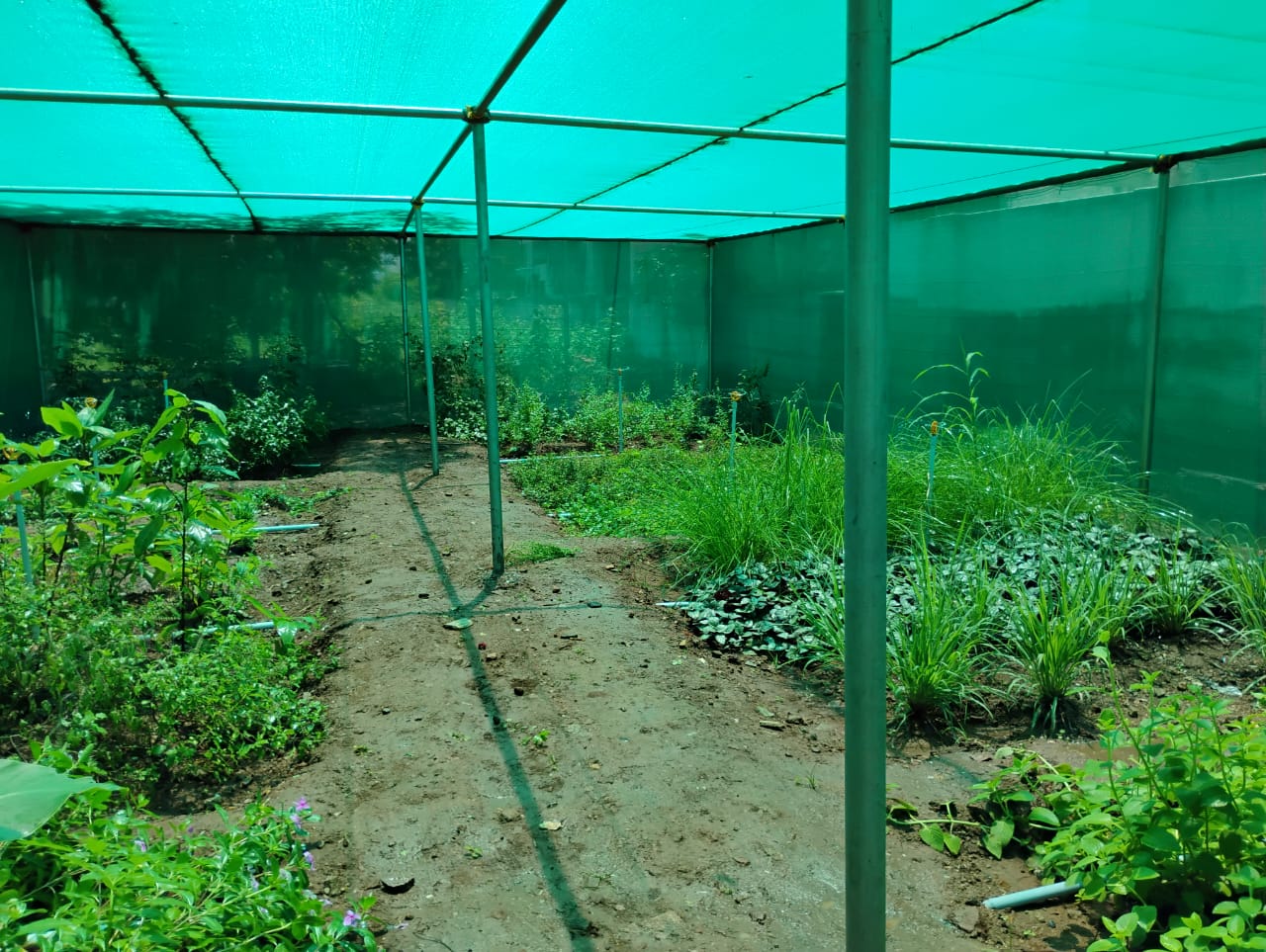
Shade nets covering a garden area (Source: Wikimedia Commons)
In a vine fruits nursery at a county government agricultural training centre, these tools enable staff to propagate healthy seedlings by ensuring precise cutting, appropriate moisture levels, and protection from environmental stressors. Proper equipment use reduces labor intensity and increases nursery throughput.
Create a free account to open more of this chapter.
Free: practical guides, quick cards, workplace scenarios and more.
Create a free accountThis chapter covered the essential aspects of establishing a vine fruits nursery, beginning with the definition of vine fruits and the critical importance of selecting an appropriate nursery site. It highlighted the key factors to consider when siting a nursery, such as soil quality, water availability, and accessibility. The chapter also detailed the tools and equipment necessary for nursery preparation, including the panga, jembe, slashers, and rake, explaining their specific uses. Nursery preparation and the correct methods for planting seeds were discussed to ensure successful germination. Effective nursery management practices were emphasized, focusing on mulching, shading, hardening off, watering, fertilizer application, pest and disease control, and pricking out to maintain healthy seedlings. Practical steps for nursery bed preparation and planting were outlined.
Type: Individual
| Tools & Equipment | Materials |
|---|---|
| Tape measure | Notebook (Foolscap) |
| Soil auger | Permanent marker pen |
| Hand trowel | Hand gloves |
| pH meter | Face mask |
| GPS device or smartphone with GPS | Gumboots |
| S/N | Item | Quantity |
|---|---|---|
| 1 | Tape measure | 1 pc per Candidate |
| 2 | Soil auger | 1 pc per Candidate |
| 3 | Hand trowel | 1 pc per Candidate |
| 4 | pH meter | 1 pc per 3 Candidates |
| 5 | Notebook (Foolscap) | 1 pc per Candidate |
| 6 | Permanent marker pen | 1 pc per Candidate |
| 7 | GPS device or smartphone with GPS | 1 pc per Candidate |
| 8 | Hand gloves | 1 pair per Candidate |
| 9 | Face mask | 1 pc per Candidate |
| 10 | Gumboots | 1 pair per Candidate |
| 11 | Land area measuring approximately 5 m by 6 m | 1 area per Candidate |
| Items to be Evaluated | Marks Available | Marks Obtained | Comments |
|---|---|---|---|
| TASK 1: Site Inspection and Selection | |||
| Wore Personal Protective Equipment (Gumboots, Hand gloves, Face mask) (Award 2 marks for wearing all PPE or 0) | 2 | ||
| Assembled all required tools and materials (Award 2 marks for assembling all or 0) | 2 | ||
| Measured and marked the site dimensions approximately 5 m by 6 m (Award 4 marks for correct measurement and marking or 0) | 4 | ||
| Inspected soil texture and structure using soil auger and hand trowel (Award 4 marks for proper inspection or 0) | 4 | ||
| Tested soil pH and recorded results correctly (Award 4 marks for testing and recording or 0) | 4 | ||
| Assessed environmental factors: sunlight exposure, drainage, and slope (Award 4 marks for thorough assessment or 0) | 4 | ||
| Recorded observations and site suitability reasons clearly in notebook (Award 4 marks for clear and complete recording or 0) | 4 | ||
| Sub-Total | 24 | ||
| PRODUCT CHECKLIST | |||
| Site marked and measured approximately 5 m by 6 m with clear boundary (Award 5 marks for correct measurement and clear marking or 0) | 5 | ||
| Soil characteristics recorded including texture, structure, and pH within suitable range (pH 5.5–7.5) (Award 5 marks for correct and complete soil data or 0) | 5 | ||
| Environmental factors documented with justification for site suitability (Award 6 marks for comprehensive and relevant environmental assessment or 0) | 6 | ||
| Sub-Total | 16 | ||
| GRAND TOTAL | 40 | ||
Type: Individual
| Tools & Equipment | Materials |
|---|---|
| Panga | Certified vine fruit seeds |
| Rake | Well rotten organic manure |
| Tape measure | DAP fertilizer |
| Meter rule | Dry mulching materials |
| Watering can | Clean water |
| Permanent marker pen | Labeling material (plywood) |
| Hand gloves | Nails (2 inch) |
| Face mask | Timber |
| Gumboots | Foolscap |
| Overall or dust coat |
| S/N | Item | Quantity |
|---|---|---|
| 1 | Panga | 1 pc per Candidate |
| 2 | Rake | 1 pc per Candidate |
| 3 | Tape measure | 1 pc per Candidate |
| 4 | Meter rule | 1 pc per Candidate |
| 5 | Watering can | 1 pc per Candidate |
| 6 | Well rotten organic manure | 5 kg per Candidate |
| 7 | Certified vine fruit seeds (passion fruit or similar) | 20 g per Candidate |
| 8 | Dry mulching materials (bale of hay or dry grass) | 4 kg per Candidate |
| 9 | DAP fertilizer | 150 g per Candidate |
| 10 | Small bucket | 2 pcs per Candidate |
| 11 | Clean water | 25 litres per Candidate |
| 12 | Piece of land 3m by 4m | 1 plot per Candidate |
| 13 | Permanent marker pen | 1 pc per Candidate |
| 14 | Labeling material (plywood 30 cm by 30 cm) | 1 pc per Candidate |
| 15 | Foolscap | 1 pc per Candidate |
| 16 | Nails (2 inch) | 4 pcs per Candidate |
| 17 | Timber (2"×1"×7 ft) | 1 pc per Candidate |
| 18 | Face mask | 1 pc per Candidate |
| 19 | Hand gloves | 1 pair per Candidate |
| 20 | Gumboots | 1 pair per Candidate |
| 21 | Overall or dust coat | 1 pc per Candidate |
| Items to be Evaluated | Marks Available | Marks Obtained | Comments |
|---|---|---|---|
| TASK 1: Prepare nursery beds | |||
| Wore Personal Protective Equipment (gumboots, overall, hand gloves, face mask) (Award 2 marks for correct PPE worn or 0) | 2 | ||
| Assembled all required tools and materials for seed planting (Award 2 marks for assembling all or 0) | 2 | ||
| Chose appropriate site and measured seedbed 3m by 4m (Award 4 marks for correct site and measurement or 0) | 4 | ||
| Cleared vegetation cover and prepared land by digging to 15 cm depth and formed sunken beds 1m width and 1.5m length with 60 cm pathways (Award 2 marks each for clearing, digging, and spacing or 0) | 6 | ||
| Mixed 150g DAP fertilizer and 5 kg well rotten organic manure thoroughly into soil and levelled bed (Award 2 marks each for fertilizer application, manure application, mixing thoroughly, and levelling or 0) | 8 | ||
| Made planting holes 1m apart within rows and 1.5m between rows, planted two seeds per hole at 2-3 cm depth, and covered lightly with soil (Award 2 marks each for hole spacing, seed quantity per hole, planting depth, and covering or 0) | 8 | ||
| Applied thin layer of dry mulch over seedbed (Award 2 marks for mulching or 0) | 2 | ||
| Watered the seeds adequately using watering can (Award 2 marks for watering or 0) | 2 | ||
| Labelled the nursery plot with crop name, date planted, and variety using plywood label and permanent marker (Award 1 mark each for crop, date, and variety labelled or 0) | 3 | ||
| Recorded all activities correctly in foolscap (Award 1 mark for correct record or 0) | 1 | ||
| Cleaned all tools and equipment after use (Award 1 mark for cleaning or 0) | 1 | ||
| Sub-Total | 39 | ||
| PRODUCT CHECKLIST | |||
| Seedbed measured accurately at 3m by 4m (Award 3 marks for correct measurement or 0) | 3 | ||
| Sunken beds formed with correct dimensions 1m width by 1.5m length and spaced 60 cm apart (Award 4 marks for correct bed formation and spacing or 0) | 4 | ||
| Seeds planted at correct spacing 1m within rows and 1.5m between rows, two seeds per hole at 2-3 cm depth (Award 5 marks for correct planting spacing, seed number, and depth or 0) | 5 | ||
| Mulch applied evenly and thinly over seedbed (Award 2 marks for proper mulching or 0) | 2 | ||
| Seedbed labelled clearly with crop, date, and variety (Award 3 marks for clear and accurate labelling or 0) | 3 | ||
| Sub-Total | 17 | ||
| GRAND TOTAL | 56 | ||
At the start of this chapter we promised you would be able to:
Tick each one you can genuinely do.
So, are you there yet?
You're competent when you can confidently do 50% or more of what this chapter promised.
Sign in to record how you're doing.