
By the end of this chapter, you will be able to:
Mastering these skills helps you build a strong foundation for growing beautiful, healthy cut flowers that thrive in real farming conditions.
Compiled by: George Oyugi
Establishing a nursery for cut flowers is a foundational step in the commercial production of floriculture crops in Kenya. The nursery acts as the initial growth environment for young plants before transplanting to the main production site. Selecting an appropriate site for the nursery significantly influences plant health, growth rates, and overall yield of cut flowers. For horticulture professionals, understanding the criteria and tools for site selection ensures optimal nursery performance and resource use efficiency.
Nursery site selection is a critical decision-making process that determines the success of cut flower production. The right site provides favourable environmental conditions, accessibility, and protection from pests and diseases, all of which contribute to healthy seedlings and economic viability. In Kenya, where climatic and soil conditions vary greatly, site selection must be tailored to local realities and market demands.
Cut flowers refer to freshly harvested flowers and flower buds intended for decorative use. They are cultivated specifically to be cut at their peak bloom and sold for ornamental purposes, including bouquets, floral arrangements, and ceremonial decorations. Example: a grower who raises rose and carnation seedlings in a nursery does so because the mature plants will later produce stems that are cut, graded and sold.
The nursery is where every cut flower crop begins, so a poor site weakens the crop before it reaches the field or greenhouse. A well-chosen site gives seedlings the soil, water, light and protection they need, and it keeps running costs low. Example: a nursery placed on a waterlogged hollow will lose seedlings to root rot every rainy season, while the same crop on a gently sloping, well-drained plot establishes evenly.
Selecting a nursery site involves evaluating multiple environmental and infrastructural factors. These factors determine the suitability of the location for nurturing high-quality cut flower seedlings under Kenyan conditions. Each factor should be checked on the ground before any land is cleared, for example by digging a test pit, observing where water stands after rain and measuring the distance to the water source.
Efficient nursery establishment and management depend on the correct tools, equipment, and materials. These items enable proper site clearing, planting, maintenance, and protection of cut flower seedlings. The table below lists the main items, and the sections that follow describe the hand tools and propagation materials named in the curriculum.
| Name | Specification | Use |
|---|---|---|
| Panga | Steel blade about 45 to 60 cm long, wooden or plastic handle | To clear bush and cut stakes and pegs |
| Jembe | Flat steel blade fitted to a wooden handle about 1 m long | To dig test pits, loosen soil and open drainage channels |
| Slasher | Long curved or straight steel blade on a long handle | To cut grass and weeds on the selected site |
| Rake | Metal tines on a long wooden handle | To remove debris and stones and level the soil surface |
| Seedling trays | Durable plastic trays with cells | To sow seeds and nurture seedlings |
| Watering cans | Metal or plastic, with fine rose | For gentle watering without soil disruption |
| Shade nets | UV-resistant nets, 30-50% shading | To protect seedlings from excessive sunlight |
| Soil mixers | Hand-operated or motorised mixers | To prepare uniform potting media |
| Pruning shears | Stainless steel blades, ergonomic | For trimming seedlings and removing diseased parts |
The panga is a heavy, single-edged cutting tool used to clear shrubs, tall weeds and small branches from a proposed nursery site. It is also used to cut stakes and pegs for marking out beds and fixing shade net posts. Example: before a flower nursery is laid out, workers use pangas to cut back the bush so the plot can be surveyed. Keep the blade sharp with a file, wipe it clean after use, apply a light film of oil and store it in a dry place with the blade covered.
The jembe is a hand hoe with a broad, flat blade used for digging, loosening and moving soil. At the site selection stage it is used to dig a test pit to check soil depth, texture and drainage, and to open shallow channels that carry away surface water. Example: a pit about 60 cm deep dug with a jembe shows whether a hard pan or standing water lies below the topsoil. Clean soil from the blade after use, check that the handle is firmly fitted and store the jembe off the ground.
A slasher is a long-handled cutting tool with a blade used to cut grass and soft weeds in a sweeping motion. It is used to clear the vegetation around the selected nursery area and to keep the boundaries and paths short and tidy, which removes hiding places for pests such as rodents and insects. Example: slashing the grass along the fence of a rose nursery reduces the cover available to pests. Sharpen the blade regularly, keep the handle tight and store the slasher dry to prevent rust.
The rake has a row of metal tines on a long handle and is used to gather cut vegetation, stones and other debris from a cleared site. It is also used to level and smooth the soil surface so that water does not collect in low spots. Example: after slashing and digging, a rake is drawn across the plot to leave an even surface for marking beds. Remove soil and plant material from the tines after use, straighten bent tines and hang the rake or store it with the tines facing down.
Seeds are one of the main propagation materials for cut flower nurseries and are used for species that grow true from seed, such as zinnia, snapdragon and statice. The quality of seed decides the uniformity and vigour of the seedlings, so seed should come from a reliable supplier, be of known variety, and have a high germination rate. Example: a nursery operator checks the packet for variety, expiry date and germination percentage before buying. Store seed in a cool, dry place in sealed containers so that it keeps its viability until sowing.
Splits are sections of a mature clump that are divided from the mother plant, each carrying roots and at least one shoot or growing point. They are used for species that spread by rhizomes or clumps, such as alstroemeria and gerbera, and they give plants that are identical to the parent. Example: a healthy alstroemeria clump is lifted and divided into portions, each with several shoots and a good root system. Select vigorous, disease-free mother plants, cut with a clean, sterilised knife and plant the splits soon after division so that they do not dry out.
Suckers are shoots that grow from the base or the roots of a mother plant and can be separated to produce new plants. In chrysanthemums, basal shoots arising from the stock plant are removed and used to raise new plants that are true to type. On grafted roses, however, suckers from the rootstock are unwanted and are removed rather than used for propagation. Choose strong suckers that have their own roots or are ready to root, cut them cleanly with a sterilised blade and keep them moist and shaded until they are planted.
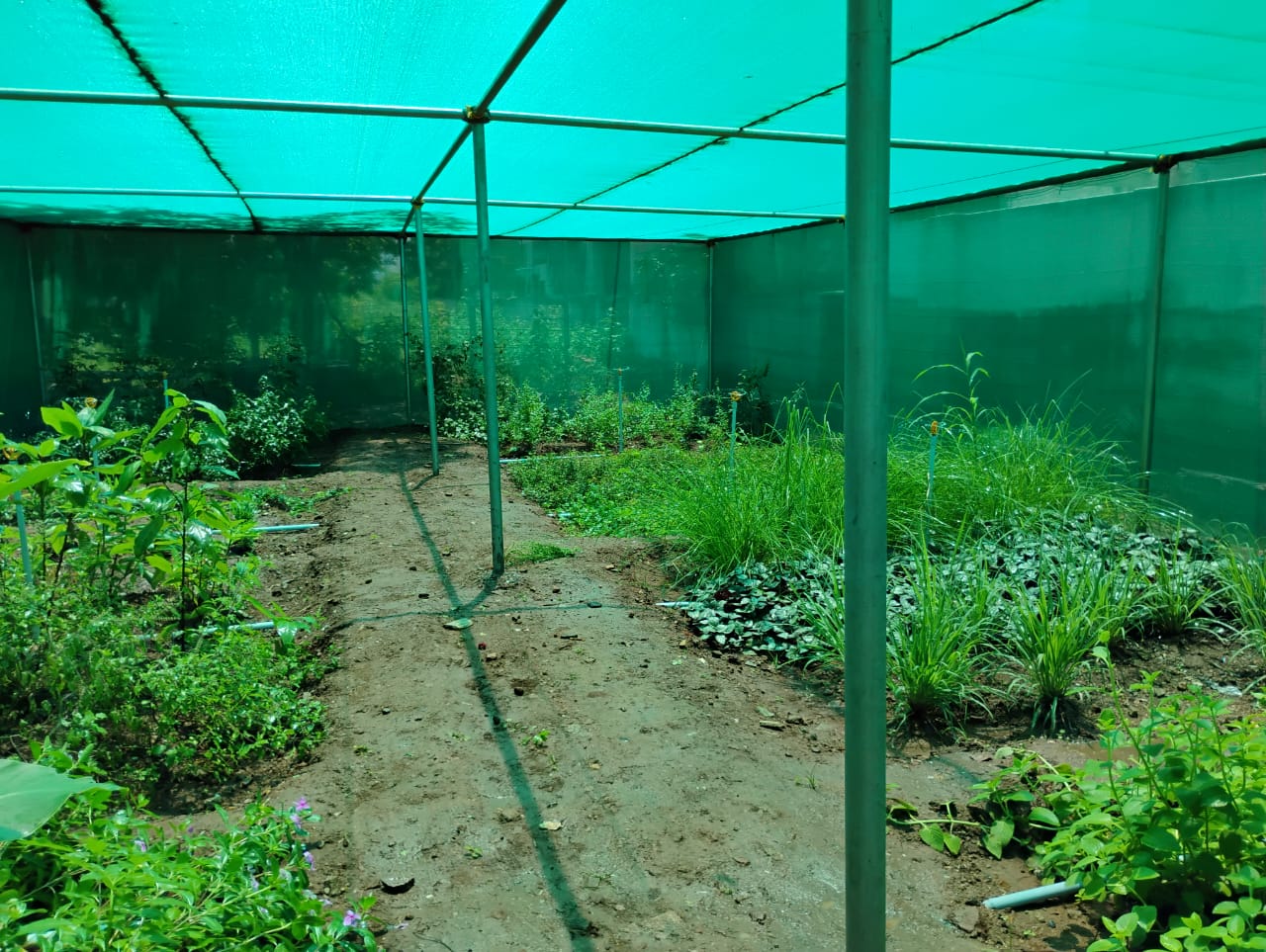
Shade nets covering a garden area (Source: Wikimedia Commons)
Define cut flowers and explain five characteristics that distinguish them from other horticultural crops. (10 marks)
Discuss the importance of asking site selection questions before establishing a cut flower nursery. Provide five key questions that should be considered. (15 marks)
Identify and explain five environmental and five infrastructural factors that influence nursery site selection in Kenya. (20 marks)
List five essential tools or materials used in a cut flower nursery and describe their uses and maintenance requirements. (15 marks)
Create a free account to open more of this chapter.
Free: practical guides, quick cards, workplace scenarios and more.
Create a free accountThis chapter focused on establishing a cut flowers nursery, starting with the critical process of nursery site selection, which involves understanding what cut flowers are and evaluating key factors to choose the best location. Essential tools and materials such as panga, jembe, slashers, rakes, seeds, splits, and suckers were identified for effective nursery setup. The preparation of the nursery followed, emphasizing soil readiness and bed formation. Planting seeds in the nursery was addressed with attention to proper techniques that promote healthy germination. Nursery management practices were explored in detail, covering mulching, shading, hardening off, watering, fertilizer application, pest and disease control, and pricking out to ensure robust seedling development. Practical steps for nursery bed preparation and planting were outlined to guide hands-on activities. Finally, the chapter concluded with nursery bed management practices necessary to maintain optimal growing conditions for cut flowers.
Type: Individual
| Tools & Equipment | Materials |
|---|---|
| Soil auger | Overall/dust coat |
| Tape measure | Safety boots |
| pH meter | Gloves |
| Hand lens (10x magnification) | Face mask |
| Soil testing kit | |
| Notebook and pen | |
| GPS device or smartphone with GPS app |
| S/N | Item | Quantity |
|---|---|---|
| 1 | Soil auger | 1 pc per Candidate |
| 2 | Tape measure | 1 pc per Candidate |
| 3 | pH meter | 1 pc per 2 Candidates |
| 4 | Hand lens (10x magnification) | 1 pc per Candidate |
| 5 | Soil testing kit (nutrient test) | 1 set per Candidate |
| 6 | Notebook and pen | 1 set per Candidate |
| 7 | GPS device or smartphone with GPS app | 1 pc per Candidate |
| 8 | Overall/dust coat | 1 pc per Candidate |
| 9 | Safety boots | 1 pair per Candidate |
| 10 | Gloves | 1 pair per Candidate |
| 11 | Face mask | 1 pc per Candidate |
| Items to be Evaluated | Marks Available | Marks Obtained | Comments |
|---|---|---|---|
| TASK 1: Site Inspection and Selection | |||
| Wore Personal Protective Equipment (Overall, Gloves, Safety boots, Face mask) (Award 1 mark for each PPE correctly worn or 0) | 4 | ||
| Assembled all required tools and materials before inspection (Award 3 marks or zero) | 3 | ||
| Measured and marked the proposed 10m x 10m nursery site using tape measure and pegs (Award 2 marks for measuring length and 2 marks for measuring width correctly) | 4 | ||
| Inspected soil texture using soil auger and hand lens (Award 2 marks for correct soil sampling and 2 marks for correct texture identification) | 4 | ||
| Tested soil pH using pH meter and recorded results (Award 2 marks for correct pH testing procedure and 2 marks for accurate recording) | 4 | ||
| Conducted soil drainage test and assessed slope of the site (Award 2 marks for drainage test and 1 mark for slope assessment) | 3 | ||
| Assessed sunlight exposure at the site during inspection (Award 2 marks for correct assessment of sunlight exposure) | 2 | ||
| Recorded all observations and site suitability factors in the notebook (Award 2 marks for complete and clear records) | 2 | ||
| Selected the most suitable site based on inspection findings and justified selection (Award 4 marks for correct selection and valid justification) | 4 | ||
| Sub-Total | 30 | ||
| PRODUCT CHECKLIST | |||
| Site demarcation of 10m x 10m is accurate within ±0.1m (Award 4 marks for correct site dimensions or zero) | 4 | ||
| Soil pH recorded and falls within acceptable range for cut flowers (5.5 - 6.5) (Award 4 marks for correct pH range indication or zero) | 4 | ||
| Soil texture identified correctly (loamy or sandy loam preferred) (Award 3 marks for correct soil texture identification or zero) | 3 | ||
| Drainage and slope assessment recorded and suitable for nursery establishment (Award 3 marks for correct drainage and slope suitability or zero) | 3 | ||
| Sunlight exposure assessment confirms adequate light for cut flowers (Award 3 marks for correct sunlight exposure assessment or zero) | 3 | ||
| Comprehensive and clear site selection report with justification (Award 3 marks for completeness and clarity or zero) | 3 | ||
| Sub-Total | 20 | ||
| GRAND TOTAL | 50 | ||
Type: Individual
| Tools & Equipment | Materials |
|---|---|
| Panga | Mulching Materials |
| Jembe | Well Decomposed Manure |
| Slasher | Water Source |
| Rake | Rose Flower Cuttings |
| Measuring Tape | |
| Pegs | |
| Watering Can |
| S/N | Item | Quantity |
|---|---|---|
| 1 | Panga | 1 Pc per Candidate |
| 2 | Jembe | 1 Pc per Candidate |
| 3 | Slasher | 1 Pc per Candidate |
| 4 | Rake | 1 Pc per Candidate |
| 5 | Gloves | 1 Pair per Candidate |
| 6 | Overall/Dust coat | 1 Pc per Candidate |
| 7 | Safety Boots | 1 Pair per Candidate |
| 8 | Face Mask | 1 Pc per Candidate |
| 9 | Measuring Tape | 1 Pc per Candidate |
| 10 | Pegs | 4 Pcs per Candidate |
| 11 | Watering Can | 1 Pc per Candidate |
| 12 | Mulching Materials | 5 Kg per Candidate |
| 13 | Well Decomposed Manure | 10 Kg per Candidate |
| 14 | Water Source | 20 Litres per Candidate |
| 15 | 1m x 2m Unploughed Land Plot | 1 Pc per Candidate |
| 16 | Rose Flower Cuttings | 10 Pcs per Candidate |
| Items to be Evaluated | Marks Available | Marks Obtained | Comments |
|---|---|---|---|
| TASK 1: Identification and Use of Nursery Tools | |||
| Wore Personal Protective Equipment (Gloves, Overall, Safety Boots, Face Mask) (Award 1 mark for each PPE correctly worn) | 4 | ||
| Correctly identified the Panga and explained its use in clearing vegetation (Award 3 marks or zero) | 3 | ||
| Correctly identified the Jembe and demonstrated its use in digging and breaking soil (Award 3 marks or zero) | 3 | ||
| Correctly identified the Slasher and demonstrated its use in slashing grasses and weeds (Award 3 marks or zero) | 3 | ||
| Correctly identified the Rake and demonstrated its use in leveling and breaking soil clods (Award 3 marks or zero) | 3 | ||
| Sub-Total | 16 | ||
| TASK 2: Practical Demonstration of Nursery Bed Preparation | |||
| Measured and demarcated a 1m x 2m plot using measuring tape and pegs (Award 2 marks for each activity or zero) | 4 | ||
| Used Panga and Slasher to clear the vegetative cover within the demarcated plot (Award 2 marks for each activity or zero) | 4 | ||
| Used Jembe to dig and break clods to obtain fine tilth (Award 2 marks for each activity or zero) | 4 | ||
| Used Rake to level the prepared nursery bed (Award 3 marks or zero) | 3 | ||
| Incorporated well decomposed manure evenly into the soil (Award 3 marks or zero) | 3 | ||
| Sub-Total | 18 | ||
| PRODUCT CHECKLIST | |||
| Nursery bed correctly demarcated measuring exactly 1m x 2m (Award 3 marks or zero) | 3 | ||
| Nursery bed cleared of all vegetation and free of large clods (Award 3 marks or zero) | 3 | ||
| Soil well tilled and leveled uniformly with rake (Award 3 marks or zero) | 3 | ||
| Manure incorporated evenly throughout the nursery bed (Award 3 marks or zero) | 3 | ||
| Sub-Total | 12 | ||
| GRAND TOTAL | 46 | ||
At the start of this chapter we promised you would be able to:
Tick each one you can genuinely do.
So, are you there yet?
You're competent when you can confidently do 50% or more of what this chapter promised.
Sign in to record how you're doing.