
By the end of this chapter, you will be able to:
These skills will help you grow strong, healthy fruit plants that are the foundation of a successful farming business!
Compiled by: David Sang
Establishing a sub-tropical fruits nursery is a critical step in the horticultural production chain that ensures healthy and vigorous planting materials for commercial orchards. In Kenya, where sub-tropical fruits such as avocados, mangoes, and guavas are increasingly important both for local consumption and export, the nursery serves as the foundation for sustainable fruit production. Proper nursery establishment involves understanding the environmental requirements, selecting quality planting materials, and implementing best practices for pest management and propagation. This chapter focuses on essential preparatory measures, starting with the use of personal protective equipment and defining key terms related to sub-tropical fruits.
Nursery work exposes workers to pesticides, fertilisers, sharp tools, thorns, soil-borne organisms, dust and the sun. Personal protective equipment (PPE) is the clothing and gear worn to create a barrier between the worker and these hazards. In a sub-tropical fruit nursery PPE is needed during pesticide spraying, grafting and pruning, mixing potting media and handling fertilisers. It also protects the planting material, because clean gloves and clothing reduce the spread of diseases between seedlings. The Occupational Safety and Health Act, 2007 requires employers to provide suitable PPE and workers to use it.
Example: a county fruit tree nursery in Embu issues each worker with gloves, overalls and gumboots, and keeps respirators and goggles in a locked store for the person who sprays fungicides.
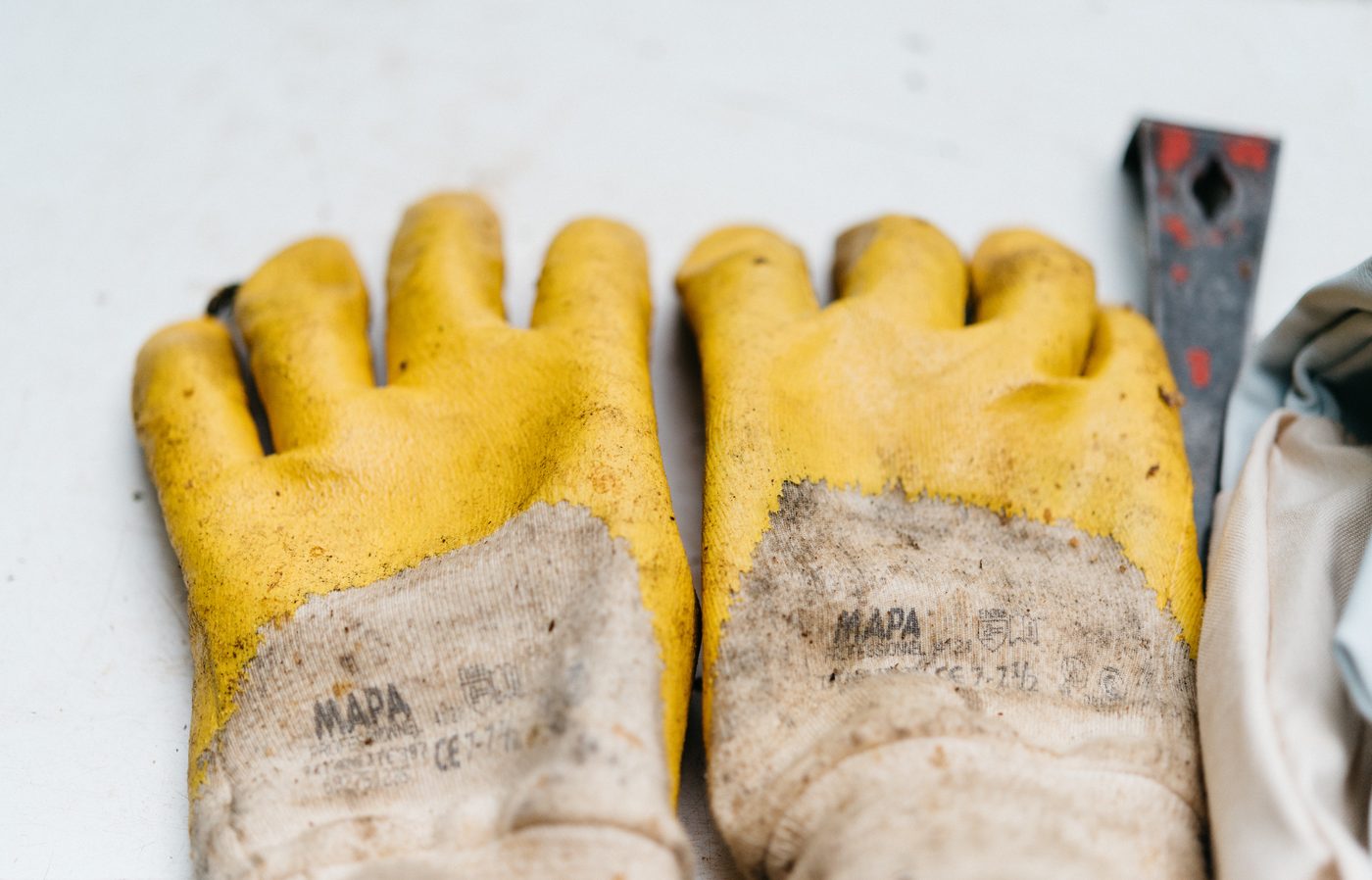
Pair of yellow work gloves used in carpentry (Source: Wikimedia Commons)
The following terms are used throughout this unit. Knowing them helps nursery workers follow instructions and communicate clearly with buyers and extension officers.
Sub-tropical fruits are fruit crops that grow best in warm climates with mild, frost-free cool seasons, between the true tropics and the temperate zones. In Kenya they do well in the medium to high altitude areas (about 1,000 to 2,400 m above sea level), such as the central highlands, the Rift Valley and parts of the western region.
The tree tomato (tamarillo, Solanum betaceum) is a fast-growing, short-lived shrub 2 to 4 m tall, grown in the cool highlands of Kenya. It bears oval red or yellow fruits used fresh and for juice. It is propagated by seed or cuttings and starts fruiting about 18 months after planting.
Strawberry (Fragaria × ananassa) is a low-growing perennial herb grown in the cool highlands for fresh fruit, jam and yoghurt flavouring. It is propagated mainly from runners (daughter plants) raised in the nursery, and needs well-drained, slightly acidic soil, mulching and regular watering.
Guava (Psidium guajava) is a hardy small tree that grows from the coast to the highlands. Its fruits are rich in vitamin C and used fresh and for juice and jam. It can be raised from seed but improved varieties are propagated by grafting, budding, layering or cuttings.
Loquat (Eriobotrya japonica) is an evergreen tree with large leathery leaves that bears clusters of small yellow-orange fruits in the cool season. It grows well in the highlands and is propagated by seed for rootstocks and by grafting for named varieties.
Lime (Citrus aurantiifolia and related species) is a citrus tree producing small, acidic green fruits used for juice, flavouring and drinks. It grows best in warm lowland and mid-altitude areas and is propagated by budding onto rootstocks such as rough lemon in the nursery.
Create a free account to open more of this chapter.
Free: practical guides, quick cards, workplace scenarios and more.
Create a free accountThis chapter introduced the essential personal protective equipment required for safely handling sub-tropical fruit nursery operations and clarified key terms related to sub-tropical fruits. It emphasized the importance of selecting an appropriate nursery site by considering factors such as climate, accessibility, and water availability. The chapter detailed the process of conducting soil analysis at the nursery site to ensure optimal soil conditions for healthy plant growth. It also covered the selection and maintenance of essential nursery tools necessary for efficient operations. Preparation of the nursery site was discussed, including land clearing and bed formation to create a suitable environment for planting. Techniques for raising planting materials in the nursery were explained, highlighting propagation methods and seedling care. Finally, the chapter addressed routine agronomic practices, including watering, fertilization, and the control of pests and diseases to maintain healthy nursery stock.
Type: Individual
| Tools & Equipment | Materials |
|---|---|
| Measuring tape | |
| Soil auger | |
| pH meter | |
| Hand trowel | |
| Soil sample bags | |
| Field notebook | |
| Pen | |
| Protective gloves | |
| Dustcoat overall | |
| Gumboots | |
| GPS device | |
| Soil moisture meter |
| S/N | Item | Quantity |
|---|---|---|
| 1 | Measuring tape | 1 Pc per Candidate |
| 2 | Soil auger | 1 Pc per Candidate |
| 3 | pH meter | 1 Pc per 2 Candidates |
| 4 | Hand trowel | 1 Pc per Candidate |
| 5 | Soil sample bags | 3 Pcs per Candidate |
| 6 | Field notebook | 1 Pc per Candidate |
| 7 | Pen | 1 Pc per Candidate |
| 8 | Protective gloves | 1 Pair per Candidate |
| 9 | Dustcoat overall | 1 Pc per Candidate |
| 10 | Gumboots | 1 Pair per Candidate |
| 11 | GPS device | 1 Pc per 3 Candidates |
| 12 | Soil moisture meter | 1 Pc per 2 Candidates |
| Items to be Evaluated | Marks Available | Marks Obtained | Comments |
|---|---|---|---|
| TASK 1: Site Selection and Demarcation | |||
| Wore Personal Protective Equipment (gloves, gumboots, dustcoat) (Award 1 mark for each PPE worn or zero) | 3 | ||
| Assembled all required tools at the site (Award 2 marks for assembling all tools or zero) | 2 | ||
| Inspected site topography for slope and drainage (Award 4 marks for thorough inspection or zero) | 4 | ||
| Used soil auger to collect 3 soil samples at different points (Award 4 marks for collecting 3 samples correctly or zero) | 4 | ||
| Tested soil pH using pH meter and recorded results (Award 4 marks for correct soil pH test or zero) | 4 | ||
| Measured soil moisture content with moisture meter (Award 3 marks for correct moisture measurement or zero) | 3 | ||
| Used measuring tape and GPS to demarcate a 5m x 5m site (Award 5 marks for accurate demarcation or zero) | 5 | ||
| Recorded all observations and measurements accurately in field notebook (Award 3 marks for complete and neat records or zero) | 3 | ||
| Selected site based on suitability criteria (soil texture, drainage, pH, moisture, accessibility) (Award 6 marks for correct site selection or zero) | 6 | ||
| Sub-Total | 34 | ||
| PRODUCT CHECKLIST | |||
| Site demarcated correctly measuring 5m x 5m (Award 4 marks for correct dimensions or zero) | 4 | ||
| Site located on suitable topography with good drainage (Award 3 marks for appropriate topography or zero) | 3 | ||
| Soil samples collected correctly and represent site variability (Award 3 marks for correct sampling or zero) | 3 | ||
| Accurate soil pH and moisture readings recorded (Award 3 marks for accuracy or zero) | 3 | ||
| Complete and clear site selection report in field notebook (Award 3 marks for completeness or zero) | 3 | ||
| Sub-Total | 16 | ||
| GRAND TOTAL | 50 | ||
Type: Individual
| Tools & Equipment | Materials |
|---|---|
| Soil auger | Distilled water |
| Plastic soil sample bags | Notebook and pen |
| pH test kit | |
| Soil texture test jars | |
| Measuring cylinder | |
| Glass stirring rod | |
| Clean white plastic tray | |
| Gloves | |
| Dustcoat | |
| Marker pen | |
| Hand trowel | |
| Plastic sieve | |
| Hand lens |
| S/N | Item | Quantity |
|---|---|---|
| 1 | Soil auger | 1 Pc per Candidate |
| 2 | Plastic soil sample bags | 5 Pcs per Candidate |
| 3 | pH test kit | 1 Pc per Candidate |
| 4 | Soil texture test jars (1 litre) | 2 Pcs per Candidate |
| 5 | Distilled water | 2 Litres per Candidate |
| 6 | Measuring cylinder (100 ml) | 1 Pc per Candidate |
| 7 | Glass stirring rod | 1 Pc per Candidate |
| 8 | Clean white plastic tray | 1 Pc per Candidate |
| 9 | Gloves | 1 Pair per Candidate |
| 10 | Dustcoat | 1 Pc per Candidate |
| 11 | Marker pen | 1 Pc per Candidate |
| 12 | Notebook and pen | 1 Set per Candidate |
| 13 | Hand trowel | 1 Pc per Candidate |
| 14 | Plastic sieve (5 mm mesh) | 1 Pc per Candidate |
| 15 | Hand lens (10x magnification) | 1 Pc per Candidate |
| Items to be Evaluated | Marks Available | Marks Obtained | Comments |
|---|---|---|---|
| TASK 1: Soil sample collection | |||
| Wore personal protective equipment (gloves, dustcoat) (Award 1 mark each for gloves, dustcoat, proper wearing) | 3 | ||
| Assembled all required tools and materials at sampling site (Award 2 marks for complete assembly or zero) | 2 | ||
| Collected soil samples from at least four different points using soil auger (Award 1 mark per correct sample point up to 4) | 4 | ||
| Placed samples in labeled plastic bags with correct site information (Award 3 marks for correct labeling and handling) | 3 | ||
| Mixed soil samples thoroughly to form a composite sample (Award 3 marks for thorough mixing) | 3 | ||
| Cleaned tools after sample collection (Award 2 marks for proper cleaning) | 2 | ||
| Disposed of waste soil and debris appropriately (Award 3 marks for proper disposal) | 3 | ||
| Sub-Total | 20 | ||
| TASK 2: Soil pH and texture analysis | |||
| Prepared soil suspension using 20g soil and 50 ml distilled water in test jar (Award 3 marks for correct preparation) | 3 | ||
| Used glass stirring rod to stir soil suspension thoroughly (Award 2 marks for proper stirring) | 2 | ||
| Allowed suspension to settle for 30 minutes before testing (Award 2 marks for timing or zero) | 2 | ||
| Conducted pH test using pH test kit correctly and recorded results (Award 5 marks for correct procedure and recording) | 5 | ||
| Performed soil texture test by allowing soil particles to settle and recorded proportions of sand, silt, and clay (Award 5 marks for correct execution and observations) | 5 | ||
| Cleaned all equipment after tests (Award 3 marks for proper cleaning) | 3 | ||
| Recorded all observations accurately in notebook (Award 3 marks for complete and legible recording) | 3 | ||
| Sub-Total | 23 | ||
| PRODUCT CHECKLIST | |||
| Composite soil sample correctly collected and labeled (Award 5 marks for correct sampling and labeling) | 5 | ||
| pH value recorded within standard range for sub-tropical fruit nursery (5.5 to 7.0) (Award 5 marks if pH is within range and recorded correctly) | 5 | ||
| Soil texture classified correctly based on particle proportions (Award 5 marks for accurate texture classification) | 5 | ||
| Complete and accurate soil analysis report in notebook (Award 7 marks for clear, complete, and organized report) | 7 | ||
| Sub-Total | 22 | ||
| GRAND TOTAL | 65 | ||
At the start of this chapter we promised you would be able to:
Tick each one you can genuinely do.
So, are you there yet?
You're competent when you can confidently do 50% or more of what this chapter promised.
Sign in to record how you're doing.