
By the end of this chapter, you will be able to:
Mastering these skills helps you work efficiently and safely, making your farm machinery operation more reliable and effective every day.
Compiled by: Charles Mwangi
Operating hand tools and equipment is a fundamental skill for animal production professionals in Kenya, as these instruments enable efficient management of farm activities, including livestock care, maintenance, and infrastructure development. Mastery of diverse tools ensures safety, productivity, and cost-effectiveness on farms. This chapter provides detailed insight into the classification of hand tools and equipment relevant to animal production, with particular focus on those used in livestock handling, gardening, workshops, carpentry, and masonry.
Hand tools and equipment on animal production farms vary widely depending on their purpose, design, and method of operation. Understanding their classification helps farmworkers select the appropriate tools for specific tasks, thereby enhancing efficiency and safety. Kenyan livestock farms and cooperatives often rely on a mixture of traditional and modern equipment tailored to animal husbandry needs.
Garden tools and equipment are essential for maintaining farm landscapes, growing fodder crops, and managing pastures on animal production farms. Effective use of garden tools supports soil health, weed control, and plant growth, which directly impacts animal nutrition and farm aesthetics.
A panga is a broad, heavy steel blade with a short handle, sharpened on one edge. Its weight lets the operator cut through thick stems and woody growth with one stroke. Example: a farmworker uses a panga to chop mature Napier grass stems for zero-grazing cows and to clear bush along a paddock fence line.
A slasher has a long handle and a straight or slightly curved steel blade. It is swung from side to side close to the ground to cut grass and light bush over a wide area. Example: slashing overgrown grass around a calf pen and along a cattle track so that ticks and snakes have less cover.
A spade has a flat, rectangular steel blade fixed to a wooden handle, often with a D-shaped grip. It is pushed into the soil with the foot to cut, lift and throw loose soil. Example: digging a shallow drainage channel beside a dairy shed or a planting hole for a fodder tree.
A rake has a row of steel tines fixed to a head on a long handle. It levels soil, breaks small clods, and gathers cut grass and debris. Example: levelling a seedbed before sowing Rhodes grass, or gathering dry grass into rows when making hay.
Secateurs are hand-held pruning shears with two blades, operated with one hand. They give a clean cut on small stems, which heals faster than a ragged tear. Example: pruning calliandra or leucaena shrubs grown as protein fodder for dairy goats.
The jembe is the Kiswahili word for the hoe, a flat steel blade set at an angle to a long wooden handle and used for digging and weeding. The fork jembe has strong steel tines in place of a solid blade. The tines break hard clods, turn heaps and loosen soil without cutting through roots. Example: turning a manure and crop-residue compost heap, or breaking up compacted soil in a fodder plot. The image below shows an ordinary solid-blade jembe, for comparison with the tined fork jembe.
A garden hoe (Source: site_preliminary (1))
A dibber is a pointed wooden or metal rod used to make planting holes of a set depth. Holes of equal depth and spacing give even crop growth. Example: making holes in a nursery bed for fodder legume seedlings or in a plot for maize grown as silage.
| Name | Specification | Use |
|---|---|---|
| Panga | Steel blade about 45 cm, single cutting edge, short handle | Cutting stems, clearing bush |
| Slasher | Steel blade about 35 cm, wooden handle about 1 m | Cutting grass and light bush |
| Spade | Steel blade 25 cm wide, handle about 0.9 m | Digging, lifting soil, drainage channels |
| Rake | Steel head 40 cm wide with tines, wooden handle | Levelling seedbeds, gathering cut grass |
| Secateurs | Steel blades, ergonomic grip | Pruning shrubs, harvesting fodder |
| Hoe (jembe) | Steel blade 30 cm wide, wooden handle 1.2 m | Digging, weeding, soil aeration |
| Fork jembe | Four steel tines, 30 cm length | Turning soil, compost aeration |
| Dibber | Pointed wood or steel shaft about 25 cm | Making planting holes |
| Watering can | 10 litres capacity, plastic or metal | Manual irrigation of plants |
Workshop tools and equipment support the repair, fabrication, and maintenance of farm infrastructure and machinery critical to animal production. Having a well-equipped workshop on a livestock farm reduces downtime and ensures continuous operation of essential facilities like water systems and feeding equipment.
A jack plane is a general-purpose bench plane, about 350 mm long, with an adjustable steel blade set in a flat sole. It removes saw marks and flattens rough boards before finer planes finish the surface. Example: planing sawn boards so that they fit flush when a calf feeder is assembled.
A hand saw has a flat toothed steel blade and a handle. The teeth cut on the forward stroke, so the saw is pushed steadily with light pressure. Example: cutting a plank to length when repairing a broken gate or a partition in a goat house.
A hammer has a forged steel head on a handle. The claw hammer, with a flat face for driving nails and a curved claw for pulling them out, is the usual workshop type. Example: nailing boards together to build nest boxes for a poultry house, or pulling out bent nails when dismantling a damaged feed rack.
A hand drill is turned by a crank handle. Gears spin a chuck that holds a twist bit, so it works without electricity. It drills small, clean holes in wood and thin metal. Example: drilling bolt holes in a wooden hay rack on a farm without a power supply at the shed.
A tape measure is a flexible steel blade, marked in millimetres and centimetres, which coils into a case with a locking button. The hooked end slides slightly to allow for its own thickness, so both inside and outside measurements are accurate. Example: measuring a pen wall before cutting timber rails to length.
A file is a hardened steel bar with fine ridges cut across its surface. Flat, half-round, round and triangular files exist, and a rasp has coarse teeth for fast removal on wood. Files cut on the forward stroke only. Example: using a half-round file to remove sharp burrs from a freshly cut edge of a metal water trough.
| Name | Specification | Use |
|---|---|---|
| Jack plane | About 350 mm long, adjustable steel blade | Flattening and smoothing rough timber |
| Hand saw | Flat steel blade 450 to 550 mm, toothed on one edge | Cutting planks and boards to length |
| Claw hammer | 450 g head, wooden handle 30 cm | Driving and pulling nails, dismantling structures |
| Hand drill | Crank-driven, chuck for twist bits up to 8 mm | Drilling holes in wood and thin metal |
| Tape measure | Steel blade 3 to 5 m, locking button | Measuring pen walls and timber lengths |
| Files | Flat, half-round, round and triangular, 200 mm | Smoothing and shaping metal and wood edges |
| Adjustable wrench | Jaw width up to 30 mm, steel body | Tightening or loosening nuts and bolts |
| Electric drill | 500 W power, variable speed | Drilling holes, driving screws |
| Hacksaw | 300 mm blade length, steel frame | Cutting metal pipes and rods |
Carpentry tools are used to measure, mark, cut, shape and join timber. On a livestock farm they are used to build and repair pens, feeders, troughs, gates and poultry houses. Each tool has a defined job, and good joints depend on choosing the right one.
Carpentry hand saws are chosen by the direction of the cut. A rip saw has coarse teeth for cutting along the grain, a crosscut saw has finer teeth for cutting across the grain, and a tenon saw has a stiffened back for neat joint cuts. Example: crosscutting timber rails to length for the partition of a goat house.
The carpenter's hammer is a claw hammer with a head of about 450 g. A wooden mallet is used with chisels because a steel head would damage the chisel handle. Example: nailing floor slats in a goat shed so that the slats stay firm under the animals' weight.
A chisel is a steel blade with a bevelled cutting edge in a wooden or plastic handle. It is driven by hand pressure or by a mallet to pare wood and cut joints. Example: cutting a housing joint in a post so that the rail of a feeding trough sits in it firmly.
A try square has a steel blade fixed at exactly 90° to a thicker stock. The stock is pressed against the edge of the timber, and the blade guides a pencil or marking knife line. Example: marking a cutting line square across a plank for a calf-pen gate, and checking that the cut ends are square.
A coping saw has a thin, narrow blade held under tension in a U-shaped frame. The blade can be turned to follow curves and removed to start cuts from inside a drilled hole. Example: cutting the curved neck opening in the headboard of a calf feeder.
| Name | Specification | Use |
|---|---|---|
| Rip, crosscut and tenon saws | Steel blades, coarse to fine teeth, tenon saw with stiffened back | Cutting along the grain, across the grain and joints |
| Wooden mallet | Hardwood head, wooden handle | Striking chisels without damaging their handles |
| Chisel | Steel blade 25 mm wide, wooden handle | Shaping wood and cutting joints |
| Try square | Steel blade 300 mm, stock fixed at 90° | Marking and checking right angles |
| Coping saw | Thin replaceable blade, frame depth about 150 mm | Cutting curves and shapes |
| Clamps | Adjustable jaw width 100 mm | Securing wood pieces during gluing or nailing |
Masonry tools support construction and maintenance of concrete and stone structures on livestock farms, such as water troughs, feed storage bins, and boundary walls. Proper use of masonry equipment enhances structural integrity and durability.
A plumb line is a cord with a pointed weight, called a plumb bob, hanging from one end. Gravity pulls the cord into a true vertical, so it shows whether a wall or corner is upright. Example: hanging a plumb line beside the corner of a new dairy shed wall to check that each course of blocks has been laid vertically.
A brick hammer has a steel head with a flat square face at one end and a chisel end at the other, on a wooden handle. The flat face taps bricks into position and breaks stones, while the chisel end splits and trims bricks to size. Example: trimming a brick to fit the end of a course when building a feed store wall.
A cold chisel is a hardened steel bar with a flat cutting edge, struck on its head with a hammer to cut brick, concrete, stone and metal. A bolster is a wide-bladed type used to cut bricks and blocks cleanly. Wear goggles, because chips fly from the struck surface. Example: chipping out a recess in a concrete floor to fit a drainage pipe in a milking shed.
A mason's level, also called a spirit level, is a straight bar with sealed vials of liquid holding an air bubble. When the bubble rests between the marks, the surface is horizontal or vertical, depending on the vial used. It ensures horizontal and vertical alignment during construction. Example: placing the level on the rim of a concrete water trough to check that it stands level so that water does not spill to one side.
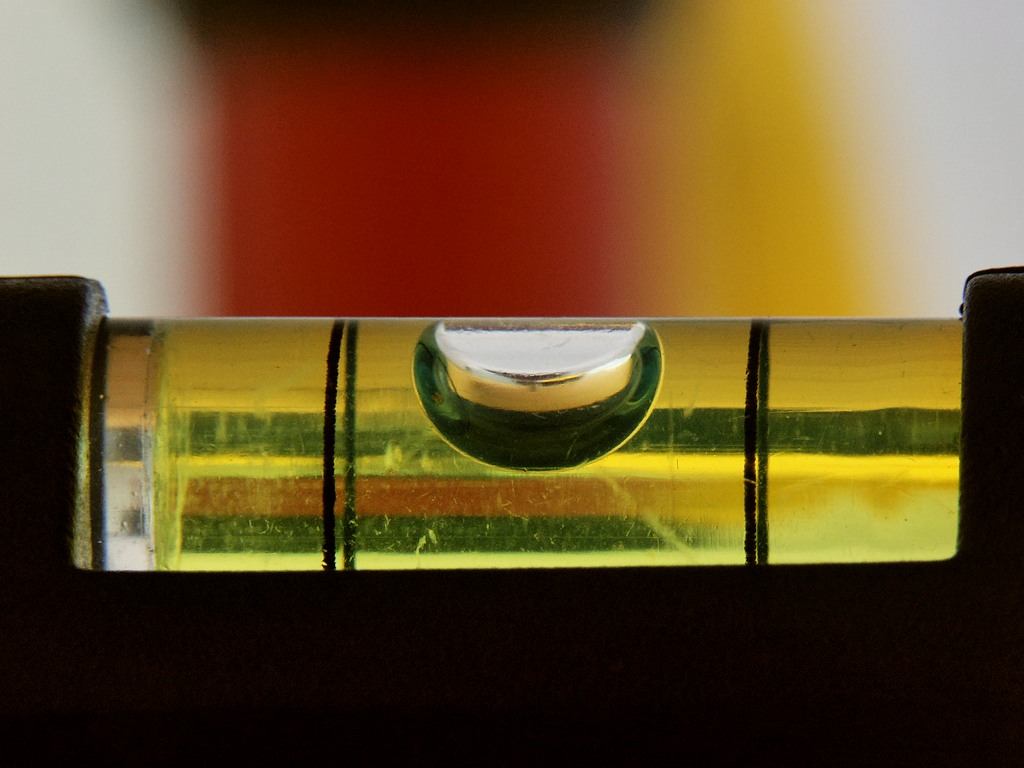
Close-up of a spirit level bubble vial (Source: Wikipedia (Spirit level))
A wheelbarrow is a single-wheeled steel tray with two handles and legs. The load sits over the wheel, so one person can move heavy material with little effort. Example: carrying sand, cement and stones to the site of a new trough, and later wheeling mixed concrete to the forms.
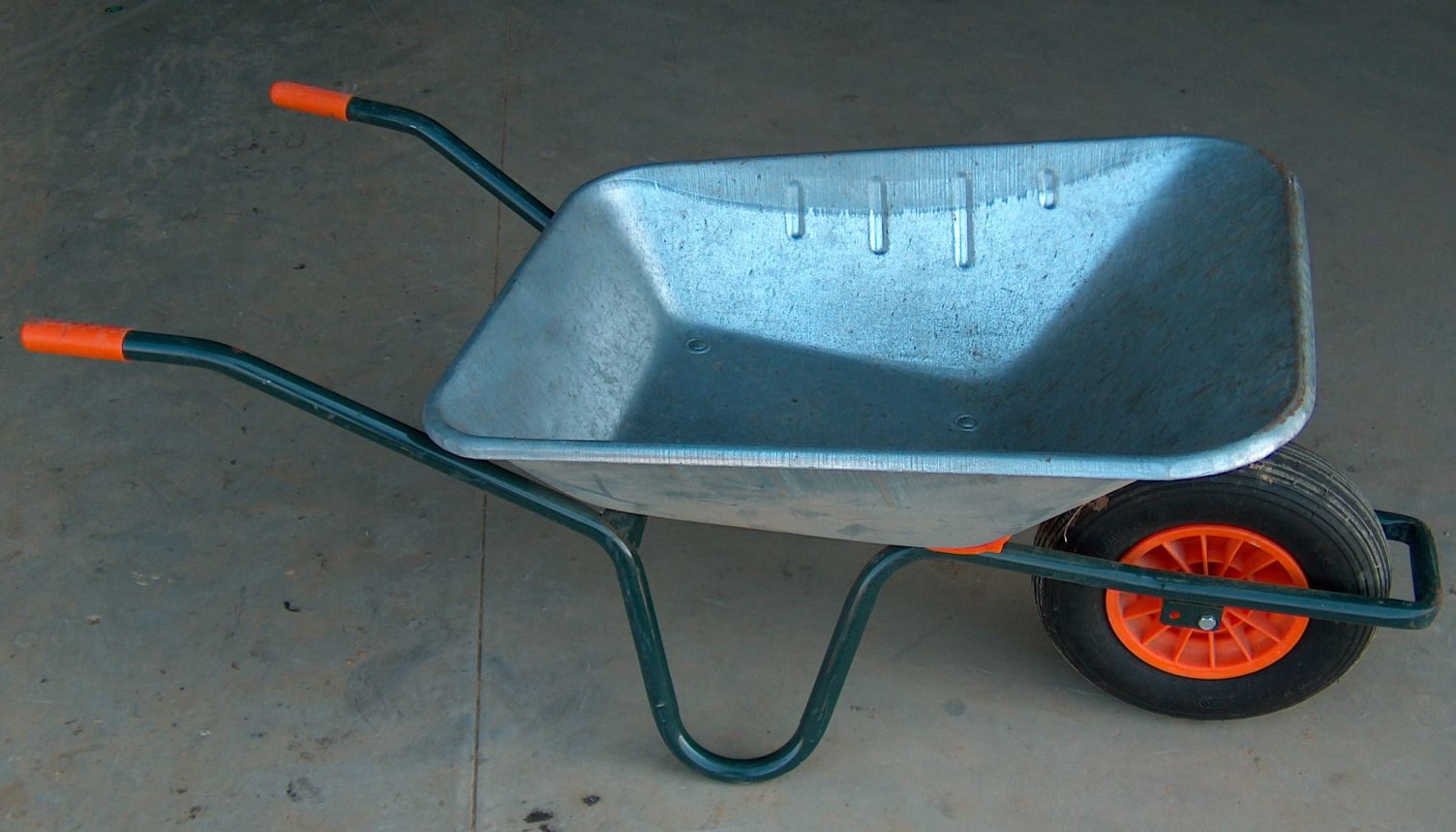
A single metal wheelbarrow with one wheel (Source: Wikimedia Commons)
A masonry saw is a hand saw with a stiff steel blade and hardened teeth that can cut soft blocks, bricks and soft stone. It makes straight cuts without the shattering that a hammer may cause. Wear a dust mask and goggles when cutting. Example: cutting a block to fit the corner of a calf pen wall.
A masonry tape measure is a long steel tape in a robust case, used to measure distances and materials and to set out layouts. Longer tapes are needed for foundations and wall lengths than for timber work. Example: measuring the length and width of a trench for the foundation of a poultry house before digging.
| Name | Specification | Use |
|---|---|---|
| Plumb line | Cord 5 to 10 m with a pointed bob of 200 to 500 g | Checking that walls and corners are vertical |
| Brick hammer | 0.5 to 1.2 kg head, flat and chisel ends | Breaking and trimming bricks and stones |
| Cold chisel | Hardened steel, 150 to 250 mm long, flat cutting edge | Cutting brick, concrete and stone |
| Mason's level | 60 cm length, bubble vial | Checking level and plumb |
| Wheelbarrow | Capacity about 100 kg, single wheel, steel tray | Transporting sand, cement, stones and concrete |
| Masonry saw | Steel blade about 500 mm with hardened teeth | Cutting soft blocks and bricks |
| Masonry tape measure | 5 m length, steel tape | Measuring distances and materials |
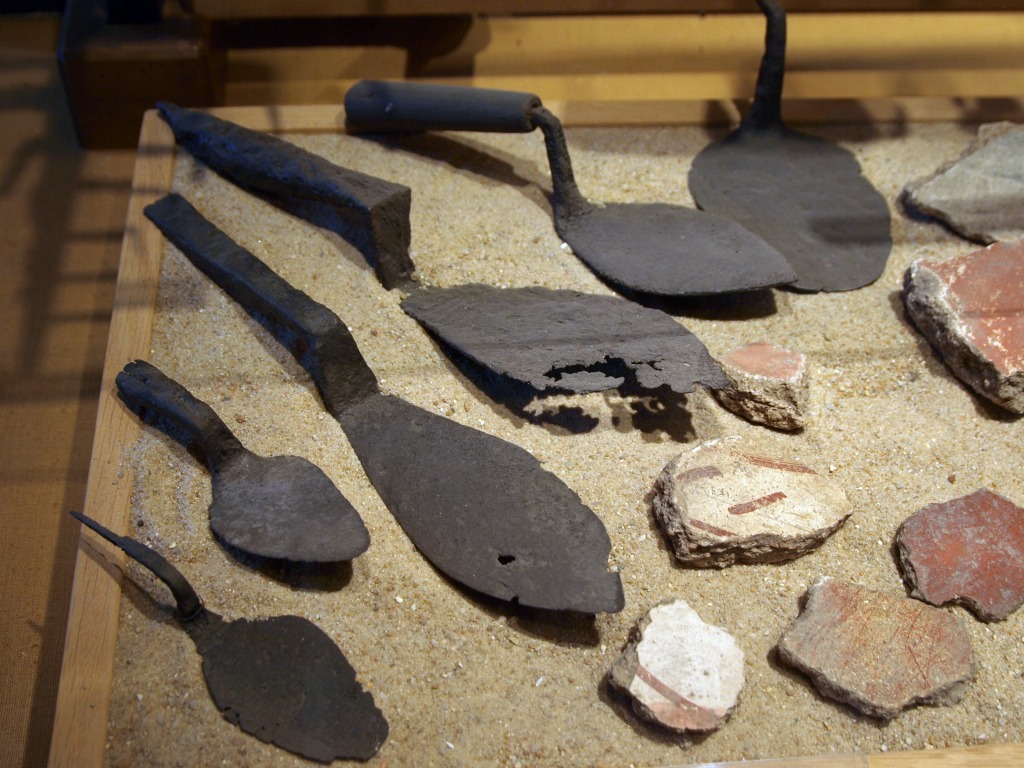
Several trowels displayed on sand (Source: Wikimedia Commons)
Livestock handling tools and equipment are designed to facilitate the safe, humane, and effective management of animals during routine husbandry, treatment, and transportation. These tools are crucial in minimising stress and injury to both animals and handlers, which is particularly important in dairy farms, beef ranches, and poultry operations across Kenya.
A burdizzo is a bloodless castrator: a strong steel clamp with two crushing jaws on long handles. It is closed over the spermatic cord through the skin, crushing the cord so that the testicle shrinks without an open wound. Each cord is crushed separately, leaving a gap in the middle of the scrotum so that the skin keeps its blood supply. Example: castrating young bull calves held in a crush, with the jaws cleaned and disinfected before use.
A tooth clipper is a small side-cutting tool used to clip the needle teeth of newborn piglets. These sharp teeth can injure the sow's udder and the faces of litter mates. The piglet is held firmly and only the tips are cut straight across, avoiding the gum and tongue. Example: clipping piglets in a farrowing pen within their first days of life, with the clipper disinfected between litters.
An ear notcher is a pair of pliers with a V-shaped or U-shaped blade that cuts small notches in the edge of the ear. The position of each notch stands for a number, so the pattern identifies the animal permanently without a tag. Example: notching piglets in a pig unit to record the litter and individual number, or marking sheep in a flock. Disinfect the blade between animals to limit the spread of infection.
A hoof trimmer is a pair of strong shears or nippers that cut away overgrown hoof wall. A curved hoof knife then pares the sole smooth. Overgrown hooves change how the animal stands and cause lameness, so trimming is done while the animal is held firmly. Example: trimming the hooves of goats in a zero-grazing unit, or of a cow restrained in a crush.
An elastrator is a pliers-like applicator that stretches a small rubber ring open so it can be slipped over the scrotum or the tail. The ring cuts off the blood supply and the part withers and drops off. It is used for castration and docking of lambs and kids, and is applied in the first week of life when the parts are small. Example: ringing male lambs in a sheep flock, making sure both testicles lie below the ring.
Shears for sheep shearing are hand blade shears: two steel blades joined by a spring bow, which are squeezed together to cut the fleece close to the skin. The blades must be kept sharp, and the sheep should be dry and held firmly on a clean floor to avoid cuts. Example: shearing a flock of sheep before the rains, then dressing any nicks with antiseptic.
A halter is a head collar made of strong fibres such as rope, nylon or leather, with a headpiece, a noseband and a lead rope. It gives control of the animal's head for leading, tying and examination. Example: haltering a calf to lead it to the crush for vaccination, or tying a goat during hoof trimming.
| Name | Specification | Use |
|---|---|---|
| Burdizzo | Steel clamp with two crushing jaws, long handles | Bloodless castration of calves, lambs and kids |
| Tooth clipper | Small side-cutting steel clipper | Clipping needle teeth of piglets |
| Ear notcher | Pliers with V-shaped or U-shaped blade | Permanent identification notches in pig and sheep ears |
| Hoof trimmer | Steel shears or nippers, with a curved hoof knife | Trimming overgrown hooves |
| Elastrator | Pliers-type applicator with rubber rings | Castration and docking of lambs and kids in the first week |
| Shears | Two steel blades joined by a spring bow | Shearing sheep |
| Halter | Rope, nylon or leather with noseband and headpiece | Leading and restraining goats, calves and cattle |
| Herding stick | Light wood or plastic pole, 1.2 to 1.5 m | Guiding cattle and sheep |
| Cattle crush | Steel pipe frame with head catch and side gates | Confining cattle for vaccination, treatment and hoof care |
| Squeeze chute | Steel frame with movable side panels | Holding animals by gentle lateral pressure |
| Sorting pen | Gated panels of steel pipe or timber rails about 1.5 m high | Separating animals by age, sex or health status |
Create a free account to open more of this chapter.
Free: practical guides, quick cards, workplace scenarios and more.
Create a free accountThis chapter examined various categories of hand tools and equipment essential for effective farm machinery operation, starting with livestock handling tools and equipment that facilitate safe and efficient management of animals. It then provided a detailed classification of hand tools and equipment, including garden tools used for soil preparation and planting, workshop tools that assist in maintenance and repairs, carpentry tools necessary for woodwork, and masonry tools for construction tasks. The chapter emphasized the proper utilization of these hand tools and equipment to maximize their efficiency and ensure user safety. Furthermore, it covered the servicing of hand tools and equipment, highlighting routine maintenance practices that prolong their lifespan and maintain functionality. Lastly, the chapter discussed appropriate storage methods to protect tools from damage and loss, ensuring they remain in good working condition for future use. Together, these topics provide a comprehensive understanding of the handling, maintenance, and management of hand tools and equipment in farm machinery operations.
At the start of this chapter we promised you would be able to:
Tick each one you can genuinely do.
So, are you there yet?
You're competent when you can confidently do 50% or more of what this chapter promised.
Sign in to record how you're doing.