
By the end of this chapter, you will be able to:
Mastering these skills will help you build strong, safe poultry structures that support healthy and productive poultry farming.
Compiled by: Wesley Kimutai
Constructing poultry structures is a fundamental skill for animal production professionals in Kenya, ensuring the health, productivity, and welfare of poultry flocks. Properly designed and constructed poultry houses protect birds from predators, adverse weather, and disease, while providing an environment conducive to growth and egg production. This chapter explores the essential tools, equipment, and materials required for poultry structure construction, focusing on practical application in diverse Kenyan farming settings.
Building a poultry house needs tools to measure, cut and fasten, equipment for the heavier work, and materials that are strong, easy to clean and keep out predators, rodents and wild birds. A poultry house must stay dry, ventilated and secure, and its floor and walls must be washable so that disease does not build up. Kenyan poultry farmers, from small rural units to commercial producers near towns, choose tools, equipment and materials to suit the design, climate and size of the house, and balance cost against durability.
Tools are the hand and power tools that a builder uses on the frame, roof, wire work and fittings of a poultry house. The right tool saves time and material, gives a neat result and lowers the risk of injury. The table lists the main tools used in poultry house construction.
| Name | Specification | Use |
|---|---|---|
| Hammer | Claw hammer with a steel head | Driving and pulling nails in the frame and roof battens |
| Screw drivers | Flat-head and cross-head, several sizes | Fixing hinges, latches and hardware cloth fittings |
| Tape measures | Steel tape and a long tape for setting out | Measuring house length, width, door and window sizes |
| Level | Spirit level with a bubble vial | Checking that foundations and floors are level and posts are upright |
| Saw | Hand saw, hacksaw and circular saw | Cutting timber, pipes and metal |
| Drill | Electric or cordless drill with wood and masonry bits | Making holes and driving screws and bolts |
| Pliers | Combination and fencing pliers | Bending, cutting and fastening wire mesh |
| Chisel | Wood chisel and cold chisel | Shaping joints and chipping masonry |
A hammer drives nails into timber and pulls out bent ones. The claw hammer is used for framing and finishing, and a heavier hammer drives stakes and pegs for setting out. Poultry house walls are often covered with timber battens and roofs are nailed, so a farmer needs a hammer that is comfortable to swing and has a firm head.

A claw hammer for carpentry use (Source: Wikimedia Commons)
Screw drivers turn screws into timber and metal. A flat-head driver fits slotted screws, and a cross-head driver fits cross-slot screws. The tip must fit the screw head, or the head wears and the screw cannot be removed later. Screws are used on doors, feeder and nest box fittings and wherever parts may need to be taken apart.
A tape measure gives the lengths of timber, the spacing of posts and the size of openings. A steel tape is used for timber work, and a long tape is used to set out the house on the ground so that the corners are right-angled and the house has the planned floor area. Accuracy matters, because the number of birds in the house depends on the floor area.
A level shows whether a surface is horizontal or a post is upright. The spirit level has a bubble that rests between two lines when the surface is level. It is used on foundations, wall courses and nest and perch supports. A house floor is made level across the width so that litter spreads evenly, and any slope required for washing is set deliberately.

Close-up of a spirit level bubble vial (Source: Wikipedia (Spirit level))
A saw cuts timber to size. A sharp blade makes clean cuts and wastes less material. A hand saw suits small jobs and places without power, a hacksaw cuts metal pipes and rods, and a circular saw cuts timber and boards quickly and accurately on larger projects.
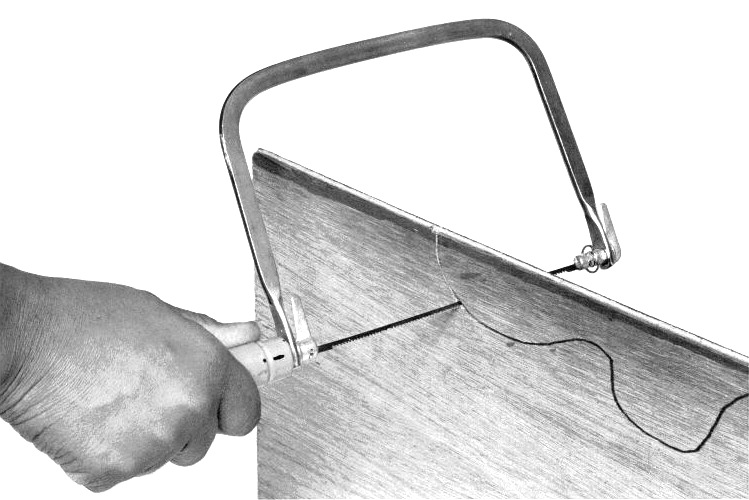
Hand saw used for cutting wood (Source: Wikimedia Commons)
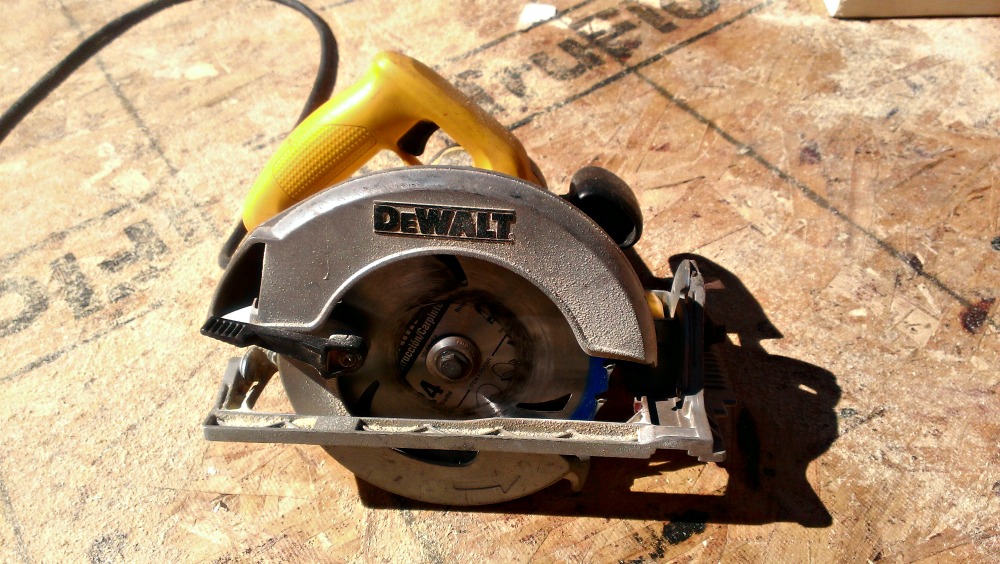
DeWalt brand circular saw on wooden surface (Source: Wikimedia Commons)
A drill makes holes for screws and bolts and, with a driver bit, drives screws. An electric drill gives steady power for rafters and metal sheets, and a cordless drill can be used where there is no mains supply. Masonry bits are used on concrete and blocks. A small pilot hole prevents timber from splitting.
Pliers grip, bend and cut. Poultry houses use wire mesh on windows, ventilation openings and runs to keep out predators, so pliers are used to cut and twist wire and fasten it to the frame. Combination pliers do most of the gripping and cutting, and fencing pliers pull and fasten strands of wire.
A chisel cuts away material to make a joint or an opening. A wood chisel is used with a mallet to make tight-fitting joints in timber frames and doorposts, and a cold chisel is struck with a hammer to chip masonry and cut metal. The cutting edge is kept sharp, and eye protection is worn.
An angle grinder cuts or grinds metal such as reinforcing bars and mesh. A nail gun speeds up nailing. These power tools save time on medium to large houses, but they need electricity or fuel, which is a limit in off-grid areas.
Safety tools protect workers from injury during construction. Their regular use reduces accidents and health risks.

Pair of yellow work gloves used in carpentry (Source: Wikimedia Commons)

Clear safety goggles for eye protection (Source: Wikimedia Commons)

Person wearing a dust mask (Source: Wikimedia Commons)

Green ear protection earmuffs (Source: Wikimedia Commons)
Construction equipment is the larger machinery that does work too heavy or too big for hand tools. Small poultry houses are built mostly by hand, with a few light machines. Large commercial houses may use hired machines for a short period. The choice depends on the size of the project, the power available and the budget.
A bulldozer clears bush, levels the site and shapes the building platform before building starts. A poultry house needs a level, well-drained site that is slightly higher than its surroundings so that rain water runs away from the walls. It may be hired by the day, because it is needed only at the start.
A crane lifts and places loads that workers cannot raise safely by hand, such as steel roof trusses on a long commercial house, large water tanks on a stand or prefabricated panels. A trained operator is needed, the load must stay within the rated capacity of the crane, and people stay clear of the load.
A dump truck carries bulk materials to the site and tips them where needed: sand, ballast, quarry dust, hardcore for the floor base and soil removed from the foundation trenches. Tipping saves much hand loading. The truck is driven onto firm, level ground before tipping.
A concrete mixer blends cement, sand, ballast and water into a uniform mix for foundations, floors and walls. A portable drum mixer is practical on many farms, and a uniform mix gives a stronger floor that is easier to clean and disinfect.
A forklift lifts and moves palletised loads, such as stacked blocks, bags of cement and bundles of roofing sheets, from the delivery point to where they are used. It saves labour and reduces back injuries on large sites. It is driven only by a trained operator, with loads carried low and on firm ground.
Wheelbarrows carry mixed concrete, sand and blocks across the site where machines cannot go. Trolleys and carts move bulky materials and increase productivity.
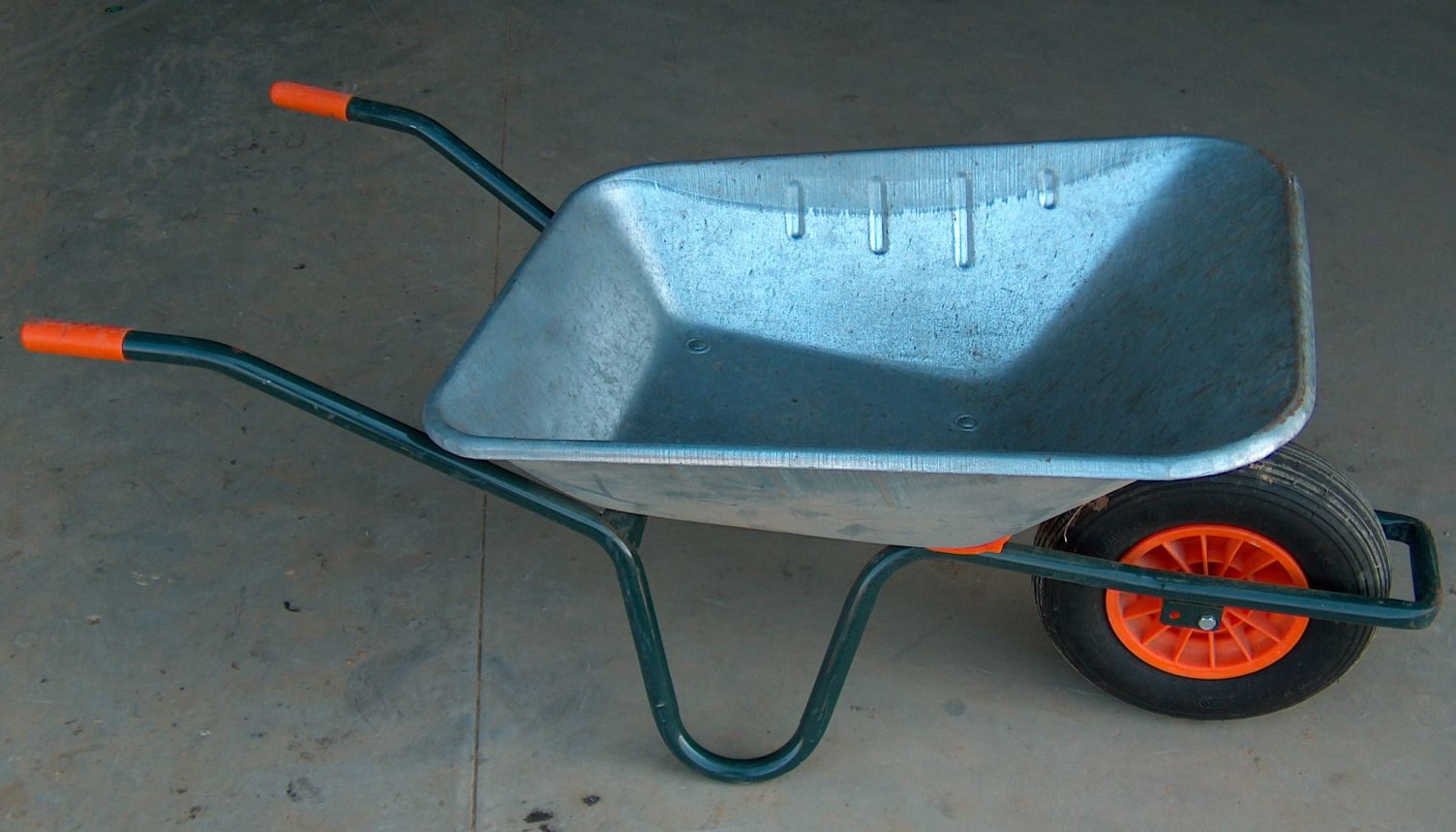
A single metal wheelbarrow with one wheel (Source: Wikimedia Commons)
A hoist or pulley system lifts heavy materials, such as timber beams, roofing sheets and cement bags, to roof height. It reduces the risk of injury and makes work safer.
Materials affect the strength, hygiene, ventilation and temperature of the poultry house. A farmer chooses materials that are available, affordable and suited to the climate, and that can be cleaned easily.
Cement is the binder that holds sand and ballast together as concrete, mortar and plaster. It is sold in 50 kg bags, stored on a raised platform in a dry room and used in the order delivered. Hard lumps show that damp has reached the cement, and such cement is not used for floors or foundations.
Sand is the fine aggregate that fills the spaces between stones in concrete and makes mortar workable. Clean, sharp sand free from clay, silt and plant matter gives strong concrete and a smooth floor surface. Sand is stored on a clean surface so that it does not pick up soil.
Blocks are used for the walls of semi-permanent and permanent poultry houses. Concrete or stone blocks give walls that resist weather and rats and that can be washed and disinfected. A low block wall often supports a wire-mesh upper wall that lets air in. Blocks are laid in cement mortar with joints staggered from course to course.

stacked concrete blocks with hollow centres (Source: Wikimedia Commons)
Quarry dust is the fine crushed rock left from stone quarrying. It is used as a partial substitute for river sand in blocks and screeds, and as a compacted layer under floors. A compacted layer of clean quarry dust under the concrete floor gives an even, well-drained base. It must be clean and free of soil.
Floors affect hygiene, comfort of the birds and ease of cleaning.
Temperature and air movement are critical to bird health.
Create a free account to open more of this chapter.
Free: practical guides, quick cards, workplace scenarios and more.
Create a free accountThis chapter explored the essential tools, equipment, and materials required for constructing poultry structures, emphasizing their specific roles in the building process. It outlined the critical considerations for selecting a suitable site to ensure optimal poultry health and productivity. The design of poultry structures was discussed with attention to functionality, ventilation, and space requirements. Detailed steps for the actual construction process were provided, highlighting best practices to achieve durable and efficient housing. The chapter also covered the importance of maintaining accurate records related to construction and ongoing maintenance to support management decisions. Effective waste management techniques were examined to promote hygiene and environmental sustainability. Furthermore, the chapter described various poultry house equipment and materials necessary for daily operations and their proper installation procedures. Finally, the role of poultry production manuals was highlighted as valuable resources for guiding consistent and informed poultry management practices.
At the start of this chapter we promised you would be able to:
Tick each one you can genuinely do.
So, are you there yet?
You're competent when you can confidently do 50% or more of what this chapter promised.
Sign in to record how you're doing.