Agripreneurs in Kenya rely heavily on efficient use of hand tools and equipment to enhance productivity and reduce labor intensity on their farms. Mastery of these implements is essential across diverse farming activities such as soil preparation, crop management, livestock care, and harvesting. This chapter equips agripreneurs with comprehensive knowledge of various hand tools and equipment, their proper operation, and maintenance, ensuring sustainable and profitable agribusiness operations.
1.1 Hand tools and equipment
Hand tools and equipment are fundamental to small and medium-scale farming operations common in Kenya. These implements vary widely depending on the specific agricultural task, from garden maintenance to livestock management. Effective use of hand tools enhances operational efficiency, reduces dependence on costly machinery, and supports environmentally friendly farming practices.
1.1.1 Garden Tools and Equipment
Garden tools and equipment are integral to managing small-scale crop production, home gardens, and nursery beds. Their correct use ensures healthy plant growth, soil aeration, and effective weed control, which are vital for high yields in vegetable farming practiced in urban and peri-urban areas.
Types of Garden Tools
Garden tools encompass a variety of implements designed for specific tasks:
- Hand trowel: Used for digging small holes, transplanting seedlings, and mixing soil. It allows precise soil manipulation in confined spaces, ideal for vegetable beds.
- Pruning shears: Designed to trim and shape plants, remove dead or diseased branches, and encourage healthy growth, especially in horticultural crops.
- Garden fork: Facilitates loosening, lifting, and turning over soil. It improves aeration and prepares the ground for planting.
- Hoe: Used for weeding, soil shaping, and creating furrows for planting. It is essential in controlling weeds without chemicals.
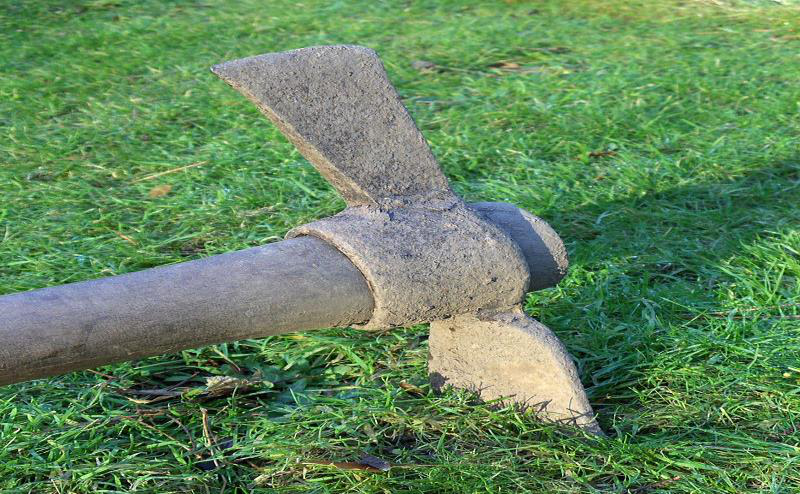
A traditional hoe (Source: site_preliminary (1))
- Watering can: Provides controlled water application to plants, ensuring moisture reaches roots efficiently.
Selection Criteria for Garden Tools
Choosing the right garden tools involves considering:
- Material quality: Tools made of stainless steel or carbon steel resist rust and provide durability under Kenyan climatic conditions.
- Ergonomics: Handles designed for comfort reduce fatigue during prolonged use, essential for smallholder farmers managing large plots.
- Size and weight: Lightweight tools enable ease of handling, particularly for women and youth involved in agripreneurship.
- Maintenance requirements: Tools that are easy to clean and sharpen reduce downtime and increase longevity.
- Cost-effectiveness: Affordability balanced with durability ensures accessibility for small-scale farmers.
Maintenance of Garden Tools
Proper maintenance prolongs tool life and ensures safety:
- Cleaning after use: Removing soil and plant residues prevents rust and pest infestation.
- Sharpening blades: Regular sharpening of shears and hoes maintains cutting efficiency.
- Oiling metal parts: Applying lubricants prevents corrosion, especially in humid conditions.
- Checking handles: Tightening loose handles prevents accidents during operation.
- Proper storage: Keeping tools in dry, sheltered places reduces wear and damage.
Safety Considerations in Garden Tool Use
Safety is paramount to prevent injuries:
- Wearing gloves: Protects hands from cuts, blisters, and infections.
- Using tools appropriately: Avoiding misuse, such as using pruning shears for cutting thick branches, reduces breakage.
- Maintaining sharp tools: Dull blades require excessive force and increase injury risk.
- Safe carrying: Holding tools with blades facing downwards prevents accidental cuts.
- Regular inspections: Identifying damaged tools early prevents accidents.
1.1.2 Livestock Handling Tools and Equipment
Livestock management in Kenya involves tools that facilitate safe handling, feeding, and health care of animals. Effective use of these tools improves animal welfare, productivity, and reduces risks to handlers.
Common Livestock Handling Tools
These tools assist in routine livestock activities:
- Halter and lead ropes: Used for guiding and restraining animals during movement or treatment.
- Cattle prod: A device that applies mild electric stimuli to encourage movement when necessary.
- Syringes and needles: Essential for administering vaccines and medicines.
- Ear taggers: Used for identification and record-keeping of livestock.
- Milking machines: Facilitate efficient and hygienic milk extraction from dairy animals.
Importance of Proper Tool Use in Livestock Handling
Correct application of tools ensures:
- Animal safety: Minimizing stress and injury during handling improves productivity.
- Handler safety: Reduces risks of kicks or bites during close contact.
- Disease control: Proper use of syringes and disinfected tools prevents disease transmission.
- Record accuracy: Identification tools like ear tags enable effective tracking of health and breeding.
- Efficiency: Mechanical milking reduces labor and improves milk quality.
Maintenance of Livestock Tools
Maintaining livestock tools is crucial for hygiene and durability:
- Sterilizing syringes: Prevents cross-contamination between animals.
- Cleaning milking equipment: Ensures milk safety and prolongs machine life.
- Inspecting halters and ropes: Prevents breakage that could lead to animal escape.
- Sharpening ear taggers: Facilitates clean tagging and reduces animal discomfort.
- Battery checks: Ensures electric devices like cattle prods function reliably.
Safety Measures in Livestock Tool Operation
Safety protocols protect both animals and handlers:
- Calm approach: Reducing animal stress lowers chances of injury.
- Proper restraint: Using halters and chutes correctly prevents animal thrashing.
- Personal protective equipment: Wearing boots and gloves reduces exposure to zoonotic diseases.
- Tool inspection: Ensuring devices are in good condition avoids malfunctions.
- Training: Handlers should be skilled in tool use to minimize accidents.
1.1.3 Cultivation Tools and Equipment
Cultivation tools prepare the soil for planting by loosening, aerating, and mixing it to create optimal conditions for seed germination. In Kenya, smallholder farmers depend heavily on manual cultivation tools due to limited access to mechanized equipment.
Types of Cultivation Tools
Common implements include:
- Hand hoe: Versatile for breaking soil crusts, weeding, and furrowing.
- Mattock: Combines an axe and adze for digging hard or compacted soils.
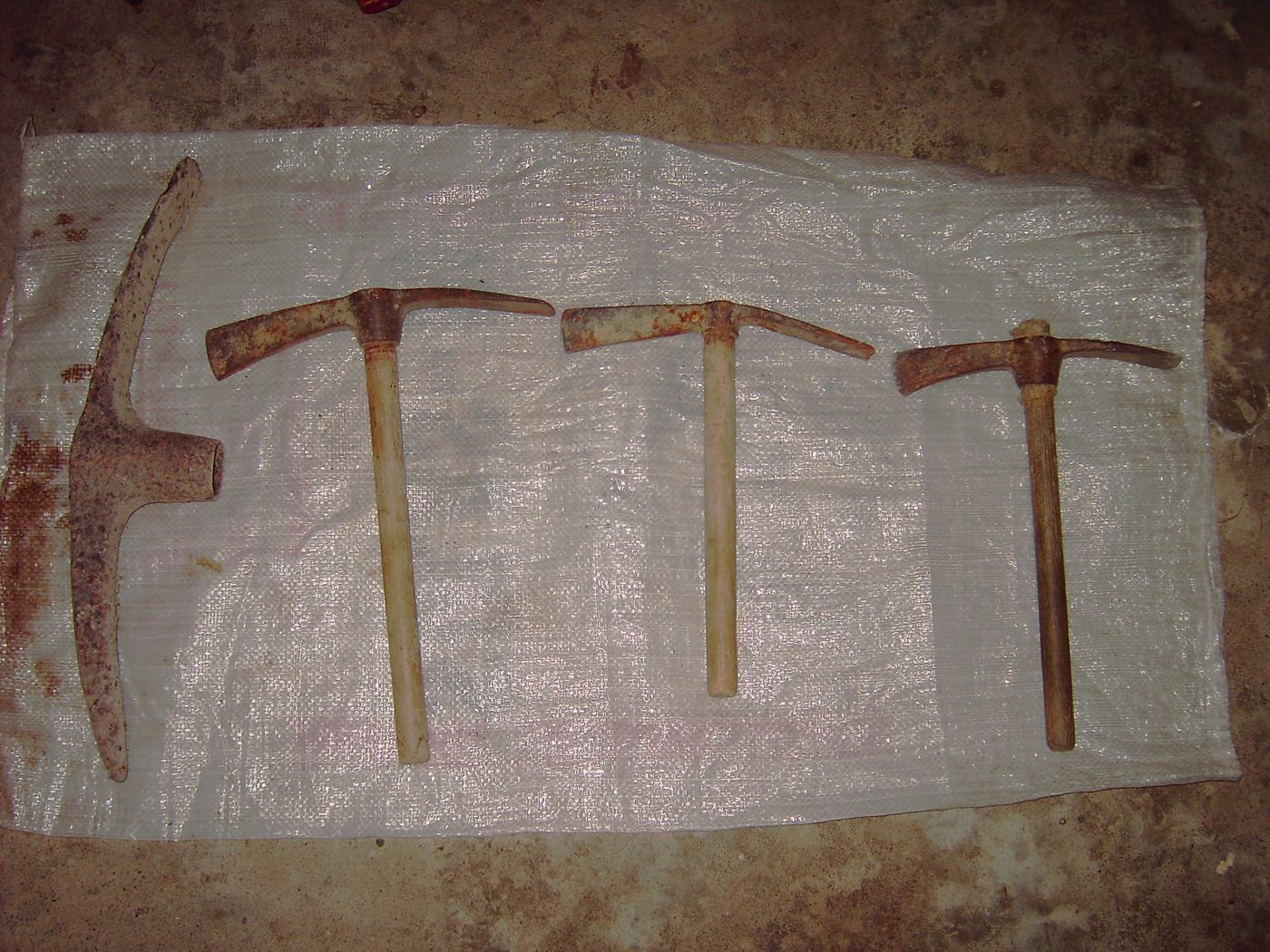
Four mattocks laid on a white sheet (Source: Wikimedia Commons)
-
Rake: Used to level soil surfaces and remove debris.
-
Spade: For digging, edging, and turning over soil.
- Pickaxe: Effective for breaking rocky or compacted ground.
Selection and Suitability of Cultivation Tools
Choosing cultivation tools depends on:
- Soil type: Heavy clay soils require robust tools like mattocks, while sandy soils can be managed with hoes.
- Plot size: Larger areas may necessitate mechanized tools or animal-drawn implements.
- Crop type: Root crops require deeper cultivation tools to avoid damage.
- Labor availability: Manual tools suit small family farms with limited labor.
- Cost and availability: Tools should be affordable and locally accessible.
Maintenance Practices for Cultivation Tools
Maintaining tools ensures efficiency:
- Sharpening edges: Regularly sharpen hoes and mattocks for easier soil penetration.
- Cleaning after use: Removes soil residues that cause rust.
- Oiling metal parts: Prevents corrosion in humid environments.
- Handle care: Replacing cracked wooden handles avoids accidents.
- Proper storage: Dry, ventilated areas prevent tool deterioration.
Impact of Proper Cultivation Tool Use on Crop Production
Correct tool use influences yields through:
- Improved soil aeration: Enhances root respiration and nutrient uptake.
- Weed control: Timely cultivation reduces competition for resources.
- Seedbed preparation: Creates favorable conditions for uniform germination.
- Moisture retention: Proper soil structure conserves water essential during dry spells.
- Reduced labor intensity: Efficient tools save time and energy, enabling timely farm operations.
1.1.4 Harvesting Tools and Equipment
Harvesting in Kenyan agripreneurship involves tools that facilitate the efficient and safe collection of mature crops. The choice of tools affects post-harvest quality and reduces losses.
Types of Harvesting Tools
Harvesting implements vary by crop:
| Name |
Specification |
Use |
| Sickles |
Curved blade, wooden handle |
Cutting cereals, grasses, and fodder |
| Harvest knives |
Straight or hooked blade |
Harvesting fruits and vegetables |
| Shears |
Sharp blades, spring-loaded |
Pruning and harvesting horticultural crops |
| Harvest baskets |
Woven, lightweight |
Collecting and transporting produce |
| Grain threshers |
Manual or motorized |
Separating grain from stalks |
Proper Use of Harvesting Tools
Effective harvesting depends on:
- Tool sharpness: Ensures clean cuts, reducing crop damage.
- Timing: Harvesting at peak maturity maximizes quality and shelf-life.
- Handling care: Minimizing bruising during collection preserves market value.
- Appropriate tool selection: Using the right tool per crop type prevents wastage.
- Post-harvest cleaning: Removing dirt and debris maintains produce hygiene.
Maintenance of Harvesting Equipment
Maintaining tools preserves functionality:
- Blade sharpening: Regularly sharpen sickles and knives for efficient cutting.
- Cleaning: Remove plant sap and dirt to prevent rust.
- Lubrication: Oil moving parts of shears to ensure smooth operation.
- Repair: Fix broken handles and replace worn blades promptly.
- Storage: Keep tools dry and away from corrosive substances.
Ergonomic and Safety Considerations in Harvesting
Preventing injuries and fatigue involves:
- Using protective gloves: Shields hands from cuts and blisters.
- Correct posture: Reduces strain during repetitive cutting tasks.
- Taking breaks: Prevents exhaustion during prolonged harvesting.
- Inspecting tools: Ensures no defects that could cause accidents.
- Training: Educates workers on safe and efficient harvesting techniques.
1.1.5 Crop Protection Tools and Equipment
Protecting crops from pests, diseases, and weeds is critical to ensuring yield and quality. Agripreneurs use various tools to apply control measures safely and effectively.
Types of Crop Protection Tools
Common implements include:
- Knapsack sprayers: Portable devices for applying pesticides and fungicides.
- Hand dusters: Used to distribute powdered insecticides over crops.
- Weeding knives: Precision tools for manual weed removal.
- Protective clothing: Includes gloves, masks, and boots to safeguard applicators.
- Traps and barriers: Physical devices to deter pests.
Proper Operation of Crop Protection Tools
Correct operation ensures efficacy and safety:
- Calibration: Adjusting sprayers for accurate dosage prevents over- or under-application.
- Mixing chemicals: Following manufacturer instructions avoids harmful concentrations.
- Application timing: Targeting vulnerable pest stages maximizes control.
- Avoiding drift: Applying pesticides during calm weather reduces contamination.
- Cleaning equipment: Prevents cross-contamination and prolongs tool life.
Maintenance and Care of Crop Protection Equipment
Sustaining tool performance involves:
- Regular inspection: Checking for leaks or blockages in sprayers.
- Cleaning after use: Washing equipment to remove chemical residues.
- Storage: Keeping tools in ventilated, shaded areas to prevent deterioration.
- Repair: Promptly fixing damaged parts to maintain safety.
- Protective gear upkeep: Washing and replacing worn clothing reduces exposure risks.
Safety Protocols in Crop Protection
Ensuring health during chemical application requires:
- Using personal protective equipment (PPE): Prevents skin and respiratory exposure.
- Following label instructions: Adheres to recommended doses and safety intervals.
- Avoiding eating or smoking: Reduces ingestion of harmful substances during application.
- Proper disposal: Safe handling of chemical containers prevents environmental contamination.
- Training applicators: Enhances understanding of risks and emergency measures.
Practice Questions
-
Explain the key factors to consider when selecting garden tools for a small-scale vegetable farm in Kenya. (10 marks)
-
Describe the maintenance procedures necessary for livestock handling equipment to ensure animal and handler safety. (10 marks)
-
Compare and contrast three cultivation tools used in Kenyan farms, highlighting their suitability for different soil types. (15 marks)
-
Outline the steps involved in the safe operation of harvesting knives for fruit picking. (10 marks)
-
Discuss the safety precautions that must be observed when using knapsack sprayers for crop protection. (10 marks)
The rest of this chapter
🔒Create a free account to open more of this chapter.
Free: practical guides, quick cards, workplace scenarios and more.
Create a free account 🔒1.2 Utilizing of hand tools and equipment
In the context of agripreneurship in Kenya, effective utilization of hand tools and equipment is essential for optimizing farm productivity and reducing labor costs. Hand tools remain vital for small-scale farmers and agribusinesses, especially in regions wher…
🔒1.3 Servicing of hand tools and equipment
Servicing hand tools and equipment is a critical aspect of farm machinery operation that directly affects durability, safety, and performance. Kenyan agripreneurs who regularly maintain their tools reduce downtime, avoid costly repairs, and improve overall far…
🔒1.4 Storage of the Hand Tools and Equipment
Proper storage of hand tools and equipment is essential for agripreneurs operating on farms across Kenya. Effective storage not only extends the lifespan of tools but also ensures safety, accessibility, and efficiency during farm operations. In the context of…
Chapter Summary
This chapter explores the various types of hand tools and equipment essential for effective farm machinery operation, including those used in gardening, livestock handling, cultivation, harvesting, and crop protection. It provides a detailed overview of garden tools such as hoes and spades, livestock handling equipment like ropes and gates, cultivation implements including hand tillers, harvesting tools such as sickles, and crop protection equipment like sprayers. The chapter also covers the proper utilization of these tools, emphasizing correct handling techniques to enhance efficiency and safety during farm activities. Servicing of hand tools is addressed, highlighting routine maintenance practices that extend tool lifespan and ensure optimal performance. Additionally, the chapter discusses appropriate storage methods to protect tools from damage and deterioration. Overall, the content equips learners with comprehensive knowledge to operate, maintain, and store hand tools and equipment effectively in various farming contexts.
Self-Assessment
🔒 PDFDownload this self-assessment, with answers
A. Written Assessment
- Identify five common garden hand tools used in small-scale horticulture and describe their primary uses. (5 marks)
- What are the essential safety precautions to observe when using livestock handling equipment? (3 marks)
🔒20 more in this section.
Chapter Examination Questions
🔒 PDFDownload these examination questions, with worked answers
SECTION A (40 Marks) - Answer ALL Questions
- Identify five common garden tools used in agripreneurship in Kenya and explain one key use for each. (4 marks)
- Describe the importance of livestock handling tools in ensuring animal welfare on a dairy farm. (4 marks)
🔒18 more in this section.
Chapter Practical Activities
Practical 1: Identify and select appropriate hand and garden tools for specific farm tasks
Agripreneurship · Level 6
Farm Machinery Operation
PRACTICAL ASSESSMENT
TIME: 3 HOURS
⬇ PDFCandidate Instructions (Candidate Tool)
Type: Individual
INSTRUCTIONS TO CANDIDATE:
1. You are required to perform the following task:
i. Identify and select appropriate hand and garden tools including hand fork, hoe, pruning shears, spade, rake, and watering can for specified farm tasks as per the provided instruction sheet.
2. You have been provided with the following resources for the practical task:
| Tools & Equipment | Materials |
|---|
| Hand fork | |
| Hoe (flat and pointed) | |
| Pruning shears | |
| Spade | |
| Rake | |
| Watering can (10 liters) | |
| Gloves (latex or leather) | |
| Dust coat | |
| Identification tag | |
⬇ PDFResources Required (Cutting List)
| S/N | Item | Quantity |
|---|
| 1 | Hand fork | 1 Pc per Candidate |
| 2 | Hoe (flat and pointed) | 1 Pc per Candidate |
| 3 | Pruning shears | 1 Pc per Candidate |
| 4 | Spade | 1 Pc per Candidate |
| 5 | Rake | 1 Pc per Candidate |
| 6 | Watering can (10 liters) | 1 Pc per Candidate |
| 7 | Gloves (latex or leather) | 1 Pair per Candidate |
| 8 | Dust coat | 1 Pc per Candidate |
| 9 | Identification tag | 1 Pc per Candidate |
| 10 | Task instruction sheet | 1 Pc per Candidate |
⬇ PDFAssessor Guide
| Items to be Evaluated | Marks Available | Marks Obtained | Comments |
|---|
| TASK 1: Identification and Selection of Hand and Garden Tools |
Wore appropriate clothing: dust coat, gloves, and identification tag
(Award 2 marks or zero) | 2 | | |
Correctly identified hand fork and selected it for soil loosening tasks
(Award 3 marks or zero) | 3 | | |
Correctly identified flat and pointed hoes and selected appropriately for weeding and soil breaking
(Award 3 marks or zero) | 3 | | |
Correctly identified pruning shears and selected them for trimming shrubs and plants
(Award 3 marks or zero) | 3 | | |
Correctly identified spade and selected for digging and transplanting
(Award 3 marks or zero) | 3 | | |
Correctly identified rake and selected for clearing debris and leveling soil
(Award 3 marks or zero) | 3 | | |
Correctly identified watering can and selected for irrigation tasks
(Award 3 marks or zero) | 3 | | |
| Sub-Total | 20 | | |
| PRODUCT CHECKLIST |
Selected tools are appropriate and match the specified farm tasks as per instruction sheet
(Award 10 marks or zero) | 10 | | |
| Sub-Total | 10 | | |
| GRAND TOTAL | 30 | | |
ASSESSMENT OUTCOME: ☐ Competent ☐ Not Yet Competent (competent if at least 50%)
Practical 2: Operate Livestock Handling Tools to Manage Animals Safely
Agripreneurship · Level 6
Farm Machinery Operation
PRACTICAL ASSESSMENT
TIME: 4 HOURS
⬇ PDFCandidate Instructions (Candidate Tool)
Type: Individual
INSTRUCTIONS TO CANDIDATE:
1. You are required to perform the following task:
i. Operate a livestock handling chute 2500mm long x 1000mm wide x 1500mm high to safely restrain and move cattle using ropes and cattle prods as per standard safety procedures.
2. You have been provided with the following resources for the practical task:
| Tools & Equipment | Materials |
|---|
| Cattle handling chute | Ropes |
| Livestock sorting panel | |
| Cattle prods | |
| Ropes | |
| Protective gloves | |
| Protective boots | |
| Dust coat | |
⬇ PDFResources Required (Cutting List)
| S/N | Item | Quantity |
|---|
| 1 | Cattle handling chute (metal frame 2.5m long x 1m wide x 1.5m high) | 1 pc per 5 Candidates |
| 2 | Livestock sorting panel (metal panels 1.2m x 2m) | 2 pcs per Candidate |
| 3 | Cattle prods (battery operated, 12V) | 1 pc per Candidate |
| 4 | Ropes (12mm diameter, 4m length) | 2 pcs per Candidate |
| 5 | Protective gloves (leather) | 1 pair per Candidate |
| 6 | Protective boots (rubber) | 1 pair per Candidate |
| 7 | Dust coat | 1 per Candidate |
| 8 | First aid kit | 1 shared per 10 Candidates |
⬇ PDFAssessor Guide
| Items to be Evaluated | Marks Available | Marks Obtained | Comments |
|---|
| TASK 1: Safe Operation of Livestock Handling Tools |
Wore appropriate PPE: gloves, boots, dust coat
(Award 1 mark for each or zero) | 3 | | |
Inspected livestock handling chute and panels for safety and functionality
(Award 3 marks if all safety checks done correctly or zero) | 3 | | |
Correctly set up the handling chute and sorting panels to create a safe flow path for cattle
(Award 1 mark for each correctly positioned panel or chute component x4) | 4 | | |
Demonstrated correct use of ropes to guide and restrain cattle without causing harm
(Award 2 marks for safe tying technique, 2 marks for correct handling) | 4 | | |
Used cattle prod appropriately and safely to encourage cattle movement without abuse
(Award 3 marks for correct and humane use or zero) | 3 | | |
Managed cattle movement through the chute calmly and efficiently avoiding stress or injury
(Award 3 marks for smooth handling or zero) | 3 | | |
Cleaned and stored tools and equipment properly after use
(Award 2 marks for proper cleaning and storage or zero) | 2 | | |
| Sub-Total | 22 | | |
| PRODUCT CHECKLIST |
Livestock handling chute and panels correctly assembled and stable
(Award 4 marks if chute is stable, panels aligned and secure or zero) | 4 | | |
Ropes tied correctly with no damage or unsafe knots
(Award 3 marks for correct knots and rope condition or zero) | 3 | | |
Safe and humane handling of cattle demonstrated (no visible injury or stress)
(Award 5 marks for evidence of safe animal handling or zero) | 5 | | |
| Sub-Total | 12 | | |
| GRAND TOTAL | 34 | | |
ASSESSMENT OUTCOME: ☐ Competent ☐ Not Yet Competent (competent if at least 50%)
🔒Use of cultivation tools to prepare land for plantingPractical 3
🔒Harvest sweet potatoes using hand toolsPractical 4
🔒Apply crop protection tools to control pests on maize cropPractical 5
🔒Efficient Utilization of Hand Tools and Equipment for Farm TasksPractical 6
🔒Service and Maintain a 1500mm Long Hand HoePractical 7
🔒Proper Cleaning and Storage of Hand Tools and EquipmentPractical 8
🔒Combine garden and cultivation tools to prepare a 3m x 3m garden plotPractical 9
🔒Integrate harvesting and crop protection tools in crop managementPractical 10
