
By the end of this chapter, you will be able to:
These skills are important because they help you create the best environment for healthy crops and sustainable farming success.
Compiled by: Harun Kimani
Preparing a crop seedbed is a fundamental step in annual crop production that significantly influences crop establishment, growth, and yield. In Kenya's diverse agricultural zones, proper seedbed preparation ensures that seeds have optimal conditions for germination and early development. This chapter focuses on the initial phase of seedbed preparation, specifically land clearing, which is crucial for creating a suitable environment for crop cultivation. Understanding the methods and importance of land clearing equips agriculture and extension professionals to advise farmers effectively and improve crop productivity.
Land clearing involves removing unwanted vegetation, debris, and obstacles from a field to prepare it for planting. In Kenya, where farms vary from smallholder plots to large-scale commercial farms, land clearing must be adapted to the local context, soil type, and crop requirements. Proper land clearing facilitates subsequent soil preparation activities such as tilling and leveling, which are essential for a uniform seedbed.
Land clearing can be achieved through various methods, each suited to particular contexts and resources available to farmers:
Using hand tools such as machetes, pangas, slashers, hoes, fork jembes and axes to remove shrubs, grasses and small trees. It is labour-intensive but suitable for small plots typical of many Kenyan smallholder farms, such as those around Kericho or Meru. It needs no fuel or capital, works on steep or stony ground where machines cannot go, and lets the worker leave useful trees standing. Its limits are speed and the labour it demands.
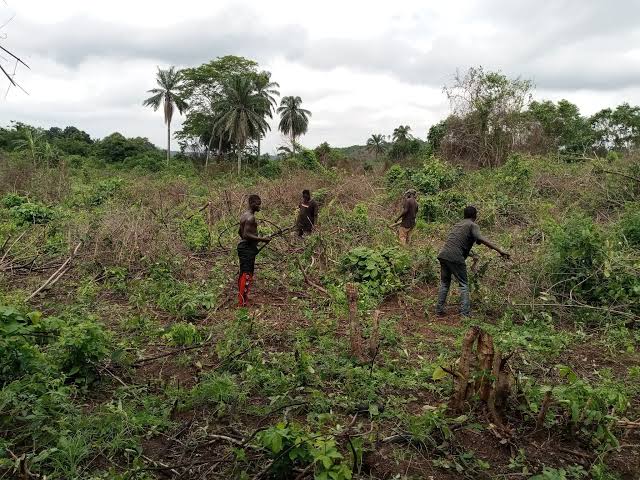
Figure: Manual land clearing using a panga and slasher.
Using machinery such as tractors fitted with brush cutters or bulldozers to remove larger vegetation and debris quickly. This method is common in commercial farms and large-scale irrigation schemes in places like Bomet or Kitale. It clears large areas in a day and handles trees and stumps that hand tools cannot, but it costs a great deal to hire, needs a trained operator, and the weight of the machine compacts the soil and can strip topsoil if used carelessly.
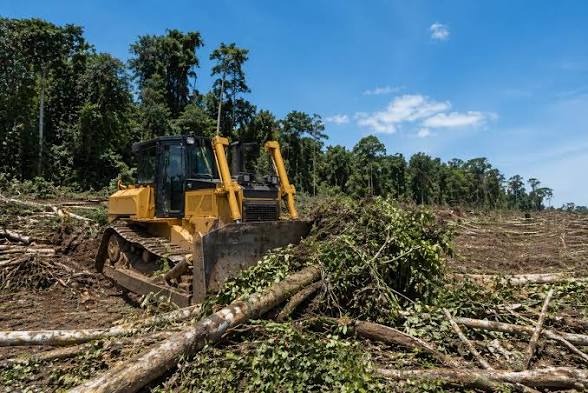
Figure: Mechanical land clearing.
Applying herbicides to kill unwanted vegetation before physical removal. This method is effective in controlling persistent weeds and invasive species but requires careful management to avoid soil contamination and crop damage. It saves labour on large areas and kills deep-rooted perennial weeds that are only cut back by slashing, but it costs money, needs correct dosage and protective clothing, and has a waiting period before planting.
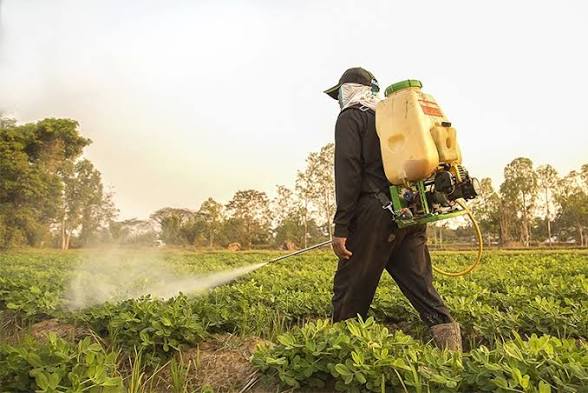
Figure: chemical land clearing.
Controlled burning removes dry vegetation and debris, facilitating easier clearing. Although cost-effective, it poses environmental risks such as soil degradation and air pollution, so it is less favored in environmentally sensitive areas like the Mau forest catchment. Burning destroys organic matter and soil organisms in the top layer, leaves the soil bare and open to erosion, and can escape into neighbouring land or forest. Where it is used, firebreaks are cleared first, the burn is done in calm weather, and someone remains on site until the fire is out.
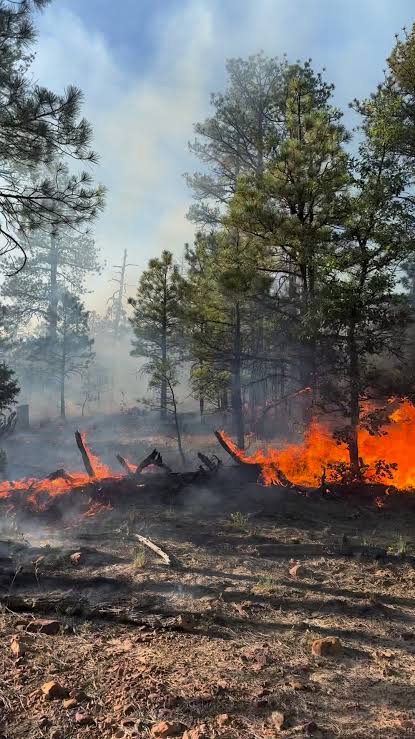
Figure: Controlled burning as a method of land clearing.
Often, farmers combine methods, starting with chemical or burning to reduce bulk, followed by manual or mechanical clearing to prepare the land thoroughly. A common sequence on a Kenyan smallholding is to slash the bush by hand, let it dry, remove the useful material as firewood or mulch, then dig out remaining roots and stumps with a jembe or fork jembe.
Efficient land clearing depends on the appropriate selection and maintenance of tools and equipment. For example:
| Name | Specification | Use |
|---|---|---|
| Machete | 18-24 inch blade, carbon steel | Cutting grasses, small shrubs |
| Hoe | Steel blade, wooden handle | Digging out roots, breaking soil |
| Tractor with Brush Cutter | 50-100 HP tractor, rotary blade | Clearing large shrubs and bushes |
| Bulldozer | Heavy machinery, tracked | Removing trees, stumps, debris |
| Herbicides | Glyphosate-based, selective | Killing unwanted vegetation |
Machete (panga)
A broad carbon steel blade, usually 18 to 24 inches, fitted to a wooden or plastic handle. It is swung to cut grasses, reeds, shrubs and small saplings, and is the commonest clearing tool on Kenyan smallholdings. It is cheap, needs no fuel, and reaches places no machine can. It must be kept sharp, since a blunt panga tears rather than cuts and tires the user quickly.
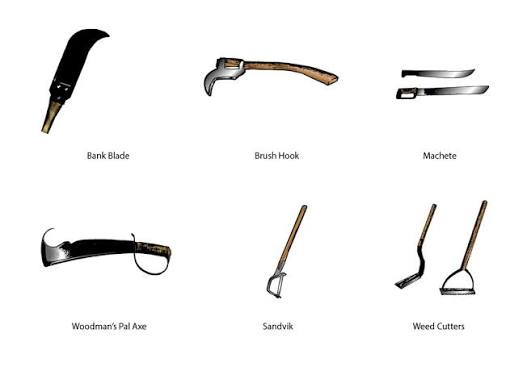
Figure: machete.
Hoe (jembe)
A steel blade set at an angle on a wooden handle. In clearing it is used to dig out roots and stumps of small shrubs, scrape off surface weeds, and break the soil where vegetation has been cut. The handle must be sound and firmly fixed, since a loose head is a common cause of injury.
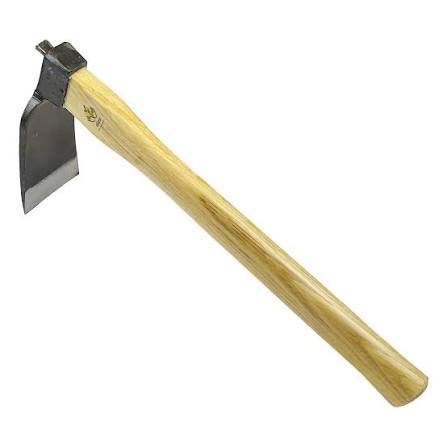
Figure: a hoe.
Tractor with brush cutter
A tractor of about 50 to 100 horsepower carrying a rotary brush cutter, either mounted at the rear on the three-point linkage and driven by the power take-off, or towed. The rotating blades cut and shred standing bush, tall grass and shrubs in a single pass. It clears large areas far faster than hand labour, and the shredded material can be left on the surface as mulch. It cannot handle large trees or stumps.
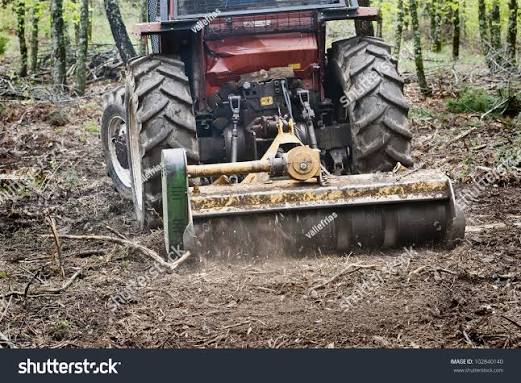
Figure: A tractor with a brush cutter.
Land clearing tractor
A tractor working on a field under clearing, hauling or pushing implements and removing cut vegetation. Tractor clearing suits large fields with few obstacles, and its cost is justified by the area covered in a day.
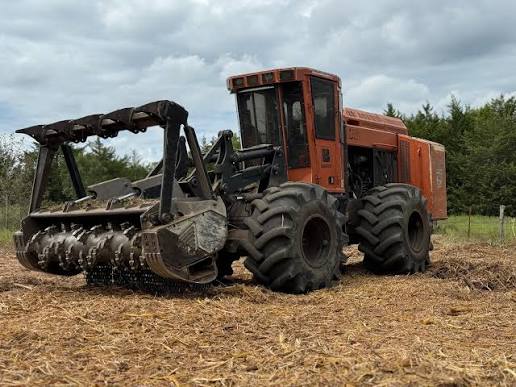
Figure: A tractor at work clearing land.
Bulldozer
Heavy tracked machinery carrying a front blade. It pushes over trees, uproots stumps, and shifts rocks and debris into heaps for burning or removal. It is used where the land has never been cultivated or has reverted to thick bush. It is expensive to hire, needs a skilled operator, and its weight compacts the soil and can strip away topsoil if the blade is set too deep, so the blade is kept shallow and the machine is used only where lighter methods will not work.
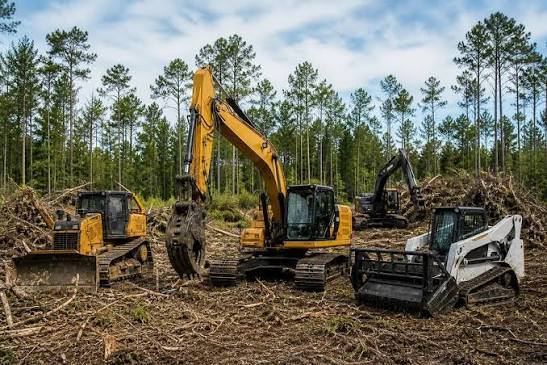
Figure: bulldozer at work.
Once vegetation and debris are removed, the soil is worked to produce a seedbed. The rotavator belongs to this stage rather than to clearing itself.
Rotavator (rotary tiller)
A tractor-mounted implement with rotating blades that cut, pulverise and mix the soil. It produces a fine seedbed in one pass and works crop residues and organic matter into the soil, which makes it useful for small-seeded crops. Repeated use at the same depth can form a hard pan below the worked layer, so the depth is varied between seasons.
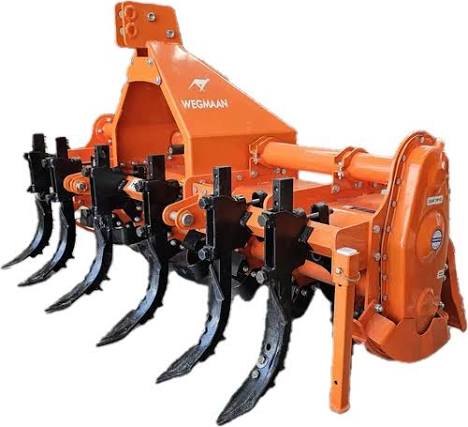
Figure: A rotavator, used after clearing to prepare a fine seedbed
Land clearing must be conducted responsibly to preserve soil fertility and biodiversity while respecting community land use:
Land clearing presents practical challenges that require adaptive solutions:
Create a free account to open more of this chapter.
Free: practical guides, quick cards, workplace scenarios and more.
Create a free accountThis chapter covers the essential steps required to prepare a crop seedbed, starting with land clearing, which involves removing unwanted vegetation and debris to create a suitable planting area. The importance of land clearing lies in improving soil accessibility and reducing competition for nutrients. Various methods of land clearing were discussed, including manual, mechanical, controlled burning, chemical clearing, grubbing, and grazing, each with specific applications depending on the field conditions. The chapter then explains tillage operations, defining key terms and highlighting the importance of tillage in soil aeration, weed control, and moisture retention. Different types of tillage such as primary, secondary, tertiary, and zero or minimum tillage were explored to show their role in seedbed preparation. Soil conservation measures were also emphasized, with techniques like contour planting, terraces, gabions, mulching, cover cropping, minimum tillage, crop rotation, and intercropping designed to prevent erosion and maintain soil fertility. Finally, the chapter reinforces the practical execution of tillage operations as a critical activity in establishing a productive crop seedbed.
Type: Individual
| Tools & Equipment | Materials |
|---|---|
| Machete | Trash Bags |
| Hoe | |
| Rake | |
| Measuring Tape | |
| Sisal Twine | |
| Pegs |
| S/N | Item | Quantity |
|---|---|---|
| 1 | PPE: Gumboots | 1 pair per Candidate |
| 2 | PPE: Dustcoat/Overall | 1 pc per Candidate |
| 3 | PPE: Gloves | 1 pair per Candidate |
| 4 | PPE: Face Mask | 1 pc per Candidate |
| 5 | PPE: Goggles | 1 pair per Candidate |
| 6 | Machete | 1 pc per Candidate |
| 7 | Hoe | 1 pc per Candidate |
| 8 | Rake | 1 pc per Candidate |
| 9 | Measuring Tape | 1 pc per 5 Candidates |
| 10 | Sisal Twine | 5 m per Candidate |
| 11 | Pegs | 4 pcs per Candidate |
| 12 | Trash Bags | 2 pcs per Candidate |
| 13 | Water for cleaning tools and PPE | Enough for all Candidates |
| Items to be Evaluated | Marks Available | Marks Obtained | Comments |
|---|---|---|---|
| TASK 1: MANUAL LAND CLEARING | |||
| Wore correct PPE: Gumboots, Dustcoat/Overall, Gloves, Face Mask, Goggles (Award 1 mark each or zero 1x5) | 5 | ||
| Measured and marked a 5m x 5m plot accurately using measuring tape, pegs and sisal twine (Award 1 mark for correct length, 1 mark for correct width, 1 mark for proper pegging and twine tension or zero 3x1) | 3 | ||
| Used machete to cut down tall grass and shrubs within the marked plot (Award up to 4 marks for effective and safe use of machete or zero) | 4 | ||
| Used hoe to uproot and remove roots and stumps within the plot (Award up to 4 marks for thorough root removal or zero) | 4 | ||
| Used rake to gather and collect debris and vegetation into piles (Award 3 marks for systematic raking and collection or zero) | 3 | ||
| Collected and disposed vegetation and debris into trash bags (Award 3 marks for proper collection and disposal or zero) | 3 | ||
| Maintained safety and proper ergonomic posture throughout the clearing process (Award 3 marks for safe practice or zero) | 3 | ||
| Sub-Total | 25 | ||
| TASK 2: CLEANING AND STORAGE | |||
| Cleaned all tools (machete, hoe, rake) using water and removed soil and debris (Award 3 marks for thorough cleaning or zero) | 3 | ||
| Cleaned PPE and stored all equipment properly in designated areas (Award 2 marks for proper cleaning and storage or zero) | 2 | ||
| Sub-Total | 5 | ||
| PRODUCT CHECKLIST | |||
| Plot cleared is exactly 5m x 5m as marked and free from vegetation and debris (Award 5 marks for complete clearing and correct dimensions or zero) | 5 | ||
| Area is evenly cleared with no patches of remaining vegetation or debris (Award 5 marks for uniform clearing or zero) | 5 | ||
| Sub-Total | 10 | ||
| GRAND TOTAL | 40 | ||
Type: Individual
| Tools & Equipment | Materials |
|---|---|
| Brush cutter machine | Petrol fuel (unleaded) |
| Machete | |
| Measuring tape | |
| Sisal twine | |
| Pegging stakes | |
| Waste disposal bags |
| S/N | Item | Quantity |
|---|---|---|
| 1 | Brush cutter machine | 1 pc per Candidate |
| 2 | Petrol fuel (unleaded) | 2 litres per Candidate |
| 3 | Protective gumboots | 1 pair per Candidate |
| 4 | Dustcoat/overall | 1 pc per Candidate |
| 5 | Safety goggles | 1 pair per Candidate |
| 6 | Face mask | 1 pc per Candidate |
| 7 | Gloves (leather) | 1 pair per Candidate |
| 8 | Machete | 1 pc per Candidate |
| 9 | Measuring tape (10m) | 1 pc per 5 Candidates |
| 10 | Sisal twine | 5 m per Candidate |
| 11 | Pegging stakes | 4 pcs per Candidate |
| 12 | Waste disposal bags | 2 pcs per Candidate |
| Items to be Evaluated | Marks Available | Marks Obtained | Comments |
|---|---|---|---|
| TASK 1: PREPARE AND WEAR PERSONAL PROTECTIVE EQUIPMENT (PPE) | |||
| Wore protective gumboots (Award 1 mark for correct use or zero) | 1 | ||
| Wore dustcoat/overall (Award 1 mark for correct use or zero) | 1 | ||
| Wore safety goggles (Award 1 mark for correct use or zero) | 1 | ||
| Wore face mask (Award 1 mark for correct use or zero) | 1 | ||
| Wore gloves (Award 1 mark for correct use or zero) | 1 | ||
| Sub-Total | 5 | ||
| TASK 2: SET OUT THE LAND AREA FOR CLEARING | |||
| Measured and marked a 10m x 10m area using measuring tape (Award 1 mark for correct measurement or zero) | 1 | ||
| Pegged the corners of the marked area correctly (Award 1 mark for correct pegging or zero) | 1 | ||
| Used sisal twine to mark boundary lines between pegs (Award 1 mark for clear boundary marking or zero) | 1 | ||
| Sub-Total | 3 | ||
| TASK 3: OPERATE THE BRUSH CUTTER FOR LAND CLEARING | |||
| Checked fuel level and filled brush cutter with petrol safely (Award 1 mark for correct filling procedure or zero) | 1 | ||
| Started brush cutter safely using correct procedure (Award 1 mark for safe starting or zero) | 1 | ||
| Cleared shrubs and small trees mechanically within the marked area (Award up to 3 marks for effective clearing or zero) | 3 | ||
| Used machete to cut down any remaining shrubs or small trees manually (Award up to 2 marks for manual clearing or zero) | 2 | ||
| Collected and disposed cleared vegetation into waste disposal bags (Award up to 2 marks for proper collection and disposal or zero) | 2 | ||
| Sub-Total | 9 | ||
| TASK 4: CLEAN AND STORE TOOLS AND EQUIPMENT | |||
| Cleaned brush cutter and machete after use (Award 2 marks for proper cleaning or zero) | 2 | ||
| Stored tools and equipment safely in designated area (Award 1 mark for correct storage or zero) | 1 | ||
| Removed and cleaned PPE properly after task completion (Award 1 mark for proper PPE removal and cleaning or zero) | 1 | ||
| Sub-Total | 4 | ||
| PRODUCT CHECKLIST | |||
| Cleared land area measures 10m x 10m as marked (Award 3 marks for correct dimension or zero) | 3 | ||
| Land area is free from shrubs and small trees (Award 4 marks for complete clearing or zero) | 4 | ||
| Cleared area is safe and free from debris hazards (Award 3 marks for safe and clean site or zero) | 3 | ||
| Sub-Total | 10 | ||
| GRAND TOTAL | 31 | ||
At the start of this chapter we promised you would be able to:
Tick each one you can genuinely do.
So, are you there yet?
You're competent when you can confidently do 50% or more of what this chapter promised.
Sign in to record how you're doing.