
By the end of this chapter, you will be able to:
These skills will empower you to make a real difference in improving community health and well-being.
Microbes and parasites play a critical role in community health, especially in Kenya where infectious diseases remain a significant public health challenge. Understanding the identity of these microorganisms and the stages of their life cycles is essential for effective diagnosis, treatment, and control of infections. This chapter focuses on defining key terms related to microbes and parasites, and identifying the anatomical sites within hosts where these organisms reside, multiply, or cause disease. Mastery of these concepts equips community health professionals to implement targeted interventions that reduce disease transmission and improve health outcomes.
In community health practice, precise terminology concerning microbes and parasites is fundamental for clear communication, accurate diagnosis, and effective intervention planning. This section clarifies essential terms that underpin microbiology and parasitology, supporting community health workers in understanding pathogen behavior and host interactions in diverse Kenyan settings.
Microbes, also known as microorganisms, are tiny living organisms that are invisible to the naked eye but ubiquitous in the environment. They include bacteria, viruses, fungi, protozoa, and certain algae. Microbes can be free-living or pathogenic, with some playing beneficial roles such as aiding digestion, while others cause diseases. In Kenya, common microbial pathogens include Mycobacterium tuberculosis, responsible for tuberculosis, and Plasmodium species causing malaria.
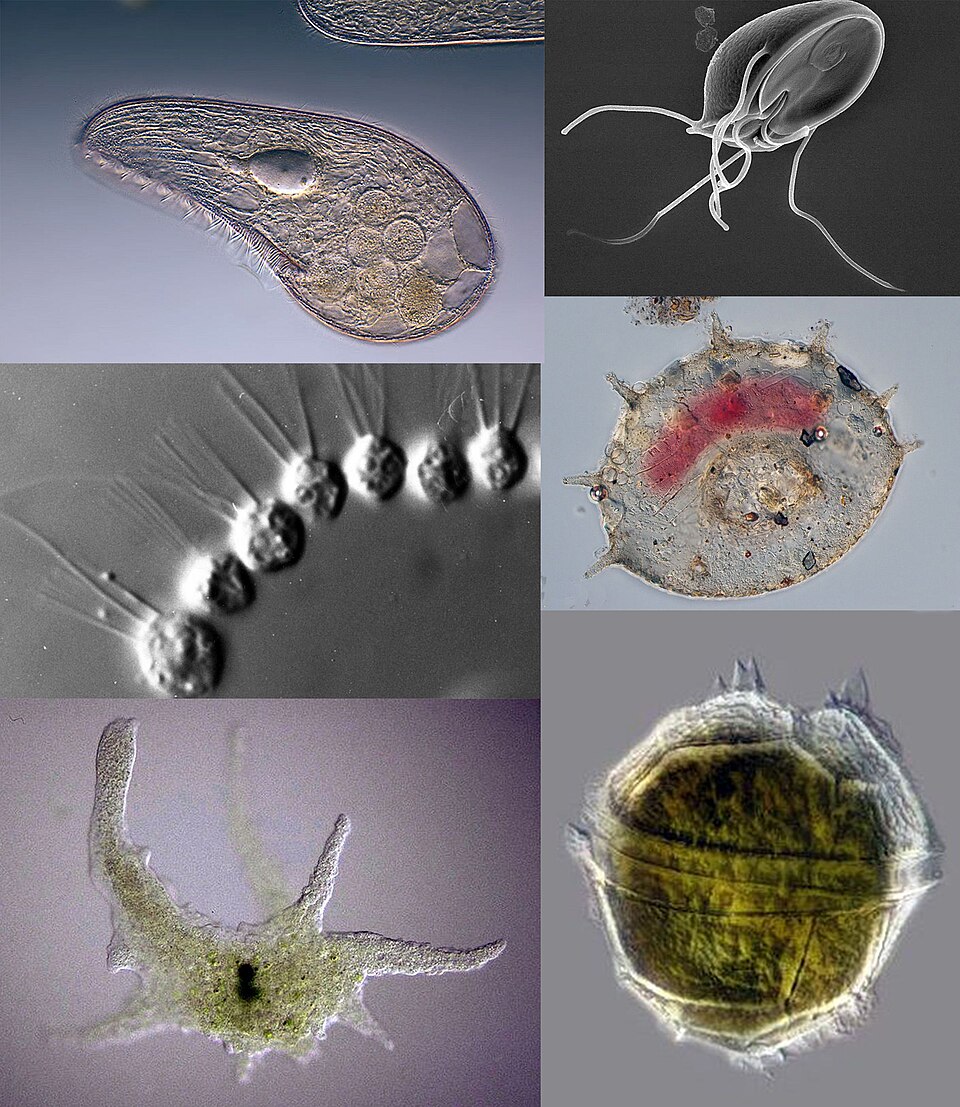
Various protozoa under microscope (Source: Wikimedia Commons (Protozoa))
Microbes are microscopic organisms that exist in virtually every environment, from soil and water to the human body. In the Kenyan context, they play diverse roles, including decomposing organic matter in agricultural soils in Uasin Gishu County and fermenting traditional foods like mursik. Some microbes are beneficial, such as those used in the production of yoghurt by Brookside Dairy, while others are harmful, causing diseases like tuberculosis and cholera. Community health workers must understand that microbes can be both allies and threats, influencing public health outcomes. Recognizing the ubiquity and diversity of microbes helps in designing effective sanitation and infection control strategies in both urban and rural Kenyan settings.
Parasites are organisms that live on or within a host organism, deriving nutrients at the host’s expense. Unlike microbes, parasites are generally larger and often multicellular. They cause parasitic infections that contribute significantly to morbidity in many Kenyan communities, particularly in rural and peri-urban areas.
The life cycle of a microbe or parasite describes the sequence of stages it undergoes from one generation to the next. Understanding life cycles is critical for interrupting transmission and designing control measures in community health programs. For example, the malaria parasite’s complex life cycle involves both human and mosquito hosts, necessitating interventions targeting both.
The life cycle of a microbe or parasite refers to the series of developmental stages it passes through from the beginning of one generation to the start of the next. For example, the malaria parasite undergoes several transformations, including sporozoite, merozoite, and gametocyte stages, in both mosquito and human hosts. In Kenya, understanding the life cycle concept is crucial for tracking how diseases like schistosomiasis persist in communities near Lake Victoria. Each stage in the life cycle may occur in different environments or hosts, requiring different control approaches. This concept underpins laboratory identification, surveillance, and targeted interventions in community health practice.
A host is an organism that harbors a microbe or parasite, providing a suitable environment for survival and reproduction. Hosts are classified based on their relationship with the parasite or microbe, which is pivotal in understanding disease dynamics in community health.
Create a free account to open more of this chapter.
Free: practical guides, quick cards, workplace scenarios and more.
Create a free accountThis chapter provided clear definitions of key terms related to microbiology and parasitology, establishing a foundation for understanding the subject. It explored the identification of various sites within hosts where parasites and microbes reside, emphasizing the importance of these locations in disease transmission and infection control. The chapter then detailed the conditions necessary for microbial growth, including temperature, water availability, moisture levels, nutrients, and light exposure, explaining how each factor influences microbial proliferation. Further, it examined the distinct phases of growth for both microbes and parasites, highlighting how these stages impact their development and potential to cause disease. Understanding these concepts is essential for effective community health interventions and disease management. The chapter integrates foundational knowledge with practical relevance to identify and control microbial and parasitic infections.
At the start of this chapter we promised you would be able to:
Tick each one you can genuinely do.
So, are you there yet?
You're competent when you can confidently do 50% or more of what this chapter promised.
Sign in to record how you're doing.