
By the end of this chapter, you will be able to:
Mastering these skills will help you work confidently and precisely with electrical machines, ensuring safety and quality in your trade.
Electrical machines are fundamental components in many Kenyan industries, ranging from hospitals and universities to banks and agricultural cooperatives. Their ability to convert electrical energy into mechanical energy and vice versa supports critical operations such as powering medical equipment, driving manufacturing machinery, and facilitating power supply systems. Understanding how to identify and operate various electrical machines equips diploma graduates with essential skills to maintain efficiency and safety in diverse professional environments.
Identifying electrical machines accurately is crucial for professionals working in fields that rely on electrical power and mechanical motion. Each type of machine has distinct characteristics and applications, which influence selection, maintenance, and troubleshooting. Kenyan institutions such as county referral hospitals and retail businesses depend on proper identification to ensure reliable operation and compliance with safety standards.
Electrical machines are primarily classified based on their function: motors, which convert electrical energy to mechanical energy, and generators, which convert mechanical energy to electrical energy. This distinction is critical for sectors like universities where laboratory equipment may include both types for different experimental setups.
Motors: Devices that convert electrical energy into mechanical rotation, essential in driving fans, pumps, and conveyor belts in factories.
Generators: Machines that produce electrical power from mechanical motion, widely used in backup power systems at county government offices.
Transformers: Devices that transfer electrical energy between circuits, modifying voltage levels to suit equipment needs, common in hotel power distribution.
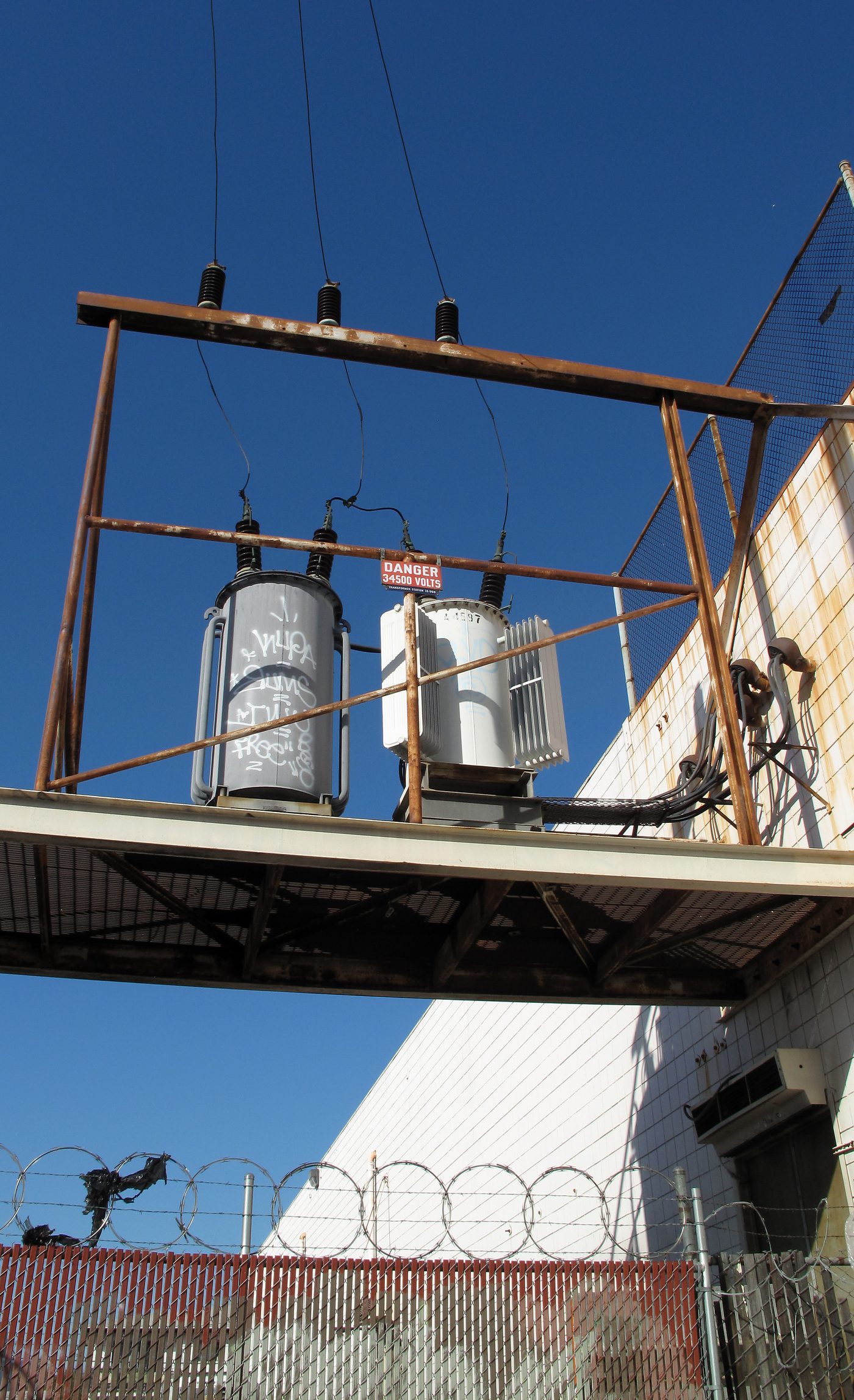
Outdoor electrical transformers on a pole (Source: Wikimedia Commons)
The physical construction and components of electrical machines provide clues for identification. For instance, hospitals rely on recognizing motor types to maintain diagnostic machines effectively.
Stator: The stationary part of the machine, housing coils or magnets; its design varies between AC and DC machines.
Rotor: The rotating element connected to the output shaft; its type (squirrel cage or wound) helps distinguish induction motors.
Commutator: Present in DC machines, enabling current reversal; absence indicates an AC machine.
Brushes: Conduct current to the rotor in DC motors and generators; their presence or absence aids identification.
Cooling Systems: Machines may have fans or liquid cooling; heavy machinery in farms often has robust cooling for continuous operation.
Electrical machines are also differentiated based on the type of electrical supply they use, which affects their design and application.
The intended application and physical size of electrical machines influence their identification and selection. For example, a hotel’s elevator motor differs significantly from the small motors used in office ventilation systems.
Create a free account to open more of this chapter.
Free: practical guides, quick cards, workplace scenarios and more.
Create a free accountThis chapter provides a comprehensive understanding of electrical machines by first focusing on their identification and distinguishing features. It then explores the operations of various types of machines including DC motors and generators, single-phase AC motors, three-phase machines such as induction and synchronous motors, and transformers. The derivation of the generator electromotive force equation is examined to explain how voltage is generated in these machines. Control methods for electrical machines are discussed to illustrate how their performance can be regulated and optimized. Calculations involving electrical machines are presented to equip students with the skills to analyze and design electrical systems accurately. Finally, the chapter highlights the wide range of applications of electrical machines across different sectors, emphasizing their significance in industrial and everyday use.
Type: Individual
| Tools & Equipment | Materials |
|---|---|
| Multimeter | 3-phase Induction Motor 415 V, 50 Hz |
| Insulation Resistance Tester (Megger) | Single-phase Induction Motor 230 V, 50 Hz |
| Screwdriver Set | DC Shunt Motor 220 V |
| Identification Labels and Markers | Synchronous Motor 415 V, 50 Hz |
| PPE Set (Safety Boots, Gloves, Goggles) | Universal Motor 230 V |
| Inspection Report Form A4 |
| S/N | Item | Quantity |
|---|---|---|
| 1 | 3-phase Induction Motor 415 V, 50 Hz | 1 Pc per Candidate |
| 2 | Single-phase Induction Motor 230 V, 50 Hz | 1 Pc per Candidate |
| 3 | DC Shunt Motor 220 V | 1 Pc per Candidate |
| 4 | Synchronous Motor 415 V, 50 Hz | 1 Pc per Candidate |
| 5 | Universal Motor 230 V | 1 Pc per Candidate |
| 6 | Multimeter | 1 Pc per Candidate |
| 7 | Insulation Resistance Tester (Megger) | 1 Pc per 2 Candidates |
| 8 | Screwdriver Set | 1 Set per Candidate |
| 9 | PPE Set (Safety Boots, Gloves, Goggles) | 1 Set per Candidate |
| 10 | Identification Labels and Markers | 1 Set per Candidate |
| 11 | Inspection Report Form A4 | 2 Sheets per Candidate |
| Items to be Evaluated | Marks Available | Marks Obtained | Comments |
|---|---|---|---|
| TASK 1: Safety and Preparation | |||
| Wore complete PPE including safety boots, gloves, and goggles (Award 2 or 0) | 2 | ||
| Gathered all tools and materials required for inspection (Award 2 or 0) | 2 | ||
| Ensured safe working environment and applied good housekeeping (Award 1 or 0) | 1 | ||
| Sub-Total | 5 | ||
| TASK 2: Identification and Classification | |||
| Physically inspected each electrical machine for nameplate data (Award 3 or 0) | 3 | ||
| Measured insulation resistance of each machine using Megger (Award 3 or 0) | 3 | ||
| Tested continuity and resistance with multimeter (Award 3 or 0) | 3 | ||
| Classified each machine correctly as induction, synchronous, universal or DC motor (Award 4 or 0) | 4 | ||
| Marked each machine with correct identification label (Award 3 or 0) | 3 | ||
| Sub-Total | 16 | ||
| TASK 3: Documentation | |||
| Completed the inspection report form accurately for all machines (Award 5 or 0) | 5 | ||
| Recorded test results and classification clearly (Award 3 or 0) | 3 | ||
| Ensured neatness and legibility of the report (Award 2 or 0) | 2 | ||
| Sub-Total | 10 | ||
| PRODUCT CHECKLIST | |||
| Inspection report form correctly completed with all required data and classifications (Award 8 or 0) | 8 | ||
| Correct and clear identification labels fixed on each electrical machine (Award 5 or 0) | 5 | ||
| Sub-Total | 13 | ||
| GRAND TOTAL | 44 | ||
Type: Individual
| Tools & Equipment | Materials |
|---|---|
| Lug Crimping Tool | 3-phase Induction Motor 415 V, 50 Hz |
| Electrician Toolkit (Screwdriver, Pliers, etc.) | Contactor 3-pole, 415 V AC Coil |
| PPE (Boots, Gloves, Goggles, Dustcoat) | Auxiliary Contactor |
| Timer (On-delay) 0-10 sec, 415 VAC | |
| Thermal Overload Relay Range 7-13 A | |
| Triple Pole Circuit Breaker | |
| Start and Stop Push Buttons | |
| PVC Single Core R/B/G Cable 4.0 mm2 | |
| PVC Single Core R/B/G Cable 2.5 mm2 | |
| Cable Fork Lugs 4.0 mm2 and 2.5 mm2 | |
| Vertical Wooden Installation Board 1m x 1m | |
| 3 Phase Isolator 415 V | |
| 12mm Cable Clips | |
| Labels and Tags |
| S/N | Item | Quantity |
|---|---|---|
| 1 | 3-phase Induction Motor 415 V, 50 Hz | 1 Pc per Candidate |
| 2 | Contactor 3-pole, 415 V AC Coil | 1 Pc per Candidate |
| 3 | Auxiliary Contactor | 1 Pc per Candidate |
| 4 | Timer (On-delay) 0-10 sec, 415 VAC | 1 Pc per Candidate |
| 5 | Thermal Overload Relay Range 7-13 A | 1 Pc per Candidate |
| 6 | Triple Pole Circuit Breaker | 1 Pc per Candidate |
| 7 | Start and Stop Push Buttons | 1 Set per Candidate |
| 8 | PVC Single Core R/B/G Cable 4.0 mm2 | 4 m per Candidate |
| 9 | PVC Single Core R/B/G Cable 2.5 mm2 | 4 m per Candidate |
| 10 | Cable Fork Lugs 4.0 mm2 and 2.5 mm2 | Enough per Candidate |
| 11 | Lug Crimping Tool | 1 Pc per Candidate |
| 12 | Electrician Toolkit (Screwdriver, Pliers, etc.) | 1 Set per Candidate |
| 13 | PPE (Boots, Gloves, Goggles, Dustcoat) | 1 Set per Candidate |
| 14 | Vertical Wooden Installation Board 1m x 1m | 1 Pc per Candidate |
| 15 | 3 Phase Isolator 415 V | 1 Pc per Candidate |
| 16 | 12mm Cable Clips | 1 Packet per Candidate |
| 17 | Labels and Tags | Sufficient per Candidate |
| Items to be Evaluated | Marks Available | Marks Obtained | Comments |
|---|---|---|---|
| TASK 1: Setup and Wiring of Motor Control Circuit | |||
| Wore personal protective equipment (boots, gloves, goggles, dustcoat) (Award 2 or 0) | 2 | ||
| Listed and prepared tools and materials needed (Award 3 or 0) | 3 | ||
| Observed correct cable colour coding throughout wiring (Award 2 or 0) | 2 | ||
| Fixed all components firmly and level on the installation board (Award 5 or 0) | 5 | ||
| Installed PVC conduits with correct dimensions and terminations (Award 4 or 0) | 4 | ||
| Cable clips spaced correctly and cables fixed firmly and neatly (Award 2 or 0) | 2 | ||
| Correctly terminated power circuit cables at all components (Award 5 or 0) | 5 | ||
| Labeled all cables and components clearly with tags (Award 2 or 0) | 2 | ||
| Performed continuity, insulation resistance and polarity tests (Award 6 or 0) | 6 | ||
| Demonstrated correct start/stop operation of the motor control circuit (Award 6 or 0) | 6 | ||
| Applied good housekeeping after completion of work (Award 2 or 0) | 2 | ||
| Sub-Total | 39 | ||
| PRODUCT CHECKLIST | |||
| Finished motor control circuit installation is firm, level, neat and matches schematic (Award 6 or 0) | 6 | ||
| Wiring matches colour code and cable sizes as per specifications (4.0 mm2 and 2.5 mm2) (Award 4 or 0) | 4 | ||
| All terminations are correctly done (twisted, folded firmly, no nicks) (Award 5 or 0) | 5 | ||
| Circuit operates correctly with timer delay and thermal overload protection functioning (Award 6 or 0) | 6 | ||
| Dimensions of installation board (1000mm x 1000mm) and component spacing correct within ±5mm (Award 4 or 0) | 4 | ||
| Sub-Total | 25 | ||
| GRAND TOTAL | 64 | ||
At the start of this chapter we promised you would be able to:
Tick each one you can genuinely do.
So, are you there yet?
You're competent when you can confidently do 50% or more of what this chapter promised.
Sign in to record how you're doing.