
By the end of this chapter, you will be able to:
Mastering these skills will help you confidently work with diodes in real electronic circuits, ensuring devices function safely and efficiently.
Semiconductor diodes are fundamental components in electronics engineering, widely applied in rectification, signal modulation, and switching circuits. In Kenya's growing electronics industry, particularly in sectors such as telecommunications, medical equipment, and automation, understanding the behaviour and application of crystal diodes is essential for designing reliable analogue circuits. This chapter explores the properties, behaviour, and equivalent models of crystal diodes, equipping electronics engineers with the knowledge to employ these devices effectively in practical systems.
The crystal diode, a semiconductor device primarily made from materials such as silicon or germanium, allows current to flow predominantly in one direction. Its unique property of unidirectional conduction makes it indispensable in converting alternating current (AC) to direct current (DC), signal demodulation, and voltage regulation. In the Kenyan electronics sector, crystal diodes are integral to power supply units in hospitals, radio communication equipment in county administrative offices, and signal processing in universities’ research laboratories.
The crystal diode consists of a p-n junction formed by joining p-type and n-type semiconductor materials. The p-type region contains an abundance of holes (positive charge carriers), while the n-type region contains excess electrons (negative charge carriers). Silicon is the preferred material in Kenya’s electronics manufacturing due to its thermal stability and availability, while germanium diodes are used in low-voltage applications because of their lower forward voltage drop.
The diode operates based on the behaviour of the p-n junction under forward and reverse bias conditions. When forward biased (positive voltage on the p-side), the depletion region narrows, allowing charge carriers to cross the junction and conduct current. In reverse bias, the depletion region widens, preventing current flow except for a negligible leakage current. This behaviour is harnessed in rectification circuits used in Kenyan hospitals for powering medical devices.
Several types of crystal diodes cater to specific functions:
Rectifier Diodes: Designed to handle high current and voltage, commonly used in power supplies for banks and retail businesses.
Signal Diodes: Smaller and faster, suitable for signal processing in communication equipment at county government offices.
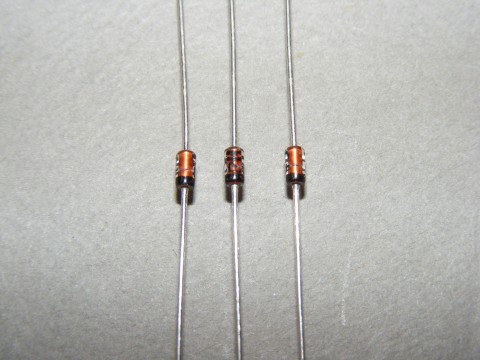
Three signal diodes with axial leads (Source: Wikimedia Commons)
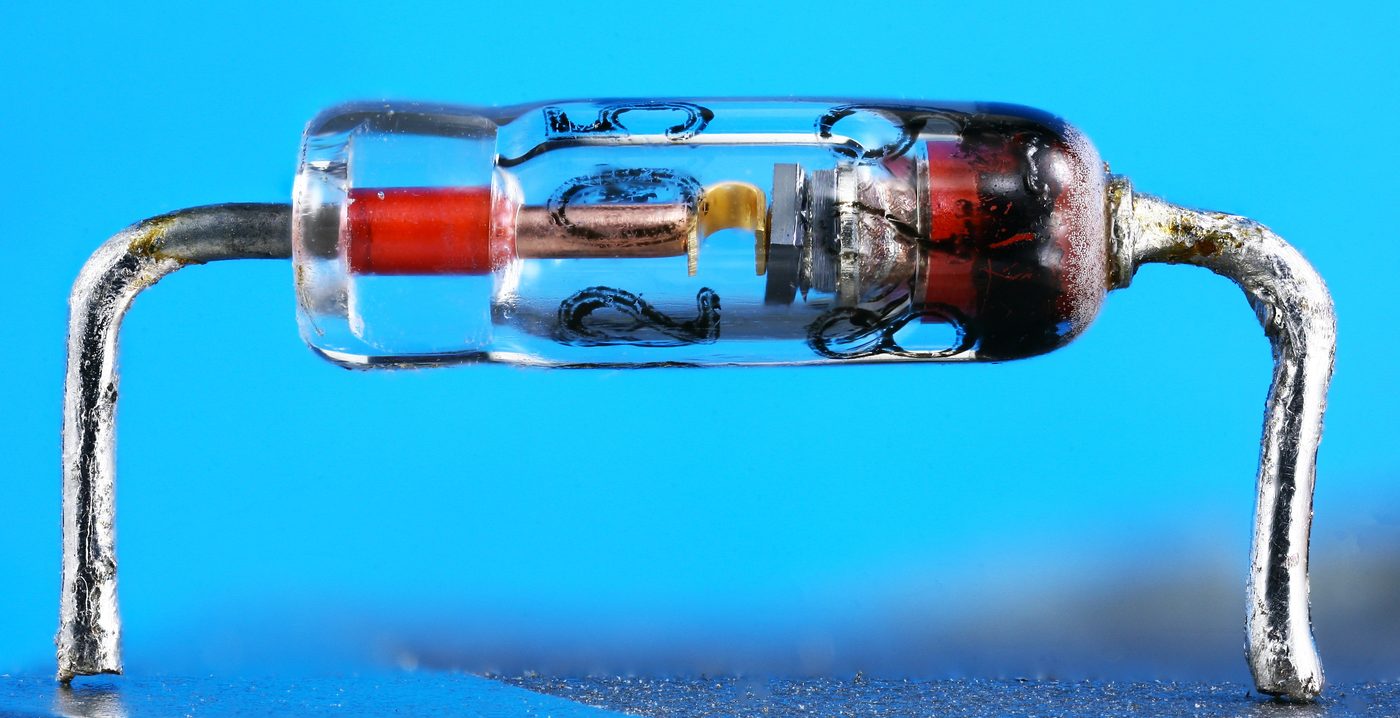
Close-up of a zener diode component (Source: Wikimedia Commons)
Schottky Diodes: Characterized by low forward voltage and fast switching, ideal for high-frequency applications in universities’ research labs.
Light Emitting Diodes (LEDs): Emit light when forward biased, employed in display panels and indicators in industrial control systems.
Crystal diodes are extensively used in:
Create a free account to open more of this chapter.
Free: practical guides, quick cards, workplace scenarios and more.
Create a free accountThis chapter began by introducing the crystal diode, explaining its fundamental role as a semiconductor device that allows current to flow primarily in one direction. The characteristics of the crystal diode were explored, including how its resistance varies with voltage and the concept of its equivalent circuit, which models its behavior in practical circuits. The discussion then moved to biasing methods, detailing forward biasing that enables current flow and reverse biasing that blocks it, highlighting the diode’s directional properties. Limitations in operating conditions were examined, focusing on forward current rating, peak inverse voltage (PIV), and power rating, which define safe usage boundaries to prevent damage. The chapter also covered special purpose diodes such as LEDs, photodiodes, optoisolators, tunnel diodes, varactor diodes, and Shockley diodes, each designed for specific functions in electronic systems. Finally, various applications of semiconductor diodes were reviewed, demonstrating their versatility in rectification, signal modulation, voltage regulation, and optical communication. This comprehensive overview established a solid foundation for understanding and applying semiconductor diodes in analogue electronics.
At the start of this chapter we promised you would be able to:
Tick each one you can genuinely do.
So, are you there yet?
You're competent when you can confidently do 50% or more of what this chapter promised.
Sign in to record how you're doing.