
By the end of this chapter, you will be able to:
These skills will help you create beautiful, well-made garments while working safely and efficiently in the real world of fashion and tailoring.
Plan for design and construction of ladies’ garments requires meticulous attention to safety measures that protect the fashion designer and tailor throughout the production process. In Kenya, where garment manufacturing environments range from small tailoring shops in Nairobi’s Central Business District to large-scale apparel factories in Athi River, adherence to personal protective equipment (PPE) standards ensures worker safety and compliance with occupational health regulations. This chapter begins by exploring the critical role of PPEs in fashion design, focusing on their types, selection, and maintenance relevant to ladies’ wear garment construction.
Personal Protective Equipment (PPE) forms an essential barrier between workers and hazards encountered during garment design and construction activities. In Kenyan tailoring workshops and fashion design studios, risks such as sharp cutting tools, chemical exposure from dyes and adhesives, and repetitive strain injuries necessitate the use of appropriate PPEs. Understanding the various PPE types, their selection criteria, and proper maintenance is vital for sustaining a safe working environment and preventing occupational injuries.
PPEs in ladies’ wear production cover a variety of protective gear designed to mitigate specific risks during fabric handling, cutting, sewing, and finishing. The choice of PPE depends on the nature of the task and the hazards involved.
Cut-resistant gloves: These gloves protect hands from sharp tools such as fabric scissors, rotary cutters, and pins. Their use is crucial during fabric cutting stages to prevent lacerations, which are common in garment workshops.
Protective aprons: Aprons shield clothing and skin from stains and chemical splashes, especially when handling dyes, adhesives, or fabric finishes. In textile workshops at universities like Kenyatta University, aprons help maintain hygiene and protect personal attire.
Face masks: Masks prevent inhalation of dust, fabric fibers, and chemical fumes emitted during fabric treatment or pressing. Tailors in Nairobi’s garment factories often use masks to reduce respiratory risks linked to prolonged exposure to textile dust.
Safety goggles: Eye protection is necessary during activities such as fabric cutting with power tools or when applying sprays and adhesives. In retail fashion outlets with in-house alteration services, goggles protect against accidental splashes.
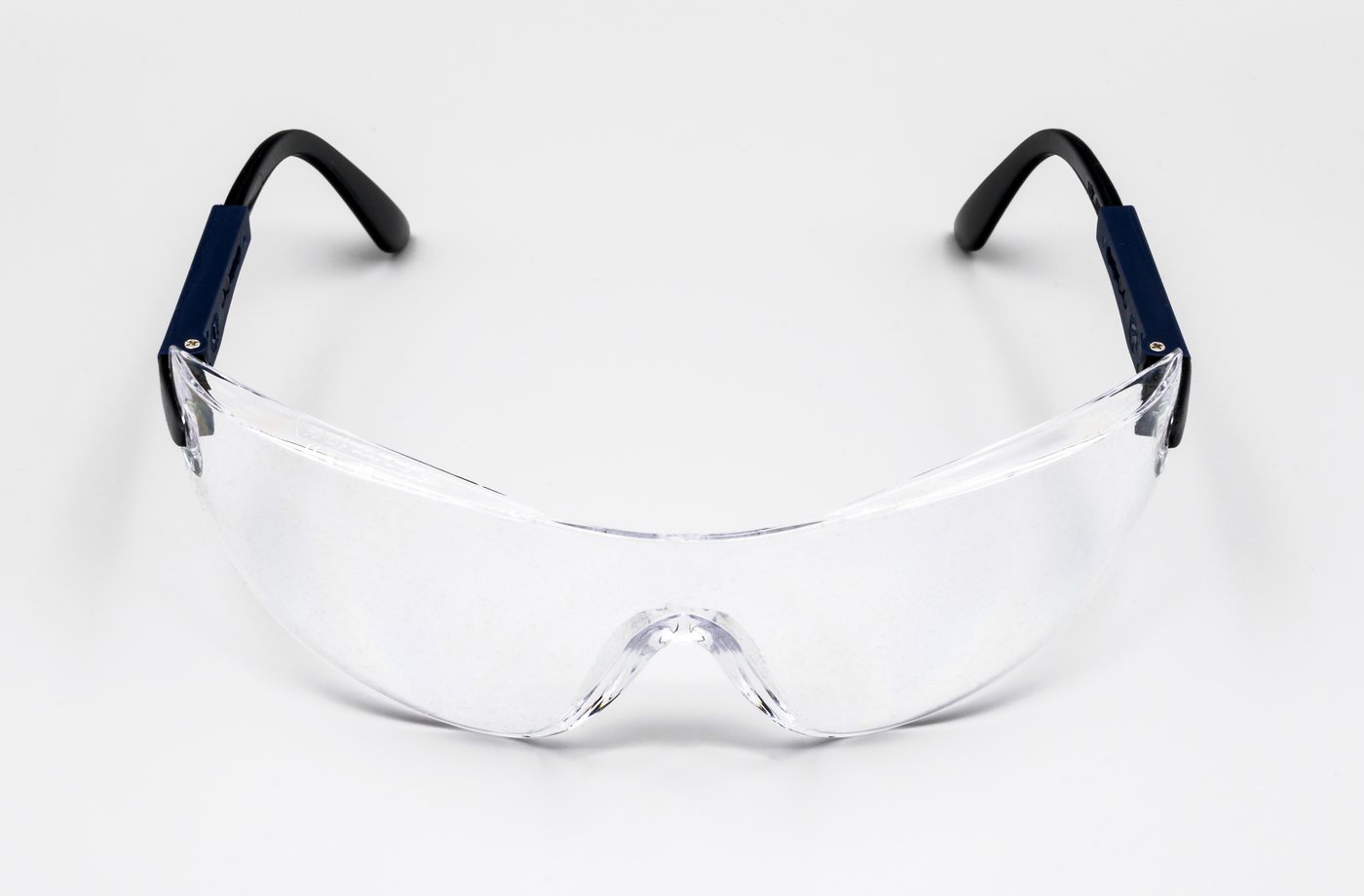
Clear safety goggles for eye protection (Source: Wikimedia Commons)
Selecting the right PPE requires assessing the specific hazards associated with each garment construction stage and the working environment. Proper selection enhances protection, comfort, and compliance with safety standards.
Hazard identification: A thorough evaluation of risks such as cuts, chemical exposure, or dust inhalation guides PPE choice. For instance, designers using strong adhesives in Kisumu’s garment workshops prioritize chemical-resistant gloves and aprons.
Material compatibility: PPE materials must resist the substances encountered. Gloves made from nitrile are preferred over latex when handling solvent-based adhesives to prevent chemical degradation.
Comfort and fit: Since garment construction involves intricate handwork, PPE must allow dexterity and comfort to avoid impeding performance. Tailors at county government offices in Mombasa often select lightweight gloves that fit snugly to maintain precision.
Durability and maintenance: PPE should withstand repeated use and cleaning without losing protective properties. Safety aprons made from washable fabrics are favored in school-based fashion studios for longevity.
Compliance with standards: PPE must meet Kenyan occupational safety regulations and standards such as those set by the Directorate of Occupational Safety and Health Services (DOSHS). This ensures legal adherence and worker protection.
Correct usage and upkeep of PPE maximize their effectiveness and extend their service life. Neglecting maintenance can lead to reduced protection and increased risk of injury.
Regular inspection: PPE should be examined before each use for signs of wear, damage, or contamination. For example, a tear in a cut-resistant glove compromises hand protection and requires immediate replacement.
Correct wearing techniques: Training workers on how to don and doff PPE correctly prevents accidental exposure. At Nairobi Women’s Hospital’s tailoring unit, staff undergo orientation on mask fitting to ensure adequate respiratory protection.
Cleaning and storage: PPE must be cleaned following manufacturer instructions to avoid degradation. Protective aprons are typically washed after each use and stored in clean, dry areas to prevent microbial growth.
Timely replacement: PPE with compromised integrity should be replaced promptly. Worn-out safety goggles with scratched lenses impair visibility and should be discarded to maintain eye safety.
Record keeping: Maintaining logs of PPE issuance, inspections, and replacements supports workplace safety audits. Textile firms in Eldoret maintain such records to demonstrate compliance during DOSHS inspections.
Despite the clear benefits of PPE, many fashion design workplaces in Kenya face challenges in consistent and effective use. Addressing these barriers is essential for safeguarding workers.
Cost constraints: Small-scale tailoring businesses may find it difficult to afford quality PPE, leading to inadequate protection.
Lack of awareness: Some workers underestimate the importance of PPE or lack training on proper use, especially in informal sector workshops.
Discomfort and reduced dexterity: PPE that impedes fine motor skills required for detailed stitching may discourage usage.
Cultural attitudes: Resistance to change and perceptions that PPE is unnecessary can affect compliance.
Maintenance difficulties: Limited facilities for cleaning and storing PPE can lead to deterioration and unsafe reuse.
Subsidizing PPE costs: County governments and industry associations can support small workshops with PPE provision programs.
Training and sensitization: Regular safety workshops and demonstrations at institutions like the Kenya Textile Training Institute improve knowledge and attitudes.
Selecting ergonomic PPE: Investing in well-designed PPE that balances protection and comfort encourages consistent use.
Promoting safety culture: Leadership in fashion cooperatives and companies must model PPE compliance to influence worker behavior.
Establishing maintenance protocols: Clear guidelines and dedicated spaces for PPE care ensure equipment longevity and effectiveness.
In the Kenyan fashion industry, the dust coat remains a fundamental garment, especially in ladies’ wear, serving both protective and stylistic purposes. This outerwear piece is designed to shield clothing from dust and dirt, particularly during travel or in environments where garments are susceptible to soiling. Fashion designers in Nairobi and other urban centres incorporate dust coats in their collections to meet the practical needs of working women, students, and professionals who require functional yet elegant protection for their attire. Understanding the design and construction of dust coats is essential for fashion designers aiming to blend utility with aesthetics in ladies’ outerwear.
A dust coat is a lightweight, loose-fitting outer garment worn over regular clothing to protect it from dust, dirt, and minor environmental damage. In Kenya, dust coats are widely used by professionals such as healthcare workers, laboratory staff, and university students, as well as by women who commute daily in busy urban settings like Nairobi and Mombasa. The garment typically features simple construction with an emphasis on ease of wear and removal, making it a practical addition to any wardrobe.
Designing a dust coat for ladies involves balancing functionality with aesthetic appeal, especially in Kenya’s vibrant fashion scene where consumers value style alongside utility. The garment’s design must accommodate the wearer’s comfort, ease of movement, and the typical environmental conditions encountered.
Selecting appropriate materials for dust coats is crucial in the Kenyan context, where climatic conditions vary from hot coastal regions to cooler highlands. The fabric choice impacts the garment’s comfort, durability, and protective qualities.
The construction of a dust coat requires precision to ensure durability, comfort, and a professional finish. Kenyan garment manufacturers and fashion designers must adhere to quality standards that meet both functional and aesthetic expectations.
In the fashion design industry, particularly during the construction of ladies’ garments, safety shoes are an essential component of personal protective equipment. In Kenyan garment manufacturing workshops and studios, workers often operate cutting tools, heavy sewing machines, and handle materials that may cause injury to the feet. Wearing appropriate safety shoes mitigates risks of punctures, cuts, and crushing injuries, ensuring that designers and workers maintain productivity without compromising their well-being. Moreover, the choice of safety shoes influences comfort during long hours of standing and movement, which is common in tailoring and garment assembly.
Four types of safety footwear commonly used in construction and engine (Source: PLUMB 5 LEARNING GUIDE-1 (1))
The primary purpose of safety shoes in garment construction is to protect the feet from physical hazards that arise in the workshop environment. Tailors and fashion designers frequently work with sharp scissors, pins, and heavy equipment that could cause serious injuries if dropped or stepped on. In Kenya, where many garment workshops are located in urban centers such as Nairobi and Mombasa, ensuring safety footwear compliance is critical to reducing workplace accidents.
Different types of safety shoes serve various protective functions, and selecting the appropriate type depends on the specific hazards in the garment construction process. Kenyan garment workshops tend to favor shoes that balance protection with comfort and flexibility, given the detailed and delicate nature of ladies’ wear production.
| Name | Specification | Use |
|---|---|---|
| Steel-toe boots | Reinforced steel toe cap, slip-resistant rubber sole | Protect against heavy object impact and slipping |
| Composite toe shoes | Lightweight composite toe cap, puncture-resistant sole | Electrical insulation and puncture protection |
| Slip-on safety shoes | Anti-slip sole, cushioned insole | Suitable for quick removal, comfort for long hours |
| Ankle-high boots | Supportive ankle coverage, oil-resistant sole | Protection against chemical spills and sharp tools |
| Low-cut safety shoes | Flexible, breathable fabric upper, reinforced sole | Light protection with increased mobility |
Safety shoes chosen for ladies’ garment construction should ideally be lightweight to avoid fatigue but durable enough to withstand sharp tools and heavy equipment commonly found in Kenyan tailoring studios and garment factories.
Selecting the correct safety shoe involves assessing the risks present in the ladies’ wear production environment and matching shoe features to these hazards. Maintenance ensures that safety shoes continue to provide adequate protection and comfort throughout their useful life.
Safety shoes contribute not only to injury prevention but also significantly affect overall efficiency and health outcomes for fashion designers and garment workers. In Kenya, where the garment industry is a substantial employer, optimizing safety footwear use can improve workforce stability and product quality.
In the Kenyan fashion industry, the design and construction of face masks have become an essential skill for fashion designers, especially following the COVID-19 pandemic. Face masks are no longer just protective gear but also fashion statements that reflect personal style and cultural identity. Ladies’ wear designers are increasingly incorporating face masks into their collections to meet both health requirements and aesthetic preferences, thus expanding their product range and relevance in the market.
Designing ladies’ face masks requires balancing functionality, comfort, and style to appeal to diverse customers. The mask must provide adequate protection while fitting well and complementing the wearer’s outfit, especially for formal or social occasions in Kenya’s urban centers like Nairobi and Mombasa.
Fit and Comfort: A well-fitting mask should contour the face without gaps to ensure protection while remaining comfortable for extended wear. Adjustable ear loops or ties are important for accommodating different face shapes and sizes common among Kenyan women.
Fabric Selection: The choice of fabric affects breathability, filtration efficiency, and appearance. Cotton, silk, and linen are popular for their comfort and availability, with some designers layering fabrics for enhanced protection.
Aesthetic Appeal: Patterns, colors, and embellishments must align with contemporary fashion trends and cultural preferences. For example, using kitenge or kikoy fabrics can add a unique Kenyan flair that resonates with local consumers.
Functionality: Masks should allow easy breathing and speaking, with some designs incorporating filter pockets or nose wires for improved protection and fit, features appreciated by professionals in health and corporate sectors.
Durability and Maintenance: Materials and construction must withstand repeated washing without losing shape or protective qualities, important for customers who use masks daily.
Constructing a ladies’ face mask involves precise sewing and finishing techniques to ensure durability, comfort, and style. Kenyan designers must master these skills to produce masks that meet both safety standards and fashion expectations.
Pattern Cutting: Accurate cutting of mask pieces, including outer fabric, lining, and interfacing, is crucial for a proper fit. Patterns may vary based on style, pleated, contoured, or fitted masks.
Seam Finishing: Using techniques such as double stitching or serging enhances the mask’s strength and longevity, especially when exposed to frequent washing.
Inserting Nose Wires: A channel for a flexible wire helps the mask conform around the nose, reducing fogging for eyeglass wearers and improving the seal.
Attaching Ear Loops or Ties: Elastic bands or fabric ties must be securely sewn and comfortable against the skin. Adjustable features improve fit for various face sizes.
Topstitching and Embellishments: Decorative stitching or adding lace, beads, or embroidery can personalize masks, making them suitable for events or fashion accessories.
Face masks intended for public use in Kenya must comply with health and safety guidelines to ensure effectiveness. Fashion designers must be aware of these standards to produce masks that protect users and build consumer trust.
Material Filtration Efficiency: Fabrics used should provide adequate filtration; multi-layered masks with at least two layers of tightly woven fabric are recommended by Kenya’s Ministry of Health.
Breathability: Masks must allow comfortable airflow to prevent discomfort and encourage consistent use, especially in Kenya’s hot climate.
Washability: Reusable masks should withstand multiple washes without degradation in protective function or fabric integrity.
Non-Toxic Materials: All components, including dyes and embellishments, must be safe for prolonged skin contact to avoid allergic reactions.
Compliance with Government Regulations: Designers should follow guidelines issued by the Ministry of Health and Kenya Bureau of Standards (KEBS) regarding mask specifications.
The demand for ladies’ face masks in Kenya reflects evolving consumer preferences influenced by health concerns and fashion trends. Understanding these trends helps designers create products that meet market needs and stand out competitively.
Customization and Personalization: Many customers seek masks that reflect their personality or coordinate with outfits, prompting designers to offer bespoke options.
Sustainable Materials: Eco-conscious consumers in Kenya prefer masks made from organic or recycled fabrics, aligning with global sustainability movements.
Integration with Accessories: Face masks are increasingly designed to complement jewelry, headscarves, or other fashion items, enhancing overall style coherence.
Price Sensitivity: While some consumers invest in premium masks with intricate designs, others prioritize affordability, especially in rural and peri-urban areas.
Brand Reputation: Buyers often trust masks from known fashion houses or designers who demonstrate adherence to safety and quality standards.
In the Kenyan fashion design industry, particularly in ladies’ wear, the thimble is a fundamental tool that supports precision and protection during garment construction. As designers and tailors work with intricate fabrics and fine hand stitching, the thimble ensures efficiency and safety. Its use is especially critical when working on delicate embroideries or couture pieces where hand sewing is predominant, such as in bespoke bridal gowns or formal wear crafted in Nairobi’s fashion hubs.
Thimbles vary by material and design, each suited to different sewing tasks and preferences. Knowing these types helps Kenyan fashion professionals select the right tool for specific garment work.
Steel: Provides excellent needle resistance, ideal for thick fabrics and repetitive sewing.
Brass: Durable with a smooth surface that prevents needle snagging, preferred for precision sewing.
Plastic: Best for lightweight fabrics where heavy protection is unnecessary, common in school training.
Leather: Balances protection and comfort, favored by artisans in rural areas who sew by hand.
black and brown leather wallet (Source: Wikimedia Commons)
Effective use and care of the thimble ensure longevity and consistent performance, crucial for Kenyan fashion professionals who rely on quality tools in their production process.
Although thimbles are simple tools, users face challenges that can affect sewing quality and comfort. Addressing these issues is important for Kenyan ladies’ wear practitioners who seek efficiency and safety.
Explain the primary functional purposes of a dust coat in ladies’ wear and how these relate to Kenyan professional environments. (10 marks)
Discuss five key design features of a ladies’ dust coat and how they enhance both functionality and style. (10 marks)
Identify and explain five important criteria for fabric selection when designing dust coats for the Kenyan market. (10 marks)
Outline six critical construction techniques that ensure the quality and durability of a dust coat. (12 marks)
Explain five key design considerations that a Kenyan ladies’ wear designer must account for when creating face masks. (10 marks)
Describe six essential construction techniques used in making ladies’ face masks and explain their importance. (12 marks)
Identify five health and safety standards relevant to the production of face masks and discuss their significance. (10 marks)
Discuss five current market trends influencing the design and sale of ladies’ face masks in Kenya. (10 marks)
Create a free account to open more of this chapter.
Free: practical guides, quick cards, workplace scenarios and more.
Create a free accountThis chapter provides a comprehensive overview of the essential personal protective equipment required in garment construction, including dust coats, safety shoes, face masks, and thimbles, emphasizing their role in ensuring worker safety. It then explores the various tools and equipment used in clothing construction, highlighting their specific functions and importance in achieving quality workmanship. The chapter proceeds to discuss the materials and supplies necessary for garment production, laying the foundation for effective design and construction processes. A detailed analysis of ladies’ garment designs follows, examining key styles such as skirts, blouses, dresses, blazers, coats, trousers, and jumpsuits. Each garment type is studied with attention to its unique design elements and construction requirements, providing a clear understanding of how to plan and execute their creation. This structured approach equips students with the knowledge to integrate safety, materials, tools, and design considerations effectively in the production of ladies’ wear.
Type: Individual
| Tools & Equipment | Materials |
|---|---|
| Dust coat | 2 meters medium weight fabric |
| Face mask | Thread to match the fabric |
| Thimble | 3 buttons 1.5cm wide without a shank |
| Safety shoes | 80cmx80cm fusible interfacing |
| Hand sewing needle | Brown papers |
| Measuring tape | |
| Tailor's chalk | |
| Dressmaker pins | |
| Cutting shears | |
| Sewing machine | |
| Iron and ironing board | |
| Working surface |
| S/N | Item | Quantity |
|---|---|---|
| 1 | Dust coat | 1 Pc per Candidate |
| 2 | Face mask | 1 Pc per Candidate |
| 3 | Thimble | 1 Pc per Candidate |
| 4 | Safety shoes (flat, closed) | 1 Pair per Candidate |
| 5 | Hand sewing needle | 2 Pcs per Candidate |
| 6 | Measuring tape | 1 Pc per Candidate |
| 7 | Tailor's chalk | 1 Pc per Candidate |
| 8 | Dressmaker pins | 1 Box per 5 Candidates |
| 9 | Cutting shears | 1 Pc per Candidate |
| 10 | Sewing machine | 1 Pc per Candidate |
| 11 | Iron and ironing board | 1 Set per 2 Candidates |
| 12 | Working surface (cutting table) | 1 Pc per Candidate |
| Items to be Evaluated | Marks Available | Marks Obtained | Comments |
|---|---|---|---|
| TASK 1: Preparation and PPE use | |||
| Wore PPE correctly: dust coat, face mask, thimble, safety shoes (Award 1 mark each for dust coat, face mask, thimble, safety shoes) | 4 | ||
| Observed occupational safety and health requirements: well-lit and well-ventilated working area (Award 1 mark each for well-lit area and ventilation) | 2 | ||
| Identified, obtained and allocated production tools and equipment according to workplace policy: pattern construction tools, pressing tools, sewing tools, cutting shears, sewing machine, working surface (Award 1 mark each for correct identification and allocation of each tool/equipment) | 6 | ||
| Identified and obtained materials and supplies according to work requirements: 2 meters medium weight fabric, 3 buttons 1.5cm without shank, 80cmx80cm fusible interfacing, brown papers, thread matching fabric (Award 1 mark each for correct identification and allocation of each material) | 5 | ||
| Checked functioning of the sewing machine before operation: threaded bobbin correctly, positioned bobbin correctly, fixed needle correctly, threaded upper thread correctly, adjusted stitch length and tension, tested stitches (Award 1 mark each for correct execution of each check) | 5 | ||
| Sub-Total | 22 | ||
| PRODUCT CHECKLIST | |||
| Correct selection and use of PPE and tools ready for garment construction (Award marks for correct, complete and safe preparation of PPE and tools) | 8 | ||
| Sub-Total | 8 | ||
| GRAND TOTAL | 30 | ||
Type: Individual
| Tools & Equipment | Materials |
|---|---|
| Cutting shears | Medium weight cotton fabric 60" wide |
| Measuring tape | Thread to match fabric |
| Tailor’s chalk | Fusible interfacing 80cm x 80cm |
| Tracing wheel | Buttons 1.5cm diameter without shank |
| Pattern construction rulers | Brown pattern paper |
| Pressing iron and board | A3 brown envelope |
| Working surface | Dust coat |
| Thimble | |
| Low-heeled closed shoes |
| S/N | Item | Quantity |
|---|---|---|
| 1 | Medium weight cotton fabric 60" wide | 2 meters per Candidate |
| 2 | Thread to match fabric | 1 reel per Candidate |
| 3 | Fusible interfacing 80cm x 80cm | 1 piece per Candidate |
| 4 | Buttons 1.5cm diameter without shank | 5 pieces per Candidate |
| 5 | Brown pattern paper | 3 meters per Candidate |
| 6 | A3 brown envelope | 1 per Candidate |
| 7 | Dust coat (Personal Protective Equipment) | 1 per Candidate |
| 8 | Thimble (Personal Protective Equipment) | 1 per Candidate |
| 9 | Low-heeled closed shoes (Personal Protective Equipment) | 1 pair per Candidate |
| 10 | Cutting shears | 1 per Candidate |
| 11 | Measuring tape | 1 per Candidate |
| 12 | Tailor’s chalk | 1 piece per Candidate |
| 13 | Tracing wheel | 1 per Candidate |
| 14 | Pattern construction rulers (French curve, L-square) | 1 set per Candidate |
| 15 | Working surface/table | 1 per Candidate |
| 16 | Pressing iron and board | 1 set per Candidate |
| Items to be Evaluated | Marks Available | Marks Obtained | Comments |
|---|---|---|---|
| TASK 1: Preparation and identification of materials | |||
| Wore personal protective equipment: dust coat, thimble, and low-heeled closed shoes (Award 1 mark each) | 3 | ||
| Observed occupational safety and health requirements: well-lit and well-ventilated working area (Award 1 mark each) | 2 | ||
| Identified and obtained all required materials and supplies as per the cutting list (Award 2 marks each for fabric, interfacing, buttons, thread, brown papers and envelope) | 10 | ||
| Checked quality and suitability of the fabric and other materials for ladies’ blouse construction (Award 1 mark each for fabric, interfacing, buttons) | 3 | ||
| Prepared materials for use: measured and cut fusible interfacing, organized buttons and thread, arranged pattern papers (Award 1 mark each) | 5 | ||
| Ensured tools and equipment are ready and serviceable: cutting shears sharp, measuring tape accurate, pressing iron working (Award 1 mark each) | 2 | ||
| Sub-Total | 25 | ||
| PRODUCT CHECKLIST | |||
| All materials correctly identified, selected and prepared according to the task requirements (Award 2 marks each for fabric, interfacing, buttons, thread, brown papers and envelope) | 10 | ||
| Materials are clean, undamaged and ready for garment construction (Award 1 mark each for fabric, interfacing, buttons, thread, brown papers) | 5 | ||
| Materials arranged neatly and labelled appropriately in the brown envelope (Award 5 marks for neatness and proper labelling) | 5 | ||
| Sub-Total | 20 | ||
| GRAND TOTAL | 45 | ||
At the start of this chapter we promised you would be able to:
Tick each one you can genuinely do.
So, are you there yet?
You're competent when you can confidently do 50% or more of what this chapter promised.
Sign in to record how you're doing.