Cutting and laying garment pieces is a foundational skill in gents’ garment construction, demanding precision and mastery of appropriate tools and techniques. In Kenya’s competitive fashion industry, where bespoke tailoring and ready-to-wear markets thrive side by side, the ability to lay and cut fabric accurately determines garment fit, quality, and customer satisfaction. This chapter equips fashion design students with essential knowledge about cutting tools and the principles of freehand cutting, fostering skills that are vital for creating clean, well-finished men’s garments.
3.1 Cutting tools, equipment, materials and supplies
In the Kenyan tailoring and fashion design sector, selecting the right cutting tools and materials directly impacts efficiency and garment quality. Professional tailors in Nairobi’s garment districts or county-level tailoring workshops rely on durable equipment to handle various fabric types, from cotton to wool blends. Understanding the specifications and proper use of these tools ensures precision cutting, reduces fabric wastage, and supports smooth workflow.
3.1.1 Cutting tools specifications and uses
| Name |
Specification |
Use |
| Dressmaker’s Shears |
8-10 inches, sharp stainless steel blades |
Cutting fabric layers smoothly with precision |
| Rotary Cutter |
Circular blade, 45mm diameter |
Cutting straight lines and curves on fabric quickly |
| Pinking Shears |
Serrated blades with zigzag edge |
Cutting fabric edges to prevent fraying |
| Tailor’s Chalk |
Triangular or rectangular block, white or coloured |
Marking fabric with temporary guidelines |
| Cutting Table |
Smooth, flat surface, approx. 2m x 1m |
Providing stable area for laying out patterns and fabric |
- Dressmaker’s shears must be kept sharp and reserved exclusively for fabric to maintain blade integrity and ensure clean cuts. They are essential for cutting multiple fabric layers without distortion.
- Rotary cutters excel in cutting curves and straight lines quickly, especially on woven fabrics; however, they require a cutting mat underneath to protect surfaces and maintain blade sharpness.
- Pinking shears create a zigzag edge to reduce fabric fraying, a critical feature when working with delicate materials like silk or lightweight cotton common in Kenyan men’s shirts.
- Tailor’s chalk is essential for marking cutting lines and seam allowances without damaging fabric; marks usually disappear after pressing or washing, facilitating accurate pattern placement.
- The cutting table should be spacious and well-lit, enabling tailors to spread fabric flat without wrinkles, which is crucial for precision in garment cutting.
3.1.2 Supporting equipment and materials
Beyond primary cutting tools, several supplementary items contribute to efficient cutting processes in Kenyan tailoring workshops.
Components of supporting equipment
- Pattern weights: Heavy objects used to hold patterns in place on fabric, preventing shifting during cutting.
- Measuring tape: Flexible tape marked in centimeters and inches, vital for verifying dimensions and seam allowances.
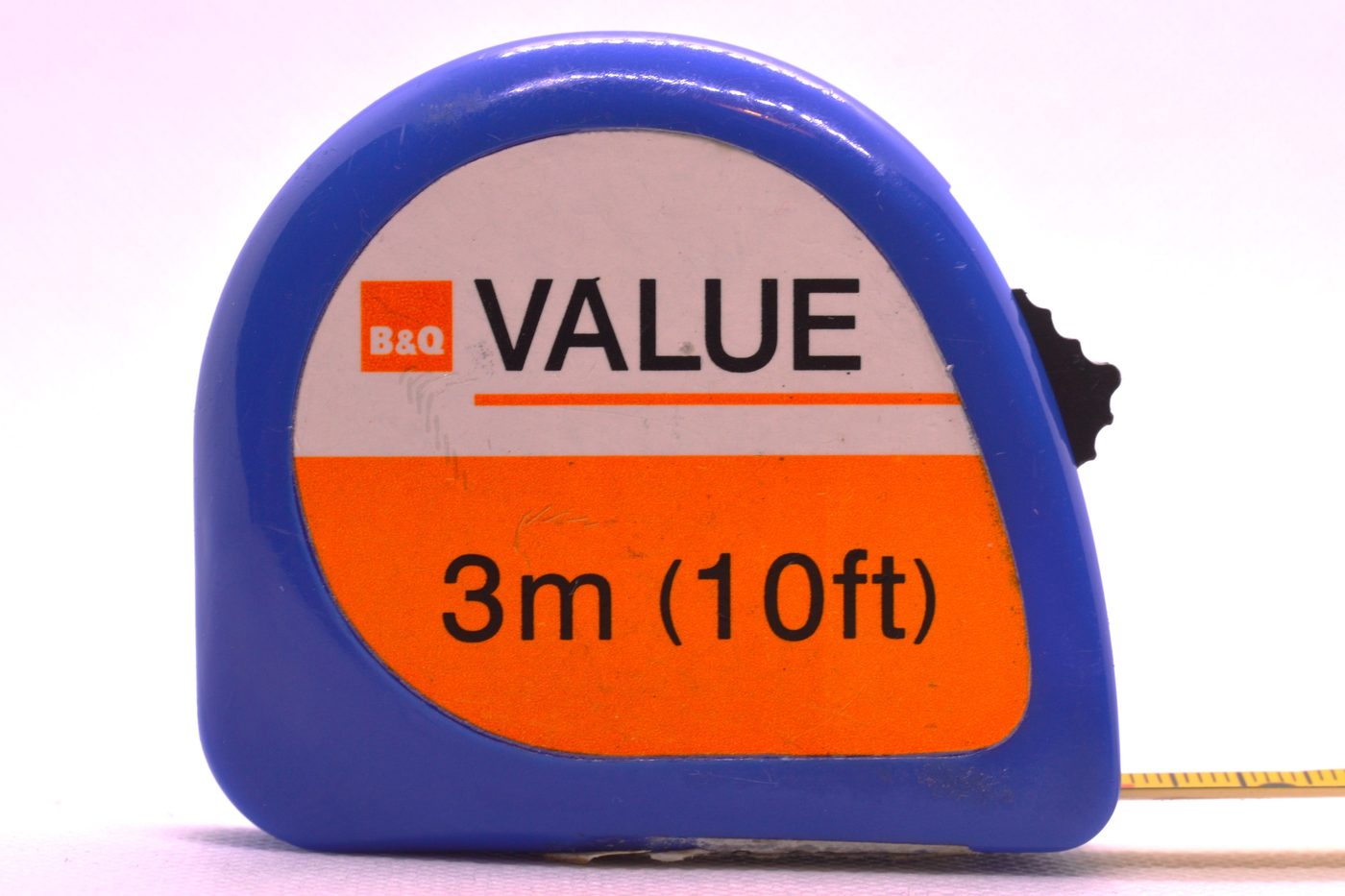
A measuring tape with metric and imperial units (Source: Wikimedia Commons)
- Tracing wheel: A spiked wheel used with carbon paper to transfer pattern markings onto fabric.
- Carbon paper: Special paper used under patterns to replicate markings precisely on fabric.
- Fabric scissors: Smaller scissors reserved for trimming threads and intricate cuts near seams.
3.1.3 Maintenance and care of cutting tools
Maintaining cutting tools prolongs their lifespan and ensures consistent performance in tailoring environments such as county government tailoring units or private fashion studios.
Guidelines for tool maintenance
- Regular sharpening: Dressmaker’s shears and rotary cutter blades require periodic sharpening by professionals to retain cutting precision.
- Cleaning: After use, blades should be wiped clean of fabric lint and dust to prevent rust and maintain smooth cutting action.
- Proper storage: Tools must be stored in protective cases or designated holders to avoid damage and accidental injury.
- Avoiding misuse: Shears should be used only for fabric cutting; opening bottles or cutting paper dulls blades prematurely.
- Inspection: Regular checks for loose screws or blade alignment issues help prevent accidents and ensure safe operation.
Proper maintenance routines contribute to the reliability of cutting tools, minimizing downtime and improving workflow efficiency in busy tailoring workshops.
3.1.4 Selection criteria for cutting tools and materials
Choosing the right tools and materials depends on the fabric type, garment complexity, and production scale typical in Kenyan fashion enterprises.
Factors influencing selection
- Fabric type: Heavier fabrics like denim or wool require robust, sharp tools, while delicate fabrics demand finer, precise instruments.
- Volume of production: High-volume tailoring units favor rotary cutters and cutting machines for speed, whereas bespoke tailors rely more on shears for detail work.
- Budget constraints: Small-scale tailors may prioritize versatile, durable tools that offer longevity over specialized equipment.
- Ergonomics: Comfortable handles and lightweight tools reduce fatigue during extended cutting sessions common in Nairobi’s garment factories.
- Safety features: Tools with blade guards and secure grips minimize workplace injuries, crucial for compliance with occupational safety standards.
Selecting appropriate cutting tools tailored to specific production needs supports quality outcomes and operational efficiency.
Practice Questions
-
List and explain five essential cutting tools used in gents’ garment construction, highlighting their specific uses. (10 marks)
-
Describe the maintenance procedures necessary to ensure longevity and performance of dressmaker’s shears. (8 marks)
-
Explain how fabric type influences the choice of cutting tools in a Kenyan tailoring workshop. (7 marks)
The rest of this chapter
🔒Create a free account to open more of this chapter.
Free: practical guides, quick cards, workplace scenarios and more.
Create a free account 🔒3.2 Principles of free hand cutting
Freehand cutting is a critical skill for fashion designers and tailors, enabling them to cut fabric accurately without relying on mechanical aids. In Kenya’s tailoring landscape, where custom designs and adjustments are frequent, mastering freehand cutting all…
🔒3.3 Free Hand Cutting Techniques
In Kenya’s fashion industry, mastering free hand cutting is essential for designers and garment makers who work with limited resources or bespoke orders. Free hand cutting allows for creativity and precision without reliance on pre-made patterns or templates,…
🔒3.4 Taking Body Measurements
Accurate body measurements form the foundation of well-fitting garments, especially in the Kenyan fashion industry where bespoke tailoring is highly valued. Tailors and designers working in Nairobi and other urban centers must be proficient in taking precise m…
🔒3.5 The basic free hand patterns
In the Kenyan fashion design industry, mastering basic free hand patterns is essential for bespoke garment construction, especially for gents’ wear where fit and style are paramount. Unlike commercial block patterns-free hand patterns allow designers to draft…
🔒3.6 Bundling Techniques
In the Kenyan fashion industry, efficient bundling techniques are crucial for managing garment pieces during production and distribution. Bundling involves grouping cut fabric pieces for specific garment styles or sizes, facilitating streamlined sewing, invent…
Chapter Summary
This chapter provides a comprehensive overview of the essential cutting tools, equipment, materials, and supplies used in garment construction, emphasizing their proper selection and maintenance. It explains the principles of free hand cutting, highlighting accuracy and fabric handling to ensure clean and precise cuts. Various free hand cutting techniques are described to equip learners with practical skills for shaping garment pieces effectively. The importance of taking accurate body measurements is discussed as a foundation for creating well-fitting garments. The chapter introduces basic free hand patterns that serve as templates for constructing different types of garments. Detailed guidance is given on cutting and assembling basic shirts, shorts, and trousers, focusing on the unique characteristics of each garment type. Additionally, bundling techniques are explored to organize fabric pieces efficiently during production. The chapter concludes with the application of these principles to basic skirts, blouses, and dresses, rounding out the essential garment construction skills.
Self-Assessment
🔒 PDFDownload this self-assessment, with answers
A. Written Assessment
- What is the primary function of a rotary cutter in garment construction? (2 marks)
- List four essential materials required for laying and cutting garment pieces. (4 marks)
🔒20 more in this section.
Chapter Examination Questions
🔒 PDFDownload these examination questions, with worked answers
SECTION A (40 Marks) - Answer ALL Questions
- Describe the essential cutting tools and equipment used in free hand cutting for basic gents’ garments in a Nairobi tailoring workshop. (4 marks)
- Explain the principles of free hand cutting and why they are important in the construction of a basic shirt. (4 marks)
🔒18 more in this section.
