Follow occupational safety and health procedures correctly to keep yourself and others safe.
Choose the right engineering materials needed for your specific task.
Determine the physical properties of engineering materials accurately.
Assess the mechanical properties of engineering materials with confidence.
Evaluate the thermal properties of engineering materials correctly.
Select the appropriate forms of supply for the engineering materials required.
Mastering these skills helps you make smart material choices that ensure quality, safety, and efficiency in real-world engineering projects.
Evaluating the properties of engineering materials is fundamental for welding professionals who must ensure the safety, durability, and performance of welded structures. Understanding the occupational health and safety standards related to materials handling and workshop practices protects workers and the environment from hazards inherent in welding operations. In Kenya, adherence to legislation and standards guides the welding industry towards responsible practices that safeguard personnel and comply with national and international requirements. This chapter explores the critical aspects of occupational health and safety, focusing on legislative frameworks, hazard identification, waste management, workshop safety, workplace procedures, hazard types, and prevention strategies.
1.1 Occupational health and safety standards
Occupational health and safety (OHS) standards in welding workshops provide a framework to protect workers from injuries and illnesses associated with exposure to hazardous materials, equipment, and processes. Welding involves risks such as exposure to fumes, ultraviolet radiation, and hot metals, which require strict controls and compliance with Kenyan legal requirements and international standards. Proper understanding and implementation of OHS standards reduce workplace accidents and promote a culture of safety critical to the welding profession.
1.1.1 Workplace legislation and standards
Workplace legislation and standards form the legal backbone ensuring safe working conditions and quality materials in welding environments. In Kenya, several laws and standards regulate welding operations to protect workers and ensure product integrity. Example: before a workshop that fabricates steel gates buys a batch of electrodes, the supervisor checks that they carry the manufacturer's classification and meet the standard specified for the job.
Kenyan workplace legislation governing welding
Occupational Safety and Health Act (OSHA) 2007: This act places a duty on employers to provide safe working environments, including proper training, protective equipment, and hazard control measures. Welding workshops must comply with its provisions on handling hazardous substances and machine safety.
Environmental Management and Coordination Act (EMCA) 1999: Addresses environmental protection, requiring proper disposal of welding waste and control of emissions.
Work Injury Benefits Act (WIBA): Provides compensation for workers injured or made ill by their work, encouraging employers to maintain safe workplaces.
Welding and materials standards
Kenya Bureau of Standards (KEBS): Sets and promotes standards for materials, equipment, and personal protective equipment (PPE) to ensure quality and safety.
ISO 9001: Quality management systems that welding workshops adopt to ensure consistent quality in welding operations.
ISO 17637: Visual testing of fusion-welded joints, used to check weld quality and maintain structural integrity.
AWS (American Welding Society) standards: Widely referenced for welding procedures and qualifications, and often adopted by welding firms to enhance quality.
Importance of compliance with materials standards
Ensures that welding materials meet chemical and mechanical property requirements to prevent failures.
Promotes uniformity and reliability in welded products, crucial for industries like construction and manufacturing.
Legal compliance helps avoid penalties and enhances the reputation of welding enterprises.
Enforcement and monitoring
Regular inspections by occupational safety and health officers and by KEBS officers to verify adherence.
Internal audits and quality checks by workshop supervisors.
Training programmes to keep welders updated on legislative changes and standards.
1.1.2 Workplace hazard identification
Identifying hazards in welding workshops is essential to prevent accidents and health issues. Welding environments present diverse risks that must be systematically recognised and assessed before effective controls can be chosen. Example: a walk through a fabrication bay may reveal a damaged electrode holder cable, an unsecured gas cylinder and a blocked exit, each of which needs a different control. The categories of hazard found are described under types of workplace hazards.
Methods of hazard identification
Workplace inspections: Routine walkthroughs to observe unsafe conditions or practices.
Job safety analysis (JSA): Breaking down welding tasks, such as setting up and striking an arc, into steps to identify potential risks at each step.
Employee reporting systems: Encouraging welders to report unsafe conditions or near misses.
Use of hazard checklists: Standardised tools to systematically assess common welding hazards.
Role of risk assessments
Evaluating the likelihood and severity of identified hazards.
Prioritising hazards for control measures based on risk levels.
Documenting findings to inform safety planning and training.
Importance of worker participation
Welders' firsthand experience helps identify less obvious hazards.
Promotes ownership of safety practices and enhances hazard recognition.
1.1.3 Workshop waste management
Managing waste generated in welding workshops is critical for environmental protection, regulatory compliance, and workplace cleanliness. Welding produces various wastes including metal scraps, slag, used electrodes, and chemical containers. Example: offcuts from a steel plate cutting job are sorted into a metal bin, while oily rags from degreasing go into a separate hazardous waste container.
Categories of welding workshop waste
Metal scraps and offcuts: Leftover pieces from cutting and grinding.
Slag and flux residues: By-products of the welding process.
Used electrodes and welding rods: Stub ends and contaminated consumables.
Hazardous chemical waste: Solvents, oils, and degreasers.
General waste: Packaging, rags, and non-hazardous refuse.
Proper waste segregation methods
Separate containers for metal waste, hazardous waste, and general waste.
Clearly labelled bins to prevent cross-contamination.
Designated areas for temporary storage before disposal or recycling.
Disposal and recycling practices
Metal scraps are collected and sold to scrap dealers for recycling.
Hazardous wastes are disposed of following EMCA guidelines, often through licensed waste handlers.
Used oils and solvents undergo treatment or are handed to authorised collectors.
Benefits of effective waste management
Reduces health risks from exposure to toxic substances.
Minimises environmental pollution, protecting soil and water resources.
Enhances workshop organisation and reduces accident risks.
1.1.4 Workshop safety
Maintaining safety in the welding workshop requires a combination of workshop rules and administrative measures, engineering controls and personal protective equipment. Each layer covers weaknesses in the others, so a welder who wears correct PPE still depends on guarded machines, sound cables and a workshop that follows its rules.
1.1.4.1 Regulations
Workshop safety regulations are the rules that govern how people behave and how equipment is used in the welding workshop. They draw on the legal duties of the employer and on the workshop's own policies, and every person entering the work area must follow them. Example: a rule that no grinder is switched on unless its guard is fitted and the operator wears a face shield prevents serious grinding injuries.
Workshop safety rules:
Authorised operation only: Only trained and authorised persons operate welding machines, grinders and cutting equipment. Apprentices work under supervision until assessed as competent.
Housekeeping: Walkways and exits are kept clear, cables are kept off the floor where people walk, and oily rags are kept away from hot work.
Gas cylinder handling: Cylinders are kept upright and secured, valve caps are fitted when not in use, and oxygen and fuel gas cylinders are stored apart and away from heat.
Hot work control: Combustible materials are removed or shielded before welding or cutting, and a suitable fire extinguisher is placed within reach.
Electrical checks: Cables, electrode holders and earth clamps are inspected before use, and machines are switched off and isolated before repair.
Arc screening: Welding screens or curtains protect other workers and passers-by from arc flash.
Personal discipline: No eating, drinking or smoking in the work area, and no horseplay near machines.
Administrative safety measures:
Clear safety policies and procedures tailored to welding activities.
Scheduled safety training and drills emphasising emergency response.
Permit-to-work systems for hot work permits to control fire risks.
Induction for new workers and visitors before they enter the workshop.
Equipment inspection schedules covering machines, cables, hoses and cylinders.
1.1.4.2 Personal Protective Equipment
Personal protective equipment (PPE) is the last barrier between the welder and a hazard that cannot be removed or controlled at source. It must match the hazard: a welding helmet protects against arc radiation, but not against grinding dust, so a separate face shield or safety glasses are needed when grinding. Example: a welder doing overhead SMAW wears a flame-resistant jacket, gauntlet gloves and a helmet to protect against falling sparks and spatter.
Name
Specification
Use
Welding helmet
Auto-darkening, UV/IR protection
Protects eyes and face from radiation and sparks
Welding gloves
Heat-resistant leather
Protects hands from burns and cuts
Respirator mask
N95 or higher filtration level
Filters welding fumes and dust
Safety boots
Steel-toe, slip-resistant
Protects feet from falling objects
Welding jacket
Flame-resistant cotton or leather
Shields body from sparks and heat
Safety glasses
Impact-resistant, side shields
Protects eyes from grinding sparks and chips
Ear protection
Ear muffs or plugs with a rated noise reduction
Reduces noise from grinding and chipping
PPE must be inspected regularly for damage and replaced as needed.
Proper donning and doffing techniques reduce contamination.
1.1.5 Workplace procedures
Standardised workplace procedures ensure consistent application of safety and quality measures in welding workshops. These procedures guide workers on how to perform tasks safely and efficiently, and they make clear who is responsible for what. Example: a procedure for hot work states who issues the permit, who watches for fires and how long the area is checked after welding stops.
1.1.5.1 Roles and responsibilities
Safety in a welding workshop works only when each person knows their duties. Duties run from the employer who provides resources, through the supervisor who checks daily practice, to the welder who follows the rules.
Employer: Provides a safe workplace, suitable machines, PPE, training and first aid facilities, and acts on reported hazards.
Supervisor: Monitors adherence to procedures during welding operations, and addresses non-compliance through corrective actions and, where needed, disciplinary measures.
Welder or artisan: Follows procedures, uses PPE correctly, keeps the work area tidy, and reports hazards, incidents and near misses.
Safety officer or safety committee: Carries out inspections, reviews incident reports, and advises management on improvements.
First aider: Gives first aid for burns, eye injuries and electric shock until medical help arrives.
Training and competency: Workers are trained on procedures before performing welding tasks, competency assessments verify they can follow them, and refresher training addresses updates or identified gaps.
1.1.5.2 Documentation
Documentation gives the workshop written proof of what must be done and what has been done. It supports training, investigations and traceability, and it protects both workers and the employer. Example: a maintenance log showing a welding machine's last cable inspection helps the supervisor decide whether it is safe to use.
Standard operating procedures (SOPs): Cover welding processes, equipment use, emergency response and maintenance. They incorporate legal requirements and good industry practice, and are kept accessible to all workers.
Maintenance logs: Record inspections and repairs of welding equipment to prevent malfunctions.
Incident reports: Capture accidents and near misses so that their causes can be found and repeats prevented.
Material certification records: Link materials used to their certificates to ensure traceability.
Hot work permits and risk assessments: Record the hazards identified, the controls applied and who authorised the work.
Training records: Show who has been trained and assessed on which procedures and equipment.
1.1.5.3 Communication
Clear communication ensures that hazards, instructions and changes reach everyone in the workshop. Welding areas are noisy and bright, so communication must not depend on speech alone. Example: a red prohibition sign at the gas store and a short briefing before a shared hot work job both warn people of the danger.
Safety signs and labels: Red signs mark prohibition and fire equipment, yellow signs warn of hazards, blue signs give mandatory instructions such as wearing a helmet, and green signs show exits and first aid.
Toolbox talks: Short briefings at the start of a shift covering the day's tasks, hazards and controls.
Reporting lines: Workers know whom to inform about a hazard, an injury or damaged equipment, and receive feedback on the action taken.
Hand signals and alarms: Agreed signals and audible alarms are used where noise or helmets make speech difficult.
Shift handover: Outgoing workers tell incoming workers about faulty equipment, open permits and unfinished hot work.
1.1.5.4 Emergency procedures
Emergency procedures set out what everyone does when a fire, electric shock, injury or chemical spill occurs. Quick, rehearsed action limits harm, so the procedures are posted, practised in regular drills, and supported by first aid kits and trained personnel on site. Example: a spark ignites rags near the cutting bench and the workers follow the fire response steps below.
Fire response procedure:
Raise the alarm by shouting a warning and operating the alarm point so everyone knows.
Switch off the welding machine and, where safe, close cylinder valves to remove power and fuel.
Fight the fire only if it is small, the exit is behind you and you are trained to use the extinguisher.
Use the correct extinguisher type for the fire, for example carbon dioxide or dry powder on electrical equipment.
Evacuate by the nearest safe exit if the fire is not quickly controlled, helping those who need assistance.
Gather at the assembly point and carry out a roll call so missing persons are reported at once.
Call the emergency services and give the location and nature of the fire.
Do not re-enter until the area has been declared safe, then report and record the incident.
For electric shock, switch off the supply before touching the victim and give first aid. For a chemical spill, contain the spill, ventilate, and follow the instructions on the safety data sheet. For injuries, give first aid and arrange medical care.
1.1.6 Types of workplace hazards
Workplace hazards in welding settings can be classified into categories that affect workers' safety and health. Understanding these types helps in tailoring preventive measures, because a physical hazard such as arc radiation needs a different control from a chemical hazard such as fume.
1.1.6.1 Physical
Physical hazards are energy-related sources of harm such as heat, light, noise, electricity and moving parts. They are present in almost every welding task.
Burns: Hot metal, spatter and sparks burn skin and clothing.
Radiation: Ultraviolet and infrared radiation from the arc cause eye damage (arc eye) and skin burns.
Noise: Grinding, chipping and cutting operations can lead to hearing loss.
Moving machinery: Grinders, drills and guillotines can cause cuts, entanglement and flying fragments.
Electrical: Faulty welding machines or cables, improper grounding and damaged insulation increase the risk of electric shock.
Fire and explosion: Flammable gases, sparks and combustible materials can ignite, and damaged cylinders can be dangerous.
1.1.6.2 Chemical
Chemical hazards arise from substances that harm the body by inhalation, skin contact or swallowing. In welding, the main sources are fumes, gases and workshop chemicals.
Exposure to welding fumes containing manganese, chromium and nickel.
Inhalation of gases such as carbon monoxide, ozone and nitrogen oxides.
Fume from galvanised steel, which contains zinc and can cause fever-like illness if inhaled.
Contact with solvents and degreasers used in surface preparation, whose vapours from some products can break down into toxic gases near the arc.
1.1.6.3 Biological
Biological hazards come from micro-organisms and contaminated materials. They are less common in welding than other hazards but still need attention.
Exposure to contaminated water or surfaces can cause infections, particularly through cuts and burns.
Shared PPE such as helmets, respirators and gloves, or shared eating areas, may facilitate the spread of pathogens.
Poor sanitation and untreated wounds can allow infection to develop.
1.1.6.4 Environmental
Environmental hazards come from the conditions in and around the work area rather than from the task itself. They can make an otherwise safe task dangerous.
Confined spaces: Shielding gases such as argon and carbon dioxide are heavier than air and can collect in low or enclosed spaces, displacing oxygen.
Poor ventilation: Fumes and gases build up where air does not move, increasing exposure.
Weather and heat: Welding outdoors in rain increases shock risk, and hot, humid conditions cause heat stress, especially in full PPE.
Poor lighting and floors: Dim areas, wet or oily floors and cluttered walkways lead to slips, trips and falls.
Pollution from the workshop: Spills and uncontrolled waste can contaminate soil and drains.
Ergonomic hazards:
Ergonomic hazards come from the way work is arranged and performed, and they cause gradual injury rather than sudden accidents. Welders often hold awkward positions for long periods, so back and joint problems develop over months or years. Example: a welder fitting a pipe in a trench may hold a bent, twisted posture for an hour.
Repetitive motions: Repetitive welding and grinding movements can cause musculoskeletal disorders.
Awkward postures: Welding in confined spaces or overhead forces the body into strained positions.
Manual handling: Lifting heavy plates, pipes and cylinders leads to strains, so mechanical aids or team lifting are used.
Control measures: Adjustable workstations, positioners, job rotation and rest breaks reduce the strain.
1.1.7 Prevention and control
Preventing and controlling hazards in welding workshops involves a hierarchy of controls that prioritises elimination and substitution before relying on personal protection. Controls higher in the hierarchy are more reliable because they do not depend on the welder's behaviour. Example: for a job that produces heavy fume, the workshop first considers a different process, then local exhaust, then limited exposure time, and finally respirators.
Elimination and substitution
Using welding methods that produce fewer fumes, such as TIG instead of SMAW when the job allows.
Replacing toxic solvents with less hazardous alternatives.
Engineering controls
Ventilation systems: Local exhaust ventilation captures and removes welding fumes and gases at the source.
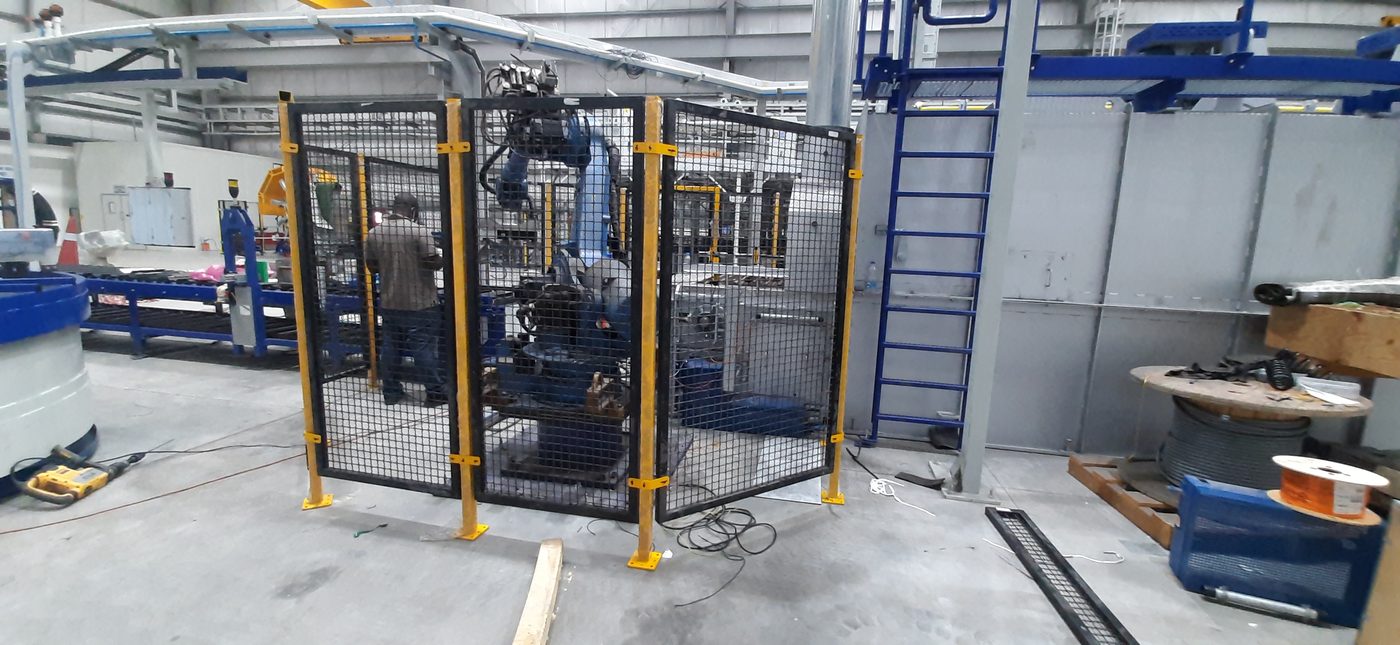
Machine guards: Protective barriers on grinders and cutting tools prevent injuries.
Industrial machine guard enclosing equipment (Source: Wikipedia (Machine guarding))
Fire suppression systems: Fire extinguishers and sprinklers to manage fire outbreaks.
Ergonomic workstations: Adjustable tables and supports to reduce strain.
Insulated tools and equipment: Reduce electrical risks.
Administrative controls
Scheduling work to limit exposure time to hazards.
Implementing job rotation to reduce ergonomic strain.
Providing training on hazard awareness and safe work practices.
Use of personal protective equipment
PPE is used when the hazard cannot be removed or reduced enough by higher controls, and it is selected to suit the specific hazard.
Ensuring availability and correct use of the PPE listed under Personal Protective Equipment.
Practice Questions
Explain how the Occupational Safety and Health Act (OSHA) 2007 influences safety practices in welding workshops. (6 marks)
Identify and describe five types of hazards commonly found in welding environments. (10 marks)
Outline the steps involved in effective workshop waste management in a welding facility. (8 marks)
Discuss the role of engineering controls in maintaining workshop safety for welders. (6 marks)
Describe six key elements that should be included in workplace procedures to ensure safety and efficiency in welding operations. (12 marks)
The rest of this chapter
🔒
Create a free account to open more of this chapter.
Free: practical guides, quick cards, workplace scenarios and more.
Every welding decision starts with the properties of the metal on the bench. Physical, mechanical and thermal properties determine how a metal melts, how it reacts to the arc, how much it distorts, and whether the finished joint can carry its load in service.…
🔒1.3 Forms of Metal Supply
The availability of metals in various forms is critical to welding professionals who must select the appropriate metal shape and size for specific fabrication tasks. In Kenya's welding industry, understanding the characteristics and typical uses of different m…
🔒1.4 Applications of forms of supply
Metal reaches the workshop, the foundry or the construction site in standard forms, and each form suits certain jobs. Choosing the right form is a practical decision: it affects how much machining, cutting and welding is needed, how much material is wasted, an…
🔒1.5 Mill Test Certificates
A mill test certificate (MTC), also called a mill test report or material test certificate, is a document issued by the manufacturer of a metal product. It states the grade of the material, the batch it came from, and the results of the chemical analysis and m…
🔒1.6 Types of Metals
In welding practice, understanding the types of metals is crucial for selecting appropriate welding techniques and ensuring structural integrity. Metals broadly classify into ferrous and non-ferrous groups, each with distinct physical and chemical properties t…
Chapter Summary
This chapter examined occupational health and safety standards critical to maintaining a secure working environment in metallurgy, covering relevant legislation, hazard identification, waste management, and safety regulations including the use of personal protective equipment. It highlighted the roles and responsibilities within workplace procedures, emphasizing proper documentation, communication, and emergency response protocols. Various types of workplace hazards were explored, including physical, chemical, biological, and environmental risks, alongside methods for their prevention and control. The chapter then detailed the physical, mechanical, and thermal properties of metals, describing characteristics such as color, strength, ductility, melting point, and thermal expansion. Different forms of metal supply were introduced, including ingots, bars, plates, tubes, and wires, followed by their specific applications in engineering contexts. The importance of Mill Test Certificates was explained, focusing on how to interpret and use them to verify material quality. Finally, the chapter distinguished between ferrous and non-ferrous metals, outlining common types such as steel, cast iron, aluminium, copper, and titanium, and their relevance in various industrial applications.
Chapter Examination Questions
🔒 PDFDownload these examination questions, with worked answers
SECTION A (40 Marks) - Answer ALL Questions
Explain how the Occupational Safety and Health Act (OSHA) 2007 influences welding workshop safety procedures in a typical Nairobi-based metal fabrication company. (4 marks)
Identify four types of physical hazards commonly encountered in welding workshops and describe one control measure for each. (4 marks)