
By the end of this chapter, you will be able to:
Mastering these skills will help you perform soldering work confidently and safely, making you a valuable professional in your trade.
Soldering is a fundamental skill across many professional fields in Kenya, from repairing electronic devices in ICT businesses to maintaining plumbing systems in county government offices and hospitals. Mastery of soldering tools and equipment ensures efficient, safe, and durable joins in metals and electrical components, critical for operational reliability. This chapter introduces the essential soldering tools, their specific uses, and the best practices for their care and storage to prolong usability and maintain workplace safety.
Soldering requires specialized tools that vary depending on the materials and scale of the task. Understanding the types of soldering equipment and their applications is vital for professionals across sectors such as banking, healthcare, and retail, where equipment maintenance often involves minor solder repairs. Proper handling, maintenance, and storage of soldering tools enhance their lifespan and ensure consistent performance.
The variety of soldering tools available caters to different joining tasks, from fine electronics work to plumbing repairs. Each tool type is designed to deliver specific heat levels, precision, and ease of use, which influence the quality of the soldered joint.
| Name | Specification | Use |
|---|---|---|
| Soldering Iron | 30-60 Watts, adjustable temperature feature | Used for general electronics soldering and small metalwork |
| Soldering Gun | 100-240 Watts, pistol-shaped | Suitable for heavier gauge wires and larger metal joints |
| Soldering Station | Includes adjustable iron, temperature control | Provides precise temperature control for delicate electronics |
| Desoldering Pump | Spring-loaded vacuum pump | Removes molten solder from joints for rework or repair |
| Soldering Tweezers | Dual heated tips, temperature adjustable | Used for surface-mount device soldering and small components |
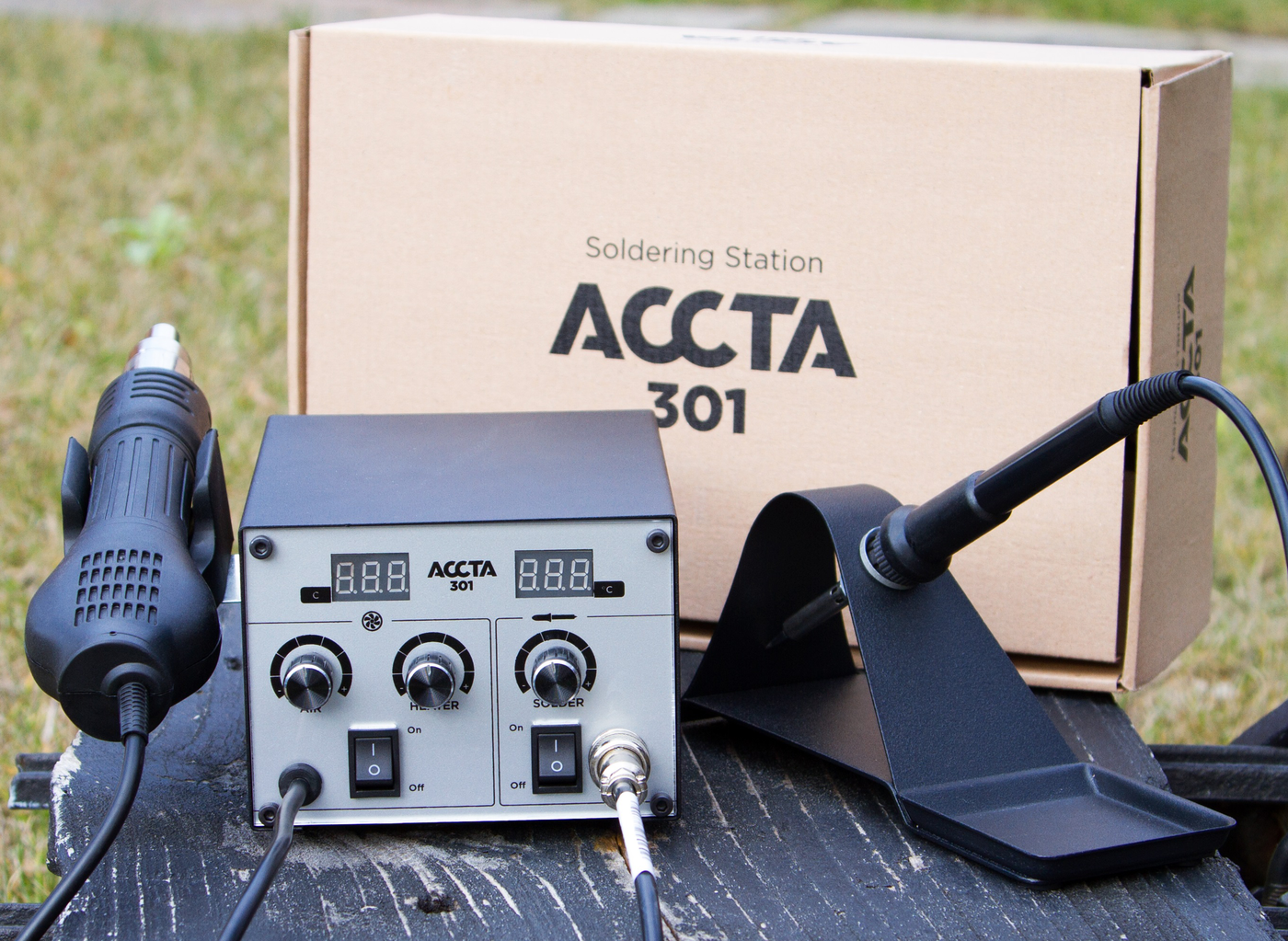
ACCTA 301 soldering station with iron and hot air gun (Source: Wikimedia Commons)
Soldering tools serve multiple functions depending on the professional environment and the nature of the work. Their use extends beyond simple joining, encompassing repair, assembly, and maintenance tasks critical in various Kenyan industries.
Soldering guns and irons are used to join copper pipes and metal fittings in water supply systems maintained by county government offices. Proper soldering ensures leak-proof joints vital for water conservation and hygiene.
A copper pipe T-joint being soldered (Source: PLUMB 5 LEARNING GUIDE-1 (1))
In small-scale manufacturing units, such as cooperatives producing metal crafts, soldering tools facilitate assembly of metal parts. This enhances product durability and aesthetic finish.
Hotels and retail businesses use soldering tools to maintain and assemble electronic signage and lighting systems. Efficient soldering reduces downtime and maintenance costs.
Technical training institutions employ soldering stations and tweezers to teach students precision soldering skills required for modern electronics assembly and repair.
Proper care and storage of soldering tools prevent damage, ensure safety, and extend tool life. In busy workplaces such as banks and agricultural cooperatives, maintaining tools in good condition reduces replacement costs and supports uninterrupted operations.
Identify five types of soldering tools commonly used in professional settings and describe their primary uses. (10 marks)
Explain why regular maintenance of soldering tools is critical in a hospital’s biomedical engineering workshop. (8 marks)
Describe safe storage practices for soldering equipment in a busy retail electronics repair shop. (7 marks)
Discuss the advantages of using a soldering station over a basic soldering iron in university technical workshops. (5 marks)
Create a free account to open more of this chapter.
Free: practical guides, quick cards, workplace scenarios and more.
Create a free accountThis chapter explored the essential tools and equipment used in soldering, detailing the various types, their specific uses, and the proper methods for care and storage to ensure longevity and effective performance. It then examined the materials involved in soldering, focusing on fluxes and solder, and their critical roles in facilitating strong and clean joints. The discussion proceeded to the setting of soldering parameters, highlighting the importance of controlling temperature and pressure to achieve optimal results. The soldering process was described step-by-step, emphasizing the correct procedure to follow for successful joint formation. Different types of soldering operations were outlined, illustrating the range of techniques available for various applications. Finally, the chapter covered the practical uses of soldering across multiple contexts, demonstrating its versatility and significance in fabrication and repair work.
Type: Individual
| Tools & Equipment | Materials |
|---|---|
| Soldering iron 60W | Solder wire (60/40 Tin-Lead), 1.0 mm diameter |
| Pipe cutter | Flux paste (rosin-based) |
| Wire brush | Copper pipe, Ø15 mm, length 150 mm |
| Soldering stand | |
| Cleaning cloth | |
| Heat resistant gloves | |
| Safety goggles |
| S/N | Item | Quantity |
|---|---|---|
| 1 | Soldering iron 60W | 1 Pc per Candidate |
| 2 | Solder wire (60/40 Tin-Lead), 1.0 mm diameter | 50 grams per Candidate |
| 3 | Flux paste (rosin-based) | 1 tube per 3 Candidates |
| 4 | Copper pipe, Ø15 mm, length 150 mm | 2 pieces per Candidate |
| 5 | Pipe cutter | 1 Pc per Candidate |
| 6 | Wire brush | 1 Pc per Candidate |
| 7 | Heat resistant gloves | 1 pair per Candidate |
| 8 | Safety goggles | 1 pair per Candidate |
| 9 | Soldering stand | 1 Pc per Candidate |
| 10 | Cleaning cloth | 1 Pc per Candidate |
| Items to be Evaluated | Marks Available | Marks Obtained | Comments |
|---|---|---|---|
| TASK 1: Adherence to Safety Procedures | |||
| Wore safety goggles correctly (Award 1 or 0 mark) | 1 | ||
| Wore heat resistant gloves correctly (Award 1 or 0 mark) | 1 | ||
| Used a soldering stand to hold the iron safely (Award 1 or 0 mark) | 1 | ||
| Ensured the work area was clean and free from flammable materials (Award 1 or 0 mark) | 1 | ||
| Sub-Total | 4 | ||
| TASK 2: Selection and Preparation of Tools and Materials | |||
| Selected correct soldering iron and checked it for safety (Award 1 or 0 mark) | 1 | ||
| Cut copper pipes to specified length using pipe cutter (Award 1 or 0 mark) | 1 | ||
| Cleaned pipe ends using wire brush to remove oxidation (Award 1 or 0 mark) | 1 | ||
| Applied flux paste evenly on pipe ends to be joined (Award 1 or 0 mark) | 1 | ||
| Prepared solder wire for use (Award 1 or 0 mark) | 1 | ||
| Sub-Total | 5 | ||
| TASK 3: Demonstration of Proper Soldering Technique | |||
| Heated the joint area with soldering iron adequately (Award 1 or 0 mark) | 1 | ||
| Applied solder wire correctly to heated joint to ensure good flow (Award 1 or 0 mark) | 1 | ||
| Avoided overheating or burning of the pipes and flux (Award 1 or 0 mark) | 1 | ||
| Allowed joint to cool naturally without disturbance (Award 1 or 0 mark) | 1 | ||
| Cleaned the soldered joint with cleaning cloth after cooling (Award 1 or 0 mark) | 1 | ||
| Sub-Total | 5 | ||
| TASK 4: Housekeeping | |||
| Turned off and safely stored soldering iron and tools (Award 1 or 0 mark) | 1 | ||
| Disposed of waste materials correctly (Award 1 or 0 mark) | 1 | ||
| Cleaned work area and returned tools and materials to proper place (Award 1 or 0 mark) | 1 | ||
| Sub-Total | 3 | ||
| PRODUCT CHECKLIST | |||
| Soldered joint is clean, smooth and fully bonded without gaps or cold joints (Award 2 or 0 marks) | 2 | ||
| Copper pipes are joined securely and aligned correctly as per working drawing (Award 2 or 0 marks) | 2 | ||
| No visible flux residue or solder splatter on the pipes (Award 1 or 0 mark) | 1 | ||
| Dimensions of joined pipes conform to specified length 150 mm ±1 mm (Award 2 or 0 marks) | 2 | ||
| Sub-Total | 7 | ||
| GRAND TOTAL | 24 | ||
Type: Individual
| Tools & Equipment | Materials |
|---|---|
| Propane gas torch with regulator and hose | Copper sheet 100 mm x 50 mm x 1 mm |
| Soldering iron 60W | Brass flat bar 100 mm x 20 mm x 2 mm |
| Wire brush | Soft solder wire (Sn60Pb40) 1.5 mm diameter |
| Emery cloth (Grade 400) | Hard solder rod (silver solder) 2 mm diameter |
| Pliers | Flux for soft soldering |
| Bench vice | Flux for hard soldering |
| Leather gloves | |
| Safety goggles | |
| Leather apron |
| S/N | Item | Quantity |
|---|---|---|
| 1 | Copper sheet 100 mm x 50 mm x 1 mm | 2 pcs per Candidate |
| 2 | Brass flat bar 100 mm x 20 mm x 2 mm | 2 pcs per Candidate |
| 3 | Soft solder wire (Sn60Pb40) 1.5 mm diameter | 1 roll per 5 Candidates |
| 4 | Hard solder rod (silver solder) 2 mm diameter | 1 rod per 5 Candidates |
| 5 | Flux for soft soldering | 1 jar per 10 Candidates |
| 6 | Flux for hard soldering | 1 jar per 10 Candidates |
| 7 | Propane gas torch with regulator and hose | 1 set per Candidate |
| 8 | Soldering iron 60W | 1 per Candidate |
| 9 | Wire brush | 1 per Candidate |
| 10 | Emery cloth (Grade 400) | 1 piece per Candidate |
| 11 | Pliers | 1 per Candidate |
| 12 | Bench vice | 1 per Candidate |
| 13 | Leather gloves | 1 pair per Candidate |
| 14 | Safety goggles | 1 pair per Candidate |
| 15 | Leather apron | 1 per Candidate |
| 16 | Fire extinguisher (CO2 type) | 1 per workshop |
| Items to be Evaluated | Marks Available | Marks Obtained | Comments |
|---|---|---|---|
| TASK 1: Adhere to Safety Procedures | |||
| Wore safety goggles correctly (Award 1 or 0) | 1 | ||
| Wore leather gloves (Award 1 or 0) | 1 | ||
| Wore leather apron (Award 1 or 0) | 1 | ||
| Ensured work area clear of flammable materials (Award 1 or 0) | 1 | ||
| Sub-Total | 4 | ||
| TASK 2: Prepare Workpieces for Soldering | |||
| Cleaned copper sheets and brass bars using wire brush and emery cloth (Award 2 or 0) | 2 | ||
| Secured workpieces correctly in bench vice (Award 1 or 0) | 1 | ||
| Applied appropriate flux evenly on joint areas for soft and hard soldering (Award 2 or 0) | 2 | ||
| Sub-Total | 5 | ||
| TASK 3: Perform Soft Soldering | |||
| Set up and operated soldering iron correctly (Award 1 or 0) | 1 | ||
| Applied soft solder wire correctly to heated joint (Award 2 or 0) | 2 | ||
| Produced uniform, clean solder joints without excess solder (Award 2 or 0) | 2 | ||
| Sub-Total | 5 | ||
| TASK 4: Perform Hard Soldering (Brazing) | |||
| Set up and operated propane gas torch safely (Award 1 or 0) | 1 | ||
| Applied hard solder rod correctly with torch heat (Award 2 or 0) | 2 | ||
| Produced uniform, strong brazed joints without burn marks or voids (Award 3 or 0) | 3 | ||
| Sub-Total | 6 | ||
| TASK 5: Shutdown and Housekeeping | |||
| Turned off gas torch and soldering iron properly (Award 1 or 0) | 1 | ||
| Cleaned work area and disposed of waste safely (Award 1 or 0) | 1 | ||
| Returned tools and materials to their designated places (Award 1 or 0) | 1 | ||
| Sub-Total | 3 | ||
| PRODUCT CHECKLIST | |||
| Soft soldered copper sheets with joints uniform and free from cracks or excess solder (Award 5 or 0) | 5 | ||
| Hard soldered brass bars with brazed joints uniform, strong and free from burn marks or porosity (Award 5 or 0) | 5 | ||
| Workpieces dimensionally accurate and clamped as per working drawing (100 mm x 50 mm x 1 mm; 100 mm x 20 mm x 2 mm) (Award 4 or 0) | 4 | ||
| Sub-Total | 14 | ||
| GRAND TOTAL | 37 | ||
At the start of this chapter we promised you would be able to:
Tick each one you can genuinely do.
So, are you there yet?
You're competent when you can confidently do 50% or more of what this chapter promised.
Sign in to record how you're doing.