
By the end of this chapter, you will be able to:
Mastering these skills ensures you can build and maintain reliable networks that keep people connected and businesses running efficiently.
Identifying the type of network is fundamental for cyber security professionals tasked with protecting organizational assets in Kenya. Different network types come with distinct architectures, protocols, and vulnerabilities, requiring tailored security strategies. Understanding these networks enables effective threat detection, risk mitigation, and response planning. This chapter equips learners with the foundational terminology essential for classifying and analyzing computer networks in diverse Kenyan environments such as county government offices, banks, educational institutions, and healthcare facilities.
A network is a collection of interconnected devices that communicate and share resources such as data, applications, and hardware. In cyber security, networks form the backbone through which information flows, making their protection critical. A computer network specifically refers to a set of computers linked to exchange information and share resources. Kenyan cyber security professionals encounter various computer networks, from simple setups in small businesses to complex infrastructures in financial institutions like Equity Bank. Understanding what constitutes a network is the basis for securing communication channels and detecting unauthorized access.
Network topology describes the physical or logical arrangement of devices and connections within a network. It influences performance, scalability, and security vulnerabilities. Common topologies include star, bus, ring, mesh, and hybrid. For example, a star topology used in a Nairobi hospital connects all devices through a central switch, simplifying monitoring but creating a single point of failure. Recognizing topology helps cyber security teams design appropriate defense mechanisms such as segmentation and intrusion detection.
A network protocol is a set of rules and conventions that govern data exchange between network devices. Protocols dictate how data is formatted, transmitted, and received, ensuring interoperability. Examples include TCP/IP, HTTP, FTP, and DNS. Kenyan cyber security experts must understand protocols to analyze traffic, configure firewalls, and identify malicious activities. For instance, monitoring TCP/IP packet flow at a county government office can reveal attempts at unauthorized access or data exfiltration.
Network types classify networks based on their geographic scope and connectivity:
Local Area Network (LAN): Covers a small geographical area such as an office or campus. LANs provide high-speed connections ideal for internal communication and resource sharing. A university in Kenya typically uses LANs to connect classrooms, libraries, and administration offices.
Wide Area Network (WAN): Spans large geographical areas, connecting multiple LANs. WANs rely on public or private communication links. Kenyan banks use WANs to link branches across the country, requiring robust security to protect sensitive financial data.
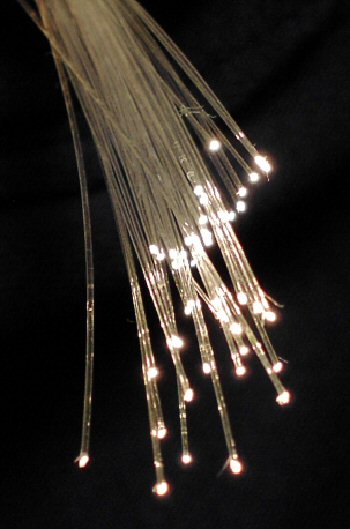
Fiber optic cables used in wide area networks (Source: Wikimedia Commons (Computer network))
Metropolitan Area Network (MAN): Covers a city or metropolitan region, larger than LAN but smaller than WAN. County governments may use MANs to connect various departments within Nairobi for efficient service delivery.
Personal Area Network (PAN): The smallest network type, usually within a few meters, connecting personal devices such as smartphones and laptops. Cyber security professionals must secure PANs against threats like unauthorized Bluetooth access in hotel conference settings.
Understanding these network types enables professionals to tailor security controls appropriate to the scale and complexity of each environment.
Create a free account to open more of this chapter.
Free: practical guides, quick cards, workplace scenarios and more.
Create a free accountThis chapter explored the fundamental terms related to computer networking, establishing a clear understanding of key concepts such as nodes, links, and protocols. It then detailed the essential components that make up a network, including hardware devices like routers, switches, and network interface cards, explaining their roles in facilitating communication. The discussion progressed to network design and architecture, highlighting how networks are structured to optimize performance, scalability, and security. Various architectural models and design considerations were examined to illustrate how networks meet specific organizational needs. The chapter concluded with a study of different network topologies, describing configurations such as bus, star, ring, mesh, and hybrid, and how each impacts network efficiency and fault tolerance. Together, these topics provide a comprehensive foundation for identifying and understanding different types of networks in practical settings.
Type: Individual
| Tools & Equipment | Materials |
|---|---|
| Notebook or writing pad | Reference sheet on networking terms |
| Pen or pencil | |
| Computer or tablet with word processing software |
| S/N | Item | Quantity |
|---|---|---|
| 1 | Notebook or writing pad | 1 Pc per Candidate |
| 2 | Pen or pencil | 1 Pc per Candidate |
| 3 | Reference sheet on networking terms | 1 Pc per Candidate |
| 4 | Computer or tablet with word processing software | 1 Pc per Candidate |
| Items to be Evaluated | Marks Available | Marks Obtained | Comments |
|---|---|---|---|
| TASK 1: Definition and Explanation of Networking Terms | |||
| Candidate uses appropriate PPE if applicable (e.g. safe use of electrical devices) (Award 1 mark for correct PPE usage or zero) | 1 | ||
| Candidate selects suitable tools and materials before starting the task (Award 2 marks for correct selection, zero if missing) | 2 | ||
| Candidate writes definitions for at least 10 basic networking terms (Award 1 mark per correct term definition up to 5) | 5 | ||
| Candidate explains the function of each networking term clearly (Award 1 mark per clear explanation up to 5) | 5 | ||
| Candidate organizes the document logically with appropriate headings (Award 2 marks for logical organization and headings, zero otherwise) | 2 | ||
| Candidate uses correct spelling and grammar in the document (Award 2 marks for correct spelling and grammar, zero otherwise) | 2 | ||
| Sub-Total | 17 | ||
| PRODUCT CHECKLIST | |||
| Document contains at least 10 clearly defined and explained networking terms (Award 5 marks if all terms are correctly defined and explained, zero otherwise) | 5 | ||
| Document length is not less than 500 words (Award 3 marks if minimum word count met, zero otherwise) | 3 | ||
| Document is neatly presented and well-formatted using the word processing software (Award 3 marks for neat and professional presentation, zero otherwise) | 3 | ||
| Sub-Total | 11 | ||
| GRAND TOTAL | 28 | ||
Type: Individual
| Tools & Equipment | Materials |
|---|---|
| Crimping Tool | RJ45 Ethernet Connectors |
| Cable Tester | Cat5e Ethernet Cable (2 meters length) |
| Screwdriver Set | Network Switch (8 ports) |
| Wire Stripper | Network Interface Cards (NICs) |
| Power Supply for Switch | |
| Computer Systems |
| S/N | Item | Quantity |
|---|---|---|
| 1 | RJ45 Ethernet Connectors | 10 Pcs per Candidate |
| 2 | Cat5e Ethernet Cable (2 meters length) | 5 lengths per Candidate |
| 3 | Network Switch (8 ports) | 1 Pc per Candidate |
| 4 | Crimping Tool | 1 Pc per Candidate |
| 5 | Cable Tester | 1 Pc per Candidate |
| 6 | Network Interface Cards (NICs) | 2 Pcs per Candidate |
| 7 | Screwdriver Set | 1 Set per Candidate |
| 8 | Wire Stripper | 1 Pc per Candidate |
| 9 | Computer Systems | 2 Pcs per Candidate |
| 10 | Power Supply for Switch | 1 Pc per Candidate |
| Items to be Evaluated | Marks Available | Marks Obtained | Comments |
|---|---|---|---|
| TASK 1: Identification and preparation of network components | |||
| Candidate wears appropriate PPE (e.g. anti-static wrist strap if available) (Award 1 mark for correct PPE use or zero) | 1 | ||
| Candidate identifies all required network components correctly (Award 1 mark for each correctly identified component, max 2) | 2 | ||
| Candidate measures and cuts Cat5e cables to 2 meters accurately (Award 1 mark for each cable cut to correct length, max 2) | 2 | ||
| Candidate strips cable ends properly without damage (Award 1 mark for each cable end stripped correctly, max 2) | 2 | ||
| Sub-Total | 7 | ||
| TASK 2: Assembly and testing of network cables | |||
| Candidate correctly arranges wires according to T568B standard (Award 3 marks if all 8 wires correctly arranged, zero otherwise) | 3 | ||
| Candidate crimps RJ45 connectors securely on both ends (Award 1 mark per cable end crimped properly, max 2) | 2 | ||
| Candidate tests cables successfully with a cable tester (Award 3 marks for successful continuity and wiring test, zero otherwise) | 3 | ||
| Sub-Total | 8 | ||
| TASK 3: Physical assembly of the network | |||
| Candidate connects cables from computers’ NICs to switch ports (Award 1 mark per correctly connected cable, max 2) | 2 | ||
| Candidate powers up the switch and ensures indicator LEDs light up (Award 2 marks if switch powers on and LEDs indicate activity, zero otherwise) | 2 | ||
| Sub-Total | 4 | ||
| PRODUCT CHECKLIST | |||
| All cables measure 2000mm ± 10mm (Award 1 mark per cable meeting length tolerance, max 2) | 2 | ||
| RJ45 connectors securely crimped with no exposed wires (Award 2 marks if all connectors are neat and secure, zero otherwise) | 2 | ||
| Network topology matches the star layout per schematic (Award 3 marks if correct cabling to switch and devices, zero otherwise) | 3 | ||
| Cable tester confirms correct wiring and continuity (Award 3 marks for all cables passing tests, zero otherwise) | 3 | ||
| Sub-Total | 10 | ||
| GRAND TOTAL | 29 | ||
At the start of this chapter we promised you would be able to:
Tick each one you can genuinely do.
So, are you there yet?
You're competent when you can confidently do 50% or more of what this chapter promised.
Sign in to record how you're doing.