
By the end of this chapter, you will be able to:
Mastering these skills will help you create delicious, flaky pastries that meet professional quality standards in any bakery or pastry kitchen.
Laminate pastry dough is a foundational skill in Baking Technology, critical for producing flaky, layered pastries such as croissants, Danish pastries, and puff pastry. Mastery of lamination techniques ensures consistent quality, texture, and volume in finished products, which is highly valued in Kenya’s competitive bakery industry. Understanding the specific tools and equipment used in lamination directly impacts efficiency and product outcome, particularly in professional settings such as hotel kitchens, large-scale bakeries, and catering businesses. This chapter focuses on the essential tools and equipment for pastry dough lamination, highlighting their specifications, functions, and maintenance within the Kenyan baking context.
The selection and proper use of lamination tools are vital to achieving the desired dough layers without compromising dough integrity. In Kenya, bakery professionals often balance traditional hand techniques with mechanized tools to optimize production while maintaining product quality. The tools and equipment covered here range from basic hand implements to specialized machinery, each designed to handle specific lamination steps efficiently.
A clear understanding of the tools used in lamination and their technical specifications is essential for effective pastry production. The following table presents the main tools alongside their typical specifications and uses in a bakery setting.
| Name | Specification | Use |
|---|---|---|
| Rolling Pin | Wooden or stainless steel, 40-60 cm length, smooth surface | Used to roll out dough evenly to desired thickness |
| Pastry Scraper | Stainless steel blade, 10-15 cm wide, wooden or plastic handle | Used to lift, cut, and manipulate dough during lamination |
| Dough Sheeter | Adjustable thickness settings, stainless steel rollers, motorized or manual | Mechanized rolling of dough to uniform thickness and size |
| Pastry Brush | Natural or synthetic bristles, handle length 15-20 cm | Used to apply water, egg wash, or butter on dough layers |
| Laminating Board | Smooth wooden or plastic surface, approx. 60x40 cm | Provides a clean, flat surface for rolling and folding dough |
Efficient use of lamination tools directly influences the quality and uniformity of pastry products. Kenyan bakery professionals, whether in small-scale artisan shops or large industrial bakeries, must apply precise techniques to optimize these tools.
Proper maintenance of lamination tools extends their lifespan and ensures consistent pastry quality, a priority for Kenyan bakery operators mindful of operational costs and hygiene standards.
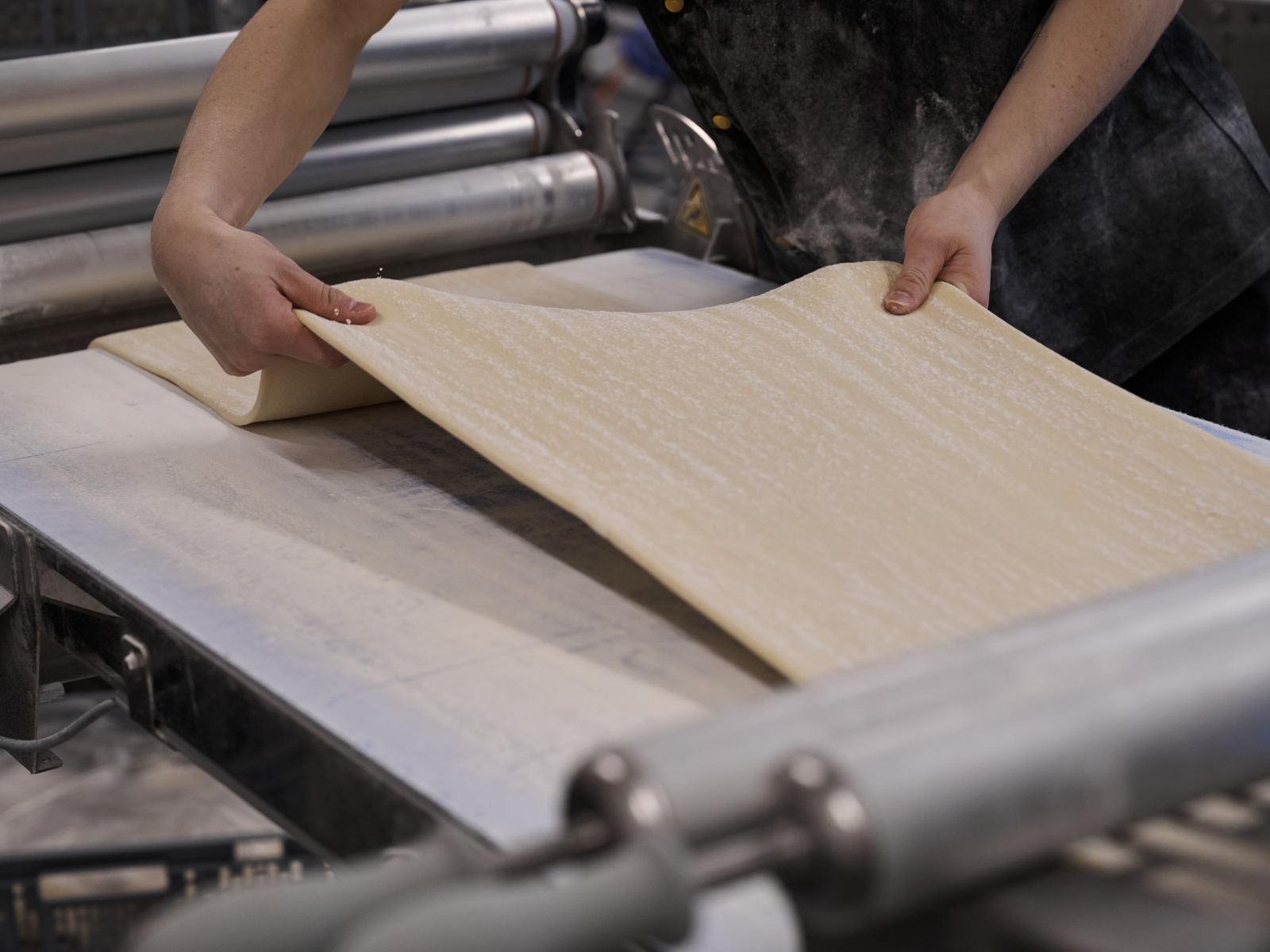
Dough being processed on a dough sheeter (Source: Wikimedia Commons (Dough sheeting))
Choosing appropriate lamination tools depends on bakery scale, product range, and budget constraints common in Kenya’s baking industry. Understanding these criteria helps bakers invest wisely in equipment that enhances productivity and product quality.
Create a free account to open more of this chapter.
Free: practical guides, quick cards, workplace scenarios and more.
Create a free accountThis chapter focused on the essential tools and equipment required for the lamination of pastry dough, highlighting their roles in achieving the desired dough texture and layering. It detailed the step-by-step procedure for lamination, explaining how careful folding and rolling create the characteristic flaky structure of laminated pastries. The chapter also addressed common faults encountered during lamination, such as uneven layers or dough tearing, and provided practical solutions to correct these issues. Understanding the correct use of equipment and mastering the lamination process are critical for producing high-quality pastry products. The identification of faults and their remedies ensures consistency and reduces waste in pastry production. Overall, the chapter provided a comprehensive guide to the technical and practical aspects of pastry dough lamination.
Which of the following tools is essential for evenly rolling out laminate pastry dough?
a) Pastry brush
b) Rolling pin
c) Bench scraper
d) Dough cutter
(2 marks)
Describe the role of the dough scraper in the lamination process. (3 marks)
Type: Individual
| Tools & Equipment | Materials |
|---|---|
| Mixing bowl | Chilled pastry margarine block 150g |
| Rolling pin | Flour for dusting 50g |
| Bench scraper | Refrigerator space for resting dough |
| Pastry brush | |
| Measuring scale (digital) | |
| Pastry board (non-stick) | |
| Clean kitchen cloth | |
| Writing materials (logbook, pen) |
| S/N | Item | Quantity |
|---|---|---|
| 1 | Mixing bowl | 1 Pc per Candidate |
| 2 | Rolling pin | 1 Pc per Candidate |
| 3 | Bench scraper | 1 Pc per Candidate |
| 4 | Pastry brush | 1 Pc per Candidate |
| 5 | Measuring scale (digital) | 1 Pc per Candidate |
| 6 | Pastry board (non-stick) | 1 Pc per Candidate |
| 7 | Chilled pastry margarine block 150g | 1 Block per Candidate |
| 8 | Flour for dusting 50g | 50g per Candidate |
| 9 | Refrigerator space for resting dough | 1 space per Candidate |
| 10 | Clean kitchen cloth | 1 Pc per Candidate |
| 11 | Writing materials (logbook, pen) | 1 set per Candidate |
| Items to be Evaluated | Marks Available | Marks Obtained | Comments |
|---|---|---|---|
| TASK 1: Identification and preparation of tools and equipment | |||
| Wears appropriate personal protective equipment (PPE) such as clean apron and hairnet (Award 1 mark for proper PPE use) | 1 | ||
| Selects correct mixing bowl suitable for dough preparation (Award 1 mark for correct bowl selection) | 1 | ||
| Chooses appropriate rolling pin for dough lamination (Award 1 mark for correct rolling pin) | 1 | ||
| Selects bench scraper for dough handling and folding (Award 1 mark for correct bench scraper) | 1 | ||
| Selects pastry brush for brushing dough layers (Award 1 mark for correct pastry brush) | 1 | ||
| Uses digital scale to weigh margarine accurately to 150g (Award 1 mark for accurate weighing) | 1 | ||
| Prepares pastry board clean and dusted with flour for rolling (Award 1 mark for clean and dusted pastry board) | 1 | ||
| Prepares chilled pastry margarine block for lamination (Award 1 mark for margarine preparation) | 1 | ||
| Arranges refrigerator space for dough resting after folding (Award 1 mark for proper resting arrangement) | 1 | ||
| Prepares clean kitchen cloth for covering dough during resting (Award 1 mark for clean kitchen cloth preparation) | 1 | ||
| Records tools and equipment selected in logbook (Award 1 mark for proper documentation) | 1 | ||
| Sub-Total | 11 | ||
| PRODUCT CHECKLIST | |||
| Correct identification and selection of all required tools and equipment as per task instruction (Award up to 5 marks depending on completeness and correctness) | 5 | ||
| Sub-Total | 5 | ||
| GRAND TOTAL | 16 | ||
Type: Individual
| Tools & Equipment | Materials |
|---|---|
| Mixing bowl | Wheat flour |
| Weighing scale | Salt |
| Measuring jug | Pastry margarine |
| Rolling pin | Water (chilled) |
| Pastry brush | |
| Knife | |
| Pastry board | |
| Kitchen cloth |
| S/N | Item | Quantity |
|---|---|---|
| 1 | Wheat flour | 600g per Candidate |
| 2 | Salt | 10g per Candidate |
| 3 | Pastry margarine | 150g per Candidate |
| 4 | Water (chilled) | 140 ml per Candidate |
| 5 | Mixing bowl | 1 per Candidate |
| 6 | Weighing scale | 1 per Candidate |
| 7 | Measuring jug | 1 per Candidate |
| 8 | Rolling pin | 1 per Candidate |
| 9 | Pastry brush | 1 per Candidate |
| 10 | Knife | 1 per Candidate |
| 11 | Pastry board | 1 per Candidate |
| 12 | Kitchen cloth | 1 per Candidate |
| 13 | PPE (clean uniform, hair net, apron, gloves) | 1 set per Candidate |
| Items to be Evaluated | Marks Available | Marks Obtained | Comments |
|---|---|---|---|
| TASK 1: Prepare and mix initial laminated pastry dough | |||
| Observed use of PPE and hygienic standards (Award 1 mark each for clean uniform, hair net, apron, gloves, clean hands, no jewelry, no nail polish) | 7 | ||
| Identified, collected and assembled ingredients: wheat flour, salt, pastry margarine, chilled water (Award 1 mark for each ingredient correctly identified and collected) | 4 | ||
| Identified, collected and assembled production tools: mixing bowl, weighing scale, measuring jug, rolling pin, pastry brush, knife, pastry board, kitchen cloth (Award 0.5 mark for each correct tool collected) | 4 | ||
| Weighed and measured ingredients accurately as per recipe: 600g wheat flour, 10g salt, 150g pastry margarine, 140 ml chilled water (Award 1 mark for weighing flour and salt, 1 mark for margarine and water) | 2 | ||
| Mixed flour and salt thoroughly before adding water (Award 2 marks for correct mixing procedure) | 2 | ||
| Added chilled water gradually to form a smooth dough without overworking (Award 3 marks for correct hydration and mixing technique) | 3 | ||
| Rounded the dough and rested it wrapped in kitchen cloth in a cool place (Award 3 marks for correct shaping and resting procedure) | 3 | ||
| Prepared pastry margarine by softening and shaping into a 150mm square (Award 3 marks for correct margarine preparation) | 3 | ||
| Sub-Total | 28 | ||
| PRODUCT CHECKLIST | |||
| Dough sheet prepared to approx. 300mm x 300mm suitable for lamination (Award 3 marks for correct dough sheet size and consistency) | 3 | ||
| Dough texture: smooth, pliable and not sticky (Award 2 marks for appropriate dough texture) | 2 | ||
| Pastry margarine shaped correctly to 150mm square and soft enough for lamination (Award 2 marks for correct margarine shape and consistency) | 2 | ||
| Ingredients proportion and measurements reflect the recipe (Award 3 marks for accuracy in ingredient proportions) | 3 | ||
| Sub-Total | 10 | ||
| GRAND TOTAL | 38 | ||
At the start of this chapter we promised you would be able to:
Tick each one you can genuinely do.
So, are you there yet?
You're competent when you can confidently do 50% or more of what this chapter promised.
Sign in to record how you're doing.