
By the end of this chapter, you will be able to:
These skills will help you create high-quality yeast products safely and efficiently, setting you up for success in your baking career!
Compiled by: Elizabeth Ngugi
Preparing straight dough is a fundamental skill in yeast product production that applies to many professional fields across Kenya. Whether in hospitality establishments, county government canteens, or agricultural cooperatives processing bakery goods, understanding the preparation of straight dough ensures consistent product quality and efficiency. This chapter provides a thorough foundation, beginning with essential terminology, personal protective equipment, ingredient identification and functions, and the equipment needed for straight dough making.
The terminology used in preparing straight dough is critical for clear communication and effective practice in a bakery. This section clarifies key terms related to dough, safety gear, ingredients and equipment, so that learners have a solid working vocabulary for a hotel bakery, a retail bakery or a production unit.
Dough is a soft, pliable mass made by mixing flour with water and other ingredients, then kneading it until the gluten develops. It is thick enough to be shaped by hand or machine, unlike a batter, which can be poured. Example: in a bakery production room, the mixture of flour, water, yeast, salt and sugar that comes out of the mixer and is shaped into loaves is dough.
Straight dough is a yeast dough made by the straight dough method, in which all the ingredients are mixed together in a single stage. The dough then goes through one bulk fermentation (first proofing), is divided and shaped, given a second proofing and baked. No pre-ferment such as a sponge is prepared beforehand, which makes the method simple, quick and suited to everyday bread, buns, doughnuts and pizza bases. Example: a baker who weighs flour, yeast, sugar, salt, fat and water, mixes them in one go and bakes bread the same day is using the straight dough method.
Personal Protective Equipment (PPE) safeguards the health and safety of workers handling dough preparation, especially in commercial bakeries. Proper use of PPE reduces the risk of food contamination and of injuries such as burns, cuts and slips, and supports compliance with workplace safety and food safety requirements. Each item below has a specific purpose and must be clean, in good condition and worn correctly before production starts.
Personal protective equipment (PPE) (Source: 5f700936fcc590f8)
Kitchen boots are closed-toe, non-slip, washable shoes or boots that protect the feet from hot spills, dropped trays and wet floors. Example: in a busy bakery production room where flour dust and water make the floor slippery, non-slip soles reduce falls when carrying heavy trays of dough.
A kitchen cloth is a clean, dry cloth used for wiping work surfaces, equipment and spills; it is never used for drying hands, because hands are dried on single-use paper towels or a hand dryer. A separate clean, damp cloth may be laid over dough pieces during proofing to stop a dry skin from forming. Cloths must be washed regularly and kept for one purpose only, for example one for work surfaces and another for covering dough, to avoid spreading germs.
An apron shields clothing and skin from spills, flour dust and hot water during mixing and washing. It also keeps the jacket and trousers clean, and must be removed when leaving the production area, for example to go to the toilet. Example: a baker wears a clean apron over the jacket while scaling ingredients and removes it before leaving the bakery.
The chef's jacket is a long-sleeved, double-breasted cotton jacket, usually white or light in colour. The thick cotton insulates the body and forearms from the heat of ovens and from splashes, and the light colour shows dirt quickly so that it is changed when soiled. It should be fully buttoned with the sleeves down during production.
The chef's hat (a toque or cap) covers the hair and keeps it from falling into the dough, which maintains product cleanliness and meets food safety expectations. Long hair must be tied back and fully tucked under the hat. A hairnet is worn in the same way where a hat alone does not cover all the hair, for example under a cap for workers with long hair or a beard net for beards.
Chef's trousers or skirts are loose-fitting, comfortable garments, usually of cotton, that cover the legs and protect them from heat, spilt hot liquids and flour. Loose fit allows free movement when lifting and bending and lets air circulate in a warm bakery. They should be clean at the start of each shift and of a length that does not touch the floor.
The neck tie (neckerchief) is a small cotton cloth knotted around the neck. It absorbs sweat produced in the heat near ovens and mixers, so that perspiration does not drip into the dough, and it keeps the jacket collar neat. It must be washed after every shift.
Oven gloves are thick, heat-resistant mitts used for handling hot trays, tins and oven racks when loading and unloading the oven. They must be dry, because moisture conducts heat quickly and can cause burns, and they must be long enough to cover the wrists. Example: when removing a tray of baked buns from a deck oven, the baker uses oven gloves, never a damp cloth.
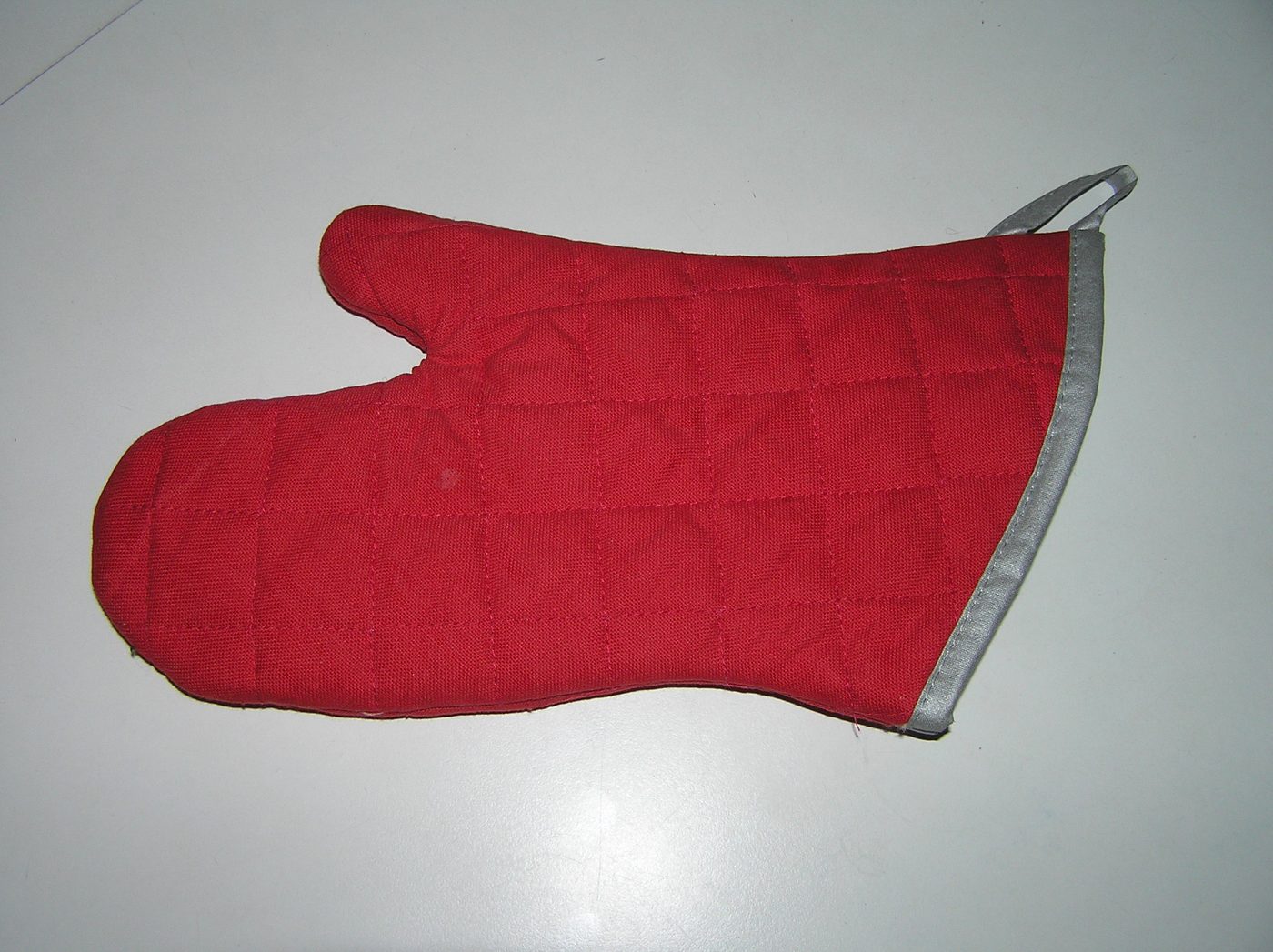
red quilted oven glove for handling hot trays and tins (Source: Wikimedia Commons)
Disposable gloves protect the product from contamination by the hands. They are worn when handling ready-to-eat items such as sliced or filled products and are changed when torn, soiled or when changing tasks. Hands are still washed before the gloves are put on.
Masks reduce the risk of respiratory contamination of the product and limit inhalation of flour dust and airborne yeast particles. Bakery workers who handle large quantities of flour, for example at the scaling and mixing stages, may use masks to reduce the risk of flour-related allergies and breathing problems.
The straight dough method requires a small number of precisely weighed ingredients, each contributing to dough structure, fermentation and final product quality. Being able to recognise each ingredient, its common forms and its quality signs ensures consistent baking results in hotel kitchens, retail bakeries and production units. How each one works in the dough is explained in the next section.
Flour is the main ingredient and is milled from wheat grain. Bread flour (strong flour) has a high protein content that forms plenty of gluten and is the standard for yeast doughs, while white and brown (wholemeal) flours differ in how much bran is left. Some bakeries blend wheat flour with sorghum or millet flour for added nutrition, but the wheat part must remain high enough to form gluten. Good flour is dry, free-flowing, free of lumps and has a fresh, neutral smell.
Yeast is a living single-celled fungus (Saccharomyces cerevisiae) sold in three common forms: fresh (compressed) yeast, active dry yeast and instant dry yeast. Dry yeast has a longer shelf life and is convenient in retail bakeries, while fresh yeast must be refrigerated and used quickly. Yeast is stored in a cool, dry place or fridge as directed on the pack, and old or expired yeast gives weak rising.
Sugar is the sweetener, usually white granulated sugar, sometimes brown sugar, honey or syrup. It is a fine, dry, free-flowing crystal that dissolves easily in the dough liquid. Hotels and retail bakeries adjust the amount to suit the product, a small amount for ordinary bread and more for buns and doughnuts.
Salt is a fine white crystal added in a small amount, usually weighed separately from the other ingredients. Fine table salt dissolves readily in the dough; coarse salt is better kept for toppings, such as on focaccia. Iodised salt may be used where available.
Shortening is a solid fat, such as white vegetable fat, margarine, butter or lard, that is firm at room temperature. It is cut into small pieces or softened so that it blends evenly into the dough. The type used affects flavour, richness and how soft the crumb is.
Oil is a liquid fat, such as sunflower, corn or other vegetable oil, used instead of or alongside solid shortening. It is easy to measure and mix, and is common in doughs such as pizza and focaccia where an oil-rich flavour is wanted. It should be fresh and free of any rancid smell.
The liquid in most straight doughs is water, which must be clean, safe drinking water. Milk, fresh or reconstituted from powder, can replace part or all of the water in richer doughs. The temperature of the liquid is controlled because it directly affects how fast the yeast works and the final dough temperature.
Other ingredients are added to enrich the dough or improve its quality, depending on the product.
Each ingredient in straight dough plays a specific role in dough development, fermentation and the characteristics of the finished bread. Understanding these roles helps a baker to adjust a recipe sensibly, and to find the cause when a dough behaves differently from usual.
Flour contains two proteins, glutenin and gliadin, which combine with water and kneading to form gluten. Gluten forms the framework of the dough, trapping the gas produced during fermentation so that the dough expands and holds its shape. The starch in flour also provides food for yeast and sets during baking to form the crumb. Example: a strong bread flour gives a taller loaf with a finer crumb than a weak flour.
Water dissolves the sugar and salt, moistens the flour proteins so that gluten can form, and activates yeast so that fermentation begins. A lukewarm temperature of about 30°C suits yeast; very cold water slows fermentation, while water above about 50°C begins to damage yeast cells. Water temperature is therefore checked before mixing.
Yeast feeds on sugars and produces carbon dioxide gas and alcohol. The gas is trapped by the gluten, causing the dough to rise, and the by-products give bread its characteristic flavour and aroma. Retail bakeries check yeast freshness so that rising is consistent from batch to batch.
Salt slows yeast activity, which prevents over-proofing, and strengthens the gluten, making the dough more elastic and easier to handle. It also brings out the flavour of the bread. Too little salt gives a flat-tasting, sticky, fast-rising dough, while too much slows or stops fermentation. For this reason salt is not placed directly on yeast when ingredients are added to the mixer.
Sugar is a quick source of energy for yeast and promotes active fermentation. It adds sweetness, helps the crust to brown by caramelisation, and holds moisture in the crumb. Bakeries that make sweet breads and buns use more sugar than those making plain bread, but very high sugar levels slow yeast activity.
Shortening and oil coat the gluten strands, making the dough softer and more extensible, giving a tender crumb and better volume. Fat also keeps the crumb moist and slows staling, so bread stays fresh longer. Solid shortening gives richness and a soft texture, while oil gives ease of mixing and a moist crumb.
Eggs and milk add nutrition, richness, flavour and crust colour, while improvers strengthen the dough and increase volume. Flavourings, spices, fruit and seeds provide variety. Each of these is added in small, measured amounts so that the balance between structure and fermentation is not upset.
Efficient dough preparation requires appropriate equipment for weighing, mixing, fermenting, shaping and baking. Equipment is grouped by size and by how much labour it saves: large fixed equipment, mechanical or labour-saving machines, and small hand tools. Being able to identify each item, and what it is used for, is the first step to using it safely and keeping it clean.
Large equipment is heavy, usually fixed in place and forms the main working areas of the bakery.
| Name | Specification | Use |
|---|---|---|
| Baking oven | Electric or gas, deck or rack type, 200-250°C range | Bakes dough to produce bread, with precise temperature control |
| Proofing cabinet | Temperature and humidity controlled | Provides optimal conditions for the fermentation of shaped dough |
| Work bench | Stainless steel top, easy to clean | Surface for scaling, kneading, dividing and shaping |
| Bakers' rack or trolley | Stainless steel, with slots for trays | Holds trays of dough during proofing, baking and cooling |
Mechanical equipment reduces manual work, speeds production and improves the consistency of the dough, which is essential in a busy bakery.
| Name | Specification | Use |
|---|---|---|
| Dough mixer | Electric, spiral or planetary type | Mixes and kneads dough uniformly |
| Dough divider | Manual or automatic, adjustable size | Divides dough into equal portions so that products are the same size |
| Dough moulder | Electric, adjustable rollers | Shapes divided dough pieces into loaf shape |
| Dough sheeter | Electric, adjustable rollers | Rolls dough to an even thickness, for example for pizza bases |
Small equipment is hand-held or easily moved, and is used for measuring, handling and finishing.
| Name | Specification | Use |
|---|---|---|
| Weighing scale | Digital or balance type, accurate to 1 g | Weighs ingredients accurately |
| Mixing bowl | Stainless steel, assorted sizes | Holds ingredients during mixing, durable and easy to clean |
| Measuring jug | Graduated, plastic or stainless steel | Measures water and other liquids |
| Thermometer | Probe type | Checks water and dough temperature |
| Dough scraper | Plastic or stainless steel | Divides dough, scrapes bowls and tables |
| Rolling pin | Wood or plastic | Rolls out dough by hand |
| Baking trays and tins | Metal, various sizes | Hold shaped dough during proofing and baking |
| Cooling rack | Wire mesh | Allows baked products to cool with air circulating around them |
Explain the purpose of wearing PPE during straight dough preparation and give examples of PPE commonly used in bakery settings. (10 marks)
Identify five main ingredients used in straight dough making and describe the role of each in the dough development process. (15 marks)
List the key equipment used in straight dough preparation and explain the function of any three. (10 marks)
Create a free account to open more of this chapter.
Free: practical guides, quick cards, workplace scenarios and more.
Create a free accountThis chapter provided a comprehensive overview of preparing straight dough, beginning with key definitions including personal protective equipment and their uses, as well as the identification and roles of ingredients essential to straight dough making. It detailed the necessary equipment needed for the process and outlined the steps for collecting and assembling both ingredients and equipment efficiently. Emphasis was placed on hygiene practices, covering personal, environmental, and food hygiene to ensure safety and quality. The chapter also explored the different types of straight dough products and described the step-by-step process involved in their preparation. Characteristics that define good quality straight dough products were highlighted, alongside common faults that can occur during production. Finally, the chapter addressed proper packaging and storage methods to maintain product freshness and extend shelf life.
At the start of this chapter we promised you would be able to:
Tick each one you can genuinely do.
So, are you there yet?
You're competent when you can confidently do 50% or more of what this chapter promised.
Sign in to record how you're doing.