
By the end of this chapter, you will be able to:
These skills will help you make a real difference by protecting your community’s health through informed and active participation.
Microbiology and parasitology are foundational disciplines in community health, equipping professionals with the knowledge to recognize infectious agents and their life cycles. Understanding the identity of microbes and parasites, alongside the specific host sites they inhabit, is crucial for effective disease prevention and control in Kenya’s diverse environments. Community health workers who can accurately identify these organisms and their preferred habitats contribute significantly to managing endemic infections, improving public health outcomes in county hospitals, clinics, and rural health programs.
This section clarifies key terminology essential for community health practitioners to communicate effectively about microbes and parasites. Precise definitions ensure uniform understanding across healthcare settings, facilitating accurate diagnosis, treatment, and health education.
The term microbe refers to microscopic organisms that can be unicellular, multicellular, or acellular. These organisms include bacteria, viruses, fungi, protozoa, and algae, many of which play roles in health and disease. In Kenyan community health settings, microbes such as Mycobacterium tuberculosis, Plasmodium species, and Staphylococcus aureus are common agents of infectious diseases.
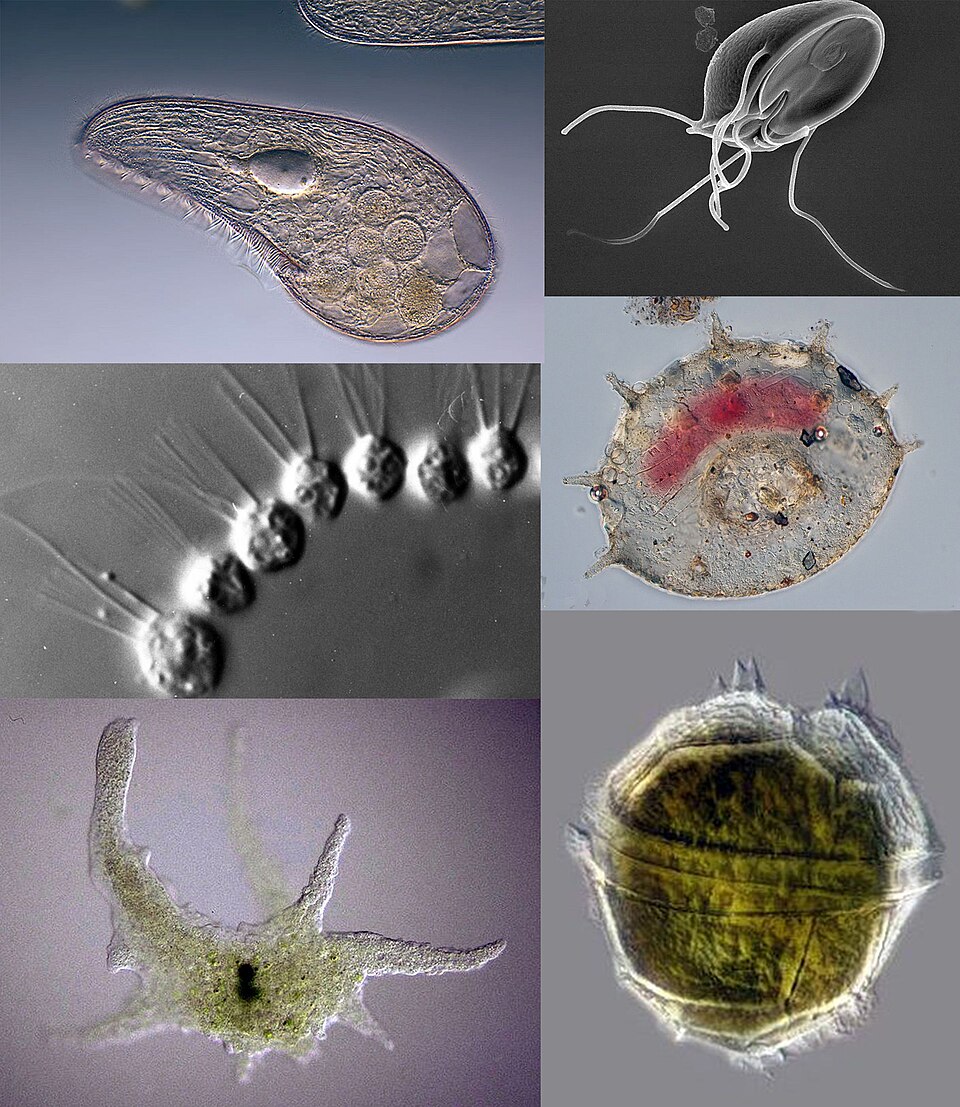
Various protozoa under microscope (Source: Wikimedia Commons (Protozoa))
Understanding microbial classification helps community health professionals identify disease causative agents and tailor interventions accordingly.
A microbe is a microscopic organism that cannot be seen with the naked eye. These organisms include bacteria, viruses, fungi, protozoa, and algae. In Kenyan community health, microbes are significant because they are responsible for many infectious diseases, such as tuberculosis and cholera, and also play beneficial roles in processes like waste decomposition and food fermentation. Understanding what constitutes a microbe allows health workers to recognize potential sources of infection and implement preventive measures in clinics, schools, and households.
A parasite is an organism that lives on or inside a host organism, deriving nutrients at the host’s expense. Parasites cause a range of diseases in humans, especially in tropical and subtropical regions of Kenya, where conditions favor their survival and transmission.
Recognizing parasite types enables community health workers to implement appropriate control measures, such as mass deworming programs or vector control initiatives.
A parasite is an organism that lives on or inside another organism, known as the host, and obtains nutrients at the host's expense. Parasites can cause harm to their hosts, leading to diseases such as malaria, schistosomiasis, and intestinal worm infections. In Kenya, parasites are a major public health concern, especially in rural and peri-urban communities where sanitation and vector control may be inadequate.
The life cycle of a microbe or parasite refers to the sequence of developmental stages it undergoes from one generation to the next. Life cycles often involve multiple stages and hosts, which influences transmission dynamics.
In community health practice, understanding these life cycles is critical for interrupting transmission. For instance, the malaria parasite’s life cycle includes mosquito vectors and human hosts; breaking this cycle through insecticide-treated nets and antimalarial drugs reduces disease incidence.
The life cycle of a microbe or parasite describes the series of developmental stages it passes through from one generation to the next. These stages may occur in one host or involve multiple hosts and environmental phases. For example, the life cycle of Schistosoma mansoni involves both freshwater snails and humans, with different forms of the parasite adapted to each host. Understanding the concept of life cycle is essential for identifying when and where interventions can be most effective in breaking the chain of transmission.
A host is an organism that harbors a microbe or parasite, providing nourishment and shelter. Hosts may be humans, animals, or plants, depending on the microbe or parasite involved.
Community health interventions often target hosts to reduce infection reservoirs and transmission.
A host is any living organism that provides a habitat and nourishment for a microbe or parasite. The host can be a human, animal, or even a plant, depending on the organism involved. In the context of Kenyan community health, humans often serve as hosts for parasites like Plasmodium (malaria) and helminths, while animals such as cattle and rodents can act as hosts for zoonotic diseases.
An infectious agent is any microorganism or parasite capable of causing infection. A pathogen is a subset of infectious agents that cause disease in the host.
An infectious agent is any microorganism or parasite capable of entering and multiplying within a host, potentially leading to infection. However, not all infectious agents cause disease. A pathogen is a specific type of infectious agent that actually causes disease in the host. For example, Escherichia coli is an infectious agent commonly found in the human gut, but only certain strains are pathogenic and cause diarrheal illness. This distinction is important for community health workers to avoid unnecessary alarm and to focus interventions on disease-causing organisms.
Create a free account to open more of this chapter.
Free: practical guides, quick cards, workplace scenarios and more.
Create a free accountThis chapter introduced key terminology essential for understanding microbiology and parasitology within community health. It explored the various sites in hosts where parasites and microbes reside, emphasizing the importance of identifying these locations for effective diagnosis and control. The chapter examined the critical conditions that influence microbial growth, including temperature, water availability, moisture levels, nutrients, and light exposure, each playing a pivotal role in the survival and proliferation of microorganisms. Additionally, it detailed the distinct phases of microbial and parasitic growth, outlining how these stages impact infection progression and treatment strategies. Understanding these concepts provides a foundation for recognizing how microbes and parasites interact with their environment and hosts. This knowledge is fundamental for developing interventions aimed at reducing disease transmission in community settings.
At the start of this chapter we promised you would be able to:
Tick each one you can genuinely do.
So, are you there yet?
You're competent when you can confidently do 50% or more of what this chapter promised.
Sign in to record how you're doing.