Nail care is a fundamental aspect of cosmetology that requires a thorough understanding of the anatomy and physiology of the nail. In Kenya, where the beauty industry is rapidly growing, cosmetology professionals must deliver safe and effective nail care services that respect the client’s health and aesthetic needs. Preparing for nail care service begins with knowledge of the nail's structure, which guides the selection of appropriate treatment techniques and products. This chapter focuses on the detailed structure of the nail to equip practitioners with essential foundational knowledge.
1.1 Structure of the Nail
The structure of the nail is a complex system that supports its function and appearance. Professionals in nail care must understand the various parts of the nail to identify any abnormalities and to perform treatments safely. In Kenyan salons and spas, proper nail structure knowledge ensures that services such as manicures, pedicures, and artificial nail application are done without causing harm or discomfort to clients. This section breaks down the nail’s anatomy into key components, their functions, and their relevance in nail care.
1.1.1 Overview of Nail Anatomy
The nail is composed of several distinct parts, each playing a vital role in the nail’s health and appearance. Understanding these components allows cosmetologists to detect signs of disease or damage which may require referral to a healthcare professional.
Components of Nail Anatomy
- Nail Plate: The hard, translucent part of the nail made of keratin. It protects the fingertip and enhances fine touch.
- Nail Bed: The skin beneath the nail plate, rich in blood vessels, which gives the nail its pinkish color.
- Matrix: The tissue under the nail bed responsible for producing new nail cells. Damage to the matrix can affect nail growth permanently.
- Cuticle: The thin layer of dead skin at the base of the nail plate, serving as a barrier against infection.
- Lunula: The visible pale half-moon shape at the nail base, part of the matrix, indicating healthy nail growth.
Each component must be handled with care during nail treatments to avoid infections or structural damage, especially in facilities such as hospitals or county government clinics where hygiene standards are critical.
1.1.2 Functions of Nail Components
The parts of the nail work together to protect the fingertips and support tactile functions. Each component’s function informs how cosmetologists approach nail care to maintain nail health.
Key Functions by Component
- Nail Plate Protection: Shields the sensitive tips of fingers and toes from physical trauma and microbial invasion.
- Nail Bed Support: Supplies nutrients and oxygen through its rich blood supply, crucial for healthy nail growth.
- Matrix Cell Production: Continuously generates keratin cells that harden to form the nail plate, determining nail shape and thickness.
- Cuticle Barrier: Prevents bacteria and fungi from entering the nail root, reducing the risk of infections.
- Lunula Indicator: Reflects nail growth health and can signal systemic health issues when discolored or deformed.
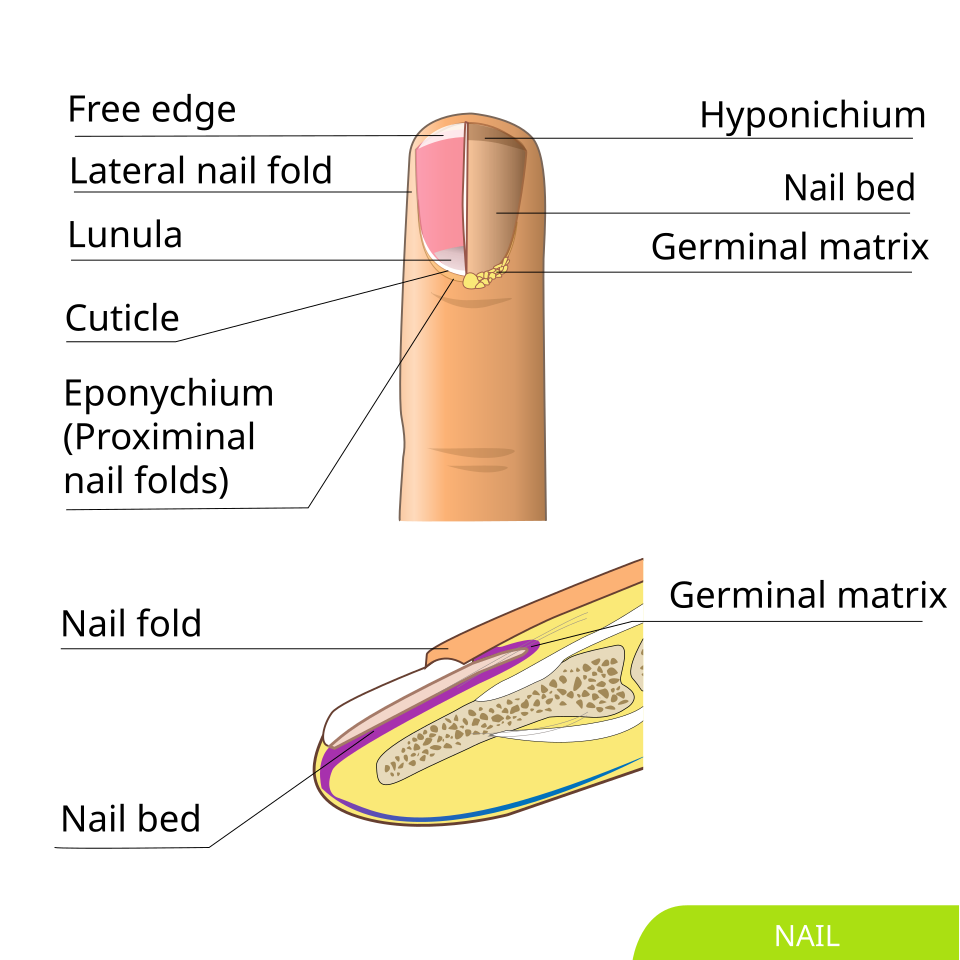
Diagram showing lunula on fingernail (Source: Wikimedia Commons (Nail (anatomy)))
In Kenyan nail salons, respecting these functions means avoiding harsh chemicals or aggressive filing that could damage the matrix or cuticle, ensuring client safety and satisfaction.
1.1.3 Nail Growth Process and Rate
Nail growth is a continuous biological process influenced by age, health, nutrition, and environmental factors. Understanding growth patterns helps cosmetologists schedule treatments and advise clients appropriately.
Factors Affecting Nail Growth
- Growth Rate: Fingernails grow approximately 3.5 mm per month, while toenails grow slower at about 1.6 mm per month.
- Age Influence: Younger clients tend to have faster nail growth compared to older adults whose growth slows down.
- Health Status: Conditions such as anemia or malnutrition can slow nail growth; cosmetologists should recognize signs indicating referral.
- Nutrition: Adequate intake of proteins, vitamins (especially biotin), and minerals supports healthy nail formation.
- Environmental Impact: Exposure to water, chemicals, and physical trauma can weaken nails and affect their growth quality.
1.1.4 Common Nail Disorders Affecting Structure
Recognizing nail disorders is essential for cosmetologists to avoid causing harm and to refer clients to medical professionals when necessary. Nail abnormalities can indicate underlying health issues or result from poor nail care practices.
Typical Nail Disorders
- Onychomycosis: Fungal infection causing thickened, discolored, and brittle nails, common in humid Kenyan regions.
- Paronychia: Infection of the cuticle area leading to redness, swelling, and pain, often due to improper manicure techniques.
- Beau’s Lines: Horizontal ridges on the nail plate indicating interrupted nail growth from illness or trauma.
- Leukonychia: White spots or lines on the nail plate often caused by minor injuries or nutritional deficiencies.
- Onycholysis: Separation of the nail plate from the nail bed, frequently resulting from allergic reactions to nail products.
In a retail beauty business in Mombasa, for instance, a cosmetologist who identifies onychomycosis in a client would avoid nail enhancements and advise medical consultation to prevent infection spread.
Practice Questions
- Describe the main components of the nail structure and explain the function of each. (10 marks)
- Explain five factors that influence the rate of nail growth in clients. (10 marks)
- Identify and describe five common nail disorders that a cosmetologist should recognize before performing nail care services. (10 marks)
- Discuss the significance of the nail matrix in nail care and the potential consequences of its damage. (10 marks)
The rest of this chapter
🔒Create a free account to open more of this chapter.
Free: practical guides, quick cards, workplace scenarios and more.
Create a free account 🔒1.2 Nail growth and functions
Understanding how nails grow and what they do allows a nail technician to give accurate advice, plan maintenance appointments and recognise when a nail problem needs medical attention. Nail growth depends on the health of the matrix and on the client's general…
🔒1.3 Nail Composition
Understanding the composition of the nail is fundamental for cosmetology professionals specializing in nail care services in Kenya. Nail technicians must appreciate the biology and structure of nails to provide effective treatments and avoid damage during proc…
🔒1.4 Nail Shapes
Nail shape is a critical aspect of nail care services, influencing both aesthetics and functionality. Kenyan cosmetology professionals must master various nail shapes to meet diverse client preferences and hand shapes, ensuring that the final result enhances t…
🔒1.5 Nail health and care
Nail health and care are fundamental in the cosmetology profession, especially for nail technicians working in Kenya’s diverse beauty industry. Healthy nails not only enhance the aesthetic appeal but also reflect overall well-being. Understanding how to mainta…
🔒1.6 Factors affecting nail growth
Nail growth is influenced by various intrinsic and extrinsic factors that cosmetology professionals must understand to provide effective nail care. In Kenya, where clients may have diverse lifestyles and health conditions, knowledge of these factors helps tail…
🔒1.7 Common diseases and disorders of nails
A nail disease is a condition caused by infection, inflammation or an underlying illness, while a nail disorder is a change in the shape, surface or growth of the nail without infection. The nail technician must tell them apart because a disease may be contagi…
🔒1.8 Introduction to skeleton system
The skeleton is the framework of 206 bones, together with cartilage and ligaments, that supports the body and gives the hands and feet the shape on which the nails grow. A nail technician handles the client's fingers, wrists, toes and ankles for long periods,…
🔒1.9 Definition of terms
Every profession has a vocabulary that its members use the same way, and nail care is no exception. A technician who understands the key terms can read a client's record, explain a service in plain words and communicate with colleagues and health workers witho…
🔒1.10 Client consultation
Client consultation is the first and most important step of every nail care service. It is a structured conversation, held privately before any treatment, in which the technician learns what the client wants, checks that the service is safe and agrees what wil…
🔒1.11 Personal protective equipment
Personal protective equipment (PPE) is the clothing and gear worn by the technician to create a barrier between the body and the hazards of nail care: chemicals, dust, germs and sharp tools. The three basic items in a nail care service are the apron, the face…
🔒1.12 Client draping
Client draping is the covering of the client's clothing and work surface with clean protective materials before a nail care service begins. In nail care the two main draping materials are towels and a cushion. Together they protect the client's clothes, keep t…
🔒1.13 Nail and skin analysis
Nail and skin analysis is the careful examination of the client's nails, cuticles and the skin of the hands or feet before treatment to decide whether the service can go ahead, what must be adapted and what must be referred. The technician looks at colour, sha…
🔒1.14 Nail care tools, equipment and materials
A nail technician works with small, precise tools and a few items of equipment, and the quality, cleanliness and correct choice of these items decide the safety and finish of every service. Tools are hand-held instruments used on the nails, equipment is the la…
🔒1.15 Nail care products and supplies
In the Kenyan cosmetology sector, the quality and selection of nail care products and supplies directly influence service outcomes and client satisfaction. Nail technicians working in salons, spas, or mobile services across Nairobi, Mombasa, and Kisumu rely on…
Chapter Summary
This chapter provides a comprehensive overview of the nail care service, beginning with the detailed structure of the nail and its composition, which forms the foundation for understanding nail health. It explores the natural growth process and essential functions of nails, highlighting the various shapes that nails can take. The chapter also addresses key factors that influence nail growth and emphasizes the importance of maintaining nail health through proper care. Common diseases and disorders affecting nails are discussed to enable early identification and management. Additionally, the chapter covers the significance and correct use of personal protective equipment as well as the importance of draping in ensuring client safety and hygiene. A thorough examination of nail care tools, equipment, and materials is presented, including their uses and maintenance to ensure longevity and effectiveness. Finally, the chapter introduces the range of nail care products and supplies essential for delivering professional nail care services.
Self-Assessment
🔒 PDFDownload this self-assessment, with answers
A. Written Assessment
- Identify the main structural parts of the nail and briefly describe their functions. (5 marks)
- Which nail shape is most suitable for clients with narrow nail beds and why? (3 marks)
🔒20 more in this section.
Chapter Examination Questions
🔒 PDFDownload these examination questions, with worked answers
SECTION A (40 Marks) - Answer ALL Questions
- Describe the main layers of the nail structure and explain their relevance to nail care services in a Nairobi beauty salon. (4 marks)
- Explain how the rate of nail growth can affect the scheduling of appointments for clients at a Kisumu spa. (4 marks)
🔒18 more in this section.
Chapter Practical Activities
Practical 1: Identify and Describe Nail Structure and Composition
Cosmetology · Level 5
Nail Care Service
PRACTICAL ASSESSMENT
TIME: 3 HOURS
⬇ PDFCandidate Instructions (Candidate Tool)
Type: Individual
INSTRUCTIONS TO CANDIDATE:
1. You are required to perform the following task:
i. Identify and describe the parts of the nail structure and its composition using anatomical models and diagrams on a manicure table.
2. You have been provided with the following resources for the practical task:
| Tools & Equipment | Materials |
|---|
| Anatomical nail structure models | PPE: Flat closed shoes |
| Nail structure diagrams | PPE: Apron |
| Marker pens | |
| Note pads | |
| Manicure table | |
⬇ PDFResources Required (Cutting List)
| S/N | Item | Quantity |
|---|
| 1 | Anatomical nail structure models | 1 Model per 2 Candidates |
| 2 | Nail structure diagrams (laminated A3 size) | 1 Diagram per Candidate |
| 3 | Manicure table | 1 Table per Candidate |
| 4 | Marker pens | 2 Pens per Candidate |
| 5 | Note pads | 1 Pad per Candidate |
| 6 | PPE: Flat closed shoes | 1 Pair per Candidate |
| 7 | PPE: Apron | 1 Apron per Candidate |
⬇ PDFAssessor Guide
| Items to be Evaluated | Marks Available | Marks Obtained | Comments |
|---|
| TASK 1: Preparation and PPE Usage |
Wore flat closed shoes
(Award 1 mark for correct PPE usage) | 1 | | |
Wore apron correctly
(Award 1 mark for correct PPE usage) | 1 | | |
Arranged anatomical models and diagrams on the manicure table
(Award 1 mark for proper workstation setup) | 1 | | |
| Sub-Total | 3 | | |
| TASK 2: Identification of Nail Structure |
Identified nail plate
(Award 1 mark for correct identification) | 1 | | |
Identified nail bed
(Award 1 mark for correct identification) | 1 | | |
Identified cuticle (eponychium)
(Award 1 mark for correct identification) | 1 | | |
Identified lunula
(Award 1 mark for correct identification) | 1 | | |
Identified nail matrix
(Award 1 mark for correct identification) | 1 | | |
Identified hyponychium
(Award 1 mark for correct identification) | 1 | | |
| Sub-Total | 6 | | |
| TASK 3: Description of Nail Composition |
Described keratin as main component of the nail
(Award 1 mark for accurate description) | 1 | | |
Explained the role of nail matrix in nail growth
(Award 1 mark for clear explanation) | 1 | | |
Described the protective function of the nail plate
(Award 1 mark for clear description) | 1 | | |
Explained the function of the cuticle in sealing and protecting
(Award 1 mark for accurate explanation) | 1 | | |
Described the lunula as visible part of the matrix
(Award 1 mark for correct description) | 1 | | |
| Sub-Total | 5 | | |
| PRODUCT CHECKLIST |
Accurate identification and labeling of all six parts of the nail structure on model/diagram
(Award 1 mark for each correct and clearly labeled part) | 5 | | |
Clear and accurate explanation of nail composition components
(Award marks for completeness and clarity of description) | 5 | | |
| Sub-Total | 10 | | |
| GRAND TOTAL | 24 | | |
ASSESSMENT OUTCOME: ☐ Competent ☐ Not Yet Competent (competent if at least 50%)
Practical 2: Measure and record nail growth; explain nail functions and growth factors
Cosmetology · Level 5
Nail Care Service
PRACTICAL ASSESSMENT
TIME: 4 HOURS
⬇ PDFCandidate Instructions (Candidate Tool)
Type: Individual
INSTRUCTIONS TO CANDIDATE:
1. You are required to perform the following task:
i. Measure and record the nail growth of a client’s fingernails in millimeters, explain the functions of nails, and identify factors affecting nail growth during a nail care preparation service.
2. You have been provided with the following resources for the practical task:
| Tools & Equipment | Materials |
|---|
| Manicure table | Cotton wool |
| Nail ruler with millimeter markings | Disinfectant solution |
| Magnifying glass | Alcohol hand sanitizer |
| Nail file | PPE - disposable gloves |
| Client record card |
| Pen |
⬇ PDFResources Required (Cutting List)
| S/N | Item | Quantity |
|---|
| 1 | Manicure table | 1 per Candidate |
| 2 | Nail ruler with millimeter markings | 1 per Candidate |
| 3 | Magnifying glass | 1 per Candidate |
| 4 | Cotton wool | 20g per Candidate |
| 5 | Nail file | 1 per Candidate |
| 6 | Disinfectant solution | 100ml per Candidate |
| 7 | Alcohol hand sanitizer | 50ml per Candidate |
| 8 | PPE - disposable gloves | 1 pair per Candidate |
| 9 | Client record card | 1 per Candidate |
| 10 | Pen for recording | 1 per Candidate |
⬇ PDFAssessor Guide
| Items to be Evaluated | Marks Available | Marks Obtained | Comments |
|---|
| TASK 1: Preparation and PPE |
Wore PPE including disposable gloves
(Award 2 marks or zero) | 2 | | |
Sanitized hands using alcohol hand sanitizer
(Award 2 marks or zero) | 2 | | |
| Sub-Total | 4 | | |
| TASK 2: Measurement and recording |
Selected appropriate fingernails for measurement
(Award 1 mark or zero) | 1 | | |
Used nail ruler correctly with millimeter scale
(Award 3 marks or zero) | 3 | | |
Measured nail growth accurately and recorded in millimeters
(Award 4 marks or zero) | 4 | | |
Used magnifying glass to inspect nail surface and edges
(Award 2 marks or zero) | 2 | | |
Recorded measurements clearly on the client record card
(Award 3 marks or zero) | 3 | | |
| Sub-Total | 13 | | |
| TASK 3: Explanation of nail functions and growth factors |
Explained at least three functions of the nails (e.g., protection, sensation, fine motor skills)
(Award 3 marks or zero) | 3 | | |
Identified at least three factors affecting nail growth (e.g., nutrition, health, age, climate)
(Award 3 marks or zero) | 3 | | |
Demonstrated practical examples or illustrations while explaining
(Award 2 marks or zero) | 2 | | |
| Sub-Total | 8 | | |
| TASK 4: Hygiene and workstation management |
Disinfected tools and working surface before and after service
(Award 3 marks or zero) | 3 | | |
Disposed of used cotton wool and gloves properly
(Award 2 marks or zero) | 2 | | |
| Sub-Total | 5 | | |
| PRODUCT CHECKLIST |
Nail growth measurements recorded correctly in millimeters on client record card
(Award 5 marks or zero) | 5 | | |
Clear and accurate explanation of nail functions and factors affecting growth
(Award 5 marks or zero) | 5 | | |
| Sub-Total | 10 | | |
| GRAND TOTAL | 40 | | |
ASSESSMENT OUTCOME: ☐ Competent ☐ Not Yet Competent (competent if at least 50%)
🔒Shape natural nails into common nail shapesPractical 3
🔒Assess and maintain nail health and care for a clientPractical 4
🔒Identify and Manage Common Nail Diseases and DisordersPractical 5
🔒Identify and describe types and composition of bones relevant to beauty therapyPractical 6
🔒Identify Major Bones Relevant to Beauty Therapy on Anatomical ModelsPractical 7
🔒Demonstrate the functions of the skeletal system relevant to nail care servicePractical 8
🔒Demonstrate Joint Movements in the Skeletal SystemPractical 9
🔒Identify Common Diseases and Disorders of the Skeletal SystemPractical 10
🔒Identify bone infections and genetic disorders related to the skeletal systemPractical 11
🔒Select and use nail care tools and equipment for a basic manicure servicePractical 12
🔒Maintain Nail Care Tools and Equipment for Nail Care ServicePractical 13
🔒Select and apply nail care products during a manicure servicePractical 14
🔒Perform Draping and Personal Protective Equipment Application for Nail Care ServicePractical 15
