
By the end of this chapter, you will be able to:
Mastering these skills will help you create reliable and efficient mechanical systems that are essential in real-world engineering and maintenance work.
Belts, ropes, and chain drives form essential components in power transmission systems within welding workshops and related engineering environments in Kenya. These mechanical elements transfer motion and force from one rotating shaft to another, often across different distances and directions, enabling welding machinery and allied equipment to function efficiently. Understanding their types, characteristics, and applications ensures welding professionals can select, maintain, and troubleshoot drive systems for optimal performance and safety. This chapter explores the definitions and distinctions of belts, ropes, and chains in the context of welding industry operations.
The terminology and conceptual understanding of belts, ropes, and chains as power transmission elements are fundamental for welding technicians. Each component has distinct mechanical properties, modes of operation, and suitability depending on load, speed, and environmental factors. Clear comprehension of these terms supports informed choices in equipment design, maintenance, and repair in Kenyan workshops and manufacturing plants.
Belts are flexible loops of material that connect two or more rotating shafts mechanically, transmitting power through friction or positive engagement. In welding workshops, belts drive auxiliary equipment such as grinding machines, cooling fans, and conveyor systems. Their ability to accommodate shaft misalignment and dampen vibrations makes them useful where smooth operation is required.
Belts come in several forms, each suited to specific power transmission needs:
Flat Belts: Made from leather, rubber, or synthetic materials, flat belts transmit power through friction between the belt and pulley surfaces. They are suitable for light to moderate loads and are common in older or simpler machinery.
V-Belts: Characterized by a trapezoidal cross-section, V-belts fit into matching pulleys, providing higher friction and torque transmission than flat belts. They are widely used in welding equipment for their compact design and efficiency.
Timing Belts: These belts have teeth that engage with the pulley grooves, ensuring synchronous rotation without slippage. Timing belts are essential in applications requiring precise speed control, such as automated welding machines.
Ribbed Belts: Featuring multiple longitudinal ribs, ribbed belts combine flexibility and grip, often employed in compact spaces with high-speed drives.
The construction of belts influences their strength, flexibility, and resistance to environmental factors:
Leather: Traditional material with good grip but susceptible to wear and moisture damage.
Polyurethane: Provides high resistance to abrasion and chemicals, suitable for harsh workshop conditions.
Fabric Reinforcement: Embedded cords or fibers (e.g., polyester, nylon) enhance tensile strength and reduce elongation.
Belts offer several benefits in welding workshop applications:
However, belts face limitations:
In Kenyan welding workshops, belts are often found driving ancillary equipment such as ventilation fans in metal fabrication shops, cooling pumps in welding power sources, and belt-driven grinders used for finishing welds. Their vibration damping properties also help protect sensitive instruments and improve operator comfort.
Ropes used in power transmission are strong, flexible elements that transmit motion by wrapping around pulleys, typically in hoisting or lifting operations linked to welding setups. Although less common than belts or chains in direct power transmission, ropes play a critical role in moving heavy welding fixtures and assemblies safely.
Ropes are classified by their construction and materials, which affect strength, flexibility, and durability:
Wire Ropes: Composed of multiple strands of steel wire twisted together, providing high tensile strength and resistance to abrasion, ideal for heavy-duty lifting in welding workshops.
Natural Fiber Ropes: Made from materials like sisal or hemp, these ropes offer flexibility but have low strength and are vulnerable to moisture and chemicals.
Synthetic Fiber Ropes: Manufactured from nylon, polyester, or polypropylene, synthetic ropes offer excellent strength-to-weight ratios, resistance to chemicals, and reduced stretch.
Braided Ropes: Constructed by interweaving strands, braided ropes provide smooth surfaces and improved flexibility, useful for precise control in lifting mechanisms.

Coiled blue braided rope with red core (Source: Wikimedia Commons)
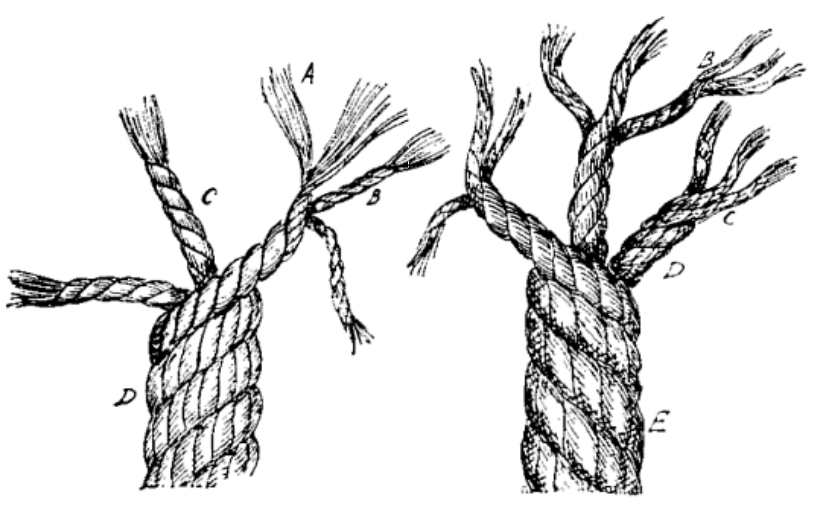
Illustration of laid ropes structure (Source: Wikimedia Commons)
The design of ropes influences their performance in welding-related applications:
Ropes provide unique benefits in welding workshops:
Constraints include:
Wire ropes are commonly used in hoisting equipment for positioning heavy metal assemblies or welding fixtures in fabrication yards and industrial workshops. Synthetic ropes may be employed in securing loads during transportation of welded structures, while braided ropes assist in precise manual handling tasks.
Chains are composed of interlinked metal links that transmit power through positive engagement with sprockets, providing reliable and slip-free motion transfer. In welding environments, chains power conveyor systems, lifting hoists, and specialized machinery requiring high torque and durability.
Chains vary in design depending on their application and load requirements:

metal roller chain coiled on white background (Source: Wikimedia Commons)
Chain materials and manufacturing processes determine strength and durability:
Chains offer several benefits in welding workshop applications:
Limitations include:
Chains power conveyor belts moving welded components through finishing stations in fabrication plants. Leaf chains operate lifting hoists that position heavy welded frames during assembly. Roller chains drive auxiliary equipment such as wire feeders in welding machines, ensuring reliable and consistent operation.
Create a free account to open more of this chapter.
Free: practical guides, quick cards, workplace scenarios and more.
Create a free accountThis chapter introduced the fundamental concepts of belts, ropes, and chain drives, defining each component and highlighting their roles in mechanical power transmission. It examined various types of belts, including flat, V belts, and circular belts, emphasizing the materials commonly used, such as rubber, which provide flexibility and durability. The configurations of belt drives were explained, distinguishing between open and crossed arrangements and their implications for direction of rotation. The design analysis of flat and V-belts covered essential parameters like velocity ratio, belt length, angle of contact, and power transmitted, which are critical for effective drive system design. The chapter also explored rope drives, outlining their types and applications where flexibility and strength are required. Finally, chain drives were discussed with attention to their different types, highlighting their suitability for transmitting power in situations demanding positive engagement and minimal slip. Overall, the chapter provided a comprehensive overview of these drive mechanisms fundamental to engineering mechanics.
Type: Individual
| Tools & Equipment | Materials |
|---|---|
| Magnifying glass | Flat belt sample |
| Notebook and pen | V belt sample |
| Identification chart of belt types | Circular (round) belt sample |
| Chain drive sample | |
| Rope drive sample |
| S/N | Item | Quantity |
|---|---|---|
| 1 | Flat belt sample | 1 Pc per Candidate |
| 2 | V belt sample | 1 Pc per Candidate |
| 3 | Circular (round) belt sample | 1 Pc per Candidate |
| 4 | Chain drive sample | 1 Pc per Candidate |
| 5 | Rope drive sample | 1 Pc per Candidate |
| 6 | Identification chart of belt types | 1 Pc per Candidate |
| 7 | Magnifying glass | 1 Pc per Candidate |
| 8 | Notebook and pen | 1 Pc per Candidate |
| Items to be Evaluated | Marks Available | Marks Obtained | Comments |
|---|---|---|---|
| TASK 1: Adherence to safety procedures | |||
| Wore appropriate PPE (overall, safety boots, gloves) (Award 1 mark for each PPE item worn correctly) | 3 | ||
| Sub-Total | 3 | ||
| TASK 2: Identification of belt types | |||
| Correctly identified flat belt sample (Award 2 marks for correct identification) | 2 | ||
| Correctly identified V belt sample (Award 2 marks for correct identification) | 2 | ||
| Correctly identified circular (round) belt sample (Award 2 marks for correct identification) | 2 | ||
| Correctly identified chain drive sample (Award 1 mark for correct identification) | 1 | ||
| Correctly identified rope drive sample (Award 1 mark for correct identification) | 1 | ||
| Sub-Total | 8 | ||
| TASK 3: Classification and reporting | |||
| Classified belts based on shape (flat, V, circular) (Award 3 marks for correct classification) | 3 | ||
| Classified belts based on typical use (e.g., power transmission, speed, load) (Award 3 marks for correct classification) | 3 | ||
| Prepared a clear and accurate report summarizing identification and classification (Award 3 marks for clarity and accuracy) | 3 | ||
| Sub-Total | 9 | ||
| PRODUCT CHECKLIST | |||
| Report includes correct identification and classification of all belt types (Award 10 marks for completeness and correctness of report content) | 10 | ||
| Report is neatly presented with clear handwriting or typed format (Award 5 marks for presentation quality) | 5 | ||
| Sub-Total | 15 | ||
| GRAND TOTAL | 35 | ||
Type: Individual
| Tools & Equipment | Materials |
|---|---|
| Measuring tape | Natural fibre rope (sisal rope) |
| Caliper | Synthetic fibre rope (nylon rope) |
| Magnifying glass | Wire rope |
| Notebook and pen | Rope sample identification chart |
| S/N | Item | Quantity |
|---|---|---|
| 1 | Natural fibre rope (e.g. sisal rope) length 2 m | 1 Pc per Candidate |
| 2 | Synthetic fibre rope (e.g. nylon rope) length 2 m | 1 Pc per Candidate |
| 3 | Wire rope length 2 m | 1 Pc per Candidate |
| 4 | Measuring tape | 1 Pc per Candidate |
| 5 | Rope sample identification chart | 1 Pc per Candidate |
| 6 | Caliper | 1 Pc per Candidate |
| 7 | Magnifying glass | 1 Pc per Candidate |
| 8 | Notebook and pen | 1 set per Candidate |
| 9 | Safety gloves | 1 Pair per Candidate |
| 10 | Safety boots | 1 Pair per Candidate |
| 11 | Overall | 1 Pc per Candidate |
| Items to be Evaluated | Marks Available | Marks Obtained | Comments |
|---|---|---|---|
| TASK 1: Adherence to safety procedures | |||
| Wore safety gloves correctly (Award 1 or 0 mark) | 1 | ||
| Wore safety boots correctly (Award 1 or 0 mark) | 1 | ||
| Wore overall correctly (Award 1 or 0 mark) | 1 | ||
| Sub-Total | 3 | ||
| TASK 2: Inspection and measurement of ropes | |||
| Measured length of each rope sample accurately (Award 1 mark per rope measured correctly) | 3 | ||
| Measured diameter of each rope using caliper (Award 1 mark per rope diameter measured correctly) | 3 | ||
| Used magnifying glass to observe rope construction details (Award 1 mark per rope observed carefully) | 3 | ||
| Referred to rope identification chart correctly (Award 1 mark per rope cross-checked with chart) | 3 | ||
| Sub-Total | 12 | ||
| TASK 3: Classification and recording | |||
| Correctly identified natural fibre rope type and construction (Award 3 or 0 marks) | 3 | ||
| Correctly identified synthetic fibre rope type and construction (Award 3 or 0 marks) | 3 | ||
| Correctly identified wire rope type and construction (Award 3 or 0 marks) | 3 | ||
| Recorded typical uses of each rope type in mechanical drives (Award 3 or 0 marks) | 3 | ||
| Sub-Total | 12 | ||
| TASK 4: Housekeeping and safety | |||
| Cleaned work area after inspection (Award 1 or 0 mark) | 1 | ||
| Disposed of any waste correctly (Award 1 or 0 mark) | 1 | ||
| Returned tools and materials to designated places (Award 1 or 0 mark) | 1 | ||
| Sub-Total | 3 | ||
| PRODUCT CHECKLIST | |||
| Accurate measurement of rope lengths and diameters within ±2 mm tolerance (Award 3 or 0 marks) | 3 | ||
| Correct classification of natural fibre rope including name and construction (Award 3 or 0 marks) | 3 | ||
| Correct classification of synthetic fibre rope including name and construction (Award 3 or 0 marks) | 3 | ||
| Correct classification of wire rope including name and construction (Award 3 or 0 marks) | 3 | ||
| Complete and clear recording of typical uses of each rope type (Award 3 or 0 marks) | 3 | ||
| Sub-Total | 15 | ||
| GRAND TOTAL | 45 | ||
At the start of this chapter we promised you would be able to:
Tick each one you can genuinely do.
So, are you there yet?
You're competent when you can confidently do 50% or more of what this chapter promised.
Sign in to record how you're doing.