Performing domestic pipework involves the careful selection and use of appropriate tools and equipment to ensure efficient installation and maintenance of water supply systems. In Kenya, professionals working in various sectors such as healthcare facilities, schools, banks, and county government offices rely on a solid understanding of pipework tools to maintain safe and reliable water distribution. Mastery of these tools enables technicians to execute repairs, installations, and modifications that comply with safety and quality standards. This chapter introduces the essential tools and concepts required for domestic pipework and explains the correct procedures for setting out pipes.
3.1 Assemble Piping Tools and Equipment
Efficient pipework requires assembling a toolkit tailored for the specific materials and tasks involved. The tools vary from manual hand tools to powered machines, each serving a distinct function in cutting, shaping, joining, or securing pipes. Kenyan professionals working in domestic settings, such as hotel maintenance teams or county hospital engineers, must be familiar with these tools to handle routine plumbing challenges effectively.
3.1.1 Pipe Wrench
The pipe wrench is a fundamental hand tool used to grip and turn pipes, fittings, and fixtures. Its adjustable jaw design allows it to fit various pipe diameters, making it indispensable for assembling or dismantling threaded pipes.
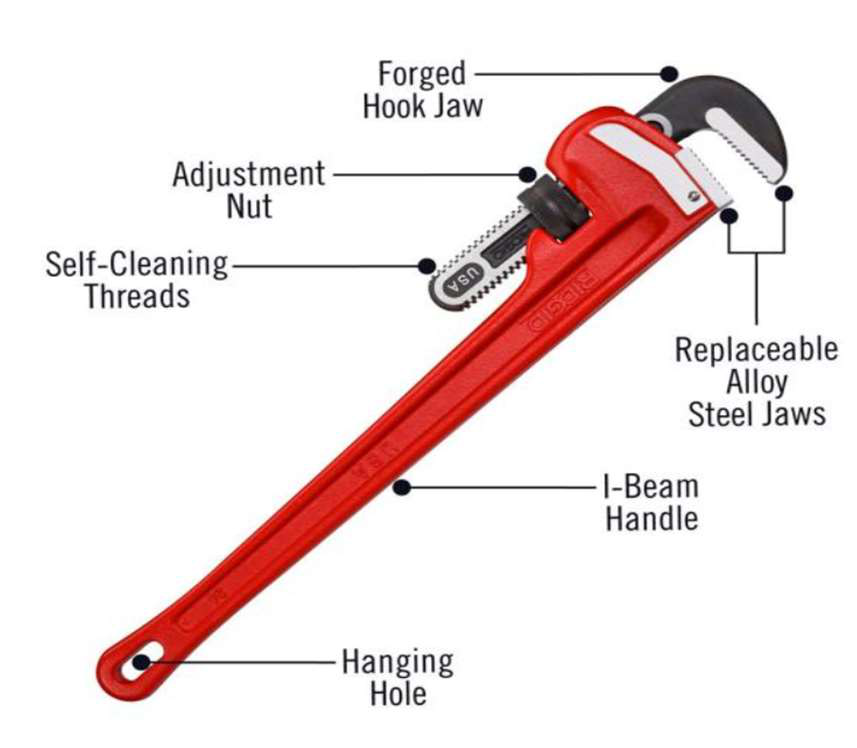
A pipe wrench (Source: INSTALL WATER STORAGE)
Design and Features
- The pipe wrench features serrated jaws that bite into pipe surfaces to prevent slipping during tightening or loosening.
- It has a long handle to provide leverage, reducing the physical effort required.
- The adjustable jaw can be set to grip different pipe sizes, from small-diameter pipes used in domestic water supply to larger pipes in commercial buildings.
- The tool is typically made of cast iron or steel to withstand high torque.
- Some pipe wrenches have cushioned handles to improve grip comfort during prolonged use.
Usage in Domestic Pipework
- Used to assemble threaded joints in galvanized steel or iron pipes commonly found in older buildings such as county government offices.
- Helps in removing stuck or corroded pipe fittings without damaging the pipe.
- Essential for tightening joints to prevent leaks in water systems.
- Suitable for working in confined spaces where pipe fittings are located.
- Can also be used to hold pipes steady while cutting or threading.
3.1.2 Pipe Cutter
A pipe cutter provides a clean, straight cut on pipes, essential for accurate fitting and jointing. It is preferred over saws when working with copper, plastic, or thin metal pipes due to its precision.
Types and Features
- The rotary pipe cutter has a circular cutting wheel and adjustable rollers to clamp the pipe.
- It allows gradual tightening to score and cut through the pipe wall evenly.
- Some pipe cutters are designed specifically for plastic pipes, incorporating blades suited for softer materials.
- Compact sizes make it suitable for tight spaces often encountered in domestic pipe installations in schools or retail shops.
- The tool produces minimal burrs, reducing the need for extensive filing before joining.
Application in Kenyan Context
- Widely used in hotel maintenance departments for cutting PPR pipes during renovation.
- Enables precise length adjustments when installing water supply lines in agricultural irrigation systems.
- Reduces wastage by providing clean cuts, which is cost-effective in budget-constrained public institutions.
- Facilitates quick repairs in busy environments such as hospitals, minimizing downtime.
- Preferred for use with copper pipes in residential buildings to ensure leak-free joints.
Applications of Pipe Cutters in Kenya
Pipe cutters are widely used in various Kenyan settings. In Nairobi's hotel maintenance departments, technicians use them to cut PPR pipes during renovations, ensuring minimal water wastage and efficient repairs. In agricultural irrigation systems in Machakos County, pipe cutters help farmers adjust pipe lengths to fit specific field layouts, improving water delivery. Public institutions such as schools in Kisii County rely on pipe cutters to maintain their water supply systems cost-effectively, as clean cuts reduce the need for replacement parts. Hospitals like Kenyatta National Hospital use pipe cutters for quick repairs, minimizing disruption to critical services. In residential buildings, especially in urban estates managed by property companies like Suraya Property Group, pipe cutters are preferred for copper pipes to guarantee leak-free joints and long-term reliability.
3.1.3 Hacksaw
The hacksaw is a versatile hand tool used for cutting metal and plastic pipes where pipe cutters are unsuitable, especially with larger diameter pipes or those made of harder materials.
Construction and Blade Types
- It consists of a metal frame holding a fine-toothed blade under tension.
- Blades vary in tooth count per inch (TPI), with finer teeth for metal and coarser for plastic.
- Frames may be adjustable to accommodate different blade lengths.
- Lightweight and portable, making it useful in fieldwork such as water supply repairs in rural cooperative offices.
- Blades are replaceable, and selection depends on the pipe material.
Practical Uses
- Employed in cutting steel pipes in county government water projects where pipe cutters cannot handle thickness.
- Useful in emergency repairs in retail businesses where quick pipe modification is necessary.
- Allows manual cutting in locations without power tools, such as remote farms.
- Can be used to trim bolts or other metal fixtures in pipe assembly.
- Requires careful handling to achieve straight cuts and avoid pipe deformation.
3.1.4 Pipe Threading Machine
Threading machines create screw threads on pipe ends, enabling the joining of pipes with threaded fittings. This tool is essential where threaded joints are preferred for durability and ease of disassembly.
| Name |
Specification |
Use |
| Pipe Threading Machine |
Electric or manual, adjustable dies |
Cuts external threads on metal pipes for fitting |
Operation and Importance
- The machine clamps the pipe and rotates cutting dies around the pipe end to form threads.
- Threading ensures leak-proof joints in high-pressure water systems in institutions like universities.
- Electric models increase speed and reduce labor in busy maintenance workshops.
- Threaded joints allow easy replacement and maintenance of pipe sections.
- Proper lubrication during threading reduces tool wear and improves thread quality.
3.1.5 Diestock
A diestock is a hand-held tool used to manually cut external threads on pipes or rods, typically for smaller diameter pipes or when electric threading machines are unavailable.
| Name |
Specification |
Use |
| Diestock |
Adjustable size with threading dies |
Manually cuts external threads on pipes |
Usage and Advantages
- Suitable for threading pipes during onsite repairs where power tools cannot be used, such as in remote county hospitals.
- Portable and economical, making it ideal for small-scale plumbing businesses.
- Requires skill to maintain straight and even threads.
- Allows threading of pipes made from various metals, including galvanized steel.
- Can be used to rethread damaged pipe ends to extend service life.
3.1.6 Pipe Vice
A pipe vice is a heavy-duty clamp used to hold pipes firmly during cutting, threading, or filing, providing stability and safety.
| Name |
Specification |
Use |
| Pipe Vice |
Fixed or portable, with adjustable jaws |
Secures pipes in place for work |
Importance in Pipework
- Prevents pipe movement that could lead to inaccurate cuts or injury.
- Used extensively in plumbing workshops in banks’ facility maintenance units for safe pipe handling.
- Adjustable jaws accommodate different pipe diameters.
- Often bolted to workbenches to provide a stable working platform.
- Helps maintain pipe alignment for accurate threading and jointing.
3.1.7 Files
Files are hand tools used to smooth and deburr pipe edges after cutting, ensuring clean joints and preventing damage to fittings.
| Name |
Specification |
Use |
| Files |
Various shapes and coarseness |
Smooth pipe ends and remove burrs |
Application and Maintenance
- Used after cutting pipes with hacksaws or pipe cutters to prepare the pipe for joining.
- Essential in hospital water system maintenance to prevent leaks caused by rough pipe edges.
- Different file shapes (flat, round, half-round) suit various pipe profiles.
- Regular cleaning of files maintains cutting efficiency.
- Careful filing ensures pipes fit properly into fittings, enhancing joint integrity.
3.1.8 Screwdrivers
Screwdrivers are used to tighten or loosen screws on pipe clamps, fixture brackets, or valve covers during pipe installation and repair.
| Name |
Specification |
Use |
| Screwdrivers |
Flathead and Phillips types |
Tighten or loosen screws on pipe accessories |
Use in Domestic Pipework
- Vital for securing pipe clips and brackets in domestic water installations at schools.
- Used in valve maintenance and replacement tasks.
- Selection of appropriate screwdriver head prevents damage to screw slots.
- Regular inspection and maintenance ensure effective torque application.
- Helps in assembling control panels in automated water supply systems in SACCO offices.
3.1.9 Drill with Various Sizes of Bits
Drills are power tools used to create holes in walls, floors, or pipes for pipe fixing or installation of fixtures.
| Name |
Specification |
Use |
| Drill |
Electric, variable speed, assorted bits |
Drilling holes for pipe supports and fixtures |
Drill Use and Safety
- Used by maintenance teams in county referral hospitals to fix pipe clamps on concrete walls.
- Various drill bits such as masonry, wood, and metal bits allow drilling into different surfaces.
- Proper selection of bit size ensures correct hole diameter for anchors or screws.
- Drilling requires safety gear to prevent injury from debris.
- Regular maintenance of drill bits keeps them sharp and effective.
3.1.10 Mallet
A mallet is a hammer with a large wooden or rubber head used to strike pipes or fittings gently without damaging them.
| Name |
Specification |
Use |
| Mallet |
Wooden or rubber head |
Apply controlled force without damaging pipes |
Functions in Pipework
- Used to position plastic pipes or fittings during assembly in hotel plumbing systems.
- Helps in tapping pipes into place without deforming them.
- Used to dislodge stuck fittings gently.
- Preferred over metal hammers when working with delicate materials like PPR pipes.
- Requires regular inspection to ensure the head is not damaged or loose.
3.1.11 Ballpein Hammer
A ballpein hammer has a flat face and a rounded pein used in metalworking tasks in pipe installation.
| Name |
Specification |
Use |
| Ballpein Hammer |
Steel head with flat and rounded ends |
Shaping metal parts and striking chisels |
Use in Pipework
- Used to shape metal pipe fittings or connectors in repair workshops at retail businesses.
- Assists in driving cold chisels to cut or shape metal pipes.
- The rounded end is used for peening to harden surfaces or shape metal.
- Provides controlled force to avoid damage to pipe components.
- Requires proper storage to prevent damage to the hammer face.
3.1.12 Cold Chisel
A cold chisel is a hardened steel tool used to cut or shape metal pipes and fittings.
| Name |
Specification |
Use |
| Cold Chisel |
Hardened steel, flat blade |
Cutting and shaping metal pipes |
Application in Domestic Pipework
- Used to cut threaded metal pipes in facility maintenance for county government buildings.
- Helps remove damaged sections without specialized cutting machines.
- Requires hammer strikes to operate, often with a ballpein hammer.
- Must be kept sharp for effective cutting.
- Safety precautions include wearing gloves and eye protection.
3.1.13 PPR Welding Machine / Heat Fusion
The PPR welding machine is a specialized tool used for joining polypropylene random (PPR) pipes by heat fusion, creating strong, leak-proof joints.
| Name |
Specification |
Use |
| PPR Welding Machine |
Electric, adjustable temperature |
Heat fusion joining of PPR plastic pipes |
Operation and Benefits
- Heats pipe ends and fittings to a molten state before pressing them together.
- Creates homogenous joints that are durable and resistant to leaks, ideal for hospital water systems.
- Temperature control ensures proper melting without degrading pipe material.
- Speeds up installation of plastic pipe networks in schools and universities.
- Requires operator training to ensure quality and safety.
3.1.14 Pipe Bender
A pipe bender is used to bend pipes to desired angles without kinking or damaging the pipe, crucial in routing pipes around obstacles.
| Name |
Specification |
Use |
| Pipe Bender |
Manual or hydraulic, with formers |
Bends pipes to specified angles |
Importance in Pipework
- Enables neat pipe layouts in confined spaces such as hotel kitchens.
- Prevents pipe deformation that could cause leaks or flow restrictions.
- Manual benders are common in small workshops, while hydraulic types are used in larger maintenance facilities.
- Used for copper, steel, and plastic pipes depending on the bender type.
- Correct bending techniques extend pipe longevity and system reliability.
3.1.15 Pipes Layout
Pipes layout refers to the planned arrangement and routing of pipes within a building or facility to optimize flow, accessibility, and maintenance.
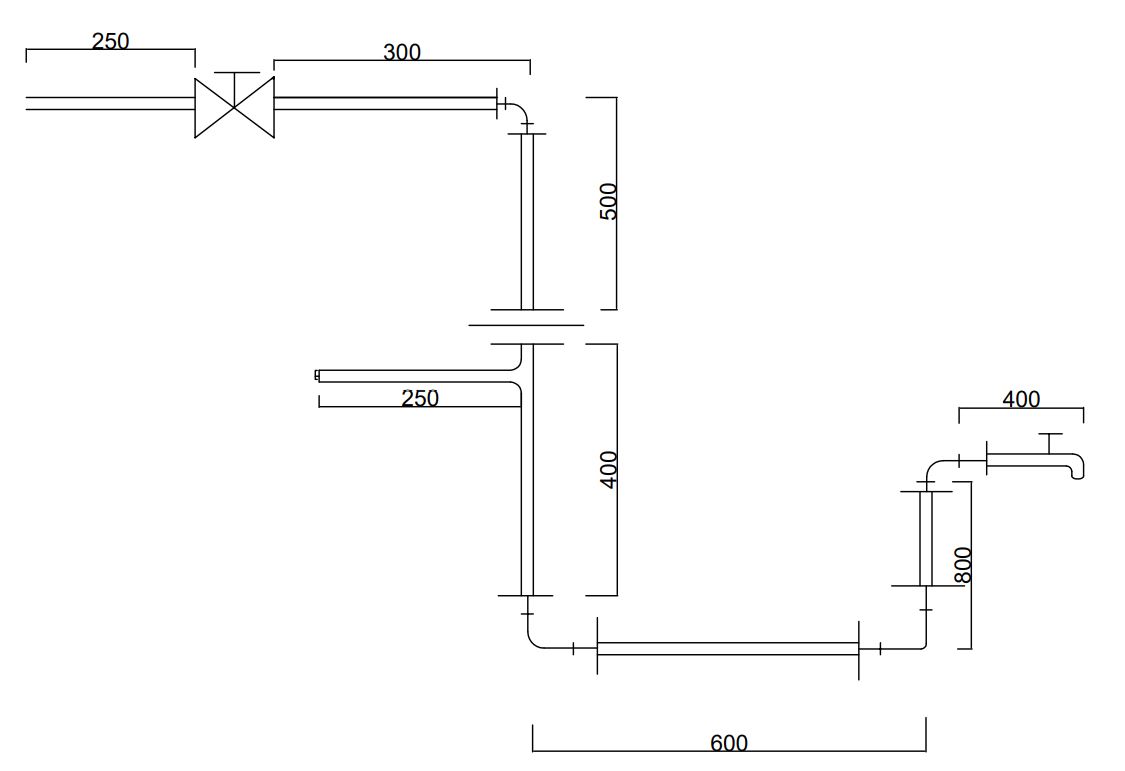
A detailed plumbing pipe layout (Source: CANDIDATE ASSESSMENT TOOL WATER SUPPLY SYSTEMS 1)
Planning Considerations
- The layout must minimize pipe length to reduce material costs and pressure loss.
- Pipes should be routed to avoid interference with electrical wiring and structural elements.
- Accessibility for future maintenance or repairs is a key factor.
- Proper slope and gradient are essential for drainage and flow efficiency.
- Compliance with national plumbing codes and standards ensures safety and quality.
3.1.16 Terms and Concepts
Understanding key terms and concepts in pipework ensures clear communication and accurate execution of tasks.
Essential Terms
3.1.17 Setting Out of the Pipes
Setting out involves marking and positioning pipes according to the layout plan before installation begins.
Steps in Setting Out
- Review the pipe layout plan and identify pipe routes.
- Mark pipe positions on walls, floors, or ceilings using chalk or markers.
- Measure and mark pipe lengths, considering fittings and connections.
- Verify alignment and slope to ensure proper flow.
- Mark fixing points for pipe supports or clips.
- Double-check measurements to avoid errors during installation.
Practice Questions
- Explain the functions and features of a pipe wrench and how it is used in domestic pipework. (10 marks)
- Describe the differences between a pipe cutter and a hacksaw, including their appropriate applications. (10 marks)
- Outline the procedure for setting out pipes before installation in a domestic water supply system. (12 marks)
- Discuss the importance of using a PPR welding machine in plastic pipe installations and the benefits it offers. (8 marks)
- List and explain five key terms commonly used in pipework and their significance in the installation process. (10 marks)
The rest of this chapter
🔒Create a free account to open more of this chapter.
Free: practical guides, quick cards, workplace scenarios and more.
Create a free account 🔒3.2 Setting out of pipe layout based on working drawings
Setting out pipe layout is a critical phase in domestic water supply installation that involves transferring the design from working drawings to the actual site. This process ensures that pipes are positioned accurately according to the specifications, avoidin…
🔒3.3 Pipes mounted based on drawing specifications
Accurate pipe mounting according to drawing specifications ensures the integrity, functionality, and safety of domestic water supply systems. Proper mounting prevents leaks, supports pipe longevity, and facilitates maintenance. Kenyan institutions such as univ…
🔒3.4 Installation of Storage and Auxiliary Fittings
The installation of storage and auxiliary fittings is a critical phase in domestic pipework. Proper installation ensures water is stored safely, delivered efficiently, and maintained at the required quality and temperature. In Kenyan institutions such as count…
🔒3.5 Pipework Functionality Tests
In domestic water supply systems across Kenya, ensuring the integrity and proper functioning of pipework is essential to deliver safe and reliable water to consumers. Whether in a county referral hospital, a university dormitory, a retail business, or a farm i…
🔒3.6 Housekeeping
Proper housekeeping is essential in domestic pipework installation and maintenance to ensure a safe, efficient and durable water supply system. In Kenyan workplaces such as county government offices, universities, and retail businesses, good housekeeping preve…
Chapter Summary
This chapter provided a comprehensive overview of performing domestic pipework, beginning with the assembly of essential piping tools and equipment such as pipe wrenches, cutters, threading machines, and welding devices. It emphasized the importance of understanding pipe layout terminology and the precise setting out of pipes based on working drawings to ensure accurate installation. The chapter detailed the correct mounting of pipes according to drawing specifications, followed by the installation of storage and auxiliary fittings including tanks, cisterns, valves, and connectors. It also covered the critical procedures for testing pipework functionality through water, air, and pressure tests to verify system integrity. Finally, the chapter highlighted the significance of maintaining good housekeeping practices to ensure a safe and efficient working environment throughout the pipework installation process.
Self-Assessment
🔒 PDFDownload this self-assessment, with answers
A. Written Assessment
- What is the primary use of a pipe wrench in domestic pipework? (2 marks)
- Identify two safety precautions to observe when using a pipe cutter. (3 marks)
🔒20 more in this section.
Chapter Examination Questions
🔒 PDFDownload these examination questions, with worked answers
SECTION A (40 Marks) - Answer ALL Questions
- Explain the purpose of a pipe wrench and describe a typical situation in a county hospital where it would be used. (4 marks)
- Identify three key safety precautions to observe when using a pipe cutter on plastic pipes. (4 marks)
🔒18 more in this section.
Chapter Practical Activities
Practical 1: Cut and thread 20mm GI pipes for domestic water supply installation
Plumbing · Level 5
Water Supply System I
PRACTICAL ASSESSMENT
TIME: 4 HOURS
⬇ PDFCandidate Instructions (Candidate Tool)
Type: Individual
INSTRUCTIONS TO CANDIDATE:
1. You are required to perform the following task:
i. Cut six lengths of 20mm Ø GI class B pipe to specified lengths and thread both ends with minimum three full threads.
2. You have been provided with the following resources for the practical task:
| Tools & Equipment | Materials |
|---|
| Pipe cutter | 20mm Ø GI class B pipe |
| Pipe threading machine | 20mm Ø GI elbow |
| Die stock | 20mm Ø GI union |
| Pipe vice | 20mm Ø GI Tee |
| Files | Gate valve 20mm Ø |
| Tape measure | Thread seal tape |
| Screw driver | Threading oil |
| Pipe wrench | Sand |
⬇ PDFResources Required (Cutting List)
| S/N | Item | Quantity |
|---|
| 1 | 20mm Ø GI class B pipe | 6.0 m per Candidate |
| 2 | Thread seal tape | Sufficient per Candidate |
| 3 | Threading oil | Sufficient per Candidate |
| 4 | 20mm Ø GI elbow | 2 Pcs per Candidate |
| 5 | 20mm Ø GI union | 1 Pc per Candidate |
| 6 | 20mm Ø GI Tee | 3 Pcs per Candidate |
| 7 | Gate valve 20mm Ø | 1 Pc per Candidate |
| 8 | Sand | Sufficient per Candidate |
| 9 | PPEs (dust coat, safety boots, gloves) | Full gear per Candidate |
⬇ PDFAssessor Guide
| Items to be Evaluated | Marks Available | Marks Obtained | Comments |
|---|
| TASK 1: Prepare and thread 20mm GI pipes |
Candidate wore full prescribed PPE (dust coat, safety boots, gloves)
(Award 1 mark for each 2 worn PPEs or zero = 2 marks) | 2 | | |
Observed safe use of pipe cutter, threading machine and files with proper tool arrangement
(Award 2 marks for each 2 observed safety or zero = 4 marks) | 4 | | |
Assembled all required tools and equipment correctly (pipe cutter, threading machine, die stock, pipe vice, files)
(Award 1 mark for each 3 tools assembled or zero = 3 marks) | 3 | | |
Assembled all required materials correctly (20mm GI pipe, fittings, threading oil, thread seal tape, sand)
(Award 1 mark for each 6 materials assembled or zero = 6 marks) | 6 | | |
Measured and cut six lengths of 20mm GI pipe accurately as per drawing (e.g. 1.0m, 0.75m, 0.85m, 1.2m, 0.9m, 1.3m)
(Award 1 mark for each measured length or zero = 5 marks) | 5 | | |
Threaded both ends of each pipe length accurately with minimum three full threads
(Award marks for correct threading on all pipe ends minimum 3 threads each) | 10 | | |
Used threading oil appropriately during threading process
(Award 2 marks for correct use of threading oil or zero) | 2 | | |
Cleaned and filed pipe ends and threaded sections to remove burrs and sharp edges
(Award marks for smooth and clean pipe ends and threads) | 6 | | |
Cleaned workspace as per standard operating procedures
(Award 2 marks for clean workspace or zero) | 2 | | |
Stored tools and equipment properly as per manufacturer's instructions
(Award 2 marks for proper storage or zero) | 2 | | |
| Sub-Total | 42 | | |
| PRODUCT CHECKLIST |
All six 20mm GI pipes cut to specified lengths within ±5mm tolerance, both ends threaded with minimum 3 full threads, threads clean and uniform, no damage to pipe ends
(Award marks for accurate lengths, correct threading, and quality finish of pipe ends) | 18 | | |
| Sub-Total | 18 | | |
| GRAND TOTAL | 60 | | |
ASSESSMENT OUTCOME: ☐ Competent ☐ Not Yet Competent (competent if at least 50%)
Practical 2: Perform Pipe Bending on 20mm GI Pipes to Specified Angles
Plumbing · Level 5
Water Supply System I
PRACTICAL ASSESSMENT
TIME: 4 HOURS
⬇ PDFCandidate Instructions (Candidate Tool)
Type: Individual
INSTRUCTIONS TO CANDIDATE:
1. You are required to perform the following task:
i. Bend 20mm Ø GI pipe sections accurately to 45° and 90° angles.
2. You have been provided with the following resources for the practical task:
| Tools & Equipment | Materials |
|---|
| Tape measure | 20mm Ø GI class B pipe |
| Pipe bender | Pipe fittings |
| Pipe vice | Thread seal tape |
| Hacksaw | Sand |
| File | |
| Scriber | |
| Pipe wrench | |
⬇ PDFResources Required (Cutting List)
| S/N | Item | Quantity |
|---|
| 1 | 20mm Ø GI class B pipe | 6.0 m per Candidate |
| 2 | 20mm Ø PVC pipes | 1.8 m per Candidate |
| 3 | Pipe fittings (20mm GI elbows, tees, unions) | 5 Pcs per Candidate |
| 4 | Thread seal tape | Sufficient per Candidate |
| 5 | Sand | Sufficient per Candidate |
| 6 | PPE (dust coat, gloves, safety boots) | Full gear per Candidate |
⬇ PDFAssessor Guide
| Items to be Evaluated | Marks Available | Marks Obtained | Comments |
|---|
| TASK 1: Pipe Bending Process |
Candidate wears full PPE as per safety regulations
(Award 1 mark for each worn PPE item: dust coat, gloves, safety boots, zero=2 marks) | 2 | | |
Candidate uses tools safely and arranges workspace properly
(Award 2 marks for each two observed safety measures or zero=4 marks) | 4 | | |
Candidate assembles all required tools before starting bending
(Award 1 mark for each tool assembled: tape measure, pipe bender, pipe vice, zero=3 marks) | 3 | | |
Candidate measures and marks pipe accurately for bending points
(Award 1 mark for each accurate measurement or zero=5 marks) | 5 | | |
Candidate performs curved bend on pipe correctly to 45°
(Award 2 marks for correct curved bend or zero=2 marks) | 2 | | |
Candidate performs heat bend on pipe correctly to 90° as per drawing
(Award 4 marks for correct heat bend or zero=4 marks) | 4 | | |
Candidate smoothens all bends correctly using files
(Award marks for smoothness and absence of cracks or zero=6 marks) | 6 | | |
Candidate cleans workspace as per SOP after completion
(Award 2 marks for proper cleaning or zero=2 marks) | 2 | | |
Candidate stores tools and equipment properly after use
(Award 2 marks for proper storage or zero=2 marks) | 2 | | |
| Sub-Total | 30 | | |
| PRODUCT CHECKLIST |
Pipes bent to specified angles of 45° and 90° within ±2° tolerance
(Award marks for each angle correctly bent or zero=10 marks) | 10 | | |
Bends are smooth without cracks or deformities
(Award marks for smooth finish and absence of defects or zero=8 marks) | 8 | | |
Pipe lengths after bending match drawing dimensions within 10mm tolerance
(Award marks for accurate length post-bending or zero=7 marks) | 7 | | |
| Sub-Total | 25 | | |
| GRAND TOTAL | 55 | | |
ASSESSMENT OUTCOME: ☐ Competent ☐ Not Yet Competent (competent if at least 50%)
🔒Assemble a 20mm diameter domestic pipework section with various fittingsPractical 3
🔒Set out domestic water supply pipe layout from working drawingsPractical 4
🔒Mount Domestic Water Supply Pipes as per Drawing SpecificationsPractical 5
🔒Install a 1000L domestic storage water tank with auxiliary fittings as per the provided working drawingPractical 6
🔒Perform Heat Fusion Welding of 20mm PPR PipesPractical 7
🔒Prepare and drill 20mm GI and PVC pipes for domestic water supplyPractical 8
🔒Conduct water tightness test on 20mm GI pipework systemPractical 9
🔒Perform air pressure test on 20mm diameter domestic pipeworkPractical 10
🔒Carry out pressure test on 20mm Ø pipe installationPractical 11
🔒Assemble and tighten threaded 20mm GI pipe sections using pipe wrenchesPractical 12
🔒Set out and install 1000L domestic water tank connectorsPractical 13
🔒Perform housekeeping after pipework installationPractical 14
🔒Interpret and Explain Domestic Pipework TerminologyPractical 15
