
By the end of this chapter, you will be able to:
Mastering these skills ensures you can install and maintain security systems reliably, keeping people and property safe in the real world.
Security systems installation is a critical discipline within Electronics Engineering, focusing on safeguarding physical and digital assets through carefully designed and implemented electronic measures. In Kenya, as organizations across sectors such as banking, hospitality, and public service increasingly prioritize security, professionals must master the technical foundations that enable reliable installations. This chapter explores essential technical concepts including cable types used in security systems and foundational mathematical tools like derivatives, which support system analysis and optimization. Mastery of these topics equips engineers to design, install, and troubleshoot security systems with precision and confidence.
The choice of cable in security system installation directly affects system reliability, signal integrity, and overall performance. Different cables serve distinct purposes depending on signal type, distance, and environmental conditions. Kenyan engineers working in environments ranging from county government offices to large retail complexes must understand the characteristics and appropriate applications of each cable type to ensure optimal security system operation.
Coaxial cables consist of a central conductor, insulating layer, metallic shield, and outer jacket, designed to transmit high-frequency signals with minimal interference. They are widely used in CCTV camera installations due to their ability to carry video signals over relatively long distances with low signal loss. In Nairobi hospitals, for example, coaxial cables enable clear surveillance footage transmission between cameras and monitoring stations.
Central Conductor: Usually copper or copper-clad steel; conducts the electrical signal.
Dielectric Insulator: Surrounds the conductor, preventing signal loss and maintaining signal integrity.
Shielding Layer: Metallic braid or foil that protects against electromagnetic interference (EMI).
Outer Jacket: Provides mechanical protection and environmental resistance.
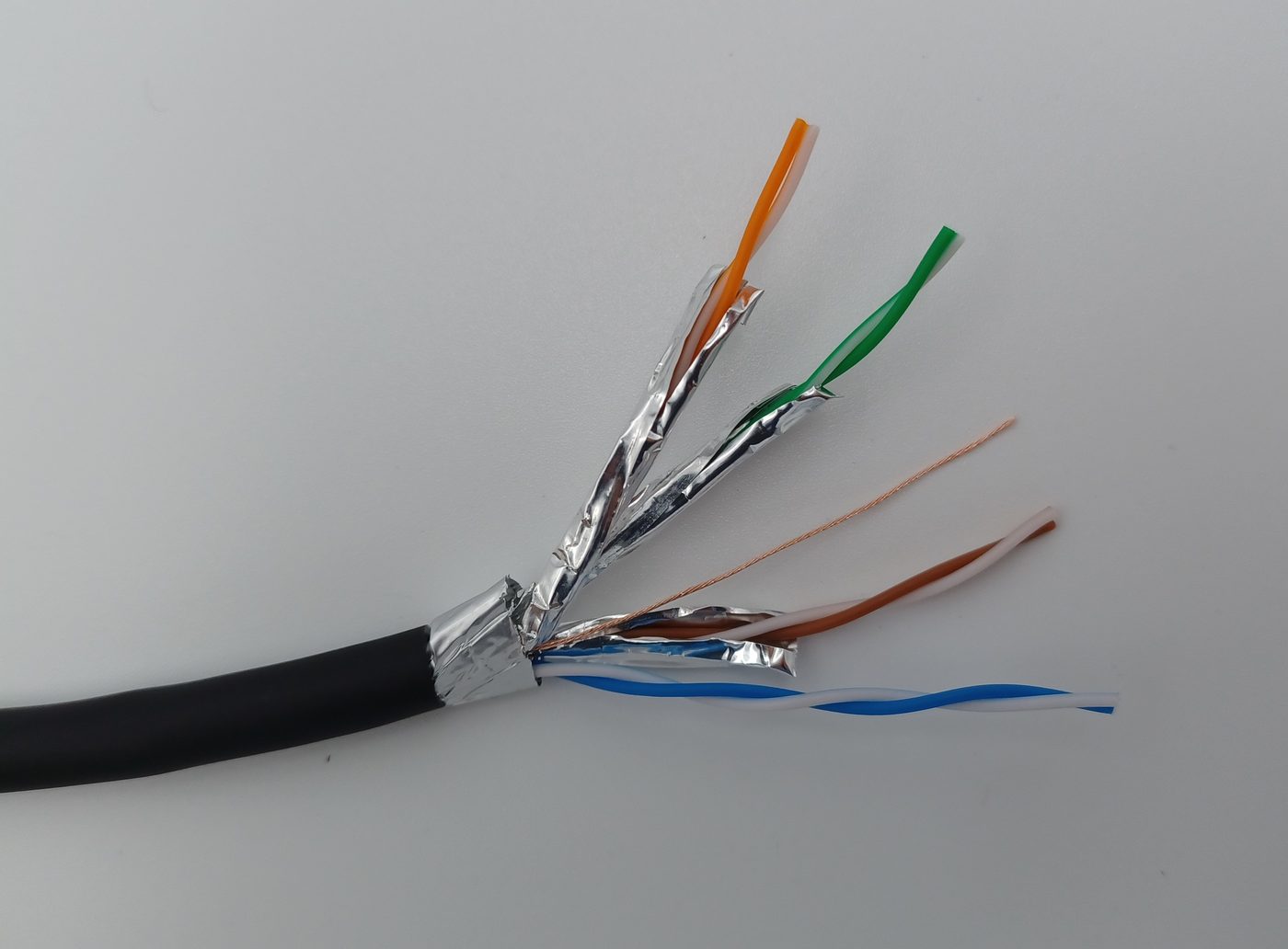
Cable with outer jacket and internal wires exposed (Source: Wikimedia Commons)
Coaxial cables are robust against external noise, making them suitable for installations in electrically noisy environments such as factories or large office buildings. However, their bulkiness and limited flexibility can pose challenges in tight installations. Understanding cable specifications such as impedance (commonly 75 ohms for video applications) is essential to avoid signal reflections and degradation.
Twisted pair cables consist of pairs of insulated copper wires twisted together to reduce electromagnetic interference and crosstalk between pairs. They are commonly used in access control systems and IP-based security cameras, where data transmission over Ethernet protocols is required.
Unshielded Twisted Pair (UTP): Most common type, cost-effective and flexible, used for indoor applications where interference is minimal.
Shielded Twisted Pair (STP): Includes additional shielding to protect against EMI, suitable for industrial or outdoor environments.
In Kenyan county government offices, UTP cables are often used to connect networked security devices to central control rooms. The twisting of wire pairs reduces noise, allowing reliable transmission of digital signals over distances typically up to 100 meters without repeaters. Proper cable termination and adherence to standards such as CAT5e or CAT6 ensure performance and future-proofing.
Fiber optic cables transmit data as pulses of light through strands of glass or plastic fiber, offering extremely high bandwidth and immunity to electromagnetic interference. These cables are increasingly used in large-scale security systems such as those in university campuses or major commercial complexes in Kenya, where long-distance, high-speed data transmission is critical.
Single-mode Fiber: Suitable for long-distance communication, with a small core diameter allowing light to travel straight.
Multi-mode Fiber: Has a larger core, used for shorter distances with multiple light paths.
Fiber optic cables require specialized installation skills, including precise connectorization and protection against physical damage. Their resistance to EMI makes them ideal for environments near heavy machinery or power lines. While more expensive than copper cables, fiber optics provide future scalability and enhanced security against signal tapping.
In security systems installation, understanding how system parameters vary with multiple factors is essential for optimizing performance. Functions of two or more variables represent scenarios where outputs depend on several independent inputs, such as signal strength depending on cable length and interference level. Derivatives of these functions help quantify how changes in one variable affect the system while keeping others constant, enabling engineers to predict and adjust system behavior effectively.
Partial derivatives measure the rate at which a function changes with respect to one variable while holding the others fixed. This concept is crucial when analyzing complex systems where multiple factors interact. For instance, in signal attenuation modeling, the attenuation A(x, y) might depend on distance x and frequency y; the partial derivative with respect to x shows how attenuation changes with distance independently of frequency.
The process of obtaining partial derivatives follows similar rules to single-variable differentiation but applied to one variable at a time:
Mastery of these rules enables engineers to derive expressions needed for system design calculations, such as optimizing sensor placement or cable routing.
Partial derivatives are used to model how system parameters respond to environmental and design variables. For example, in a security camera system, the clarity of the image C(x, y) might depend on lighting intensity x and cable quality y. Calculating ∂C/∂x helps determine how much improving lighting improves clarity, guiding cost-effective upgrades.
In Kenya’s banking sector, optimizing alarm sensor sensitivity based on room size and ambient noise level involves evaluating such multidimensional functions. This mathematical approach supports evidence-based decision-making rather than trial and error.
Partial derivatives extend beyond theoretical mathematics and find practical application in optimizing and troubleshooting security system installations. Kenyan engineers apply these concepts to control system variables effectively, ensuring system stability and responsiveness under varying conditions.
Sensitivity analysis involves assessing how small changes in input variables affect system outputs. Using partial derivatives, engineers quantify the impact of environmental changes such as temperature, humidity, or electrical interference on sensor accuracy or signal transmission.
Alarm systems require setting thresholds that balance sensitivity and false alarms. Partial derivatives of the system’s response function with respect to threshold settings allow engineers to find values that optimize detection probability.
Partial derivatives assist in fault diagnosis by modeling how deviations in input variables cause anomalies in outputs. For example, if signal attenuation varies unexpectedly, partial derivatives help isolate whether cable length, interference, or equipment malfunction is the primary cause.
In Nairobi retail businesses, this approach reduces downtime by guiding targeted inspections rather than full system overhauls.
Understanding stationary points of functions involving two variables is vital for optimizing system performance parameters such as signal strength, detection accuracy, or power consumption. Stationary points occur where the rate of change in all directions is zero, indicating potential maxima, minima, or saddle points.
Stationary points of a function f(x, y) are points where both partial derivatives vanish: ∂f/∂x = 0 and ∂f/∂y = 0. These points represent locations in the variable space where the function's slope is zero in every direction.
After identifying stationary points, classifying them as maxima, minima, or saddle points requires evaluating second-order partial derivatives. The discriminant D is defined as:
D = (∂²f/∂x²)(∂²f/∂y²) - (∂²f/∂x∂y)²
This classification guides engineers in selecting optimal operating parameters.
In Kenyan universities, optimizing camera focus and sensor sensitivity often involves functions of two variables, such as distance and angle. Identifying stationary points ensures that settings maximize image clarity or detection accuracy.
Create a free account to open more of this chapter.
Free: practical guides, quick cards, workplace scenarios and more.
Create a free accountThis chapter provides a comprehensive overview of installing security systems, beginning with the identification and types of cables used in security installations and the critical factors to consider when laying these cables, including the importance of segregation to prevent interference. The installation process covers various security technologies such as CCTV, alarm systems, and electric fences, with detailed attention to their components, materials, and backup power systems. Specifications of tools, equipment, and materials are examined, emphasizing tolerance, make, size, and class to ensure reliability and compatibility. Wiring procedures for CCTV, alarm, and electric fence systems are supported by schematic and wiring diagrams, highlighting the role of components such as transformers, relays, control panels, sounders, and sirens. The chapter also addresses insulation classes for enclosures, cable labelling, and the significance of proper cable termination along with the tools used in these processes. Integration of security systems with other components is discussed alongside practical housekeeping practices, system coding and configuration, and the proper disposal of waste material to maintain safety and environmental standards.
Type: Individual
| Tools & Equipment | Materials |
|---|---|
| Wire Stripper | RG59 Coaxial Cable 75 Ohm |
| Crimping Tool | 18/2 PVC Insulated Security Alarm Cable |
| Multimeter | 1/2 inch PVC Electrical Conduit |
| Cable Clips 10mm | |
| BNC Connectors | |
| SMA Connectors | |
| Trunking 25mm x 25mm PVC | |
| Cable Ties 100mm | |
| Electrical Tape |
| S/N | Item | Quantity |
|---|---|---|
| 1 | RG59 Coaxial Cable 75 Ohm, 20m spool | 20 m per Candidate |
| 2 | 18/2 PVC Insulated Security Alarm Cable, 10m spool | 10 m per Candidate |
| 3 | 1/2 inch PVC Electrical Conduit | 3 m per Candidate |
| 4 | Cable Clips 10mm | 20 pcs per Candidate |
| 5 | BNC Connectors for RG59 Cable | 4 pcs per Candidate |
| 6 | SMA Connectors for Alarm Cable | 4 pcs per Candidate |
| 7 | Trunking 25mm x 25mm PVC | 2 m per Candidate |
| 8 | Cable Ties 100mm | 20 pcs per Candidate |
| 9 | Electrical Tape | 1 roll per Candidate |
| 10 | Wire Stripper | 1 pc per Candidate |
| 11 | Crimping Tool | 1 pc per Candidate |
| 12 | Multimeter | 1 pc per Candidate |
| Items to be Evaluated | Marks Available | Marks Obtained | Comments |
|---|---|---|---|
| TASK 1: Identification and Selection of Cables and Components | |||
| Wore Personal Protective Equipment (PPE) including gloves and safety boots (Award 1 mark for PPE use or 0) | 1 | ||
| Applied good housekeeping by ensuring clean and organized work area before starting (Award 1 mark for good housekeeping or 0) | 1 | ||
| Correctly identified RG59 coaxial cable and explained its use for CCTV video transmission (Award 2 marks for correct identification and explanation or 0) | 2 | ||
| Correctly identified 18/2 alarm cable and explained its use for alarm signal transmission (Award 2 marks for correct identification and explanation or 0) | 2 | ||
| Selected appropriate conduit size and type for cable protection (Award 2 marks for correct conduit selection or 0) | 2 | ||
| Identified and selected correct connectors (BNC for coaxial and SMA for alarm cables) (Award 3 marks for correct connectors selected or 0) | 3 | ||
| Selected suitable cable clips and trunking for cable management (Award 2 marks for correct cable management materials or 0) | 2 | ||
| Used correct tools (wire stripper, crimping tool) for cable preparation (Award 2 marks for correct tool selection or 0) | 2 | ||
| Sub-Total | 15 | ||
| PRODUCT CHECKLIST | |||
| All cables and components correctly identified and selected as per system requirements (Award 4 marks for complete and correct selection or 0) | 4 | ||
| Selected cables and components meet specified size, type, and class standards (Award 3 marks for compliance with specifications or 0) | 3 | ||
| Cable lengths and quantities correctly matched to layout requirements (Award 3 marks for correct quantity and length or 0) | 3 | ||
| Components and cables arranged logically for efficient installation (Award 3 marks for logical arrangement or 0) | 3 | ||
| Documentation of selected materials is complete and accurate (Award 2 marks for complete documentation or 0) | 2 | ||
| Sub-Total | 15 | ||
| GRAND TOTAL | 30 | ||
Type: Individual
| Tools & Equipment | Materials |
|---|---|
| Multimeter | 1.5 mm² PVC Single core cable, Black |
| Wire stripper | 1.5 mm² PVC Single core cable, Red |
| Hammer | 2.5 mm² PVC Single core cable, Yellow-Green (Earth) |
| Screwdriver set | PVC Flexible conduit 20mm diameter |
| Measuring tape 5m | PVC Trunking 25mm x 25mm |
| Marker pen | Cable clips 10mm |
| Cable labels pre-printed | |
| Cable ties 150mm | |
| Electrical tape |
| S/N | Item | Quantity |
|---|---|---|
| 1 | 1.5 mm² PVC Single core cable, Black | 3.0 m per Candidate |
| 2 | 1.5 mm² PVC Single core cable, Red | 3.0 m per Candidate |
| 3 | 2.5 mm² PVC Single core cable, Yellow-Green (Earth) | 2.0 m per Candidate |
| 4 | PVC Flexible conduit 20mm diameter | 2.0 m per Candidate |
| 5 | Cable clips 10mm | 20 pcs per Candidate |
| 6 | Cable labels pre-printed (numbers 1-20) | 20 pcs per Candidate |
| 7 | PVC Trunking 25mm x 25mm | 3.0 m per Candidate |
| 8 | Cable ties 150mm | 10 pcs per Candidate |
| 9 | Electrical tape | 1 roll per Candidate |
| 10 | Multimeter | 1 pc per Candidate |
| 11 | Wire stripper | 1 pc per Candidate |
| 12 | Hammer | 1 pc per Candidate |
| 13 | Screwdriver set | 1 set per Candidate |
| 14 | Measuring tape 5m | 1 pc per Candidate |
| 15 | Marker pen | 1 pc per Candidate |
| Items to be Evaluated | Marks Available | Marks Obtained | Comments |
|---|---|---|---|
| TASK 1: Planning and Preparation | |||
| Wore Personal Protective Equipment (PPE) correctly (Award 1 mark for wearing dustcoat/overall and safety boots) | 1 | ||
| Applied good housekeeping practices before starting work (Award 1 mark for clean and safe working area) | 1 | ||
| Measured and marked cable routes accurately for 3.0m length (Award 2 marks for correct measurement and marking) | 2 | ||
| Selected correct cables and followed colour coding for segregation (Award 2 marks for correctly identifying and segregating cables by colour) | 2 | ||
| Prepared cable labels and planned labelling sequence (Award 1 mark for correct labelling plan) | 1 | ||
| Prepared tools and materials for cable laying (Award 1 mark for readiness of correct tools and materials) | 1 | ||
| Sub-Total | 8 | ||
| TASK 2: Execution of Cable Laying and Segregation | |||
| Laid cables in PVC conduit and trunking with proper segregation (Award 3 marks for adherence to segregation and neat installation) | 3 | ||
| Fixed cable clips and ties uniformly at correct intervals (max 300mm) (Award 2 marks for correct spacing and firm fixing) | 2 | ||
| Ensured cables are not twisted, nicked or damaged during installation (Award 2 marks for careful handling of cables) | 2 | ||
| Terminated cables correctly with proper twisting and insulation (Award 3 marks for proper termination and insulation) | 3 | ||
| Applied cable labels correctly and legibly on each cable (Award 2 marks for neat and correct labelling) | 2 | ||
| Used electrical tape neatly to secure cable ends and terminations (Award 1 mark for neat application of tape) | 1 | ||
| Sub-Total | 13 | ||
| TASK 3: Testing and Final Checks | |||
| Performed continuity and insulation resistance tests using multimeter (Award 3 marks for correct testing and interpretation) | 3 | ||
| Verified cable segregation and labelling after installation (Award 2 marks for correct and consistent segregation and labelling) | 2 | ||
| Applied good housekeeping and cleaned work area after completion (Award 1 mark for proper cleaning and waste disposal) | 1 | ||
| Sub-Total | 6 | ||
| PRODUCT CHECKLIST | |||
| Cables laid over 3.0m length with correct segregation and no crossing (Award 4 marks for correct cable routing and segregation) | 4 | ||
| Cables fixed firmly with clips and ties spaced not more than 300mm apart (Award 3 marks for uniform and secure fixing) | 3 | ||
| Cable labels applied legibly and correspond to cable colour coding (Award 3 marks for accurate and clear labelling) | 3 | ||
| Cable terminations neat, insulated and free from damage (Award 4 marks for quality terminations) | 4 | ||
| Installation complies with safety and segregation standards (Award 3 marks for conformity to standards) | 3 | ||
| Sub-Total | 17 | ||
| GRAND TOTAL | 44 | ||
At the start of this chapter we promised you would be able to:
Tick each one you can genuinely do.
So, are you there yet?
You're competent when you can confidently do 50% or more of what this chapter promised.
Sign in to record how you're doing.