Electrical Engineering  ·  Level 6
Electrical Installation
Chapter 6: Perform electrical installation maintenance
📚 7 Topics
⚑ What you will be able to do

By the end of this chapter, you will be able to:

  • develop an effective maintenance strategy based on how the electrical system works
  • prepare a maintenance schedule that follows your organization's procedures
  • inspect electrical equipment and systems accurately in line with IET regulations
  • prepare all the necessary materials and tools according to your maintenance plan
  • carry out maintenance activities safely and correctly following IET regulations
  • perform system tests accurately and reliably as required by IET regulations
  • update maintenance records clearly and consistently according to your maintenance strategy

Mastering these skills will help you keep electrical systems running safely and efficiently, making you a valuable asset in the electrical trade.

Electrical installation maintenance is a critical aspect of ensuring the safety, reliability, and efficiency of electrical systems across diverse sectors in Kenya. Whether in county referral hospitals, universities, retail businesses, or county government offices, maintaining electrical installations prevents disruptions that could affect critical services and operations. This chapter focuses on the essential safety procedures and terminology that every professional involved in electrical maintenance must understand and apply to uphold high standards of practice.

6.1 Safety Procedures Maintenance

Safety procedures in electrical installation maintenance are fundamental to protecting workers, users, and property from electrical hazards. Given the complex and potentially dangerous nature of electrical systems, adherence to safety protocols is non-negotiable in all Kenyan workplaces, including hospitals, schools, banks, and agricultural cooperatives. Proper safety maintenance reduces the risk of electrical shocks, fires, and equipment damage, ensuring continuity of service and compliance with legal requirements.

6.1.1 Identification and Assessment of Electrical Hazards

Identifying and assessing electrical hazards is the first step in maintaining safety during electrical installation maintenance. This process involves recognizing potential sources of danger and evaluating their severity to implement appropriate control measures.

Key Aspects of Hazard Identification

  • Visual Inspection of Equipment: Regularly check for damaged cables, exposed wires, and corroded connectors, which are common hazards in retail stores where frequent movement of goods can strain installations.
  • Verification of Load Ratings: Ensure that electrical devices and circuits in county government offices are not overloaded beyond their rated capacity to prevent overheating and possible fires.
  • Assessment of Environmental Conditions: Moisture and dust in agricultural storage facilities can increase the risk of short circuits and equipment failure.
  • Checking Earthing Systems: Proper grounding must be verified in hospitals to protect sensitive medical equipment and personnel.
  • Review of Past Incident Reports: Analysing previous electrical faults in universities can help identify recurring hazards and inform preventive maintenance.

6.1.2 Use of Personal Protective Equipment (PPE) in Maintenance

Personal protective equipment is vital to safeguard technicians from electrical injuries during maintenance work. The correct selection and use of PPE are critical in environments such as banking halls and hotels where electrical installations are extensive.

Essential PPE for Electrical Maintenance

  • Insulated Gloves: Protect hands from electric shock when handling live wires; essential in SACCO offices that rely on uninterrupted power supply.

Pair of insulated gloves for electrical safety
Pair of insulated gloves for electrical safety (Source: Wikimedia Commons)

  • Safety Boots: Prevent grounding through the body by providing insulation from the floor, important in agricultural processing plants.

A single safety boot for industrial use
A single safety boot for industrial use (Source: Wikimedia Commons)

  • Protective Eyewear: Shields eyes from sparks or arc flashes during testing or fault rectification in educational institutions.

Clear protective eyewear for safety
Clear protective eyewear for safety (Source: Wikimedia Commons)
  • Flame-Resistant Clothing: Reduces injury risk from electrical fires, necessary in county referral hospitals with high electrical loads.
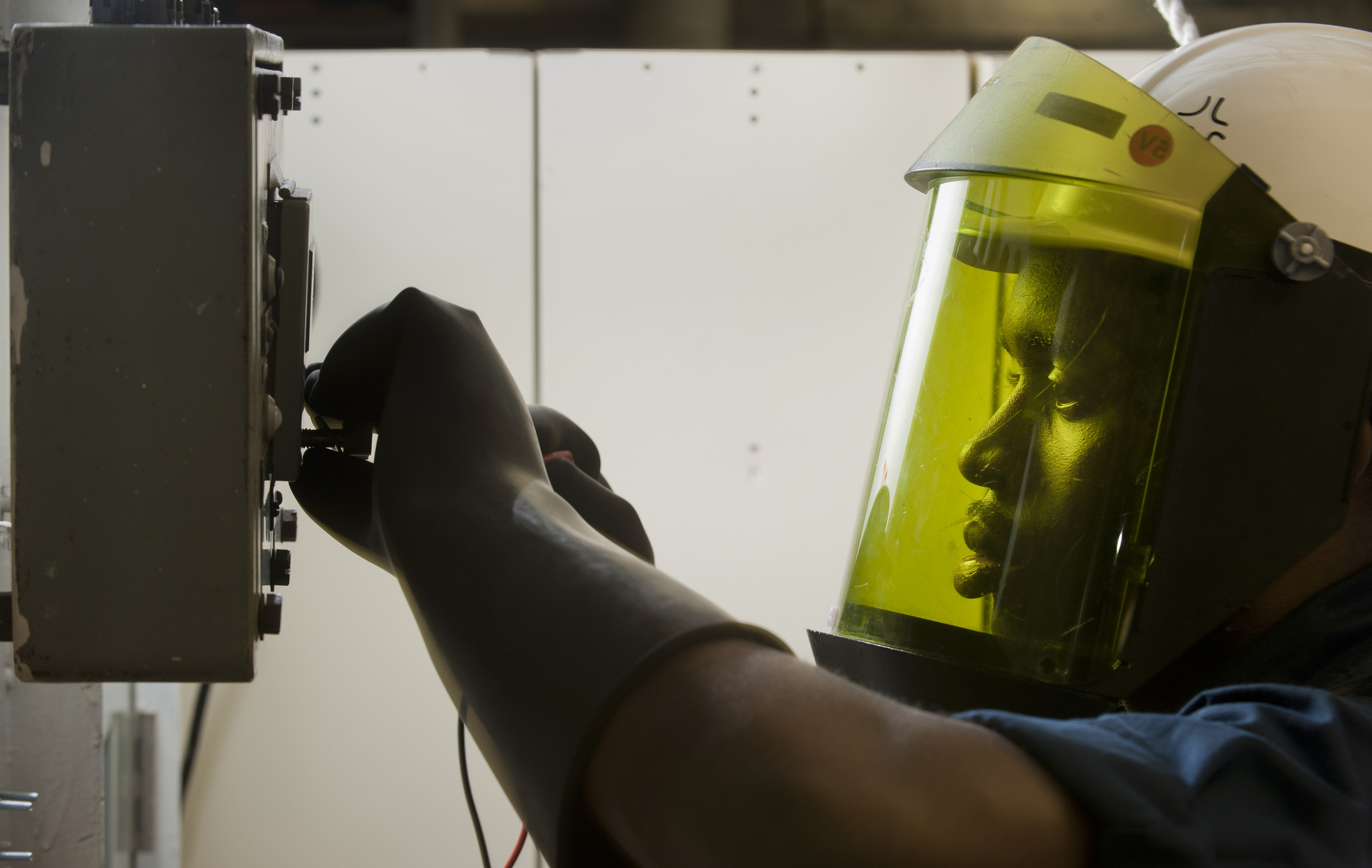
  • Face Shields: Used when working on high voltage installations to protect the face from arc flash hazards.

Person wearing a yellow face shield
Person wearing a yellow face shield (Source: Wikipedia (Face shield))

6.1.3 Lockout/Tagout Procedures for Electrical Equipment

Lockout/tagout (LOTO) procedures are critical safety practices that ensure electrical equipment is de-energized and cannot be re-energized accidentally during maintenance. This practice is mandatory in all workplaces including government offices and retail businesses.

Steps in Lockout/Tagout Implementation

  • Preparation: Identify all energy sources connected to the equipment before maintenance at the facility.
  • Notification: Inform affected personnel in the hotel or office building about the planned lockout.
  • Shutdown: Turn off equipment following manufacturer instructions to prevent energy flow.
  • Isolation: Physically disconnect power sources, such as circuit breakers or switches.
  • Lock Application: Attach locks or tags to energy isolating devices to prevent reactivation.
  • Verification: Confirm that the equipment is de-energized by testing with appropriate instruments before starting work.

6.1.4 Emergency Response and First Aid during Electrical Incidents

Despite preventive measures, electrical accidents can occur. Immediate and effective emergency response and first aid are vital to minimize injury severity in workplaces such as universities or county hospitals.

Critical Emergency Response Actions

  • Power Disconnection: Quickly isolate the electrical source to prevent further harm.
  • Use of Non-Conductive Materials: Remove the victim using wooden or plastic objects, avoiding direct contact.
  • Cardiopulmonary Resuscitation (CPR): Administer CPR if the victim is unresponsive and not breathing.
  • Calling Emergency Services: Contact medical professionals promptly, especially in remote farm locations.
  • Reporting the Incident: Document and report the incident to management and safety officers for investigation and future prevention.

Practice Questions

  1. Explain why hazard identification is crucial before performing electrical maintenance in a retail business. (5 marks)
  2. List and describe the essential personal protective equipment used during electrical maintenance in a SACCO office. (10 marks)
  3. Outline the steps involved in the lockout/tagout procedure and explain its importance in ensuring safety. (12 marks)
  4. Describe the immediate actions to take when an electrical shock incident occurs in a county hospital. (8 marks)
The rest of this chapter
🔒

Create a free account to open more of this chapter.

Free: practical guides, quick cards, workplace scenarios and more.

Create a free account
🔒6.2 Meaning of Terms

Understanding the terminology used in electrical installation maintenance is fundamental for effective communication, compliance, and safe practice across all professional fields. Clear comprehension of these terms enables technicians and supervisors in sector…

🔒6.3 Maintenance

Maintenance is a critical aspect of electrical installations to ensure safety, reliability, and efficiency in diverse professional environments such as hospitals, educational institutions, retail outlets, and county government offices. In Kenya, regular mainte…

🔒6.4 Fault Diagnosis/Troubleshooting

In electrical installation maintenance, fault diagnosis and troubleshooting are essential skills that enable technicians to identify and rectify electrical faults efficiently. In Kenya, organizations such as county referral hospitals and universities rely heav…

🔒6.5 System Isolation Points

Isolation points in electrical systems are designated locations where power can be safely disconnected for maintenance or emergency purposes. Proper identification and use of these points are critical to protecting personnel and equipment during electrical ins…

🔒6.6 System Tests

System tests in electrical installation maintenance are essential procedures that verify the safety, functionality, and compliance of electrical systems after installation or repair. These tests ensure that the electrical network operates as intended, preventi…

🔒6.7 Maintenance Report and Records

Maintenance reports and records are critical components of electrical installation maintenance. They provide a documented history of inspections, tests, repairs, and replacements, enabling traceability, planning, and compliance verification. Organizations such…

Chapter Summary

This chapter covers essential safety procedures that must be observed during electrical installation maintenance to protect personnel and equipment. It clarifies key terms related to maintenance to ensure a common understanding among practitioners. The chapter explores various types of maintenance including periodic service, preventive, breakdown, and corrective maintenance, detailing their specific procedures and how to schedule them effectively using service manuals. It emphasizes the importance of identifying and properly documenting the tools, materials, and equipment used in maintenance, alongside ensuring their specifications comply with established safety standards. Fault diagnosis and troubleshooting techniques are discussed to enable efficient identification and resolution of electrical issues. The chapter also highlights the role of system isolation points in safely disconnecting power during maintenance activities. Finally, it explains different system tests such as continuity, functionality, and polarity tests, and underscores the necessity of maintaining accurate maintenance reports and records for accountability and future reference.

Self-Assessment

🔒 PDFDownload this self-assessment, with answers

A. Written Assessment

  1. What are the key safety procedures to follow before starting electrical maintenance work? (3 marks)
  2. Define the term "preventive maintenance" in the context of electrical installations. (2 marks)
🔒26 more in this section.

Chapter Examination Questions

🔒 PDFDownload these examination questions, with worked answers

SECTION A (40 Marks) - Answer ALL Questions

  1. Explain four safety procedures that must be observed during electrical installation maintenance at a county referral hospital. (4 marks)
  2. Define the terms "preventive maintenance" and "corrective maintenance" and highlight one key difference between them. (4 marks)
🔒18 more in this section.

Chapter Practical Activities

Practical 1: Implement safety procedures during electrical installation maintenance

Electrical Engineering · Level 6
Electrical Installation
PRACTICAL ASSESSMENT
TIME: 4 HOURS
⬇ PDFCandidate Instructions (Candidate Tool)

Type: Individual

INSTRUCTIONS TO CANDIDATE:
1.  You are required to perform the following task:
i.  Perform electrical maintenance on a 4-way consumer control unit 400mm x 300mm x 150mm ensuring all safety procedures are implemented as per standard.
2.  You have been provided with the following resources for the practical task:
Tools & EquipmentMaterials
MultimeterPPE Dustcoat/Overall
Voltage testerInsulated gloves
Insulated screwdriversSafety helmet
Spirit levelSafety boots
Lockout tagout kitSafety goggles
4-way consumer control unit
Circuit breakers (6A, 10A, 16A)
PVC sheathed cables 1.5mm2 and 2.5mm2
Junction box
Deep pattress box
1 gang one way switch
13A socket outlet
Fluorescent lamp complete
Wood screws
⬇ PDFResources Required (Cutting List)
S/NItemQuantity
1Insulated gloves1 Pair per Candidate
2Safety helmet1 Pc per Candidate
3Safety boots1 Pair per Candidate
4Safety goggles1 Pair per Candidate
5Lockout tagout kit1 Kit per Candidate
6Multimeter1 Pc per Candidate
7Voltage tester1 Pc per Candidate
8Insulated screwdrivers1 Set per Candidate
9Electrical Consumer Control Unit (CCU) with 4 ways1 Pc per Candidate
10Circuit breakers (6A, 10A, 16A)3 Pcs per Candidate
11PVC sheathed cables 1.5mm2 and 2.5mm25 Metres each per Candidate
12Junction box1 Pc per Candidate
13Deep pattress box2 Pcs per Candidate
141 gang one way switch1 Pc per Candidate
1513A socket outlet1 Pc per Candidate
16Fluorescent lamp complete1 Pc per Candidate
17Spirit level1 Pc per Candidate
18PPE Dustcoat/Overall1 Pc per Candidate
19Wood screws10 Pcs per Candidate
⬇ PDFAssessor Guide
Items to be EvaluatedMarks AvailableMarks ObtainedComments
TASK 1: Implementation of safety procedures during maintenance
Wore full personal protective equipment (dustcoat, gloves, helmet, boots, goggles)
(Award 3 marks for full PPE worn, 0 if any missing)
3
Ensured area was clean and free from hazards before starting work
(Award 2 marks for clear, safe working area, 0 if not)
2
Applied lockout tagout procedure to isolate power supply
(Award 3 marks for correct isolation and tagging, 0 if not done or done incorrectly)
3
Used insulated tools correctly during maintenance
(Award 2 marks for correct use of insulated tools, 0 if not)
2
Tested circuit with multimeter and voltage tester before and after maintenance
(Award 3 marks for proper testing, 0 if omitted or incorrect)
3
Maintained good housekeeping during and after maintenance
(Award 2 marks for tidy work and proper waste disposal, 0 if not)
2
Restored power safely and removed lockout tags after confirming safety
(Award 3 marks for safe restoration, 0 if unsafe or omitted)
3
Sub-Total18
PRODUCT CHECKLIST
Consumer control unit maintained without damage and all safety procedures visibly implemented
(Award 7 marks for neat, damage-free unit and visible safety signs, 0 if not)
7
Sub-Total7
GRAND TOTAL25
ASSESSMENT OUTCOME:   ☐ Competent    ☐ Not Yet Competent (competent if at least 50%)

Practical 2: Explain Electrical Maintenance Terminology

Electrical Engineering · Level 6
Electrical Installation
PRACTICAL ASSESSMENT
TIME: 3 HOURS
⬇ PDFCandidate Instructions (Candidate Tool)

Type: Individual

INSTRUCTIONS TO CANDIDATE:
1.  You are required to perform the following task:
i.  Explain the meaning and practical implications of 10 common electrical maintenance terms as per the provided reference sheet.
2.  You have been provided with the following resources for the practical task:
Tools & EquipmentMaterials
Pen and NotebookElectrical Maintenance Terminology Reference Sheet
⬇ PDFResources Required (Cutting List)
S/NItemQuantity
1Electrical Maintenance Terminology Reference Sheet1 per Candidate
2Pen and Notebook1 set per Candidate
⬇ PDFAssessor Guide
Items to be EvaluatedMarks AvailableMarks ObtainedComments
TASK 1: Identification and Explanation of Electrical Maintenance Terms
Wore personal protective equipment (e.g. dustcoat or overall)
(Award 1 mark for correct PPE worn or zero)
1
Applied good housekeeping practice by ensuring a clean and organized working area before starting
(Award 1 mark for clean and organized area or zero)
1
Correctly identified 10 common electrical maintenance terms from the reference sheet
(Award 0.5 marks per correct term identified or zero)
5
Provided accurate explanations of the meaning of each term
(Award 1 mark per accurate explanation or zero)
10
Described practical implications or examples of each term in electrical maintenance work
(Award 1 mark per correct practical implication or zero)
10
Sub-Total27
PRODUCT CHECKLIST
Complete and legible written explanation covering meaning and practical implications of all 10 terms
(Award 8 marks for completeness, clarity, and legibility or zero)
8
Sub-Total8
GRAND TOTAL35
ASSESSMENT OUTCOME:   ☐ Competent    ☐ Not Yet Competent (competent if at least 50%)
🔒

Free: practical guides, quick cards, workplace scenarios and more.

Create a free account
🔒Perform preventive maintenance on electrical installationsPractical 3
🔒Conduct corrective maintenance on a faulty lighting circuitPractical 4
🔒Schedule electrical equipment maintenance using manufacturer service manualsPractical 5
🔒Identify and document electrical maintenance tools and materialsPractical 6
🔒Verification of Electrical Tools and Materials Compliance with Safety StandardsPractical 7
🔒Diagnose and rectify electrical faults in a single-phase lighting circuitPractical 8
🔒Isolate Electrical Systems Safely at Designated Isolation PointsPractical 9
🔒Perform continuity testing on a single lighting circuitPractical 10
🔒Functionality Testing of Electrical ComponentsPractical 11
🔒Perform Polarity Testing on a Single Phase Lighting CircuitPractical 12
🔒Prepare Electrical Maintenance Report and Records for a Residential InstallationPractical 13
🔒Fault Diagnosis and Corrective Maintenance of a Faulty Lighting CircuitPractical 14
🔒Plan and Execute Electrical Installation Maintenance for a Consumer Control UnitPractical 15
Flashcards 20 cards Study deck ▾
Question
1

↻ Tap card to reveal answer
🔒

18 more in this section.

Create a free account
Test Yourself 20 questions Start quiz ▾
0%
0 / 2
🔒

18 more in this section.

Create a free account
Am I competent?

At the start of this chapter we promised you would be able to:

  • develop an effective maintenance strategy based on how the electrical system works
  • prepare a maintenance schedule that follows your organization's procedures
  • inspect electrical equipment and systems accurately in line with IET regulations
  • prepare all the necessary materials and tools according to your maintenance plan
  • carry out maintenance activities safely and correctly following IET regulations
  • perform system tests accurately and reliably as required by IET regulations
  • update maintenance records clearly and consistently according to your maintenance strategy

Tick each one you can genuinely do.

So, are you there yet?

You're competent when you can confidently do 50% or more of what this chapter promised.

Sign in to record how you're doing.