Constructing effective road drainage and hydraulic structures is critical for the longevity and safety of road infrastructure in Kenya. Proper drainage prevents water accumulation that can damage pavement layers and subgrades, while hydraulic structures like culverts and bridges ensure uninterrupted water flow across road alignments. This chapter focuses on the preparatory phase of drainage construction, emphasizing the mobilization of resources necessary for successful implementation. Civil engineering professionals must coordinate manpower, machinery, and materials efficiently to deliver drainage works within project timelines and budgets.
1.1 Mobilization of Drainage Construction Resources
Mobilization refers to assembling and positioning all the required resources at the construction site to initiate drainage works. In the Kenyan civil engineering context, effective mobilization is vital to avoid delays caused by resource shortages or logistical challenges, especially in remote or rural road projects. The process involves identifying the necessary manpower, selecting appropriate machinery, procuring materials, and scheduling their deployment to optimize productivity.
1.1.1 Identification of Required Resources (manpower, equipment, and materials)
Identifying the correct resources for drainage construction is the foundation of project success. A comprehensive resource assessment must consider the scope of work, site conditions, and project specifications.
Manpower Requirements
- Skilled Labour: Drainage works require experienced civil engineers, site supervisors, and technicians familiar with hydraulic structures and soil conditions. Their expertise ensures adherence to design standards and safety protocols.
- Semi-skilled Labour: Operators for machinery such as excavators and compactors must have certification and practical experience to maximize equipment efficiency and minimize downtime.
- Unskilled Labour: General labourers assist with manual tasks like material handling, trench cleaning, and minor earthworks, supporting skilled teams.
- Safety Personnel: Dedicated safety officers monitor compliance with occupational health and safety regulations, reducing accident risks on site.
- Administrative Staff: Project clerks and procurement officers manage documentation and logistics, ensuring smooth resource flow.
Equipment Identification
-
Excavators: Needed for trenching drainage channels and installing culverts. Their size and power depend on soil type and trench dimensions.
-
Compactors: Essential for soil compaction in embankments and backfill layers around drainage pipes to prevent settlement.
- Concrete Mixers: Required if the drainage design includes concrete culverts or headwalls.
- Transport Vehicles: Trucks and trailers for moving materials and machinery to the site.
- Surveying Instruments: Total stations and GPS units help in accurate layout and grading of drainage structures.
Material Requirements
- Pipes and Culverts: Selection depends on hydraulic capacity, material type (concrete, HDPE, or metal), and durability.
- Aggregates: Crushed stone and gravel for bedding and backfill.
- Concrete Components: Cement, sand, and water for concrete works.
- Geotextiles: Used for soil stabilization and filtration in drainage trenches.
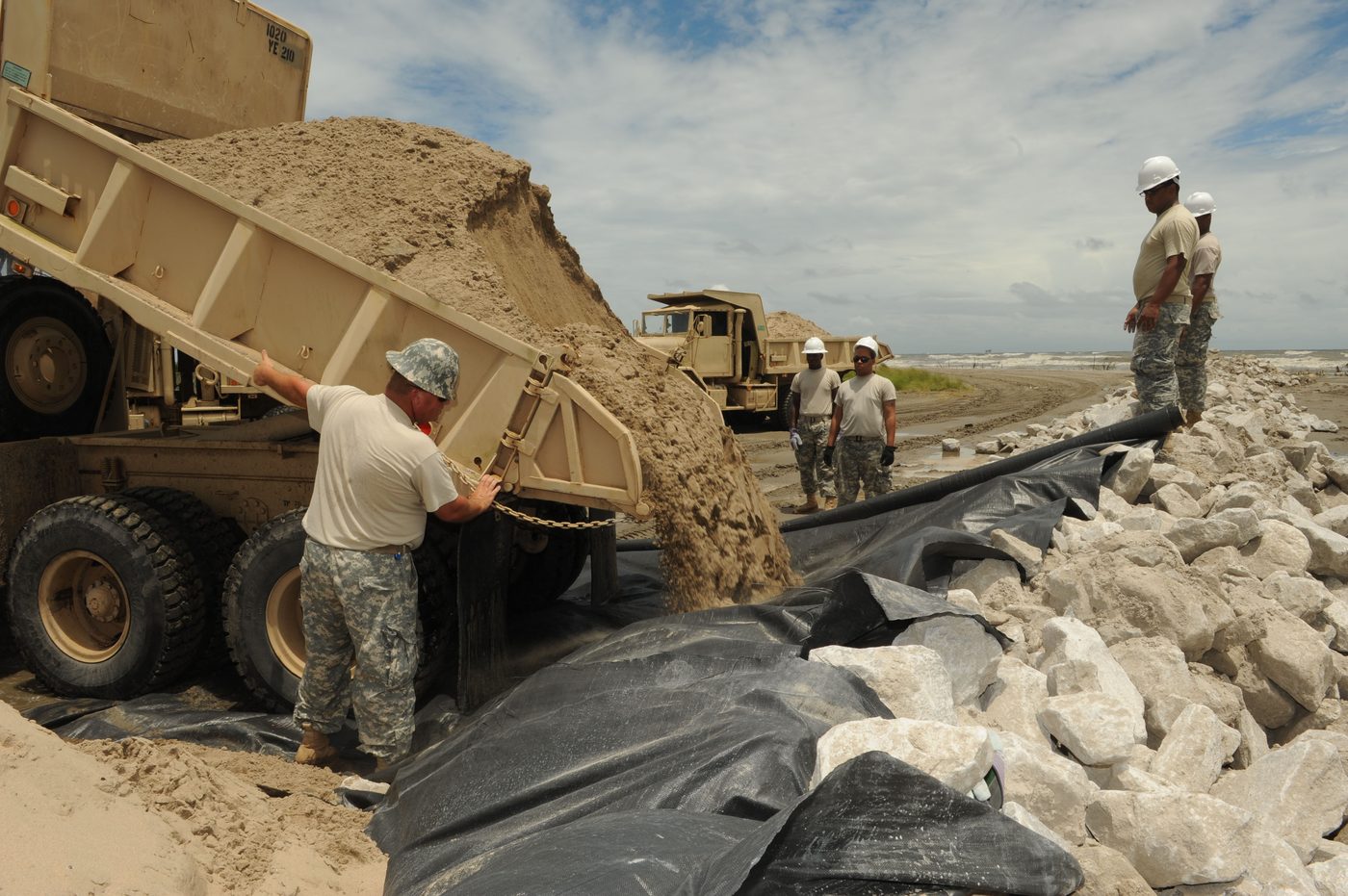
Geotextile fabric used in construction site (Source: Wikimedia Commons)
- Protective Coatings: For metal pipes to prevent corrosion.
1.1.2 Selection of Drainage Construction Machinery (e.g., excavators, compactors)
Choosing the right machinery influences project cost, quality, and duration. Kenya’s varied terrain and soil types necessitate careful equipment selection to handle specific site challenges.
Key Considerations in Machinery Selection
- Soil Characteristics: Hard rocky soils require more powerful excavators with rock-breaking attachments. Soft or swampy soils may need tracked excavators for better traction.
- Project Scale: Large-scale road projects in counties like Kisumu demand heavy-duty machinery with high capacity, whereas smaller rural roads might use smaller machines to reduce costs.
- Machinery Availability: Local availability of equipment affects procurement decisions; renting from nearby depots reduces transport time and expenses.
- Fuel Efficiency: Machines with better fuel consumption lower operational costs, a critical factor for budget-constrained projects.
- Operator Skill Level: Selecting machinery compatible with available skilled operators ensures efficient and safe operation.
| Name |
Specification |
Use |
| Excavator |
20-30 ton tracked, hydraulic arm |
Digging trenches, removing soil |
| Compactor |
Vibratory plate or roller type |
Soil compaction in embankments |
| Concrete Mixer |
3-5 cubic meters capacity |
Mixing concrete for culverts |
| Dump Truck |
10-15 ton load capacity |
Transporting materials and debris |
Maintenance of Construction Machinery
Machinery breakdown during drainage works halts progress and can leave open trenches exposed to rainfall, risking trench collapse and additional excavation costs. Routine servicing and daily pre-start checks are therefore integral to the machinery selection decision, particularly on remote sites where replacement equipment may take days to arrive.
- Excavators must be regularly inspected for hydraulic leaks and track wear.
- Compactors require daily checks on vibration mechanisms and roller surfaces.
- Concrete mixers need cleaning after each batch to prevent hardened concrete buildup.
- Dump trucks should have well-maintained brakes and tires for safe operation on rough roads.
1.1.3 Procurement and Transportation of Construction Materials
Timely procurement and transportation of materials are crucial to maintain workflow continuity. In Kenya, logistical challenges such as poor road access and supply chain delays must be anticipated during planning.
Procurement Strategies
- Supplier Selection: Choose suppliers with proven reliability and quality compliance, such as certified quarries for aggregates or licensed pipe manufacturers.
- Bulk Purchasing: Buying materials in bulk from central suppliers can reduce unit costs and ensure consistent quality.
- Quality Assurance: Conduct pre-delivery inspections and laboratory tests on materials like aggregates and concrete components to confirm compliance with Kenyan standards.
- Contractual Terms: Clear agreements on delivery schedules, penalties for delays, and warranty conditions protect project interests.
Transportation Planning
- Route Selection: Identify the most efficient and safe routes for material delivery, considering road conditions and weight restrictions.
- Vehicle Scheduling: Coordinate vehicle arrivals to avoid site congestion and ensure continuous material supply.
- Handling and Storage: Use appropriate methods to unload and store materials on site, protecting them from weather and contamination.
- Security Measures: Implement site security to prevent theft or vandalism of stored materials, especially in remote locations.
1.1.4 Scheduling and Deployment of Resources
Efficient scheduling ensures that manpower, machinery, and materials are available exactly when needed, minimizing idle time and cost overruns.
Scheduling Techniques
- Work Breakdown Structure (WBS): Divide drainage construction into logical tasks such as excavation, pipe laying, backfilling, and finishing works.
- Critical Path Method (CPM): Identify key activities that determine project duration and allocate resources to prevent delays.
- Resource Leveling: Adjust resource allocation to avoid overloading equipment or personnel and to smooth workflow.
- Contingency Planning: Include buffers for unforeseen events like adverse weather or equipment breakdowns.
Deployment Considerations
- Phased Mobilization: Deploy machinery and personnel in phases aligned with construction stages to optimize utilization.
- Communication Protocols: Establish clear communication channels between site managers, operators, and suppliers to coordinate activities.
- Monitoring and Adjustment: Use daily progress reports and site meetings to track resource use and make adjustments as needed.
- Health and Safety Compliance: Ensure all deployed resources meet safety standards and workers have appropriate protective equipment.
Practice Questions
- Explain the importance of identifying the correct manpower and equipment before commencing drainage construction works in road projects. (10 marks)
- Discuss five critical factors to consider when selecting machinery for drainage construction in Kenya. (10 marks)
- Outline the steps involved in effective procurement and transportation of drainage construction materials. (12 marks)
- Describe how scheduling and deployment of resources can affect the success of a drainage construction project. Provide examples relevant to Kenyan road projects. (8 marks)
The rest of this chapter
🔒Create a free account to open more of this chapter.
Free: practical guides, quick cards, workplace scenarios and more.
Create a free account 🔒1.2 Determination of Drainage Positions
Determining the correct positions for drainage in road construction is crucial to ensure efficient water removal, prevent flooding, and maintain road longevity. In Kenya, where seasonal rains can be intense, proper drainage positioning protects infrastructure…
🔒1.3 Legal Documents for Drainage Structures Construction
The construction of drainage and hydraulic structures in Kenya requires strict adherence to legal frameworks designed to safeguard public safety, environmental sustainability, and land rights. Civil engineering professionals must navigate a complex set of perm…
🔒1.4 Interpretation of Drawings
In civil engineering projects such as road construction and drainage works, accurate interpretation of construction drawings is fundamental. These drawings serve as the blueprint guiding the entire construction process, ensuring that hydraulic structures and d…
🔒1.5 Setting Out Construction Works
Setting out is a fundamental phase in road drainage and hydraulic structure construction, providing the spatial framework that guides all subsequent activities. In Kenya, where road networks traverse varied terrain and climatic conditions, precise setting out…
🔒1.6 Construction of Culvert
The construction of culverts is a critical aspect of road drainage works in civil engineering projects across Kenya. Culverts are essential in allowing water to pass beneath roads, railways, or embankments without causing flooding or erosion, ensuring infrastr…
🔒1.7 Construction Procedures for Drains
In road construction within Kenya, proper drainage is critical to maintain pavement integrity and safety. Uncontrolled water can cause erosion, pavement failures, and increased maintenance costs. This section details the construction procedures for drains, foc…
🔒1.8 Construction of Drains and Gullies
In Kenyan road construction projects, proper water management is essential to safeguard road integrity and longevity. Drains and gullies serve as critical hydraulic structures that channel surface runoff away from roads, preventing erosion, flooding, and subgr…
🔒1.9 Bridge Construction
Bridge construction is a critical aspect of road infrastructure development in Kenya, enabling connectivity across rivers, valleys, and other physical obstacles. The engineering design and construction methods must suit local conditions including soil type, hy…
🔒1.10 Construction of Drifts and Causeways
Drifts and causeways are critical components in road construction, particularly in areas prone to seasonal flooding or where watercourses interrupt road alignments. In Kenya, many rural and peri-urban roads cross rivers, streams, or flood plains where permanen…
🔒1.11 Quality Control Operations
Quality control in road drainage and hydraulic structures is essential to ensure durability, safety, and functionality. In Kenya, where infrastructure projects face challenges like variable climate and resource constraints, strict adherence to quality control…
🔒1.12 Retaining Wall Construction Operations
Retaining walls are critical components in road construction projects in Kenya, especially in areas with significant elevation changes or unstable soil conditions. These structures prevent soil erosion, landslides, and support the road embankments, ensuring th…
🔒1.13 Backfilling Procedures
Backfilling is a critical stage in road drainage and bridge construction projects across Kenya, where proper restoration of excavated areas supports structural integrity and prevents future settlement problems. Civil engineers working on county government road…
Chapter Summary
This chapter covers the comprehensive process of constructing road drainage and hydraulic structures, starting with the mobilization of resources including manpower, machinery, and materials, as well as their scheduling and transportation. It explains how to determine appropriate drainage positions through site surveys, topographical and hydrological analysis, and marking out drainage lines. The chapter highlights the importance of acquiring legal permits and complying with environmental regulations to ensure lawful construction. It guides the interpretation of various drainage construction drawings and their application to accurate site setting out using surveying instruments. The construction of culverts, drains, gullies, bridges, drifts, and causeways is detailed with emphasis on types, materials, installation procedures, and quality control measures. Further, the chapter addresses retaining wall construction techniques and the critical role of backfilling, including material selection, placement, compaction, and quality assurance to maintain structural stability and longevity. Throughout, quality control operations are emphasized to uphold construction standards and address defects effectively.
Self-Assessment
🔒 PDFDownload this self-assessment, with answers
A. Written Assessment
-
Which of the following is NOT typically considered a key resource in mobilizing drainage construction? (2 marks)
a) Manpower
b) Equipment
c) Marketing materials
d) Construction materials
-
Explain why site surveys are critical in determining drainage positions for road construction projects. (3 marks)
🔒26 more in this section.
Chapter Examination Questions
🔒 PDFDownload these examination questions, with worked answers
SECTION A (40 Marks) - Answer ALL Questions
- Explain the key factors to consider when selecting machinery for drainage construction on a road project in Kisumu County. (4 marks)
- Describe the role of topographical surveys in determining drainage positions for a highway construction project. (4 marks)
🔒18 more in this section.
Chapter Practical Activities
Practical 1: Mobilize and Schedule Resources for Construction of Road Drainage Channel 2000mm x 500mm x 600mm
Civil Engineering · Level 6
Road Construction Works II
PRACTICAL ASSESSMENT
TIME: 5 HOURS
⬇ PDFCandidate Instructions (Candidate Tool)
Type: Individual
INSTRUCTIONS TO CANDIDATE:
1. You are required to perform the following task:
i. Mobilize and schedule manpower, machinery, and materials for the construction of a road drainage channel 2000mm long, 500mm wide, and 600mm deep.
2. You have been provided with the following resources for the practical task:
| Tools & Equipment | Materials |
|---|
| Shovel | Murram |
| Excavator | Hard-core |
| Compactor (tamping rod) | Water |
| Wheelbarrow | |
| Tape measure | |
| Mattock/Jembe | |
| Notebook and pen | |
| PPEs | |
⬇ PDFResources Required (Cutting List)
| S/N | Item | Quantity |
|---|
| 1 | Open field site area | 1 per Candidate |
| 2 | Shovel | 1 pc per Candidate |
| 3 | Excavator | 1 pc per 5 Candidates |
| 4 | Compactor (tamping rod) | 1 pc per Candidate |
| 5 | Wheelbarrow | 1 pc per 5 Candidates |
| 6 | PPEs (Safety boots, Overall, Gloves) | 1 set per Candidate |
| 7 | Notebook and pen | 1 pc each per Candidate |
| 8 | Tape measure | 1 pc per Candidate |
| 9 | Murram | 30 kgs per Candidate |
| 10 | Hard-core | 1 wheelbarrow per Candidate |
| 11 | Water | 15 liters per Candidate |
| 12 | Mattock/Jembe | 1 pc per Candidate |
⬇ PDFAssessor Guide
| Items to be Evaluated | Marks Available | Marks Obtained | Comments |
|---|
| TASK 1: Mobilization and Scheduling of Drainage Construction Resources |
Wore PPE (Safety boots, Overall, Gloves)
(Award 3 marks or zero) | 3 | | |
Identified and listed required manpower, equipment, and materials needed
(Award 5 marks or zero) | 5 | | |
Selected appropriate machinery for excavation and compaction (e.g., excavator, compactor)
(Award 5 marks or zero) | 5 | | |
Prepared procurement and transportation plan for materials (murram, hard-core, water)
(Award 4 marks or zero) | 4 | | |
Scheduled and deployed resources with timeline and sequence for construction activities
(Award 8 marks or zero) | 8 | | |
| Sub-Total | 25 | | |
| PRODUCT CHECKLIST |
Resource schedule document showing manpower, equipment, and materials with quantities and timelines
(Award 8 marks or zero) | 8 | | |
Correct identification of machinery suitable for drainage construction
(Award 5 marks or zero) | 5 | | |
Procurement plan includes correct quantities: 30 kgs murram, 1 wheelbarrow hard-core, 15 liters water per candidate
(Award 5 marks or zero) | 5 | | |
Scheduling timeline matches task dimensions: 2000mm length, 500mm width, 600mm depth
(Award 7 marks or zero) | 7 | | |
| Sub-Total | 25 | | |
| GRAND TOTAL | 50 | | |
ASSESSMENT OUTCOME: ☐ Competent ☐ Not Yet Competent (competent if at least 50%)
Practical 2: Conduct Site Survey and Determine Drainage Positions for Road Drainage Works
Civil Engineering · Level 6
Road Construction Works II
PRACTICAL ASSESSMENT
TIME: 4 HOURS
⬇ PDFCandidate Instructions (Candidate Tool)
Type: Individual
INSTRUCTIONS TO CANDIDATE:
1. You are required to perform the following task:
i. Conduct a site survey and mark drainage positions along a 200m road section considering water flow and topography.
2. You have been provided with the following resources for the practical task:
| Tools & Equipment | Materials |
|---|
| Tape measure | PPEs (Safety boots, Overall, Gloves) |
| Surveyor's leveling staff | |
| Abney level or clinometer | |
| Notepad and pen | |
| Markers (stakes or flags) | |
⬇ PDFResources Required (Cutting List)
| S/N | Item | Quantity |
|---|
| 1 | Open field survey area | 0.5 hectare per Candidate |
| 2 | Tape measure | 1 pc per Candidate |
| 3 | Surveyor's leveling staff | 1 pc per Candidate |
| 4 | Abney level or clinometer | 1 pc per 5 Candidates |
| 5 | Notepad and pen | 1 pc each per Candidate |
| 6 | Markers (stakes or flags) | 10 pcs per Candidate |
| 7 | PPEs (Safety boots, Overall, Gloves) | 1 set per Candidate |
⬇ PDFAssessor Guide
| Items to be Evaluated | Marks Available | Marks Obtained | Comments |
|---|
| TASK 1: Conduct Site Survey and Mark Drainage Positions |
Wore PPE (Safety boots, Overall, Gloves)
(Award 3 marks or zero) | 3 | | |
Collected all necessary tools and materials
(Award 2 marks or zero) | 2 | | |
Measured and recorded topography using tape measure and leveling staff
(Award 5 marks for accurate measurements or zero) | 5 | | |
Used Abney level or clinometer to determine gradient
(Award 4 marks for correct use or zero) | 4 | | |
Identified natural water flow paths and marked suitable drainage positions with stakes/flags
(Award 6 marks for correct positioning or zero) | 6 | | |
Recorded all observations and drainage positions clearly in notepad
(Award 3 marks for clear and complete notes or zero) | 3 | | |
| Sub-Total | 23 | | |
| PRODUCT CHECKLIST |
Drainage positions marked correctly along 200m road section with spacing between 20m and 40m
(Award 6 marks for correct spacing or zero) | 6 | | |
Drainage positions aligned with natural water flow and gradient direction
(Award 6 marks for correct alignment or zero) | 6 | | |
Survey records show accurate topography and gradient measurements within ±5% tolerance
(Award 5 marks for accuracy or zero) | 5 | | |
| Sub-Total | 17 | | |
| GRAND TOTAL | 40 | | |
ASSESSMENT OUTCOME: ☐ Competent ☐ Not Yet Competent (competent if at least 50%)
🔒Mark Out Drainage Lines and Structure Positions on SitePractical 3
🔒Prepare and Verify Legal Documentation for Drainage ConstructionPractical 4
🔒Interpret drainage construction drawings to extract alignment and dimensionsPractical 5
🔒Set Out Road Drainage Structures on Site as per DrawingPractical 6
🔒Construct Box and Pipe Culverts 1200mm x 800mm and 600mm DiameterPractical 7
🔒Excavate and construct a 4m long open lined drain with stone pitchingPractical 8
🔒Construct and install a concrete gully 600mm x 600mm x 500mm deep connected to main drainagePractical 9
🔒Construct bridge foundations and superstructure for a 4m span beam bridgePractical 10
🔒Construct a Drift 4.0m x 3.0m x 0.6m as per the provided working drawingPractical 11
🔒Perform Quality Control on Road Drainage and Bridge StructuresPractical 12
🔒Construct a gravity retaining wall 1500mm high and 1000mm thick with proper backfillPractical 13
🔒Perform Backfilling and Compaction for Drainage and Bridge WorksPractical 14
