
By the end of this chapter, you will be able to:
Mastering these skills helps you create strong, safe excavation supports that protect workers and keep the job site running smoothly.
Compiled by: Michael Macharia
Temporary works are essential for ensuring safety and stability during excavation activities in carpentry and joinery projects. Trench timbering, a critical form of temporary works, provides support to excavation walls, preventing collapses that could cause injury or project delays. In the Kenyan construction context, where soil conditions and weather variability can pose significant risks, proper selection, preparation, and installation of trench timbering materials are paramount to safeguarding workers and maintaining project timelines.
In carpentry and joinery, trench timbering materials must be carefully chosen and prepared to provide reliable support for excavation walls. The materials used must balance strength, durability, and ease of installation while complying with safety regulations in Kenya. Understanding the characteristics and proper handling of these materials is essential for carpenters to deliver safe and efficient excavation support.
Identifying appropriate materials for trench timbering involves recognizing the types of timber and supplementary components that provide adequate strength and resistance to soil pressure during excavation. Each material has a role: sheeting holds back the soil face, walers spread the pressure, struts resist it across the trench, and fasteners and wedges keep everything tight. A carpenter who can recognise each material and its condition on delivery prevents weak or unsuitable members reaching the trench. Example: on a sewer extension for a housing estate, the site carpenter sorted the delivered timber into poling boards, walings and struts and rejected two split pieces before any excavation started.
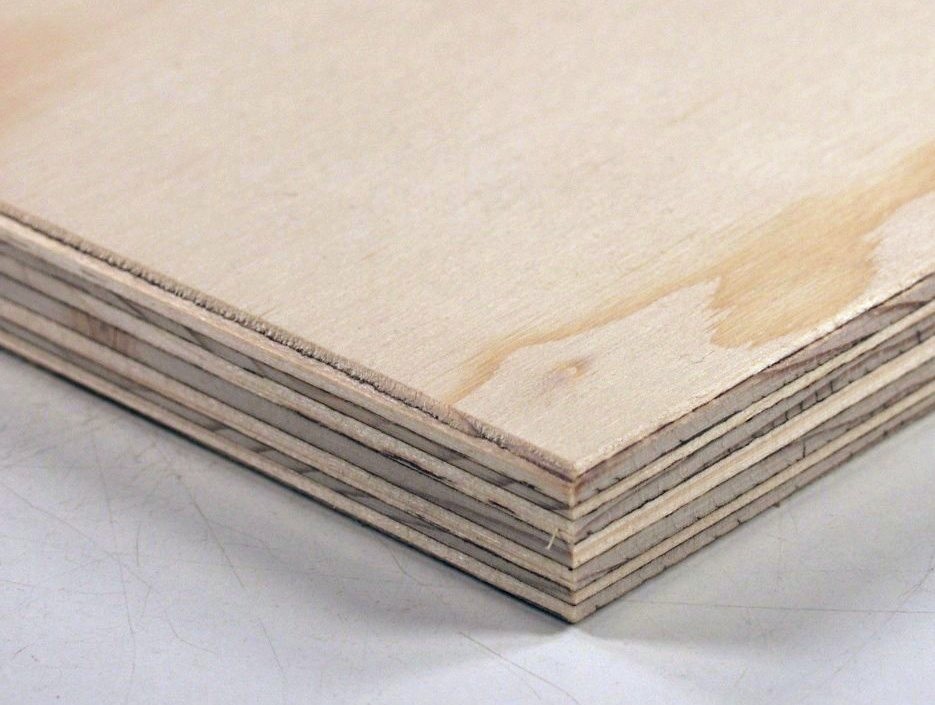
Close-up of plywood sheets (Source: Wikipedia (Plywood))
Trench timbering requires tools for measuring, cutting, fixing and tightening timber members, and equipment for lowering them safely into the trench. Using the correct tools ensures members are cut to the right length, fixed tightly and installed without workers having to stand in an unsupported trench. All tools must be checked before use, and heavy members are lowered with ropes or lifting equipment rather than thrown in. Example: before timbering a 2.4 m deep trench for a water company's main, the gang checked their saws, sledgehammer and lowering ropes and kept them in a tool box at the trench edge.
| Name | Specification | Use |
|---|---|---|
| Tape measure | Steel, 5 m to 30 m | Measuring trench width, depth and member lengths |
| Spirit level | 600 mm to 1 200 mm | Checking walings are level and poling boards plumb |
| Crosscut saw | 550 mm to 650 mm blade | Cutting struts, walings and boards to length |
| Circular saw | Portable, 185 mm to 235 mm blade | Fast, accurate cutting of members on site |
| Claw hammer | 450 g to 680 g | Driving nails and fixing cleats |
| Sledgehammer | 3 kg to 6 kg | Driving wedges and tightening struts |
| Adjustable spanner | 250 mm to 300 mm | Tightening bolts and adjustable steel props |
| Lowering ropes | Natural or synthetic, 12 mm to 16 mm | Lowering members safely into the trench |
| Ladder | Timber or aluminium, extending 1 m above trench edge | Safe access for installers |
Selecting materials for trench timbering requires evaluating factors such as soil type, trench depth, load conditions, and environmental exposure. These criteria ensure the chosen materials meet safety and performance requirements. Example: for a deep drainage trench in waterlogged ground at a flower farm in Naivasha, the engineer specified treated hardwood walings and close boarding instead of the open poling used in dry ground.
Preparation of timber members involves cutting, shaping, treating, and assembling components to ensure they fit precisely and perform their role effectively during trench support. Preparing members at ground level, away from the trench, reduces the time workers spend in the excavation. Example: for a storm drain at a county referral hospital, the carpenters prepared a full cutting list and pre-cut all struts on the bench before the excavator opened the trench.
Number of boards per side = trench length ÷ board width
A trench 12 m (12 000 mm) long is close-boarded with 225 mm wide boards.
Number of boards per side = 12 000 ÷ 225
Number of boards per side = 53.3, so 54 boards
Total boards = 54 × 2 = 108 boards
Strut length = trench width − 2 × (board thickness + waling thickness)
The trench is 900 mm wide, boards are 38 mm thick and walings are 75 mm thick.
Strut length = 900 − 2 × (38 + 75)
Strut length = 900 − 2 × 113
Strut length = 900 − 226
Strut length = 674 mm
The installation of trench timbering must follow a systematic process to ensure stability and worker safety throughout excavation. Proper sequencing and secure fixing are critical. Example: on a county water project laying a pipeline through Machakos town, timbering was installed in 3 m lengths immediately behind the excavator so no section of trench was left unsupported overnight.
Installation must be coordinated with excavation teams to minimize exposure of unsupported trench walls. Communication between carpenters and machine operators enhances safety.
Safety checks are vital throughout the trench timbering process to prevent accidents and ensure compliance with Kenyan occupational safety standards. Checks are made on the materials before installation, on the work as it proceeds and on the completed support before anyone works in the trench. Example: at a secondary school sewer connection, the supervisor stopped work when a strut was found loose during installation and had it re-wedged before the gang returned to the trench.
Create a free account to open more of this chapter.
Free: practical guides, quick cards, workplace scenarios and more.
Create a free accountThis chapter covered the essential aspects of installing trench timbering for excavation support, beginning with the identification and selection of suitable materials, tools, and equipment necessary for temporary works. It detailed the preparation and installation process of timber members while emphasizing the importance of conducting thorough safety checks at every stage. The discussion then focused on timber walling boards, poling boards, and struts, highlighting the criteria for selecting appropriate struts and their correct placement to ensure effective trench support. Securing and bracing techniques were explored with attention to the choice of braces, their installation, and the safety measures required. Safe access to the trench was addressed by identifying proper entry points, selecting suitable materials for these areas, and placing supports to maintain stability. The chapter also stressed the need for continuous inspection and maintenance of the timbering throughout excavation, identifying critical areas that require reinforcement and ongoing safety evaluations. Finally, good housekeeping practices on-site were underscored as vital for maintaining a safe and efficient working environment.
Which of the following materials is most suitable for trench timbering in clay soil?
a) Plywood boards
b) Hardwood timber boards
c) Steel sheets
d) Plastic sheets
(2 marks)
List four essential tools used when preparing temporary works members for trench timbering. (4 marks)
Type: Individual
| Tools & Equipment | Materials |
|---|---|
| Spirit level | Sawn softwood timber 150mm x 50mm x 1200mm |
| Tape measure | Sawn softwood timber 100mm x 50mm x 1000mm |
| Carpenter’s square | Steel trench struts 75mm x 50mm x 1000mm |
| Claw hammer | Wire nails 75mm |
| Timber wedges |
| S/N | Item | Quantity |
|---|---|---|
| 1 | Sawn softwood timber; size 150mm x 50mm x 1200mm | 3 Pcs per Candidate |
| 2 | Sawn softwood timber; size 100mm x 50mm x 1000mm | 2 Pcs per Candidate |
| 3 | Steel trench struts; size 75mm x 50mm x 1000mm | 2 Pcs per Candidate |
| 4 | Wire nails 75mm (3 inches) | 20 Pcs per Candidate |
| 5 | Timber wedges | 6 Pcs per Candidate |
| 6 | Spirit level | 1 Pc per 3 Candidates |
| 7 | Tape measure (7.5m) | 1 Pc per Candidate |
| 8 | Carpenter’s square | 1 Pc per Candidate |
| 9 | Claw hammer | 1 Pc per Candidate |
| 10 | Personal Protective Equipment (Safety boots, Helmet, Overall) | As appropriate |
| Items to be Evaluated | Marks Available | Marks Obtained | Comments |
|---|---|---|---|
| TASK 1: Identification and Classification of Trench Timbering Materials | |||
| Wore Personal Protective Equipment (Safety boots, Helmet, Overall) (Award 1 mark for each PPE worn as per workplace procedures or 0) | 3 | ||
| Assembled all required tools and materials (Award 1 mark for each correct tool and material assembled or 0) | 3 | ||
| Measured and identified sawn softwood timber sizes correctly (Award 1 mark for each timber size correctly identified or 0) | 3 | ||
| Identified steel trench struts and classified their use (Award 2 marks for correct identification and classification or 0) | 2 | ||
| Identified and counted wire nails and timber wedges (Award 1 mark each for correct identification or 0) | 2 | ||
| Demonstrated correct use of measuring tools (tape measure, square, spirit level) (Award 1 mark for each tool correctly used or 0) | 3 | ||
| Sub-Total | 16 | ||
| PRODUCT CHECKLIST | |||
| Correctly identified and labeled all timber sizes and types (Award 5 marks for 100% correct identification or 0) | 5 | ||
| Correct classification of trench timbering components (wales, struts, sheeting) (Award 5 marks for accurate classification or 0) | 5 | ||
| Properly counted and identified nails and wedges (Award 3 marks for complete and correct count or 0) | 3 | ||
| Demonstrated neat and clear labeling or tagging of materials (Award 3 marks for neat and clear labeling or 0) | 3 | ||
| General workplace housekeeping after identification task (Award 3 marks for cleared work area and returned tools or 0) | 3 | ||
| Sub-Total | 19 | ||
| GRAND TOTAL | 35 | ||
Type: Individual
| Tools & Equipment | Materials |
|---|---|
| Spirit level | Sawn softwood timber 150mm x 50mm x 2400mm |
| Tape measure | Sawn softwood timber 100mm x 50mm x 2400mm |
| Carpenter’s hammer | Steel trench supports 2400mm length |
| Wire nails 3 inch | |
| Bolts and nuts 16mm diameter | |
| PPE: Safety boots, Helmet, Overall, Gloves |
| S/N | Item | Quantity |
|---|---|---|
| 1 | Sawn softwood timber 150mm x 50mm x 2400mm | 4 Pcs per Candidate |
| 2 | Sawn softwood timber 100mm x 50mm x 2400mm | 3 Pcs per Candidate |
| 3 | Steel trench supports (wales) 2400mm length | 2 Pcs per Candidate |
| 4 | Wire nails 3 inch | 30 Pcs per Candidate |
| 5 | Bolts and nuts 16mm diameter | 6 Sets per Candidate |
| 6 | Spirit level | 1 Pc per Candidate |
| 7 | Tape measure 7.5m | 1 Pc per Candidate |
| 8 | Carpenter’s hammer | 1 Pc per Candidate |
| 9 | PPE: Safety boots, Helmet, Overall, Gloves | 1 Set per Candidate |
| Items to be Evaluated | Marks Available | Marks Obtained | Comments |
|---|---|---|---|
| TASK 1: Select Temporary Works Materials | |||
| Wore Personal Protective Equipment (Safety boots, Helmet, Overall, Gloves) (Award 1 mark each for correct PPE worn or 0) | 3 | ||
| Assembled all required tools and materials as per cutting list (Award 1 mark each for tools and materials assembled or 0) | 3 | ||
| Measured and inspected timber for defects and correct dimensions (2400mm length, 150mm x 50mm and 100mm x 50mm cross sections) (Award 2 marks for each timber size correctly measured and inspected or 0) | 4 | ||
| Checked steel trench supports for length and structural integrity (Award 2 marks for correct inspection or 0) | 2 | ||
| Selected appropriate nails and bolts for assembly (Award 2 marks for correct selection or 0) | 2 | ||
| Demonstrated safe handling and storage of materials on site (Award 2 marks for correct handling or 0) | 2 | ||
| Sub-Total | 16 | ||
| PRODUCT CHECKLIST | |||
| Timber pieces selected meet dimensional requirements: length 2400mm (3 pieces x 1 mark), cross section 150mm x 50mm (2 pieces x 1 mark), 100mm x 50mm (3 pieces x 1 mark) (Award 1 mark for each correct timber piece dimension or 0) | 8 | ||
| Steel trench supports are 2400mm long and free from defects (Award 2 marks for correct length and condition or 0) | 2 | ||
| Nails and bolts correctly selected for durability and size (Award 3 marks for correct selection or 0) | 3 | ||
| Materials arranged and stored safely as per site requirements (Award 3 marks for proper storage or 0) | 3 | ||
| Sub-Total | 16 | ||
| GRAND TOTAL | 32 | ||
At the start of this chapter we promised you would be able to:
Tick each one you can genuinely do.
So, are you there yet?
You're competent when you can confidently do 50% or more of what this chapter promised.
Sign in to record how you're doing.