Wear the correct personal protective equipment following all safety procedures.
Assemble timbering tools and equipment correctly for your job.
Prepare trench timbering materials accurately to fit the task.
Set out trench timbering in line with the National Building Code requirements.
Safely dismantle timbering following the National Building Code rules.
Store timbering materials properly according to the manufacturer’s instructions.
These skills will help you create safe and reliable temporary structures that protect workers and keep building projects running smoothly.
Compiled by: Wambui Muriuki
Building temporary works requires strict adherence to safety protocols to protect workers from hazards associated with construction activities. Timbering works, which involve supporting excavations and trenches, expose workers to risks such as falling objects, collapsing soil, and sharp tools. Personal protective equipment (PPE) serves as the last line of defense in minimizing injuries and ensuring safe working conditions. In Kenya, institutions like county referral hospitals and large-scale farms emphasize the use of appropriate PPE to comply with the Occupational Safety and Health Act and safeguard their workforce during temporary works.
1.1 PPEs
PPEs are specialized gear designed to protect workers against physical, chemical, and biological hazards encountered during timbering and other temporary works. Their proper selection, use, and maintenance are critical to preventing accidents that could lead to serious injuries or fatalities. In the context of Kenyan workplaces, PPE usage is mandated by law and reinforced through workplace safety policies at organizations such as universities and retail businesses.
1.1.1 Types
Understanding the various types of PPE relevant to timbering works is essential for effective hazard mitigation. Each type protects different parts of the body and addresses specific risks associated with the work environment.
Head Protection
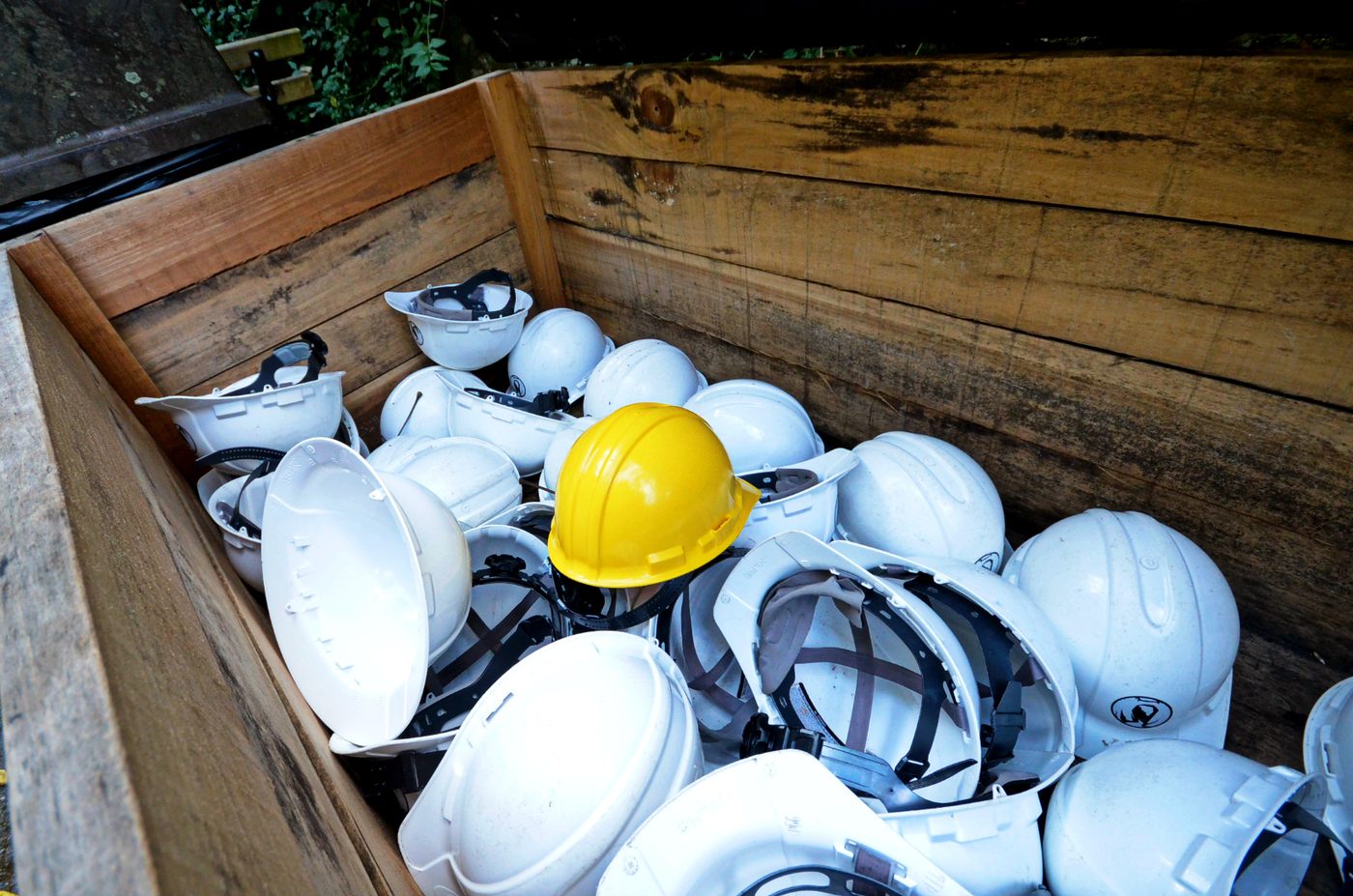
Hard hats are designed to protect the skull from impact injuries caused by falling objects or accidental bumps against timber supports. They are typically made from high-density polyethylene and have an adjustable suspension system to ensure a secure fit.
Yellow and white hard hats in a wooden crate (Source: Wikimedia Commons)
In a large county government office construction site, workers use hard hats to prevent head injuries from loose timber or tools falling from scaffolds.
Eye and Face Protection
Safety goggles and face shields guard against dust, flying debris, and splinters generated when cutting or shaping timber. They prevent eye injuries that can cause temporary or permanent vision impairment.
Employees in a university workshop use goggles when cutting timber for temporary formwork to avoid eye irritation and injury.
Hand Protection
Work gloves, often made from leather or reinforced fabric, protect hands from splinters, cuts, and abrasions during handling of timber and nails. Some gloves also offer chemical resistance if preservatives or adhesives are used.
Farm workers engaged in constructing timber supports for irrigation trenches benefit from gloves to maintain hand safety and grip.
Foot Protection
Safety boots with steel toes protect feet from heavy falling objects and provide stability on uneven or slippery surfaces. They also reduce the risk of puncture wounds from nails or sharp objects on the ground.
At a retail warehouse setting, workers involved in timber stacking wear safety boots to prevent foot injuries from dropping planks.
Respiratory Protection
Dust masks or respirators are necessary when cutting or sanding timber to prevent inhalation of sawdust, which can cause respiratory irritation or long-term lung problems.
In a hospital maintenance department, workers wear dust masks during timber repairs to maintain respiratory health.
1.1.2 Uses
PPE must be used correctly and consistently to provide the intended protection during timbering works. Its effectiveness depends on matching the PPE type to the specific hazard and the work being performed.
Protection Against Falling Objects
Hard hats must be worn whenever there is a risk of tools, timber pieces, or debris falling from height during the erection or dismantling of temporary supports. This is common in school construction sites where timber formwork is assembled overhead.
Safeguarding Eyes from Particulates
Workers involved in cutting or shaping timber must wear goggles or face shields to prevent injuries from flying chips and dust, ensuring uninterrupted vision and safety during precision tasks.
Hand Safety During Handling
Gloves are essential when lifting, carrying, or nailing timber to protect against splinters and sharp edges. In cooperative farming projects, this reduces the incidence of hand injuries among laborers.
Foot Protection on Uneven Terrain
Safety boots provide grip and protect feet from heavy timber falling or rolling. In hotel landscaping projects involving timber retaining walls, boots prevent foot injuries on rough ground.
Respiratory Health Maintenance
Dust masks prevent inhalation of fine timber particles and chemical fumes from preservatives, reducing occupational respiratory diseases among workers in retail furniture assembly workshops.
1.1.3 Identification
Proper identification and differentiation of PPE ensure that workers select the right equipment for their tasks and maintain compliance with safety standards. In Kenyan workplaces, clear markings and colour coding assist in PPE management.
Colour Coding Systems
Many organizations use colour codes to identify PPE types and their intended users. For instance, in a county hospital construction site, yellow helmets might designate supervisors while white helmets are for general workers, facilitating quick recognition and role clarity.
Markings and Labels
PPE items typically bear manufacturer labels indicating compliance with safety standards such as the Kenya Bureau of Standards (KEBS). This helps workers and safety officers verify the quality and suitability of the equipment.
Inspection Tags
Some PPE, like harnesses or respirators, have inspection tags with dates of last service or expiry, ensuring only safe and functional equipment is used. A university workshop maintains records of PPE inspections to guarantee worker safety.
Storage and Accessibility
Clearly labelled storage areas for different PPE types improve organization and ensure that workers can easily access the correct equipment when needed, as practiced in large retail warehouses.
Training and Awareness
Identification also involves training workers to recognize the correct PPE for specific hazards. County government offices conduct regular safety briefings to reinforce PPE knowledge and proper use.
Practice Questions
Explain five types of personal protective equipment used in timbering works and describe the specific hazards each protects against. (10 marks)
Discuss the importance of correct PPE use during timbering works and provide examples of how improper use can lead to workplace injuries. (10 marks)
Describe how PPE identification and management systems contribute to workplace safety in Kenyan construction or maintenance projects. (10 marks)
The rest of this chapter
🔒
Create a free account to open more of this chapter.
Free: practical guides, quick cards, workplace scenarios and more.
Timbering is the temporary support of the sides of trenches, pits and other excavations to prevent the soil from collapsing onto workers, plant or nearby structures. Collapse of an unsupported trench is one of the most common causes of death in construction, b…
🔒1.3 Trench timbering
Trench timbering is the temporary support of the vertical sides of a trench with timber or steel members so that the soil does not collapse while foundations, pipes or cables are being laid. Soil exerts a sideways pressure that increases with depth, and even f…
🔒1.4 Erection of timbering
Erection of timbering is the process of installing temporary supports in a trench, pit or shaft in the right order, at the right time and in the right positions, so that the soil face is held firm before workers are exposed to it. Good members are useless if t…
🔒1.5 Dismantling of timbering
Dismantling of timbering, also called striking, is the planned removal of the temporary supports from a trench, pit or shaft once the permanent works are complete and backfilling has started. It is one of the most dangerous stages of excavation work, because e…
🔒1.6 Storage of Timbering Materials
Proper storage of timbering materials is essential in maintaining their strength, durability, and safety for use in temporary works. In Kenya, where construction and maintenance projects often operate under tight budgets and timelines, efficient storage reduce…
Chapter Summary
This chapter explored the essential aspects of performing timbering works in building temporary structures. It began with a detailed overview of personal protective equipment, covering various types, their specific uses, and how to properly identify them to ensure worker safety. The discussion then moved to the different timbering tools and equipment, explaining their types and practical applications on site. A significant portion addressed trench timbering, emphasizing the techniques required to secure excavation sites effectively. The chapter further examined the procedures for erecting timbering structures, highlighting the critical steps for safe and stable installation. It also covered the dismantling process, ensuring that timbering removal is conducted safely without compromising the work environment. Finally, the chapter concluded with methods for storing timbering materials, stressing proper storage techniques to maintain material quality and readiness for future use.
Chapter Examination Questions
🔒 PDFDownload these examination questions, with worked answers
SECTION A (40 Marks) - Answer ALL Questions
Identify four types of personal protective equipment (PPE) commonly used during timbering works in a county hospital construction site. (4 marks)
Explain the primary use of a spirit level in timbering works at a university dormitory expansion project. (4 marks)
1. You are required to perform the following task:
i. Select and prepare timbering tools and equipment including hammer, saw, measuring tape, carpenter's square, plumb bob, and spirit level for timbering works as per site requirements.
2. You have been provided with the following resources for the practical task: