
By the end of this chapter, you will be able to:
Mastering these skills will help you build strong, efficient mechanical systems that work safely and effectively in the real world.
Torsion theory is fundamental in understanding how rotating mechanical components in automotive systems respond to applied forces. In Kenya's automotive industry, whether in vehicle repair workshops or manufacturing plants, mastery of torsion principles ensures the design, maintenance, and troubleshooting of shafts, axles, and drive components are executed safely and effectively. This chapter lays the groundwork for analyzing twisting forces and their impact on automotive mechanical systems, which is crucial for engineers and technicians working with transmission shafts, steering columns, and other torsion-sensitive parts.
Torsion is a mechanical phenomenon that occurs when a structural element is subjected to a twisting force or moment, causing it to rotate about its longitudinal axis. In automotive engineering, torsion is particularly relevant in components such as drive shafts and axles that transmit power from the engine to the wheels. Understanding torsion helps automotive engineers predict material behavior, prevent failure, and optimize component design for durability and performance.
Torsion involves the application of torque that causes shear stress and angular deformation in a member. Unlike bending or axial loading, torsion produces a twisting action that affects the entire cross-section of the component. For example, in a vehicle’s propeller shaft, the engine’s rotational force induces torsion to transmit power to the differential. The shaft must resist these twisting forces without excessive deformation or failure.
Various mechanical members experience torsion in automotive systems, including:
Shafts: Commonly used to transmit torque between components, such as crankshafts and camshafts in engines.
Axles: Carry vehicle load and transmit torque to the wheels, often under combined torsion and bending.
Couplings: Connect rotating shafts and accommodate misalignment while transmitting torque.
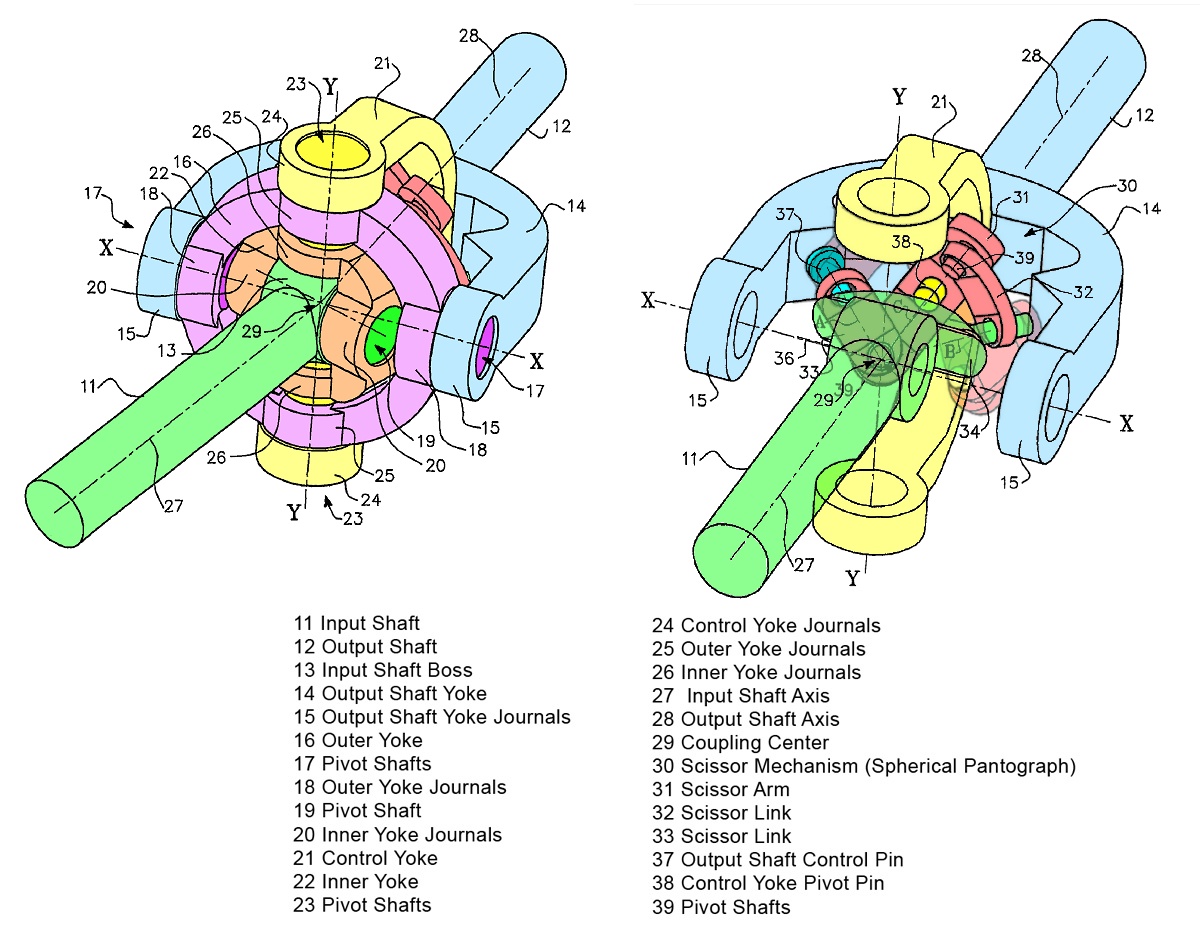
Automotive shaft couplings with labeled parts (Source: Wikimedia Commons)
Steering Columns: Transmit driver input torque to the steering mechanism.
Drive Shafts: Transfer engine power to the rear wheels in rear-wheel-drive vehicles.
Each member must be designed to withstand specific torsional loads to ensure reliability and safety.
Torsional stress is the shear stress induced by the twisting moment, while torsional strain is the angular deformation resulting from this stress. The relationship between applied torque, the material’s shear modulus, and the resulting twist angle is critical in automotive component design. For instance, excessive torsional strain in a drive shaft can lead to vibrations, noise, or catastrophic failure during vehicle operation.
Comprehending torsion enables automotive engineers to:
Create a free account to open more of this chapter.
Free: practical guides, quick cards, workplace scenarios and more.
Create a free accountThis chapter introduced torsion as the twisting action experienced by mechanical components when subjected to torque. It explored torque analysis, explaining how forces create rotational effects that must be carefully evaluated in engineering designs. The study of shafts focused on their behavior under torsion, distinguishing between those arranged in series and those arranged in parallel, with each configuration affecting torque distribution differently. Determining the angle of twist was covered in detail, presenting the relationship between applied torque, shaft properties, and resulting deformation. The engineers' torsion equation was developed to quantify this angle, providing a practical tool for design and analysis. Throughout, the chapter emphasized the importance of understanding torsion to ensure mechanical systems perform reliably and safely under operational loads.
Type: Individual
| Tools & Equipment | Materials |
|---|---|
| Torque wrench | Torsion test shaft model |
| Dial gauges | |
| Vernier caliper | |
| Protractor |
| S/N | Item | Quantity |
|---|---|---|
| 1 | Torsion test shaft model | 1 Pc per Candidate |
| 2 | Set of dial gauges | 1 Set per Candidate |
| 3 | Torque wrench | 1 Pc per Candidate |
| 4 | Vernier caliper | 1 Pc per Candidate |
| 5 | Protractor | 1 Pc per Candidate |
| 6 | Safety boots | 1 Pair per Candidate |
| 7 | Overall | 1 Pc per Candidate |
| 8 | Gloves | 1 Pair per Candidate |
| 9 | Notebook and pen | 1 Set per Candidate |
| Items to be Evaluated | Marks Available | Marks Obtained | Comments |
|---|---|---|---|
| TASK 1: Preparation and PPE usage | |||
| Wore personal protective equipment: safety boots, overall, gloves (Award 1 mark for each correctly worn PPE) | 3 | ||
| Assembled required tools and materials: torsion test shaft model, torque wrench, dial gauges, vernier caliper, protractor (Award 3 marks for complete and correct assembly or zero) | 3 | ||
| Prepared work area ensuring safety and cleanliness (Award 1 mark for safe and tidy setup) | 1 | ||
| Calibrated dial gauges and protractor before use (Award 2 marks for correct calibration or zero) | 2 | ||
| Sub-Total | 9 | ||
| TASK 2: Demonstration of torsion and measurement | |||
| Applied torque gradually on the shaft using torque wrench (Award 3 marks for correct and safe torque application or zero) | 3 | ||
| Measured the angle of twist accurately using dial gauges and protractor (Award 3 marks for correct measurement technique or zero) | 3 | ||
| Measured diameter and length of the shaft using vernier caliper (Award 2 marks for accurate measurements or zero) | 2 | ||
| Recorded all observations clearly in the notebook (Award 2 marks for clear and complete recording or zero) | 2 | ||
| Sub-Total | 10 | ||
| TASK 3: Explanation and definition | |||
| Defined torsion as the twisting of an object due to applied torque (Award 3 marks for correct and clear definition or zero) | 3 | ||
| Explained the effect of torsion on mechanical components using the shaft model (Award 4 marks for clear explanation with reference to the demonstration or zero) | 4 | ||
| Discussed safety considerations when working with torsion in mechanical systems (Award 3 marks for relevant safety discussion or zero) | 3 | ||
| Sub-Total | 10 | ||
| PRODUCT CHECKLIST | |||
| Correct measurements of shaft length (500mm) and diameter (40mm) (Award 3 marks for measurements within ±1mm tolerance) | 3 | ||
| Accurate recorded angle of twist corresponding to applied torque (Award 4 marks for correct and consistent readings) | 4 | ||
| Clear and concise definition and explanation of torsion in notebook (Award 3 marks for clarity and completeness) | 3 | ||
| Demonstration setup correctly assembled with no safety hazards (Award 2 marks for proper setup and safety compliance) | 2 | ||
| Sub-Total | 12 | ||
| GRAND TOTAL | 41 | ||
Type: Individual
| Tools & Equipment | Materials |
|---|---|
| Torque wrench | Steel shaft 500mm length, 40mm diameter |
| Dial gauge or deflection meter | Personal protective equipment (overall, safety boots, gloves) |
| Vernier caliper | Notebook and pen |
| Engineering calculator | |
| Steel ruler |
| S/N | Item | Quantity |
|---|---|---|
| 1 | Steel shaft 500mm length, 40mm diameter | 1 Pc per Candidate |
| 2 | Torque wrench (0-100 Nm range) | 1 Pc per Candidate |
| 3 | Dial gauge or deflection meter | 1 Pc per Candidate |
| 4 | Vernier caliper | 1 Pc per Candidate |
| 5 | Engineering calculator | 1 Pc per Candidate |
| 6 | Steel ruler | 1 Pc per Candidate |
| 7 | Personal protective equipment (overall, safety boots, gloves) | 1 set per Candidate |
| 8 | Notebook and pen | 1 set per Candidate |
| Items to be Evaluated | Marks Available | Marks Obtained | Comments |
|---|---|---|---|
| TASK 1: Preparation and Measurement | |||
| Wore personal protective equipment (overall, safety boots, gloves) (Award 1 mark for each PPE worn or zero) | 3 | ||
| Assembled all required tools and materials (Award 3 marks for complete set or zero) | 3 | ||
| Measured shaft diameter and length accurately using vernier caliper and steel ruler (Award 2 marks for each accurate measurement or zero) | 4 | ||
| Set up the shaft securely for torque application (Award 3 marks for correct setup or zero) | 3 | ||
| Sub-Total | 13 | ||
| TASK 2: Torque Application and Data Collection | |||
| Applied torque to the shaft using the torque wrench within specified range (Award 4 marks for correct application or zero) | 4 | ||
| Measured angular deflection or twist using dial gauge or deflection meter (Award 4 marks for correct measurement or zero) | 4 | ||
| Recorded data accurately in notebook (Award 3 marks for complete and neat recording or zero) | 3 | ||
| Used engineering calculator to compute torque and compare with applied values (Award 4 marks for correct calculations or zero) | 4 | ||
| Sub-Total | 15 | ||
| TASK 3: Reporting and Housekeeping | |||
| Prepared a brief report of findings including calculated and measured torque values (Award 4 marks for clear and correct report or zero) | 4 | ||
| Cleaned work area and returned tools and materials to proper places (Award 3 marks for proper housekeeping or zero) | 3 | ||
| Completed the task within the allocated time (Award 2 marks for timely completion or zero) | 2 | ||
| Sub-Total | 9 | ||
| PRODUCT CHECKLIST | |||
| Shaft dimensions (length 500mm, diameter 40mm) measured within ±0.5mm tolerance (Award 3 marks for accurate measurement or zero) | 3 | ||
| Applied torque measured and recorded correctly within ±5% accuracy (Award 4 marks for correct measurement or zero) | 4 | ||
| Calculated torque values correctly using torsion formulas with proper units (Award 5 marks for correct calculations or zero) | 5 | ||
| Report clearly compares measured and calculated torque with appropriate conclusions (Award 3 marks for clarity and correctness or zero) | 3 | ||
| Sub-Total | 15 | ||
| GRAND TOTAL | 52 | ||
At the start of this chapter we promised you would be able to:
Tick each one you can genuinely do.
So, are you there yet?
You're competent when you can confidently do 50% or more of what this chapter promised.
Sign in to record how you're doing.