
By the end of this chapter, you will be able to: - confidently design belt drives that suit specific job requirements - accurately design rope drives that meet the needs of the job - design chain drives correctly according to job requirements
Mastering these skills will help you create reliable power transmission systems essential for many engineering and maintenance tasks in the real world.
Belts, ropes, and chain drives are fundamental components in automotive engineering, serving as essential mechanisms for power transmission between rotating shafts. In Kenya's automotive industry, including vehicle manufacturing, repair workshops, and parts supply, understanding these drives ensures efficient design, maintenance, and troubleshooting of automotive systems. These drives influence the reliability and performance of engines, cooling systems, and auxiliary devices. Mastery of their definitions and characteristics equips automotive technologists to optimize vehicle operation and service.
The definitions of belt, rope, and chain drives highlight their distinct roles and mechanical properties in power transmission. Each component possesses unique construction and operational characteristics suited to different automotive applications. Recognizing these differences is critical for selecting the correct drive system in vehicle maintenance and design.
Belts are continuous flexible loops made from various materials, used to transmit power between rotating shafts by frictional contact. In automotive engineering, belts commonly drive alternators, water pumps, and air conditioning compressors. The belt wraps around pulleys attached to shafts, and the tension in the belt ensures friction sufficient to transfer torque without slipping.
Polyurethane Belts: Some belts feature polyurethane with embedded steel or Kevlar cords, offering high resistance to wear and elongation.
V-belts: These have a trapezoidal cross-section that fits into matching pulley grooves, increasing friction and power transmission efficiency.
Timing belts: Made of rubber with high-strength cords and teeth on the inner surface, timing belts synchronize camshaft and crankshaft rotation in engines.
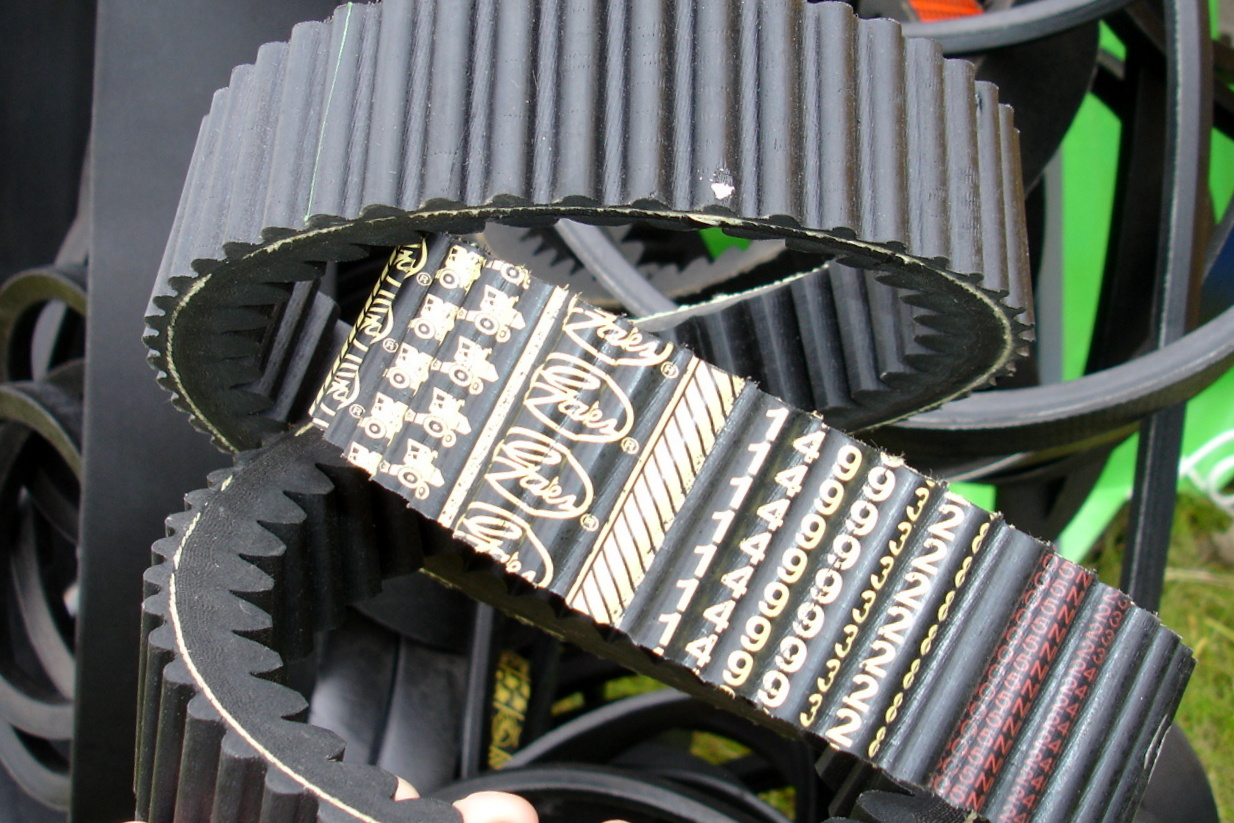
Automotive timing belts close-up (Source: Wikimedia Commons)
Belts transmit power through the friction generated between the belt surface and pulley. Proper tension is crucial; too loose causes slipping and power loss, while too tight increases bearing loads and reduces belt life. In automotive systems, belts allow for smooth and quiet operation, essential for passenger comfort and engine efficiency.
Belts power critical engine accessories, such as alternators at Nairobi Hospital, water pumps in county ambulance vehicles, and air conditioning compressors in hotel shuttle buses. Their ease of replacement and cost-effectiveness make them preferred in many automotive auxiliary systems.
Ropes in mechanical power transmission are less common than belts or chains but serve specialized roles where flexibility and high tensile strength are needed. In automotive contexts, ropes can be found in emergency towing, winching, or vehicle recovery operations rather than as primary drive components.
Natural Fiber Ropes: Historically used but now rare in automotive due to lower strength and susceptibility to rot.
Synthetic Fiber Ropes: Materials like nylon, polyester, and polypropylene offer high strength-to-weight ratios, resistance to chemicals, and durability.
Wire Ropes: Comprise multiple strands of steel wires twisted together, providing exceptional tensile strength and abrasion resistance.
Braided and Twisted Ropes: Different constructions affect flexibility, strength, and resistance to kinking, important for specific automotive tasks.
Ropes excel in tensile strength and flexibility but lack the rigidity for precise power transmission. They absorb shock loads effectively, which is valuable in towing and recovery but unsuitable for driving rotating machinery.
Ropes are used in vehicle recovery at farms, for example, pulling stuck tractors or trailers, and in winches on 4x4 vehicles employed in rough terrains such as those in Maasai Mara conservancies. They are also essential in securing cargo during transport by road freight operators.
Due to their lack of positive engagement with pulleys or sprockets, ropes cannot reliably transmit rotary motion without slippage. Their primary role remains in tension applications rather than driving mechanisms.
Chains consist of linked metal components designed to transmit mechanical power positively between shafts, especially where belts would slip or fail. In automotive engineering, chains are vital for timing drives and heavy-duty power transmission where durability and precision are paramount.
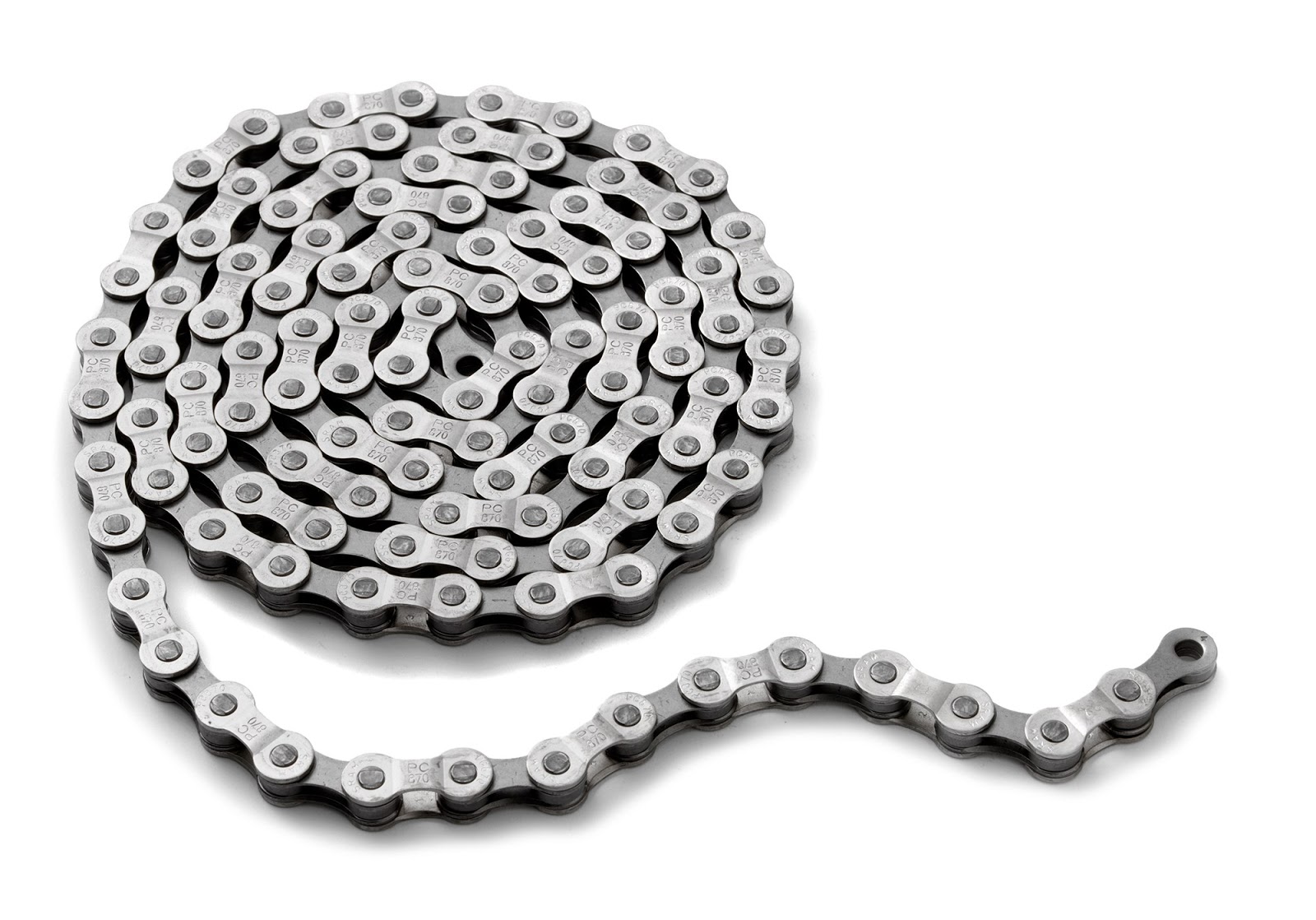
metal roller chain coiled on white background (Source: Wikimedia Commons)
Chains transmit power through positive mechanical engagement with sprockets, eliminating slippage even under high torque loads. This ensures accurate synchronization in engine timing and robust power transfer in heavy-duty applications.
Automotive timing chains synchronize camshaft and crankshaft rotation in engines at institutions such as Kenyatta National Hospital’s vehicle fleet maintenance. Chains also drive heavy-duty components in commercial trucks and agricultural machinery, where belts would be inadequate due to load demands.
Create a free account to open more of this chapter.
Free: practical guides, quick cards, workplace scenarios and more.
Create a free accountThis chapter explored the fundamental concepts of belts, ropes, and chain drives as essential components in mechanical power transmission. It began by defining a belt as a flexible loop used to link two or more rotating shafts, a rope as a strong, flexible length used for transmitting power or lifting, and a chain as a series of linked metal elements designed to transfer motion. The discussion then focused on belts, detailing the common materials such as rubber, cotton, and leather, each chosen for their strength and flexibility. Various types of belts were examined, including flat belts, V belts, and circular belts, with explanations of their configurations in open and crossed arrangements. Design analysis covered critical parameters like velocity ratio, belt length, angle of contact, and power transmitted, essential for selecting and optimizing belt drives. Rope drives were introduced with attention to their different types and applications in transmitting mechanical power. Finally, the chapter concluded with an overview of chain drives, emphasizing the various types used to provide reliable and efficient power transfer in engineering systems.
Type: Individual
| Tools & Equipment | Materials |
|---|---|
| Measuring tape | Flat belt sample |
| Caliper | V belt sample |
| Magnifying glass | Circular belt sample |
| Identification chart of belts | |
| Notebook and pen |
| S/N | Item | Quantity |
|---|---|---|
| 1 | Flat belt sample | 1 Pc per Candidate |
| 2 | V belt sample | 1 Pc per Candidate |
| 3 | Circular belt sample | 1 Pc per Candidate |
| 4 | Identification chart of belts | 1 Pc per Candidate |
| 5 | Measuring tape | 1 Pc per Candidate |
| 6 | Notebook and pen | 1 set per Candidate |
| 7 | Caliper | 1 Pc per Candidate |
| 8 | Magnifying glass | 1 Pc per Candidate |
| 9 | Personal protective equipment (Safety boots, Overall) | 1 set per Candidate |
| Items to be Evaluated | Marks Available | Marks Obtained | Comments |
|---|---|---|---|
| TASK 1: Preparation and PPE | |||
| Wore personal protective equipment: safety boots and overall (Award 1 mark for each correctly worn PPE) | 2 | ||
| Assembled all required tools and materials (Award 2 marks for complete assembly or zero) | 2 | ||
| Prepared work area according to workshop procedures (Award 1 mark for clean and organized workspace) | 1 | ||
| Sub-Total | 5 | ||
| TASK 2: Identification and Classification | |||
| Measured length and width of flat belt using measuring tape and caliper (Award 1 mark each for accurate measurement of length, width, and thickness) | 3 | ||
| Measured cross-sectional dimensions of V belt and circular belt (Award 1 mark each for correct measurement of height, width, and diameter) | 3 | ||
| Inspected belts for surface characteristics and material type using magnifying glass (Award 1 mark each for correct identification of surface texture and material) | 2 | ||
| Classified belts into flat, V and circular types based on observations (Award 1 mark each for correct classification of each belt type) | 3 | ||
| Recorded belt characteristics and typical applications in notebook (Award 2 marks for clear and accurate recording) | 2 | ||
| Sub-Total | 13 | ||
| PRODUCT CHECKLIST | |||
| Correctly identified and classified flat belt (Award 3 marks for correct classification and description) | 3 | ||
| Correctly identified and classified V belt (Award 3 marks for correct classification and description) | 3 | ||
| Correctly identified and classified circular belt (Award 3 marks for correct classification and description) | 3 | ||
| Recorded belt dimensions within ±2mm tolerance (Award 3 marks for accurate dimension recording) | 3 | ||
| Provided typical applications for each belt type (Award 3 marks for correct application descriptions) | 3 | ||
| Sub-Total | 15 | ||
| GRAND TOTAL | 33 | ||
Type: Individual
| Tools & Equipment | Materials |
|---|---|
| Measuring tape | Cotton rope sample 10mm diameter |
| Micrometer screw gauge | Manila rope sample 12mm diameter |
| Magnifying glass | Sisal rope sample 15mm diameter |
| Wire rope sample 10mm diameter | |
| Synthetic fiber rope sample 12mm diameter | |
| Rope drive pulley set 150mm diameter |
| S/N | Item | Quantity |
|---|---|---|
| 1 | Cotton rope sample 10mm diameter | 1 Pc per Candidate |
| 2 | Manila rope sample 12mm diameter | 1 Pc per Candidate |
| 3 | Sisal rope sample 15mm diameter | 1 Pc per Candidate |
| 4 | Wire rope sample 10mm diameter | 1 Pc per Candidate |
| 5 | Synthetic fiber rope sample 12mm diameter | 1 Pc per Candidate |
| 6 | Rope drive pulley set 150mm diameter | 1 set per Candidate |
| 7 | Measuring tape | 1 Pc per Candidate |
| 8 | Micrometer screw gauge | 1 Pc per Candidate |
| 9 | Magnifying glass | 1 Pc per Candidate |
| 10 | Notebook and pen | 1 set per Candidate |
| 11 | Personal Protective Equipment (PPE): Overall, Safety boots, Gloves | 1 set per Candidate |
| Items to be Evaluated | Marks Available | Marks Obtained | Comments |
|---|---|---|---|
| TASK 1: Identification and Classification of Ropes | |||
| Wore personal protective equipment: overall, safety boots, gloves (Award 1 mark for each PPE worn properly) | 3 | ||
| Assembled all required tools and materials correctly (Award 3 marks for complete assembly or zero) | 3 | ||
| Measured rope diameters accurately using micrometer and measuring tape (Award 1 mark for each correctly measured rope diameter) | 5 | ||
| Inspected rope samples for fiber type and construction using magnifying glass (Award 1 mark for each correctly identified rope type) | 5 | ||
| Classified ropes correctly into natural fiber, synthetic fiber, and wire rope categories (Award 1 mark for each correct classification) | 5 | ||
| Demonstrated correct fitting of each rope type on the 150mm diameter pulley (Award 1 mark for each rope correctly fitted and tensioned on pulley) | 5 | ||
| Explained the suitability of each rope type for different rope drive applications (Award 1 mark for each correct explanation per rope type) | 4 | ||
| Carried out housekeeping and cleaned work area (Award 2 marks for thorough cleaning and proper disposal) | 2 | ||
| Completed the task within the allocated time (Award 2 marks if completed within time) | 2 | ||
| Sub-Total | 34 | ||
| PRODUCT CHECKLIST | |||
| Rope diameters measured match specified sizes: 10mm, 12mm, 15mm, 10mm, 12mm (Award 1 mark for each correctly measured rope diameter) | 5 | ||
| Ropes correctly classified into cotton, manila, sisal, wire, and synthetic fiber categories (Award 1 mark for each correct classification) | 5 | ||
| Ropes properly fitted and tensioned on pulleys without slippage or damage (Award 2 marks for correct fitting and tension per rope category, total 6 marks) | 6 | ||
| Written explanations clearly match rope types and their applications (Award 1 mark for each clear and accurate explanation) | 5 | ||
| Sub-Total | 21 | ||
| GRAND TOTAL | 55 | ||
At the start of this chapter we promised you would be able to:
Tick each one you can genuinely do.
So, are you there yet?
You're competent when you can confidently do 50% or more of what this chapter promised.
Sign in to record how you're doing.