In procurement management, research studies underpin evidence-based decision-making and strategic sourcing by providing theoretical frameworks to analyze market behaviour, supplier performance, and procurement risks. Reviewing relevant theories allows procurement professionals in Kenya to understand complex supply chain dynamics and align procurement strategies with organizational goals. This chapter focuses on key theories applicable to procurement research, enabling practitioners to critically evaluate literature and apply theoretical insights to real-world procurement challenges.
2.1 Relevant Theories of the Study
Theories offer structured explanations of phenomena and guide empirical research. In procurement management, relevant theories help explain behaviours of buyers, suppliers, and markets, shaping procurement strategies and policies. Kenyan procurement professionals benefit from grounding their research in theories that reflect both global best practices and local market realities, such as public procurement reforms and supplier diversity challenges.
2.1.1 Transaction Cost Theory
Transaction Cost Theory (TCT) explains procurement decisions by focusing on the costs associated with exchanging goods or services. It is particularly useful in analyzing make-or-buy decisions, contract design, and supplier selection in Kenyan public and private sectors.
Core Principles of Transaction Cost Theory
- Transaction Costs Include Search and Information Costs: Procurement officers incur costs while searching for potential suppliers and gathering information about their capabilities and prices, as seen in county government tenders.
- Bargaining and Decision Costs: Negotiating contract terms requires time and resources, impacting procurement efficiency in organizations like SACCOs.
- Enforcement and Monitoring Costs: Ensuring contract compliance involves supervision and penalties, which are significant in large-scale projects at institutions like the Kenya Medical Supplies Authority.
- Asset Specificity Increases Costs: When investments are tailored to particular suppliers or products, switching costs rise, influencing long-term supplier relationships in manufacturing firms.
- Uncertainty Influences Contractual Arrangements: In volatile markets, such as agricultural inputs procurement, contracts must accommodate risks, affecting procurement strategies.
Application in Kenyan Procurement Context
Public entities often face high transaction costs due to bureaucratic procedures and regulatory compliance. For example, at the Nairobi City County, transaction cost considerations affect whether to procure services internally or outsource. Understanding TCT helps procurement managers design contracts that minimize unnecessary costs while safeguarding public funds.
2.1.2 Agency Theory
Agency Theory explores the relationship between principals (owners or managers) and agents (procurement officers or suppliers), focusing on conflicts of interest and information asymmetry. It is critical in Kenyan procurement to manage risks of moral hazard and ensure accountability.
Key Aspects of Agency Theory
- Principal-Agent Relationship: The principal delegates procurement tasks to agents, expecting them to act in the principal’s best interest, common in county government procurement units.
- Information Asymmetry: Agents often have more information than principals, which can lead to opportunistic behaviour if unchecked, such as supplier collusion in tendering processes.
- Moral Hazard: Agents may shirk duties or prioritize personal gain over organizational goals, a risk in decentralized procurement offices.
- Adverse Selection: Principals may select agents with hidden undesirable traits, such as inadequate skills or integrity issues, affecting procurement outcomes.
- Incentive Alignment: Designing performance-based contracts and monitoring mechanisms helps align agent behaviour with principal objectives, as practiced in some Kenyan banks’ procurement functions.
Kenyan Procurement Implications
Agency problems are prevalent in public procurement where oversight is weak. For instance, the Kenya Revenue Authority procurement department implements strict reporting and audit mechanisms to mitigate agency risks. Applying Agency Theory guides the development of transparent procurement policies and controls.
2.1.3 Resource-Based View Theory
The Resource-Based View (RBV) theory posits that organizations achieve competitive advantage by effectively managing valuable, rare, and inimitable resources, including procurement capabilities.
Fundamental Components of Resource-Based View
- Valuable Resources: Procurement functions that secure cost-effective, high-quality inputs add value to the organization, such as efficient sourcing of medical supplies at Kenyatta National Hospital.
- Rarity: Unique supplier relationships or specialized procurement knowledge create advantages, for example, exclusive contracts with tea farmers’ cooperatives.
- Imitability: Capabilities difficult to replicate, such as robust supplier evaluation systems, protect competitive advantage.
- Organizational Capability: The ability to coordinate procurement resources and processes effectively, as seen in large retail chains, ensures sustained performance.
- Sustainability: Long-term success depends on continuously developing procurement skills and adapting to market changes.
Application in Kenyan Procurement Settings
Counties that invest in procurement training and technology gain a strategic edge by reducing costs and improving supplier performance. The RBV framework encourages procurement managers to focus on building internal competencies and leveraging supplier networks.
2.1.4 Institutional Theory
Institutional Theory examines how organizational behaviour is influenced by formal and informal rules, norms, and cultural expectations. In Kenya, procurement is heavily regulated, making this theory vital for understanding compliance and adaptation.
Institutional Influences on Procurement
- Regulatory Environment: Compliance with laws such as the Public Procurement and Asset Disposal Act shapes procurement practices in government agencies.
- Normative Pressures: Professional standards and ethical norms guide procurement officers’ conduct, reinforced by bodies like the Kenya Institute of Supplies Management.
- Cognitive Frameworks: Shared beliefs about ‘best practice’ influence procurement policies in organizations, including private sector firms.
- Isomorphism: Organizations tend to mimic successful procurement approaches from peers to gain legitimacy, evident in SACCOs adopting e-procurement systems.
- Institutional Change: Reforms and policy shifts, such as digitization initiatives by the National Treasury, drive procurement evolution.
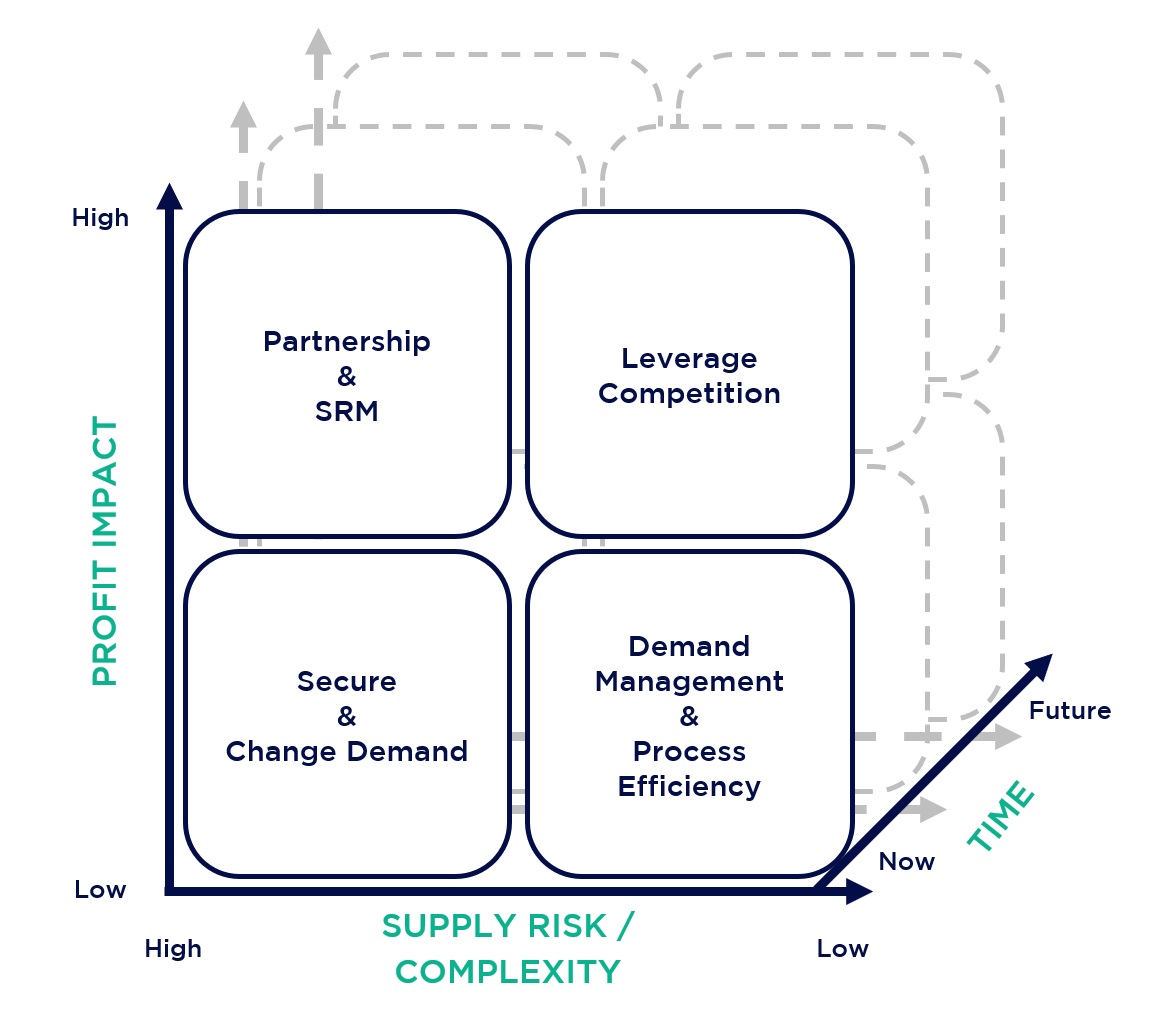
Matrix showing procurement change strategies (Source: Wikimedia Commons (Procurement))
Kenyan Procurement Context
Procurement units in county governments must balance regulatory compliance with operational efficiency. Institutional Theory explains how external pressures shape procurement routines and the adoption of new technologies.
Practice Questions
- Explain how Transaction Cost Theory influences procurement decisions in Kenyan public sector organizations. (10 marks)
- Discuss the challenges posed by Agency Theory in procurement management and suggest mechanisms to address them. (10 marks)
- Describe how the Resource-Based View can be applied to enhance procurement capabilities in a Kenyan retail company. (10 marks)
- Analyze the role of Institutional Theory in shaping procurement practices within Kenyan county governments. (10 marks)
The rest of this chapter
🔒Create a free account to open more of this chapter.
Free: practical guides, quick cards, workplace scenarios and more.
Create a free account 🔒2.2 Empirical Literature Review
In procurement management research, empirical literature review focuses on studies that use observed and measured phenomena to derive conclusions. This review is critical in Kenya’s procurement sector where decisions must be evidence-based to enhance transpare…
🔒2.3 Conceptual Framework
In procurement management research, a conceptual framework serves as the foundation that guides the entire study by illustrating the relationships among key variables. For procurement professionals in Kenya, developing a clear conceptual framework helps in sys…
🔒2.4 Research Gaps
In procurement management research within Kenya, identifying research gaps is critical for advancing knowledge and improving procurement practices. Research gaps highlight areas insufficiently explored or understood, offering opportunities for scholars and pro…
Chapter Summary
This chapter explored the critical role of reviewing research literature in a study. It began by examining relevant theories that provide the foundational understanding and guide the research questions and methodology. The discussion then moved to empirical literature review, where previous studies and their findings were analyzed to establish the current state of knowledge and context for the research. Following this, the chapter explained the conceptual framework, which visually and logically organizes the key variables and their relationships within the study. Finally, the identification of research gaps was emphasized as essential for justifying the need for the study by highlighting areas that have not been sufficiently addressed. Together, these components ensure that the research is grounded in existing knowledge while contributing new insights.
Self-Assessment
🔒 PDFDownload this self-assessment, with answers
A. Written Assessment
- What is the primary purpose of reviewing relevant theories in a procurement management research study? (2 marks)
- Identify two key characteristics of empirical literature in procurement research. (2 marks)
🔒20 more in this section.
Chapter Examination Questions
🔒 PDFDownload these examination questions, with worked answers
SECTION A (40 Marks) - Answer ALL Questions
- Explain how the Theory of Transaction Cost Economics can be applied to procurement management in Kenyan public institutions. (4 marks)
- Identify and describe two relevant procurement theories that support supplier relationship management. (4 marks)
🔒18 more in this section.
