Inflation and unemployment are critical economic concepts that directly influence the performance and sustainability of cooperatives in Kenya. Understanding the nature of inflation helps cooperative managers anticipate changes in the cost of inputs and consumer prices, which affect members’ purchasing power and loan repayment capacity. Meanwhile, unemployment impacts the cooperative’s membership base and the overall demand for cooperative products and services. This chapter develops a deep understanding of inflation types and causes, equipping cooperative professionals to make informed decisions for financial planning and risk management.
9.1 Types of Inflation
In Kenya’s cooperative sector, inflation manifests in different forms, each with distinct causes and effects on cooperative operations and members’ welfare. Recognizing these types enables cooperative managers to formulate appropriate strategies to mitigate inflationary pressures, ensuring stable pricing and sustainable growth.
9.1.1 Cost Push Inflation
Cost push inflation occurs when the overall price level rises due to increases in the costs of production inputs, rather than from heightened consumer demand. This type of inflation is particularly relevant for agricultural cooperatives, where rising prices of fertilizers, seeds, and fuel can increase production costs and reduce profit margins. For example, a dairy cooperative may face cost push inflation if the price of animal feed and veterinary services rises sharply, forcing the cooperative to increase milk prices to maintain viability.
Characteristics of Cost Push Inflation
- Input Price Increases: Rising costs of raw materials, such as fertilizers or packaging materials, push production costs higher, compelling cooperatives to raise prices.
- Wage Pressure: When labor unions negotiate higher wages, cooperatives, especially large agricultural or marketing cooperatives, may face increased wage bills.
- Supply Chain Disruptions: Interruptions in supply chains, such as transport strikes or fuel shortages, escalate costs, impacting cooperative operations.
- Exchange Rate Depreciation: A weakening Kenyan shilling increases the cost of imported goods and inputs, affecting cooperatives reliant on imported machinery or chemicals.
- Profit Margin Squeeze: Cooperatives may experience reduced profitability if they cannot pass increased costs fully to consumers due to competition or price sensitivity.
9.1.2 Demand Pull Inflation
Demand pull inflation arises when aggregate demand in the economy exceeds aggregate supply, causing prices to rise. In Kenya, this can occur when increased incomes, government spending, or credit availability leads to greater demand for goods and services than the economy can supply. For cooperatives, demand pull inflation may be observed when members’ incomes rise, increasing demand for cooperative products such as agricultural produce or consumer goods, but supply constraints limit availability.
Features of Demand Pull Inflation
- Excess Consumer Spending: Higher disposable incomes among cooperative members or communities drive increased consumption beyond supply capacity.
- Credit Expansion: Easy access to credit through SACCOs or banks raises purchasing power, encouraging higher demand for goods.
- Government Expenditure: Increased public spending on infrastructure or social programs stimulates demand in local economies.
- Capacity Constraints: Limited production capacity in sectors like farming or manufacturing creates supply bottlenecks that push prices up.
- Speculative Buying: Expectations of future price increases may lead to hoarding or speculative purchases, intensifying demand pressures.
9.1.3 Hyperinflation: Extreme Inflationary Episodes
Although rare, hyperinflation represents an extreme form of inflation where prices increase uncontrollably, often more than 50% per month. In Kenya, hyperinflation has not occurred recently, but cooperative managers must be aware of this risk in unstable economic environments or during political crises, as it drastically reduces the value of money and disrupts normal economic activities.
Indicators of Hyperinflation
- Rapid Price Escalation: Prices double or triple within weeks, creating uncertainty in pricing and contracts.
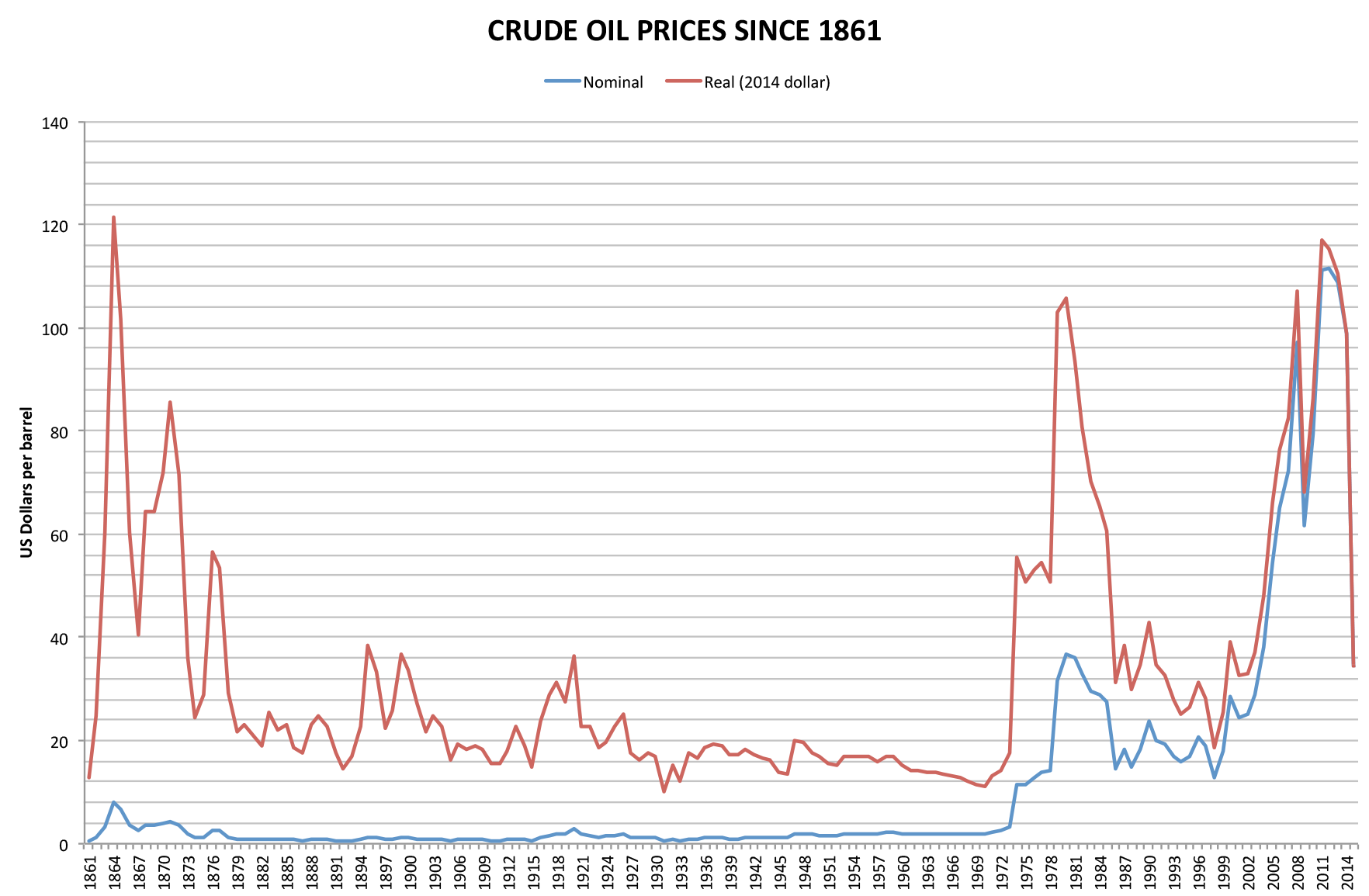
Historical crude oil price escalation graph (Source: Wikimedia Commons (Price of oil))
- Currency Devaluation: The Kenyan shilling would rapidly lose value, prompting a switch to foreign currencies or barter.
- Collapse of Savings: Members’ savings in cooperatives lose purchasing power, undermining trust in financial institutions.
- Disrupted Supply Chains: Hyperinflation causes severe shortages as suppliers withdraw from markets due to unpredictable costs.
- Erosion of Income: Fixed incomes become worthless, affecting cooperative members dependent on pensions or wages.
9.1.4 Stagflation: Inflation with Unemployment
Stagflation combines stagnant economic growth, high unemployment, and high inflation, posing a complex challenge for cooperative management. For instance, a cooperative in a county experiencing economic slowdown may witness falling sales alongside rising input prices, squeezing margins while members struggle with unemployment.
Implications of Stagflation
- Reduced Demand: Unemployed members have less disposable income, lowering demand for cooperative goods.
- Rising Costs: Inflation increases operational costs despite weak sales.
- Investment Hesitancy: Uncertainty discourages cooperative expansion or new projects.
- Financial Strain: Loan defaults increase as members face unemployment.
- Policy Dilemma: Remedies for inflation may worsen unemployment, complicating cooperative strategic planning.
Practice Questions
- Explain how cost push inflation affects agricultural cooperatives in Kenya. (6 marks)
- Describe the main characteristics of demand pull inflation and provide an example relevant to Kenyan SACCOs. (8 marks)
- Discuss the economic conditions that lead to stagflation and its effect on cooperative members. (6 marks)
The rest of this chapter
🔒Create a free account to open more of this chapter.
Free: practical guides, quick cards, workplace scenarios and more.
Create a free account 🔒9.2 Causes of Inflation
Understanding the causes of inflation is essential for cooperative managers to anticipate price changes and adjust their strategies accordingly. Inflation in Kenya arises from a combination of domestic and external factors that influence both supply and demand…
🔒9.3 Effects of Inflation
Inflation is a critical economic variable that significantly impacts cooperative societies and their members in Kenya. As inflation causes the general price level to rise, the purchasing power of money declines, influencing savings, investment, and consumption…
🔒9.4 Measures to Control Inflation
Controlling inflation is essential for maintaining economic stability and protecting the interests of cooperative members. In Kenya, the government and the Central Bank use a combination of fiscal and monetary policies to moderate inflationary pressures. Coope…
🔒9.5 Direct Intervention
Direct intervention refers to deliberate actions taken by government or regulatory bodies to influence economic conditions, particularly to address challenges such as unemployment. In Kenya, where cooperatives play a crucial role in economic development and po…
Chapter Summary
This chapter examined the different types of inflation, focusing on cost push inflation that arises from increased production costs and demand pull inflation caused by excess demand over supply. It explored various causes of inflation, including supply shocks and monetary factors, and detailed the effects inflation has on purchasing power, savings, and economic stability. The chapter also analysed measures to control inflation, highlighting fiscal policy tools such as government spending and taxation, as well as monetary policy strategies involving interest rates and money supply regulation. In addition, direct intervention methods to manage inflation were discussed. The chapter then shifted to unemployment, identifying its causes ranging from economic downturns to structural changes in the labour market. Finally, it outlined control measures for unemployment, emphasizing policy interventions aimed at job creation and skills development.
Self-Assessment
🔒 PDFDownload this self-assessment, with answers
A. Written Assessment
- What is cost-push inflation and how does it affect cooperative societies? (3 marks)
- Identify two main causes of demand-pull inflation. (2 marks)
🔒20 more in this section.
Chapter Examination Questions
🔒 PDFDownload these examination questions, with worked answers
SECTION A (40 Marks) - Answer ALL Questions
- Differentiate between cost-push inflation and demand-pull inflation with examples relevant to agricultural cooperatives in Kenya. (4 marks)
- Identify and explain two major causes of inflation that can affect Kenyan savings and credit cooperative societies (SACCOs). (4 marks)
🔒18 more in this section.
