Store keeping duties form a critical component of effective supply chain management in business organizations. In Kenya, where many enterprises operate in competitive markets, efficient store keeping ensures the availability of materials, controls costs, and prevents losses through theft or damage. This chapter explores the core concepts underpinning store keeping, stock taking procedures, and the security measures necessary to safeguard inventory. Business managers and supply chain professionals in sectors such as retail, manufacturing, and public service will find these practices essential for maintaining operational continuity and financial accountability.
3.1 Definition of terms
Store keeping duties rest on four terms: store keeping, stock taking, store security and the stock taking routine. A business that uses these terms in the same way across its buying, receiving, storing and issuing staff avoids disputes about what was counted, what was kept safe and who was answerable. Each term below is defined first and then tied to the daily work of a store in a trading or supply business, such as a hardware shop, a wholesale distributor or a manufacturer's materials store.
3.1.1 Store keeping
Store keeping is the work of receiving, storing, protecting, recording and issuing the goods and materials a business holds, so that the right item is available in the right quantity at the right time. A store keeper is the person held responsible for those goods and their records. For example, in a wholesale distributor's warehouse the store keeper checks each delivery against the purchase order, shelves it in its allocated place, and releases goods only against an approved issue note.
Good store keeping balances two aims that pull against each other. The store must be orderly and secure enough to prevent loss, and open enough for authorised staff to get what they need quickly. How each duty is carried out is covered under Store keeping duties; here the term is only defined.
Role of the store keeper
- Custodian of stock: The store keeper is accountable for everything entered into the store until it is issued out. Any shortage found later is traced back to the records the store keeper signed.
- Link between departments: The store keeper connects purchasing, which orders the goods, with the sales or production staff who use them. A stationery supplier's store keeper, for example, tells the buyer when reams of paper are close to the reorder level.
- Keeper of records: Every receipt and issue is written in the store records the same day, in a bin card, a stores ledger or a stock program. Records that agree with the shelves are the proof that the store is under control.
- Controller of issues: Goods leave the store only against a signed requisition from an authorised person. This stops informal borrowing and protects the store keeper as well as the business.
- Reporter of stock condition: Damaged, expired or slow-moving items are reported to management instead of being left to deteriorate on the shelves.
Skills required for effective store keeping
- Attention to detail: A wrongly copied code or quantity creates a difference that is hard to trace later.
- Organisation: A clear layout, with each item in a known place, saves time at issue and during counting.
- Integrity: The store keeper handles valuable goods with little supervision, so trust is the basis of the job.
- Communication: Shortages, damage and late deliveries must be reported clearly and quickly to purchasing and to management.
- Basic computer literacy: Many stores keep stock records in a spreadsheet or inventory program, so the store keeper must be able to enter and read them accurately.
3.1.2 Stock taking
Stock taking is the physical counting, checking and recording of the goods held in a store at a given date, and the comparison of that count with the stock records. It tells the business what it really owns, as opposed to what its books say it owns. In a hardware shop, for example, the count of cement bags, paint tins and nails on the shelves is compared with the stock ledger, and every difference is investigated.
Purpose of stock taking
- Verification of records: It confirms that the quantities in the books match the quantities on the shelves, and it exposes errors, theft and unrecorded issues.
- Valuation for the accounts: The closing stock figure is needed to work out the cost of goods sold and the profit for the period.
- Assessment of stock condition: Damaged, expired and obsolete items are identified so that they can be written down, returned or disposed of.
- Improvement of stock control: Patterns of usage and loss show where reorder levels and handling methods need to change.
- Support for planning: Accurate counts help the buyer decide what to order and in what quantity.
Types of stock taking
- Periodic stock taking: The whole store is counted at fixed intervals, such as monthly or quarterly, and the records are corrected after each count.
- Continuous stock taking: A few items are counted every day or week in rotation, so that every item is checked several times in the year without closing the store. This is also called cycle counting.
- Annual stock taking: A full count at the end of the financial year, carried out so that the year-end stock value can be stated in the accounts.
- Spot checking: An unannounced count of selected items, often those of high value or high risk, to test whether the records are reliable.
- Blind stock taking: The counters are not told the recorded quantity, so they cannot adjust their count to match it.
3.1.3 Store security
Store security is the set of measures that protect stock, equipment and records in a store from theft, damage, fire and unauthorised access. The measures work together: a locked door with no key control, or a guard with no record of who entered, leaves gaps. For example, a timber and building materials yard may combine a fenced yard, a lockable shed for small high-value items, a gate register and a trained watchman.
Components of store security
- Physical security: Strong doors, padlocks, window grilles, fencing and lighting make unauthorised entry difficult. A shop selling mobile phone accessories, for example, keeps its reserve stock in a locked cage behind the counter.
- Access control: Only named people are allowed into the store, and keys or entry cards are issued and recorded. Some businesses use key cards or fingerprint readers for this.
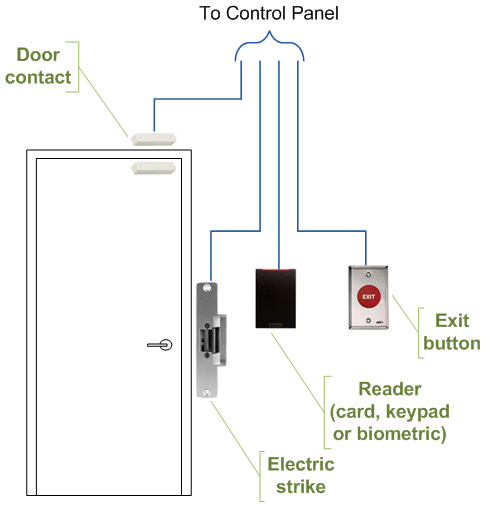
Access control system components at a door (Source: Wikimedia Commons)
- Inventory monitoring: Regular counts and reconciliations of the records bring losses to light early.
- Security personnel: Guards or watchmen deter theft and vandalism and control the gate, including the inspection of vehicles and parcels leaving the premises.
- Alarm and surveillance systems: Alarms and cameras alert the owner or manager to a break-in and provide evidence afterwards.
- Fire protection: Extinguishers, clear exits and the separation of flammable goods protect stock and people from fire.
Importance of store security
- Prevention of stock loss: Theft and pilferage reduce profit directly, because lost stock has been paid for but cannot be sold.
- Protection of valuable assets: Expensive and portable items, such as tools or electronics, need stronger protection than bulky, low-value goods.
- Reliable stock records: When stock cannot leave unrecorded, the books stay close to the physical count.
- Staff accountability: Clear rules on access and issue make each person answerable for what passes through their hands.
- Continuity of trading: A store that is not robbed or burnt can keep supplying customers, and the business keeps its reputation.
Best practices for maintaining store security
- Segregation of duties: The person who receives goods is not the one who approves payment or writes off stock, which reduces the chance of collusion.
- Staff training: Staff are taught the security rules and the signs of fraud, so that weaknesses are reported early.
- Use of technology: Inventory programs that record the user and the time of each entry leave an audit trail.
- Routine security checks: Locks, alarms, lighting and fencing are inspected on a set schedule and faults repaired at once.
- Clear documentation: Stock movements and security incidents are recorded so that they can be traced.
3.1.4 Stock taking routine
The stock taking routine is the standard, repeatable sequence of steps a business follows each time it counts stock. A fixed routine means counts are comparable from one period to the next and every count can be audited. In a wholesale distributor's warehouse, the routine may run as follows.
- Plan the count: Decide the date, the areas to be counted, the counting teams and the type of stock taking, and tell all departments in advance.
- Prepare the store: Tidy the shelves, group like items together, set aside damaged or returned goods, and stop or record all receipts and issues during the count.
- Record the book balances: Print or copy the balance on each bin card or ledger account before counting, and keep it away from blind counters.
- Count the goods: Two people count each item, one counting and one recording, and the count is entered on a numbered stock sheet or count tag.
- Check the counts: A supervisor recounts a sample of items and every item where the first count differs sharply from the book balance.
- Compare and calculate differences: Subtract the book balance from the counted quantity for each item and value any difference at cost.
- Investigate differences: Check for unrecorded receipts or issues, wrong item codes and arithmetic errors before accepting that stock is missing.
- Report and adjust: Write a stock taking report for management, obtain approval, and then correct the records.
Example: A stationery supplier's ledger shows 240 reams of A4 paper, and the count finds 232 reams. The difference is 232 − 240 = −8 reams, a shortage. At a cost of Ksh 650 per ream, the value of the shortage is 8 × 650 = Ksh 5,200. Before the ledger is adjusted, the staff check whether 8 reams were issued without a requisition.
Common problems during stock taking
- Disruption of trading: Counting can interrupt sales, so it is often done after closing time or on a quiet day.
- Counting errors: Tired or untrained counters make mistakes; using two counters and a recount of differences reduces them.
- Misplaced stock: Items on the wrong shelf are counted twice or missed, which is why clear labelling and tidy shelves come first.
- Time pressure: Using stock programs and barcode scanners speeds up counting and recording.
- Theft during the count: A supervisor controls access to the store while counting is in progress.
Practice Questions
-
Explain the key responsibilities involved in store keeping duties and how they contribute to effective inventory management in a Kenyan business context. (10 marks)
-
Discuss the different types of stock taking and their significance in maintaining accurate inventory records. (10 marks)
-
Describe essential store security measures and their importance in preventing stock loss in Kenyan organizations. (10 marks)
The rest of this chapter
🔒Create a free account to open more of this chapter.
Free: practical guides, quick cards, workplace scenarios and more.
Create a free account 🔒3.2 Store keeping duties
Store keeping is a critical function within supply chain activities, especially for business management professionals in Kenya who oversee inventory control and material handling. Effective store keeping ensures that stock is accurately accounted for, safely s…
🔒3.3 Performance Appraisal of Store Staff
Performance appraisal of store staff is a critical function in business management that ensures employees in the stores department meet organisational goals and maintain operational efficiency. In Kenya’s dynamic business environment, effective appraisal syste…
Chapter Summary
This chapter explored key concepts related to store keeping duties, including the definition of store keeping, stock taking, store security, and stock taking routines. It detailed essential store keeping duties such as conducting accurate stock taking, ensuring safe storage of materials, managing store staff effectively, and continuously monitoring stock levels to maintain inventory accuracy. The importance of maintaining security within the store to prevent loss and damage was emphasized alongside the role of systematic stock taking routines in supporting efficient stock control. Furthermore, the chapter highlighted the responsibilities of store staff in executing these duties and the need for their performance to be regularly appraised. Performance appraisal was presented as a tool to enhance the productivity and accountability of store personnel, ensuring that store operations align with organizational objectives. Overall, the chapter provided a comprehensive understanding of the activities and management practices required for effective store keeping in supply chain operations.
Self-Assessment
🔒 PDFDownload this self-assessment, with answers
A. Written Assessment
- Define the term store keeping duties in the context of supply chain management. (3 marks)
- What is the primary purpose of stock taking in a business store? (2 marks)
🔒20 more in this section.
Chapter Examination Questions
🔒 PDFDownload these examination questions, with worked answers
SECTION A (40 Marks) - Answer ALL Questions
- Define store keeping duties and explain their importance in a Kenyan retail business such as a hardware shop. (4 marks)
- What is stock taking, and why is it critical for a construction contractor’s store? (4 marks)
🔒18 more in this section.
