Pig slaughter is a critical process in pig production that directly affects meat quality, food safety, and economic returns. In Kenya, where pig farming is expanding to meet growing demand for pork, proper slaughter techniques and the use of appropriate tools and equipment are essential for both ethical and commercial reasons. Understanding the specifications and correct handling of slaughter tools ensures compliance with health standards and enhances efficiency in abattoirs and on-farm slaughter settings. This chapter focuses on the tools, equipment, and materials necessary for efficient and hygienic pig slaughter.
6.1 Slaughter tools, equipment and materials
Pig slaughter is done with a set of tools and equipment that restrain and stun the pig, bleed it, remove its hair, hang the carcass and cut it up. The materials used with them keep the work clean. Each item must be fit for the job, kept sharp or in working order and easy to clean, because dirty or blunt equipment spoils meat, causes injuries and makes the killing of the pig less humane. This topic names the main tools, equipment and materials used in a pig slaughterhouse or slab: knives, stunners, scalding tanks, gambrel and hoists, and cutting boards and tables. Preparing the slaughter house and the handling of the pig are covered in Preparation of slaughter house/slab and Pre-slaughter handling of pigs.
Knives
Knives are the main hand tools of slaughter. A different knife is used for each task, and all must be kept sharp and clean.
| Knife |
Description |
Use |
| Sticking (bleeding) knife |
Blade about 15 to 20 cm long, narrow with a pointed tip |
Cutting the large blood vessels of the neck to bleed the pig |
| Skinning or dressing knife |
Curved blade with a rounded tip |
Opening the carcass, removing the hide where the pig is skinned, and trimming |
| Breaking or cutting knife |
Stiff, strong blade about 20 to 25 cm long |
Cutting through joints and cartilage when splitting and cutting up the carcass |
| Boning knife |
Narrow, flexible blade about 12 to 15 cm long |
Removing meat from the bones |
| Steel and sharpening stone |
A rod with a handle, and a stone |
Keeping blades sharp |
- Handles and blades: Stainless steel blades with plastic handles are easy to clean and do not rust, and a handle should be non-slip.
- Sharpening: A sharp knife cuts cleanly, needs less force and slips less often than a dull one, so it is steeled often and sharpened on a stone when it is blunt.
- Sterilising: Knives are washed and then placed in hot water at 82 degrees Celsius or more between uses, or in a disinfectant approved for food contact. Two knives are used in turn, so that one is always sterile.
- Safety: Carry knives in a sheath or belt holder, cut away from the body, and wear a cut-resistant glove on the hand that holds the meat.
- Saw and cleaver: A carcass saw or heavy cleaver is used to split the carcass along the backbone.
Stunners
A stunner makes the pig unconscious before it is bled, so that it feels no pain. Stunning must be done correctly, as quickly as possible and by a trained person. Bleeding follows within seconds.
- Electrical stunner: Tongs with two electrodes are placed on either side of the head, so that an electric current passes through the brain. It is widely used on pig slaughter lines because it needs no bullet and gives a quick, reliable result when the electrodes are placed properly. The tongs are kept clean and dry, the electrodes wetted for good contact and the operator wears rubber gloves and boots.
- Captive bolt pistol: A cartridge or compressed air drives a bolt into the skull, causing concussion. It is used on a restrained pig, with the bolt aimed at the middle of the forehead, slightly above the eyes.
- Gas stunning: Large plants use carbon dioxide in a chamber. It needs expensive equipment.
- Restraining equipment: A narrow race or a V-shaped restrainer holds the pig still for stunning.
- Checking that the pig is stunned: The pig collapses and its body is limp, it does not breathe regularly and there is no response when the eye is touched. A pig that shows signs of recovery is stunned again at once.
Scalding tanks
A scalding tank holds hot water in which the carcass is dipped after bleeding, so that the hair loosens and can be scraped off. Pigs are scalded and scraped, rather than skinned, in many slaughter units.
- Tank: A trough long enough for a whole pig and about the depth of the carcass, made of stainless steel, galvanised steel or lined masonry, with a drain, a lid or cover and a way of heating the water.
- Water temperature: About 60 to 65 degrees Celsius, checked with a thermometer. Water that is too hot sets the hair on the skin and cooks the skin, and water that is too cool does not loosen the hair.
- Time: The carcass is moved in the water for a few minutes, tested by pulling a little hair. It is removed as soon as the hair comes away easily.
- Scrapers: Bell scrapers and knives, to remove the hair after scalding, and a dehairing machine in larger units.
- Hygiene: Clean the tank after use and change the water often, since hot water holds blood, dirt and microorganisms that spoil meat.
- Safety: Hot water and steam burn, so cover the tank, keep the floor non-slip and lift the carcass with a hoist and not by hand.
Gambrel and hoists
A gambrel is a strong metal bar or spreader with two hooks, which is passed behind the hind leg tendons at the hock to hang the carcass head-down. A hoist is a lifting device that raises the pig for bleeding and moves the carcass between the stages of dressing.
- Gambrel: Made of stainless steel or heavy galvanised steel, with a wide enough spread to hold the legs apart and a loop at the top for the hoist hook or rail trolley.
- Hoist: A chain hoist, a block and tackle, or an electric hoist fixed to a beam or an overhead rail, rated for more than the heaviest pig to be lifted.
- Overhead rail and trolleys: A rail with trolleys carries the hanging carcass from bleeding to scalding, dressing and the chiller without lifting it by hand.
- Bleeding rail: The carcass hangs from the rail while the blood drains, so that the carcass does not touch the floor and bleeds fully.
- Safety: Check chains, hooks and welds before use, never stand beneath a raised load, and do not exceed the rated load of the hoist.
Cutting boards and tables
Cutting boards and tables are the work surfaces for cutting up the carcass.
- Dressing table: A table made of stainless steel or tiled masonry with a smooth, non-absorbent surface, a raised edge and a slight slope towards a drain. Its height is comfortable for the person working at it.
- Cutting boards: Boards of food-grade plastic are used for cutting meat and are replaced when deeply scored. Wooden boards are avoided because blood and fat sink into cracks and are hard to clean. A red board is used for raw meat.
- Care: Scrape and wash tables and boards after use with detergent and hot water, rinse and disinfect, and let them dry.
- Separation: Edible meat, offal and condemned parts are placed on separate tables or in separate containers, so that they are not mixed.
Cleaning and protective materials
- Detergents and disinfectants: Detergent removes fat and blood, and an approved chlorine-based or iodine disinfectant is applied afterwards at the dilution on the label.
- Hot and cold water: A hose with clean water of drinking quality is used to wash carcasses and surfaces, with hot water for knives and equipment.
- Containers: Clean containers collect blood, and leak-proof bins with lids and clear labels hold offal, waste and condemned materials.
- Protective clothing: Workers wear clean overalls, rubber boots, waterproof aprons, hair covers and gloves. Disposable gloves are used once and thrown away.
- First aid and hand washing: A first aid kit is kept at hand for cuts, and clean water and soap for washing the hands.
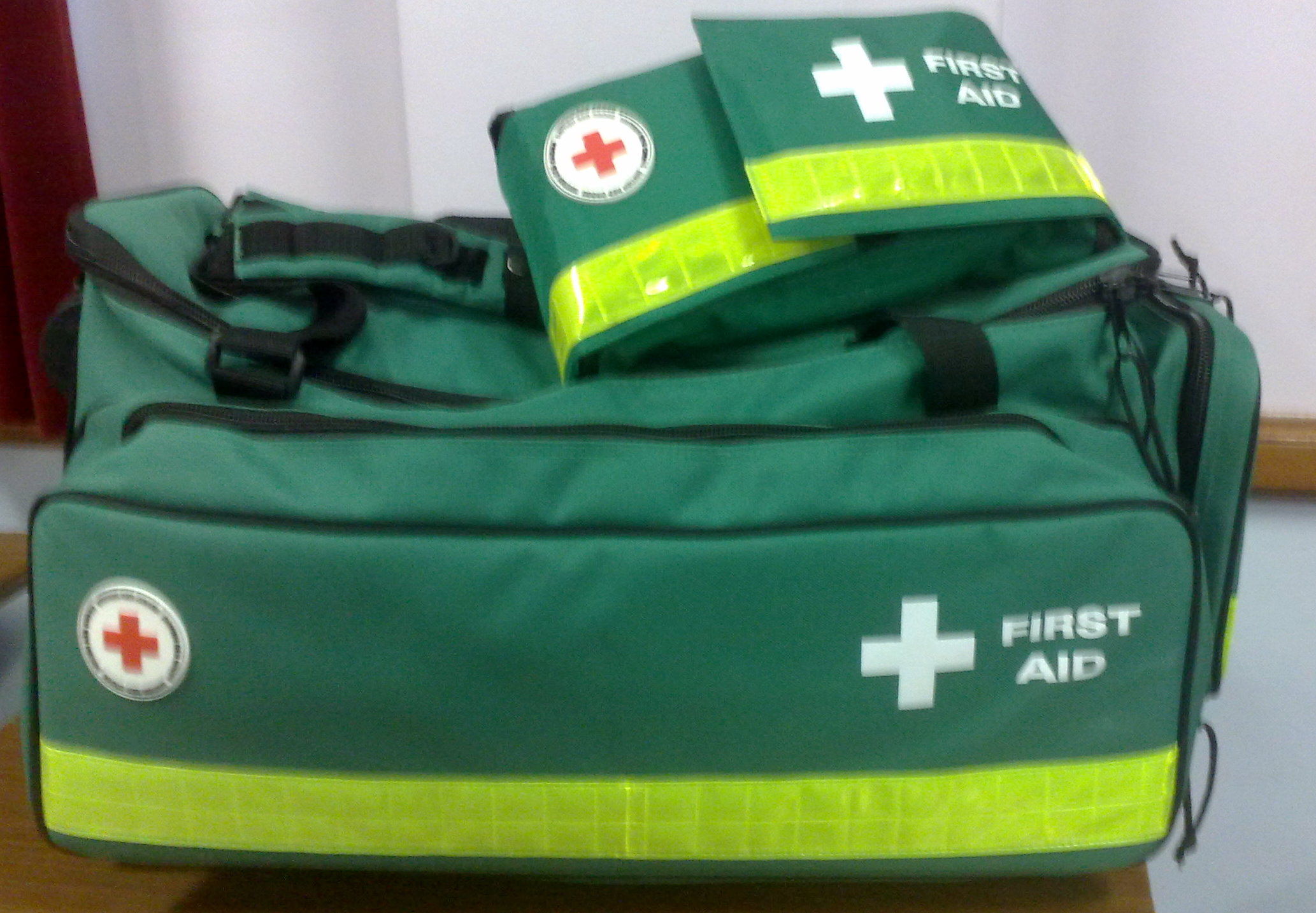
Green first aid kits with cross symbols (Source: Wikipedia (First aid kit))
Practice Questions
- Describe the specifications and uses of four types of knives essential in pig slaughter. (10 marks)
- Explain the role of stunning equipment in pig slaughter and compare two types used in Kenyan abattoirs. (10 marks)
- Identify and describe three pieces of equipment used in bleeding and carcass handling during pig slaughter. (10 marks)
- Discuss the importance of cleaning and sterilization materials during pig slaughter and list five examples with their uses. (10 marks)
The rest of this chapter
🔒Create a free account to open more of this chapter.
Free: practical guides, quick cards, workplace scenarios and more.
Create a free account 🔒6.2 Preparation of Slaughter House/Slab
Preparation of the slaughter house or slab is a critical step in pig slaughtering that ensures hygiene, animal welfare, and compliance with regulatory standards in Kenya. Proper preparation protects meat quality, prevents contamination, and provides a safe wor…
🔒6.3 Pre-slaughter handling of pigs
Pre-slaughter handling of pigs is a critical stage in pig production that directly influences the quality of pork, animal welfare, and operational efficiency in slaughter facilities. In Kenya, where pig farming is expanding rapidly with both commercial and sma…
🔒6.4 Perform humane slaughter of pigs
Humane slaughter of pigs is a critical practice in animal production that ensures animal welfare, meat quality, and compliance with Kenyan regulations such as the Prevention of Cruelty to Animals Act. In Kenya’s livestock sector, ethical treatment during slaug…
🔒6.5 Carcass Dressing
Carcass dressing is a critical phase in the pig slaughter process that involves preparing the carcass for further processing, sale, or consumption. In Kenya, proper dressing techniques ensure that the final product meets hygiene standards, reduces contaminatio…
🔒6.6 Offal Cleaning
In pig slaughter, offal cleaning is a critical step to ensure the hygiene and safety of edible organs and by-products. In Kenya's animal production sector, proper offal handling at the slaughterhouse or farm level safeguards public health and enhances market v…
🔒6.7 Preservation of Dressed Meat
In Kenya's animal production sector, preserving dressed pig meat is essential to maintain quality, ensure food safety, and extend shelf life. Given the tropical climate, meat spoilage can occur rapidly without proper preservation methods, affecting income for…
🔒6.8 Transportation of Dressed Meat
Transporting dressed pig meat from the slaughter facility to retail outlets, markets, or storage premises is a critical stage in the pig production value chain. In Kenya, this process must adhere to stringent hygiene, temperature control, and handling standard…
🔒6.9 Food Safety and Hygiene Measures
In pig slaughter operations across Kenya, adherence to food safety and hygiene measures is critical for protecting public health and ensuring the quality of pork products. Given the risks of contamination and foodborne illnesses, professionals involved in pig…
🔒6.10 Handling of by-products
In pig slaughter operations, the proper handling of by-products is critical for maximizing resource utilization, ensuring hygiene, and complying with Kenyan regulations. By-products such as offal, blood, hair, and bones have commercial value or require careful…
🔒6.11 Disposal of condemned materials and wastes
Condemned materials are carcasses, organs and other parts that the meat inspector has found unfit for human food because of disease, parasites, contamination or abnormality. They must never reach the market and must never be fed to dogs, pigs or other animals.…
🔒6.12 Cleaning of slaughter house and equipment
Cleaning the slaughterhouse and equipment is a critical activity in pig production that ensures hygiene, prevents contamination, and maintains meat quality. In Kenya, where pig farming is growing steadily, proper sanitation in slaughter facilities safeguards p…
🔒6.13 Maintaining slaughter structures
Maintaining slaughter structures is essential to ensure hygiene, safety, and operational efficiency in pig slaughter facilities. In Kenya, where pig farming and slaughtering are common in both rural and peri-urban areas, proper upkeep of slaughterhouses and as…
🔒6.14 Record Keeping
In pig slaughter operations within Kenya's animal production sector, meticulous record keeping is vital for ensuring traceability, compliance with regulatory standards, and efficient management of resources. Accurate records support quality control, help in mo…
Chapter Summary
This chapter covers the essential tools, equipment, and materials required for pig slaughter, emphasizing their specifications and uses. It then details the preparation of the slaughterhouse or slab to ensure a clean and organized workspace. Proper pre-slaughter handling of pigs is discussed to minimize stress and promote humane treatment. The humane slaughter process is explained with attention to animal welfare standards. Following slaughter, the chapter outlines carcass dressing techniques and the cleaning of offal to maintain quality. It addresses the preservation methods for dressed meat and the correct procedures for transporting the meat to prevent contamination. Food safety and hygiene measures are highlighted throughout the slaughter process, alongside the handling of by-products and the disposal of condemned materials such as organs and wastes. Finally, the chapter emphasizes the importance of cleaning the slaughterhouse and equipment, maintaining slaughter structures, and keeping accurate records to ensure efficient and compliant operations.
Self-Assessment
🔒 PDFDownload this self-assessment, with answers
A. Written Assessment
- Identify five essential tools used in pig slaughter and explain their specific functions. (5 marks)
- Describe the key steps involved in preparing a slaughterhouse or slab for pig slaughter. (4 marks)
🔒20 more in this section.
Chapter Examination Questions
🔒 PDFDownload these examination questions, with worked answers
SECTION A (40 Marks) - Answer ALL Questions
- Identify five essential slaughter tools used in pig slaughtering and explain their primary function in a typical Kenyan slaughter slab. (4 marks)
- Describe the key steps involved in preparing a slaughter house or slab before commencing pig slaughter. (4 marks)
🔒18 more in this section.
