
By the end of this chapter, you will be able to:
Mastering these skills will help you support healthy pig breeding and improve productivity, making a real difference in successful pig production.
Compiled by: Joyce Waweru
Pig breeding is a cornerstone of successful pig production enterprises in Kenya, influencing productivity, genetic improvement, and profitability. Effective management of breeding requires the use of specific tools, equipment, and materials to enhance reproductive efficiency and maintain herd health. This chapter focuses on the essential breeding management tools and devices used in Kenyan pig farms, providing professionals with practical knowledge to optimize breeding outcomes. Understanding and applying these tools correctly supports sustainable pig production aligned with national agricultural goals.
Pig breeding management involves a variety of specialized tools and equipment designed to facilitate artificial insemination, heat detection, record keeping, and health monitoring. These tools are critical in modern pig production systems across Kenya, from smallholder farms to commercial units. Proper use and maintenance of these devices improve reproductive performance, reduce labor, and contribute to genetic progress in pig herds.
Identification and accurate record-keeping are fundamental in managing breeding programs to track lineage, reproductive cycles, and individual animal performance. In Kenyan pig farms, several tools are used to ensure each pig is uniquely identifiable and breeding data is systematically recorded.
Artificial insemination is a widely adopted reproductive technology in Kenya’s pig industry, improving genetic diversity and reducing disease transmission risks. The success of AI depends on specialized equipment and materials designed to handle and deliver semen effectively.
| Name | Specification | Use |
|---|---|---|
| AI catheter | Flexible plastic tube, 30-50 cm long | To deposit semen into the sow’s cervix |
| Semen collection bags | Sterile, leak-proof, 500 ml capacity | To collect boar semen hygienically |
| Semen extender | Nutrient solution with antibiotics | To preserve and extend semen viability |
| Thermos flask | Insulated container maintaining 15-20°C | To transport and store semen doses |
| Disposable gloves | Latex or nitrile, powder-free | To maintain hygiene during insemination |
Detecting the optimal time for breeding is vital for reproductive efficiency. Kenyan pig producers use various tools and devices to identify sows in heat and synchronize estrus across groups to streamline breeding schedules.
| Name | Specification | Use |
|---|---|---|
| Heat detection paint | Non-toxic, colored paste or spray | Applied to boar or sow to detect mounting behavior |
| Boar harness with marker | Harness fitted with colored crayons | Marks sows in heat during mating behavior |
| Estrus synchronization drugs | Hormonal injections or oral tablets | To regulate and synchronize the onset of estrus |
| Heat detection charts | Printed calendars with estrus cycle tracking | To record and predict heat periods |
| Infrared thermometers | Handheld, non-contact thermometers | To detect slight body temperature changes indicating heat |
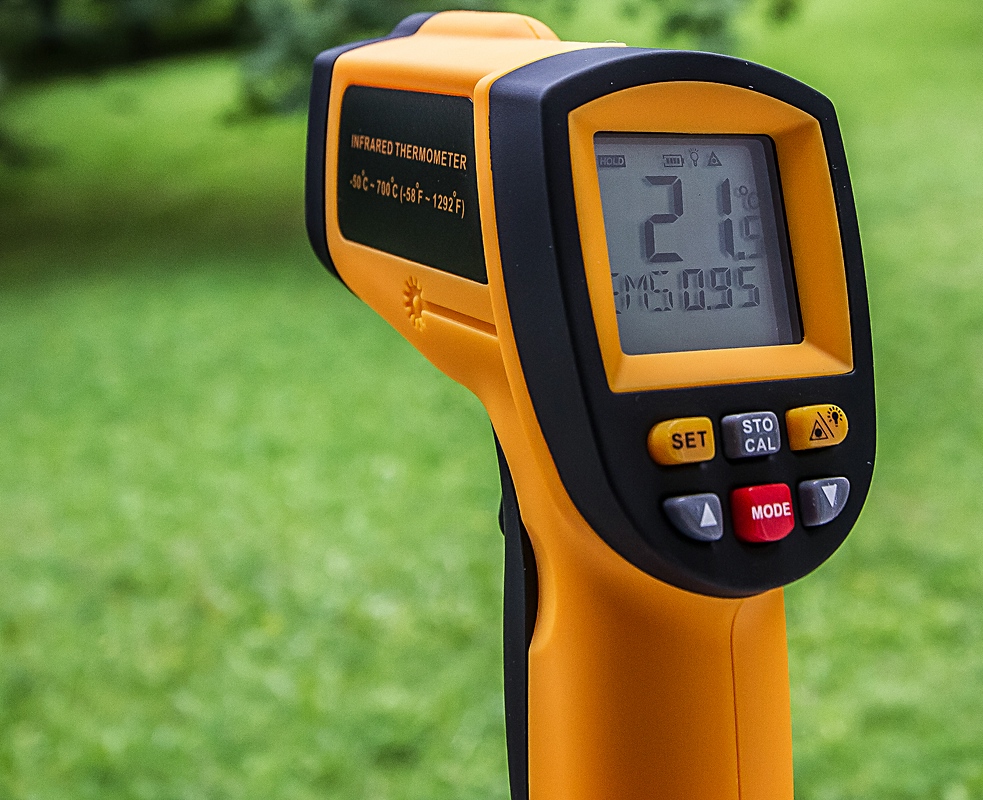
Handheld infrared thermometer measuring temperature (Source: Wikipedia (Infrared thermometer))
Maintaining sow health and a suitable breeding environment is essential to maximize reproductive success. Various materials and devices support hygiene, health assessment, and environmental control in pig breeding units.
| Name | Specification | Use |
|---|---|---|
| Digital weighing scales | Capacity up to 200 kg, accuracy ±0.5 kg | To monitor sow body condition during breeding |
| Thermometers | Mercury or digital, range 35-42°C | To detect fever or illness in breeding stock |
| Disinfectants | Chlorine-based or iodine solutions | For sanitizing breeding pens and equipment |
| Ventilation fans | Electric, adjustable speed | To maintain optimal temperature and air quality |
| Farrowing crates | Steel or wooden, with adjustable bars | To provide safe space for sows during farrowing |
Explain the importance of identification tools in pig breeding management and describe five different types used in Kenyan pig farms. (10 marks)
List and describe the main equipment used in artificial insemination in pig breeding. How does each contribute to successful insemination? (12 marks)
Discuss five methods or devices used for heat detection in sows and explain how they improve breeding efficiency. (10 marks)
Describe the role of health monitoring equipment in pig breeding management and list five essential devices or materials used to maintain a suitable breeding environment. (10 marks)
Create a free account to open more of this chapter.
Free: practical guides, quick cards, workplace scenarios and more.
Create a free accountThis chapter explored the various tools, equipment, and materials essential for effective pig breeding management, highlighting their roles in ensuring successful reproduction. It examined different pig breeds, emphasizing their characteristics and suitability for specific production goals. The practice of flushing was discussed as a nutritional strategy to improve sow fertility. Various breeding methods and technologies were outlined, presenting options that enhance genetic improvement and reproductive efficiency. The chapter addressed the care requirements for pregnant sows, focusing on health and nutrition to support gestation. Steaming up was explained as a preparatory phase before farrowing, aimed at optimizing sow condition and piglet survival. Farrowing management techniques were covered to ensure smooth delivery and minimize losses. Additionally, the importance of maintaining detailed breeding records was emphasized for monitoring performance and making informed decisions. The chapter concluded by examining product pricing, identifying market outlets, and discussing contractual agreements that govern the sale and supply of breeding stock and pork products.
At the start of this chapter we promised you would be able to:
Tick each one you can genuinely do.
So, are you there yet?
You're competent when you can confidently do 50% or more of what this chapter promised.
Sign in to record how you're doing.