
By the end of this chapter, you will be able to:
Mastering these skills will help you understand animal biology and make informed decisions in the real world of animal care and farming.
Compiled by: Faith Adhiambo
Classification of farm animals is fundamental for animal production professionals in Kenya, enabling effective management, breeding, nutrition, and disease control. Understanding taxonomic principles helps differentiate animals based on shared characteristics, evolutionary relationships, and biological traits. This chapter focuses on the classification of mammals commonly found on farms, providing a scientific framework that supports practical decision-making in livestock enterprises across diverse Kenyan agro-ecological zones.
Taxonomy is the science of naming, describing, and classifying organisms into hierarchical groups based on shared traits and genetic relationships. For animal production professionals, taxonomic classification aids in identifying species, understanding their physiology and behaviour, and optimising their use in farming systems. In Kenya, where livestock diversity includes cattle, goats, sheep, camels, donkeys, rabbits and pigs, taxonomic knowledge guides appropriate husbandry practices tailored to each animal group.
Cattle are the main source of milk and beef in many Kenyan farming systems, so correct identification of the type of cattle in a herd guides breeding and feeding decisions. They belong to Kingdom Animalia, Phylum Chordata, Class Mammalia, Order Artiodactyla, Family Bovidae and Genus Bos. The two species kept on farms are Bos taurus (taurine, humpless, such as Friesian and Ayrshire dairy breeds) and Bos indicus (zebu, humped, such as the Boran and Small East African Zebu).
Zebu cattle are well adapted to hot lowlands and tolerate heat, ticks and poor pasture better, while taurine breeds give higher milk yields in cooler highlands. Because both belong to the same genus, they can be crossed to produce animals combining hardiness and productivity. Cattle are ruminants with a four-compartment stomach (rumen, reticulum, omasum and abomasum) for digesting fibrous plant material.
Rabbits are small farm mammals kept for meat and fur on small plots, for example in a backyard hutch unit. They are not rodents: they belong to Order Lagomorpha, Family Leporidae, and the domestic rabbit is Oryctolagus cuniculus. Lagomorphs differ from rodents in having a second, small pair of peg-like incisors behind the upper front incisors.
Rabbits are non-ruminant herbivores that ferment fibre in the caecum, and they re-ingest soft droppings (caecotrophs) to recover nutrients. This digestive design means they need a high-fibre diet of good hay and fresh forage, which differs from the feeding of ruminants. Their short gestation and large litters make them a quick-turnover species.
Sheep are kept for meat, wool or hair, and skins, especially in drier grazing areas. They belong to Order Artiodactyla, Family Bovidae, Subfamily Caprinae, Genus Ovis, and the domestic species is Ovis aries. Like cattle, they are ruminants with a four-compartment stomach.
Sheep are mainly grazers that crop short grass close to the ground with a split upper lip, so they need pasture management that avoids overgrazing and heavy worm burdens. Hair sheep and wool sheep are breeds within the same species, not different species, and they interbreed freely.
Goats are kept for milk, meat and skins, and they cope well on poor, bushy rangeland. They belong to Order Artiodactyla, Family Bovidae, Subfamily Caprinae, Genus Capra, and the domestic species is Capra hircus. Examples of breeds are the Galla, Small East African goat and the dairy breed Toggenburg.
Goats are ruminants that behave mainly as browsers, preferring leaves, twigs and shrubs to short grass, so their feeding and fencing needs differ from those of sheep. Although sheep and goats look alike and belong to the same family and subfamily, they are in different genera and do not normally produce viable offspring together, which shows why genus and species matter in breeding programmes.
Donkeys are used mainly for transport and draft power, for example carrying water, feed and produce on farms with poor roads. They belong to Order Perissodactyla (odd-toed ungulates), Family Equidae and Genus Equus, with the domestic species written as Equus africanus asinus. They bear weight on a single dominant toe protected by a hoof.
Donkeys are non-ruminant herbivores that ferment fibre in the large intestine (hindgut fermenters), so they cope with coarse, low-quality roughage but are sensitive to rich feed and sudden diet changes. A donkey crossed with a horse gives a mule, which is normally sterile, a clear example of why species boundaries matter in breeding.
Camels are the key livestock of arid and semi-arid northern Kenya, valued for milk, meat and transport. The one-humped camel is Camelus dromedarius, in Order Artiodactyla, Family Camelidae and Genus Camelus. Camelids are even-toed but walk on broad padded feet suited to sand and dry ground.
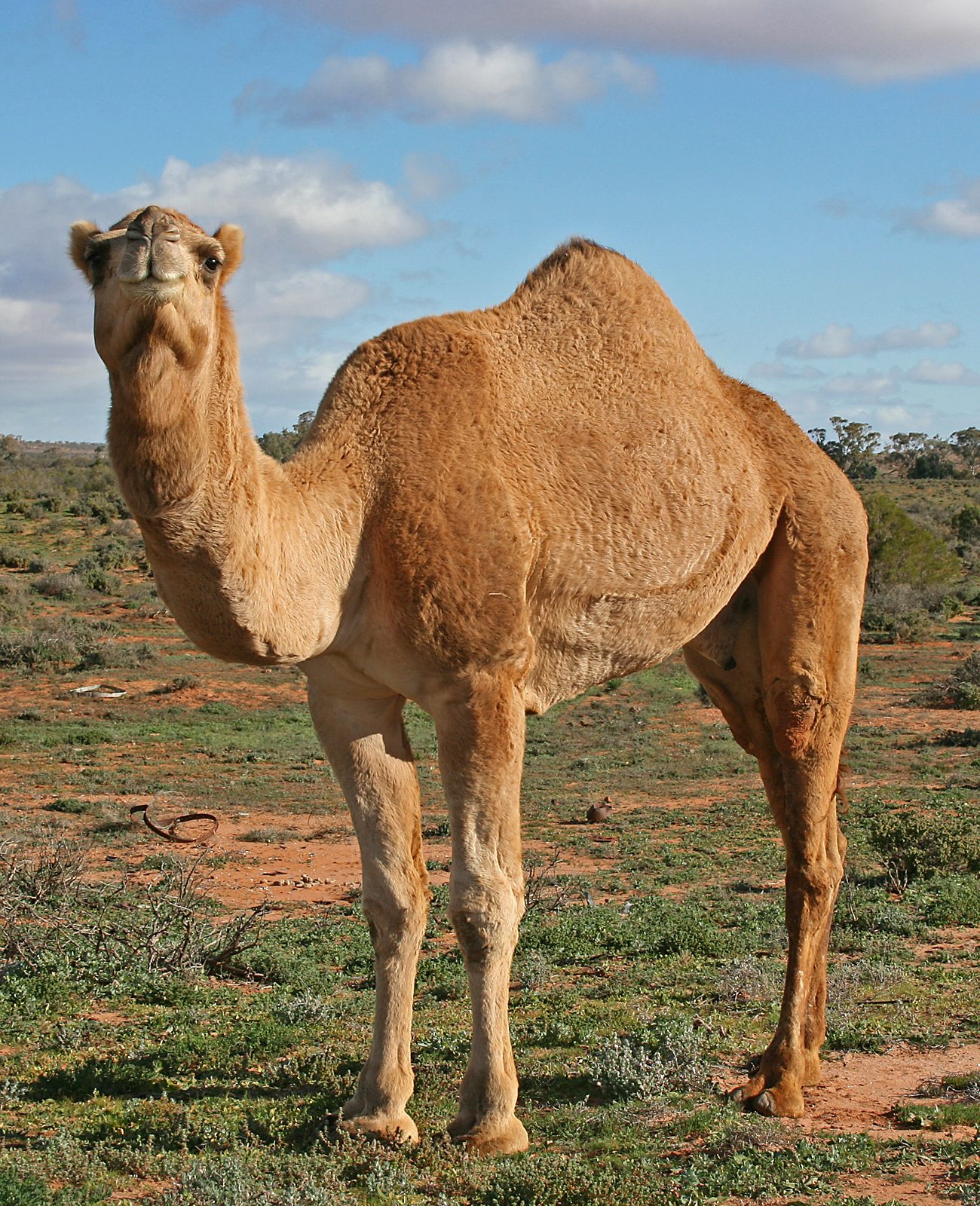
Dromedary camel, member of family Camelidae (Source: Wikimedia Commons (Camelidae))
Camels chew the cud and have a three-compartment stomach, so they are classed as pseudo-ruminants rather than true ruminants like cattle. They tolerate heat and water shortage and browse thorny shrubs, which is why they thrive where cattle struggle.
Horses are kept for riding, racing, draft work and recreation, for example on stud and riding farms. They belong to Order Perissodactyla, Family Equidae and Genus Equus, and the domestic horse is written as Equus ferus caballus. Each foot carries one functional toe ending in a hoof.
Horses are hindgut fermenters with a simple stomach, a small stomach capacity and a large caecum and colon. They therefore need small, frequent meals of good forage, and feeding large amounts of concentrate at once increases the risk of colic. Horses and donkeys share a genus but are separate species.
The taxonomic system organises living organisms into ranks from broad to specific, reflecting evolutionary relationships. This allows animal producers and scientists to categorise mammals systematically and communicate clearly.
Farm mammals share biological features that separate them from other classes of animals, and these features influence feeding, housing and health care.
Farm mammals belong to a few orders that share anatomical and physiological features influencing their production roles.
Pigs are raised for pork and bacon in many Kenyan farms, although they are not listed among the points above. They belong to Order Artiodactyla, Family Suidae, and the domestic pig is Sus scrofa domesticus. Unlike cattle, sheep and goats, pigs are omnivores with a simple stomach, so they are fed balanced rations of energy and protein rather than mainly roughage.
Create a free account to open more of this chapter.
Free: practical guides, quick cards, workplace scenarios and more.
Create a free accountThis chapter explored the classification of farm animals across various biological classes using taxonomic principles. It began with mammals, highlighting their distinctive characteristics and how they are grouped based on shared anatomical and physiological traits. The classification of aves followed, focusing on birds commonly found on farms and the features that define their taxonomy. Next, the chapter addressed pisces, detailing the classification of fish species relevant to aquaculture and their taxonomic distinctions. Reptiles were then examined, emphasizing their classification criteria and the species that may be encountered in farm environments. The discussion continued with amphibians, outlining their taxonomic placement and the characteristics that separate them from other classes. Finally, the chapter covered arthropods, describing their classification and the significance of various species within farming systems. Together, these sections provided a comprehensive framework for understanding the diversity and organization of farm animals through scientific classification.
At the start of this chapter we promised you would be able to:
Tick each one you can genuinely do.
So, are you there yet?
You're competent when you can confidently do 50% or more of what this chapter promised.
Sign in to record how you're doing.