Livestock feed production is a critical component of Kenya's agricultural sector, ensuring sustainable animal nutrition and productivity. Forage production, which involves growing and harvesting plant materials suitable for animal consumption, depends heavily on the appropriate use of tools and equipment. Effective forage production tools not only improve efficiency but also enhance the quality of feed, which directly impacts the health and yield of livestock. In various Kenyan settings, from large-scale farms to county government agricultural programs, selecting and maintaining the right equipment is vital for successful forage production.
1.1 Forage production tools and forage equipment
1.1.1 Grass cutters
Grass cutters are essential for harvesting forage crops efficiently, especially in small to medium-sized farms where manual cutting would be laborious and time-consuming.
| Name |
Specification |
Use |
| Grass Cutter |
Petrol or electric engine, blade diameter 20-30 cm |
Cutting grass and forage plants |
- Grass cutters are powered by either petrol or electricity. Petrol grass cutters are popular in rural areas with limited electricity access, such as farms in Nakuru County.
- The blade diameter affects cutting width and efficiency; larger blades cover wider areas but require more power.
- Operators must ensure blades are sharp to achieve clean cuts, which promote regrowth of forage plants.
- Regular cleaning of the cutter prevents clogging with plant residues, preserving engine performance.
- Safety gear such as gloves and eye protection is necessary during operation to prevent injuries from flying debris.
1.1.2 Generator
Generators provide portable electrical power necessary for running equipment like electric grass cutters, water pumps, and sprinklers, especially in remote or off-grid forage production sites.
| Name |
Specification |
Use |
| Generator |
Capacity 5-10 kVA, fuel type petrol/diesel |
Supplying electricity for farm equipment |
- Generators enable continuous operation of electric tools during forage production when the main power grid is unavailable.
- Capacity selection depends on the total wattage of connected equipment; for instance, a 7 kVA generator can power a water pump and electric grass cutter simultaneously.
- Fuel availability influences generator choice; diesel generators are more fuel-efficient but petrol generators are easier to maintain.
- Regular oil changes and air filter cleaning extend generator lifespan.
- Noise reduction measures, such as placing the generator in a soundproof enclosure, improve working conditions, especially near residential areas.
1.1.3 Water pump with hose
Water pumps are crucial for irrigation in forage production, ensuring consistent water supply to crops during dry seasons, thereby maintaining forage quality and yield.
| Name |
Specification |
Use |
| Water Pump |
Capacity 1-3 HP, electric or petrol |
Irrigation of forage crops |
- Pumps facilitate drawing water from boreholes, rivers, or storage tanks to the fields.
- Hose length and diameter must be adequate to reach all parts of the forage plot without significant pressure loss.
- Electric pumps are preferred near power sources, such as university farms in Eldoret, while petrol pumps serve remote farms without electricity.
- After use, hoses should be drained and stored properly to prevent damage from sunlight and rodents.
- Routine inspection of pump seals and impellers prevents leaks and maintains optimal water flow.
1.1.4 Tractors (optional)
Tractors are powerful machines used to mechanize various forage production activities, including land preparation, planting, and hauling harvested forage.
| Name |
Specification |
Use |
| Tractor |
50-100 HP, diesel engine |
Land preparation, towing implements |
- Tractors increase productivity by reducing manual labor in large forage farms, such as those operated by cooperative societies in Meru County.
- Implements like ploughs, harrows, and planters can be attached to tractors to perform multiple tasks.
- Diesel engines provide the torque needed for heavy-duty fieldwork and are fuel-efficient over long hours.
- Operators require training to handle tractors safely and efficiently.
- Regular maintenance includes checking engine oil, fuel filters, and hydraulic systems to avoid breakdowns.
1.1.5 Plough and harrow
Ploughs and harrows are primary tillage tools used to prepare the soil for planting forage crops by breaking, turning, and smoothing the soil surface.
| Name |
Specification |
Use |
| Plough |
Mouldboard type, size varies |
Breaking and turning the soil |
| Harrow |
Disc or tine type, size varies |
Smoothing and leveling the soil |
- Ploughing loosens compacted soil layers, improving aeration and root penetration, which enhances forage growth.
- Harrowing follows ploughing to break clods and level the soil surface, creating an ideal seedbed.
- Manual ploughs are used in small-scale farms, while tractor-mounted ploughs serve larger areas.
- Proper depth control during ploughing prevents damaging soil structure.
- Harrows also help incorporate organic matter and fertilizers into the soil, supporting nutrient availability.
1.1.6 Shovel
Shovels are versatile hand tools used for digging, moving soil or manure, and clearing debris during forage production.
| Name |
Specification |
Use |
| Shovel |
Steel blade, wooden or metal handle |
Digging, soil moving, clearing |
- Shovels assist in small-scale land preparation, such as creating planting holes or trenches for irrigation.
- They are useful for mixing fertilizers or manure into the soil around forage crops.
- Lightweight shovels reduce operator fatigue during extended use.
- Maintaining a sharp blade edge improves digging efficiency.
- After use, shovels should be cleaned and stored in dry places to prevent rust.
1.1.7 Hoe
Hoes are essential for manual weed control and soil aeration in forage plots, especially in smallholder farms.
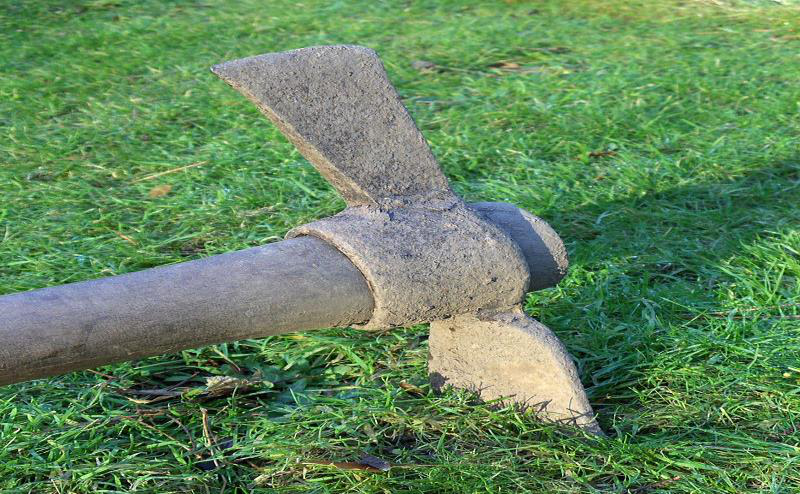
A traditional hoe (Source: site_preliminary (1))
| Name |
Specification |
Use |
| Hoe |
Flat or pointed steel blade, wooden handle |
Weeding, soil loosening, aeration |
- Regular hoeing prevents weed competition, which can reduce forage yield by depriving plants of nutrients and water.
- Hoes are also used to break soil crusts, facilitating water infiltration and root growth.
- Different hoe types (jembe, stirrup) suit various soil types and tasks.
- Proper technique minimizes soil disturbance to avoid harming forage roots.
- Hoes require occasional sharpening and handle replacement for effective use.
1.1.8 Water sprinklers
Water sprinklers distribute water evenly over forage fields, simulating rainfall and supporting crop hydration.
| Name |
Specification |
Use |
| Sprinkler |
Adjustable spray radius, pressure 1-3 bar |
Irrigation of forage crops |
- Sprinklers enable efficient water use by targeting forage areas, reducing wastage compared to flood irrigation.
- They are suitable for farms with irregular terrain where uniform water distribution is challenging.
- Systems can be portable or fixed, depending on farm size and irrigation needs.
- Maintenance includes checking nozzles for clogs and repairing leaks promptly.
- Sprinkler irrigation supports forage quality by preventing water stress during dry spells.
1.1.9 Planter
Planters ensure accurate and uniform sowing of forage seeds, enhancing germination rates and stand establishment.
| Name |
Specification |
Use |
| Planter |
Seed hopper capacity 10-20 kg, row spacing adjustable |
Sowing forage seeds uniformly |
- Mechanical planters reduce seed wastage by controlling seed depth and spacing.
- Uniform planting improves forage density and reduces competition among plants.
- In smallholder settings, hand seeders or dibblers may be used where mechanical planters are unaffordable.
- Calibration of planters before use ensures correct seed rate.
- Cleaning and oiling moving parts prevent rust and ensure smooth operation.
1.1.10 Wheelbarrow
Wheelbarrows facilitate the transport of forage, soil, fertilizers, and tools within the farm, improving operational efficiency.
| Name |
Specification |
Use |
| Wheelbarrow |
Single wheel, 70-100 kg load capacity |
Transporting materials on farm |
- Wheelbarrows reduce the physical strain of carrying heavy loads manually.
- They are especially useful in uneven or muddy terrain where vehicles cannot access.
- Proper loading balances weight over the wheel to maintain stability.
- Tires should be checked regularly for air pressure and wear.
- Storage in covered areas prevents rust and extends lifespan.
1.1.11 Hole digger
Hole diggers are used to create planting holes for forage seeds or seedlings, especially for deep-rooted forage species.
| Name |
Specification |
Use |
| Hole Digger |
Manual or powered, auger diameter 10-20 cm |
Digging planting holes |
- Manual hole diggers are suitable for small-scale forage planting.
- Powered augers increase speed and reduce labor in larger operations.
- Correct hole depth and diameter ensure proper seedling establishment.
- After use, blades should be cleaned to prevent soil buildup and rust.
- Operators must wear protective gloves to avoid injuries.
1.1.12 Fencing materials
Fencing protects forage fields from grazing animals and unauthorized access, safeguarding crop investment.
| Name |
Specification |
Use |
| Fencing Wire |
Galvanized steel, 12.5 gauge |
Creating perimeter barriers |
| Wooden Posts |
Hardwoods, 1.5-2 m length |
Supporting fencing wire |
| Staples |
Steel, rust-resistant |
Fixing wire to posts |
| Gates |
Steel or wood, lockable |
Controlled access points |
- Proper fencing prevents damage from free-ranging livestock, common in community farms around Kisumu County.
- Durable materials reduce maintenance costs and extend fence life.
- Posts must be securely embedded in the ground at regular intervals for stability.
- Gates facilitate easy entry and exit while maintaining security.
- Regular inspection and repair prevent breaches and protect forage crops.
Practice Questions
- Explain five important maintenance practices for grass cutters used in forage production. (10 marks)
- Discuss the factors to consider when selecting a generator for use in forage production in a county government farm. (10 marks)
- Outline six steps involved in preparing soil using a plough and harrow for forage planting. (12 marks)
- Describe the role of fencing materials in forage production and list four types of fencing components with their uses. (12 marks)
The rest of this chapter
🔒Create a free account to open more of this chapter.
Free: practical guides, quick cards, workplace scenarios and more.
Create a free account 🔒1.2 Propagation materials
Propagation materials are the foundation of successful forage production for livestock feed. In Kenya, the choice and quality of propagation materials directly influence the establishment rate, growth performance, and yield of forage crops. Various propagation…
🔒1.3 Land Preparation
Land preparation is a fundamental step in producing high-quality livestock forage, as it sets the foundation for healthy plant growth and optimal yield. In Kenya, where smallholder farmers and cooperative groups often engage in forage production, proper land p…
🔒1.4 Establishing Propagation Materials
Establishing propagation materials is the process of placing seeds or seedlings into the prepared land to grow forage crops. The method chosen impacts germination rates, plant vigor, and final yield. In Kenya’s diverse agro-ecological zones, farmers and agricu…
🔒1.5 Forage Management
Forage management is a critical aspect of livestock feeds production, involving the cultivation, maintenance and utilization of plant materials that provide nutrition to animals. In Kenya, effective forage management supports sustainable livestock farming by e…
🔒1.6 Harvesting of Forage
Harvesting forage at the right time and using appropriate methods is essential to preserve nutritional quality and maximize feed value. In Kenya, harvesting practices vary depending on the type of forage, climatic conditions, and available technology. For exam…
Chapter Summary
This chapter covered the essential tools and equipment required for effective forage production, including grass cutters, water pumps, and planting implements. It also examined various propagation materials such as seeds, seedlings, cuttings, splits, and tubers that serve as the foundation for establishing healthy forage crops. The importance of thorough land preparation was highlighted, focusing on good agricultural practices like liming and mulching to enhance soil fertility and moisture retention. Different methods for establishing propagation materials were discussed, including direct sowing, broadcasting, and transplanting, each suited to specific forage types and conditions. Forage management strategies were explored with attention to maintaining pastures and cultivating fodder crops to ensure sustainable feed supply. Finally, the chapter addressed the harvesting of forage, emphasizing techniques that preserve feed quality for livestock nutrition. Together, these topics provide a comprehensive guide to producing quality livestock forage efficiently.
Self-Assessment
🔒 PDFDownload this self-assessment, with answers
A. Written Assessment
- Which tool is primarily used to cut grass efficiently in forage production? (2 marks)
- Explain the role of liming in land preparation for forage production. (3 marks)
🔒20 more in this section.
Chapter Examination Questions
🔒 PDFDownload these examination questions, with worked answers
SECTION A (40 Marks) - Answer ALL Questions
- Describe the role of a grass cutter in forage production and explain its importance in a dairy farm setting in Nakuru County. (4 marks)
- Explain how a water pump with hose can improve forage crop yield in a small-scale farm at a county government agricultural demonstration centre. (4 marks)
🔒18 more in this section.
