Pig breeding is a cornerstone of successful pig production enterprises in Kenya, influencing productivity, genetic improvement, and profitability. Effective management of breeding requires the use of specific tools, equipment, and materials to enhance reproductive efficiency and maintain herd health. This chapter focuses on the essential breeding management tools and devices used in Kenyan pig farms, providing professionals with practical knowledge to optimize breeding outcomes. Understanding and applying these tools correctly supports sustainable pig production aligned with national agricultural goals.
3.1 Pig breeding management tools, equipment and materials
Breeding management needs tools to find sows that are ready to be mated, equipment to inseminate them, items to identify the animals and record what happens, and materials to keep the breeding area clean and the animals healthy. The right items increase the number of sows that conceive, reduce disease spread at mating and give the farmer records on which to select breeding stock. This topic covers the heat detection devices and insemination guns named in the curriculum, together with the identification, record-keeping, health and hygiene items used in a breeding unit. The signs of heat are covered in Heat signs in does and the methods of breeding in Breeding methods and technologies.
Heat detection devices
A heat detection device helps the attendant to tell which sows are in heat, so that they are mated or inseminated at the right time. Sows show heat clearly when a boar is near, so boar contact is used together with the other methods below.
- Teaser boar and boar pen: A mature boar walked past the sows or kept in a pen next to them stimulates them to show the standing reflex. The pen needs a strong, smooth-sided passage and a gate that the boar cannot lift.
- Boar odour spray: A spray with synthetic boar scent is used where no boar is available. The attendant sprays it near the sow's nose and presses on her back.
- Paint stick or marking crayon: Used to mark each sow that has been tested or found in heat, so that she is not tested twice and can be found again for service. Sows are checked twice a day.
- Back pressure: The attendant sits or leans on the sow's back. A sow that stands still, with ears erect, is in standing heat.
- Heat detection chart: A printed chart or calendar on which the heat dates of each sow are written, so that the next expected heat can be predicted and the sow checked at the right time.
Insemination guns
An insemination gun is the instrument that places semen in the sow's reproductive tract. The pig does not have a straight-barrelled gun like cattle. The instrument is a catheter, also called an insemination rod, which is a flexible tube attached to a semen bottle, tube or bag.
- Spiral-tipped catheter: Has a spiral end that is turned into the folds of the cervix, where it locks and stops semen flowing back. It is usually used for sows that have farrowed.
- Foam-tipped catheter: Has a soft foam tip that fits the cervix and is often used for gilts, which have a narrower tract.
- Post-cervical catheter: Has an inner tube that passes through the cervix, so that semen is placed further into the womb in a smaller volume.
- Semen container: Holds one dose of semen, usually 80 to 100 millilitres, as a bottle, a flexible tube or a bag, and connects to the catheter.
- Hygiene: Use a new, individually wrapped catheter for each sow. It is not cleaned and used again. The inseminator wears clean disposable gloves, cleans the sow's vulva before inserting the catheter and uses a lubricant that does not harm sperm.

Hand wearing a clear disposable glove (Source: Wikimedia Commons)
Related materials include a semen extender and a thermos flask or semen storage box, which keeps semen at about 15 to 18 degrees Celsius until use, and a collection bag with a filter used when the farm collects semen from its own boars.
Identification and record-keeping tools
Records of each animal tie breeding data to the right pig.
- Ear tags: Plastic or metal tags carrying a unique number let each pig be recognised quickly.
- Ear notching and tattooing: Permanent marks used in pedigree herds to identify animals for life.
- Electronic identification: Microchips or electronic tags read by a scanner, used on larger commercial units.
- Paint or marker sticks: Temporary marks to separate groups or mark a sow in heat.
- Breeding register and cards: Books and pen or sow cards that record heat dates, mating dates, boars used, expected farrowing dates, litter size and piglet weights.
- Digital records: Spreadsheets and herd management applications that store and analyse the same information.
Health monitoring and breeding environment equipment
- Weighing scale: A platform scale that checks the body weight of a gilt before first mating and the body condition of sows.
- Thermometer: A digital rectal thermometer gives a reliable reading of fever. A non-contact infrared thermometer measures skin temperature quickly, but it is not as accurate as a rectal reading.
- Disinfectants and cleaning tools: Brushes, scrapers, a sprayer and a disinfectant for pens and equipment, used between services.
- Ventilation and cooling equipment: Fans, sprinklers and shade help to reduce heat stress, which lowers fertility in both boars and sows.
- Farrowing crates: Steel or timber crates that protect piglets from being crushed during and after farrowing.
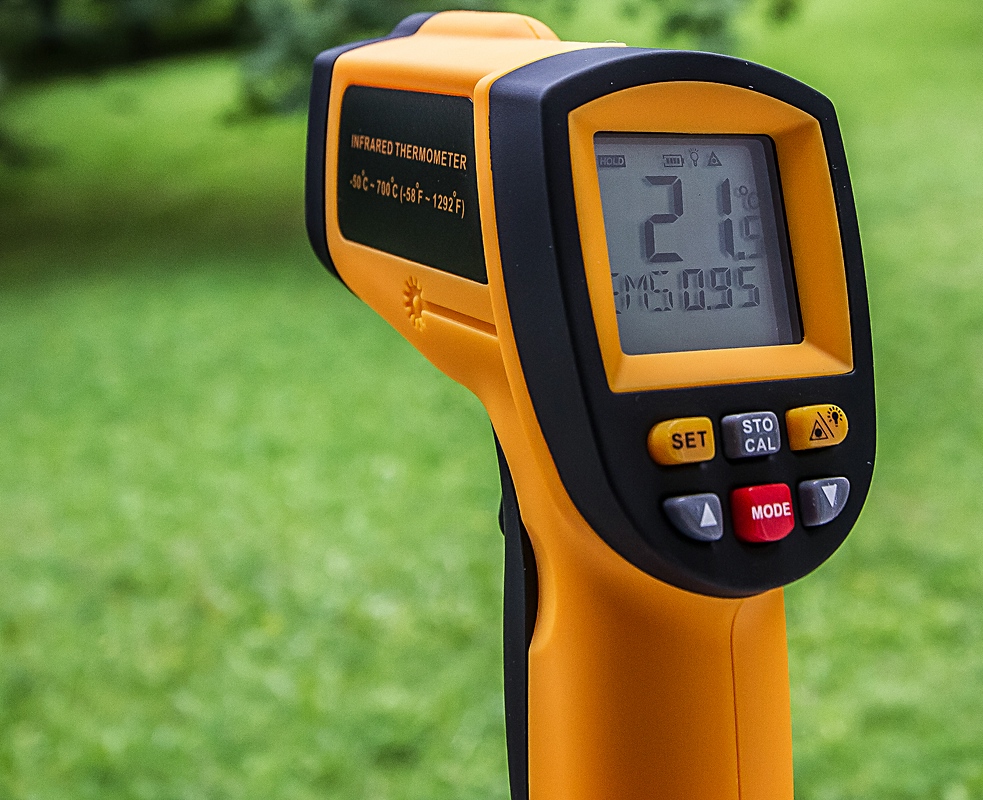
Handheld infrared thermometer measuring temperature (Source: Wikipedia (Infrared thermometer))
Equipment is stored clean and dry and checked before each breeding season. Single-use items such as catheters and gloves are discarded after use.
Practice Questions
-
Explain the importance of identification tools in pig breeding management and describe five different types used in Kenyan pig farms. (10 marks)
-
List and describe the main equipment used in artificial insemination in pig breeding. How does each contribute to successful insemination? (12 marks)
-
Discuss five methods or devices used for heat detection in sows and explain how they improve breeding efficiency. (10 marks)
-
Describe the role of health monitoring equipment in pig breeding management and list five essential devices or materials used to maintain a suitable breeding environment. (10 marks)
The rest of this chapter
🔒Create a free account to open more of this chapter.
Free: practical guides, quick cards, workplace scenarios and more.
Create a free account 🔒3.2 Pig breeds
A breed is a group of pigs that share a common origin and recognisable features, such as body colour, ear shape, body length and production traits, which they pass to their offspring. Breeds differ in growth rate, litter size, mothering ability, carcass qualit…
🔒3.3 Selection of pig breeds
Selection of pig breeds is the choice of the breed, or combination of breeds, a farm will keep, followed by the choice of the individual gilts, sows and boars that will breed. A wrong choice is costly: a breed that cannot cope with the farm's climate, feed or…
🔒3.4 Heat signs in does
Heat, also called oestrus, is the short period in the reproductive cycle when a female pig will accept the boar and can become pregnant. A sow is a female that has farrowed and a gilt is a young female that has not yet farrowed. Both show recognisable signs wh…
🔒3.5 Flushing
Flushing is a critical management practice in pig breeding that involves increasing the nutritional intake of sows prior to and during the early stages of the breeding cycle. This practice aims to improve the sow's reproductive performance by enhancing ovulati…
🔒3.6 Breeding methods and technologies
A breeding method is the way in which sows are mated and the way in which parents are chosen, and breeding technologies are the tools that make a method more efficient. The method chosen decides how fast the herd improves, how much it costs to keep boars and h…
🔒3.7 Provision of Care to Pregnant Does
In pig production, the care of pregnant does is critical to ensure high reproductive success, healthy litters, and efficient farm productivity. In Kenya, where pig farming is increasingly becoming a vital source of income for smallholder farmers and commercial…
🔒3.8 Steaming up
In pig production, steaming up refers to the management practice of preparing sows for farrowing by adjusting their nutrition and environment during the final stages of pregnancy. In Kenya’s diverse pig farming systems, steaming up plays a critical role in ens…
🔒3.9 Farrowing management
Farrowing management is a critical phase in pig production that directly influences piglet survival, sow health, and overall productivity. In Kenya, where pig farming is increasingly important for smallholder incomes and commercial enterprises, effective farro…
🔒3.10 Breeding Records
Effective management of breeding records is a critical aspect of pig production in Kenya, where farmers and commercial producers strive to improve genetic quality, reproductive performance, and overall productivity. Keeping accurate and detailed breeding recor…
Chapter Summary
This chapter explored the various tools, equipment, and materials essential for effective pig breeding management, highlighting their roles in ensuring successful reproduction. It examined different pig breeds, emphasizing their characteristics and suitability for specific production goals. The practice of flushing was discussed as a nutritional strategy to improve sow fertility. Various breeding methods and technologies were outlined, presenting options that enhance genetic improvement and reproductive efficiency. The chapter addressed the care requirements for pregnant sows, focusing on health and nutrition to support gestation. Steaming up was explained as a preparatory phase before farrowing, aimed at optimizing sow condition and piglet survival. Farrowing management techniques were covered to ensure smooth delivery and minimize losses. Additionally, the importance of maintaining detailed breeding records was emphasized for monitoring performance and making informed decisions. The chapter concluded by examining product pricing, identifying market outlets, and discussing contractual agreements that govern the sale and supply of breeding stock and pork products.
Self-Assessment
🔒 PDFDownload this self-assessment, with answers
A. Written Assessment
- Identify five essential tools and equipment used in pig breeding management and explain their purpose. (10 marks)
- Differentiate between three common pig breeds in Kenya and describe their suitability for various production systems. (8 marks)
🔒20 more in this section.
Chapter Examination Questions
🔒 PDFDownload these examination questions, with worked answers
SECTION A (40 Marks) - Answer ALL Questions
- Explain the role of breeding records in improving pig production performance at a smallholder pig farm. (4 marks)
- Identify five commonly used tools and equipment for pig breeding management and describe their functions. (4 marks)
🔒21 more in this section.
