
By the end of this chapter, you will be able to:
Mastering these skills will help you build strong, safe goat structures that support healthy and productive animals in your care.
Compiled by: James Ogutu
Constructing appropriate goat structures is fundamental to successful goat production in Kenya’s diverse agricultural settings. Proper housing ensures the health, safety and productivity of goats by providing shelter from harsh weather, predators and disease vectors. Across various sectors, from smallholder farms in Nakuru to cooperative farms in Meru, well-designed goat structures contribute to sustainable livelihoods and food security. This chapter covers the essential tools, equipment and materials required for building effective goat housing, emphasizing practical applications that suit Kenyan conditions.
A goat house is only as sound as the tools, equipment and materials used to build it. Tools are the hand-operated implements that cut, measure, fix and finish. Equipment is the heavier or powered plant that clears the site, mixes concrete and moves loads. Materials are what the structure is made of. A builder who selects all three before starting avoids delays, waste and weak work. The choice is also guided by cost, by what can be found locally and by the needs of the goats: a dry floor, good ventilation, strong walls that goats cannot break and surfaces that are easy to clean.
Tools are held and used by hand. The table gives the common tools for building a goat house and what each is used for.
| Name | Specification | Use |
|---|---|---|
| Hammer | Claw hammer with a firm handle | Driving and pulling out nails |
| Screwdrivers | Flat-head and cross-head, several sizes | Fixing and removing screws |
| Tape measures | Steel tape, metric scale, 5 m or longer | Measuring lengths and checking diagonals |
| Level | Spirit level with a straight edge | Checking that surfaces are level and upright |
| Saw | Hand saw with a sharp, set blade | Cutting timber to length |
| Drill | Hand or cordless drill with wood and masonry bits | Making holes for bolts, screws and wire |
| Pliers | Combination pliers with a cutting edge | Gripping, twisting and cutting wire |
| Chisel | Wood chisel with a sharp bevelled edge | Cutting joints and housings in timber |
The hammer is used to drive nails when framing the walls, fixing roof timbers and building feeding troughs. The claw on the back pulls out bent nails. Hold the handle near the end for a strong, controlled swing and keep the face of the hammer clean so that it does not glance off the nail.
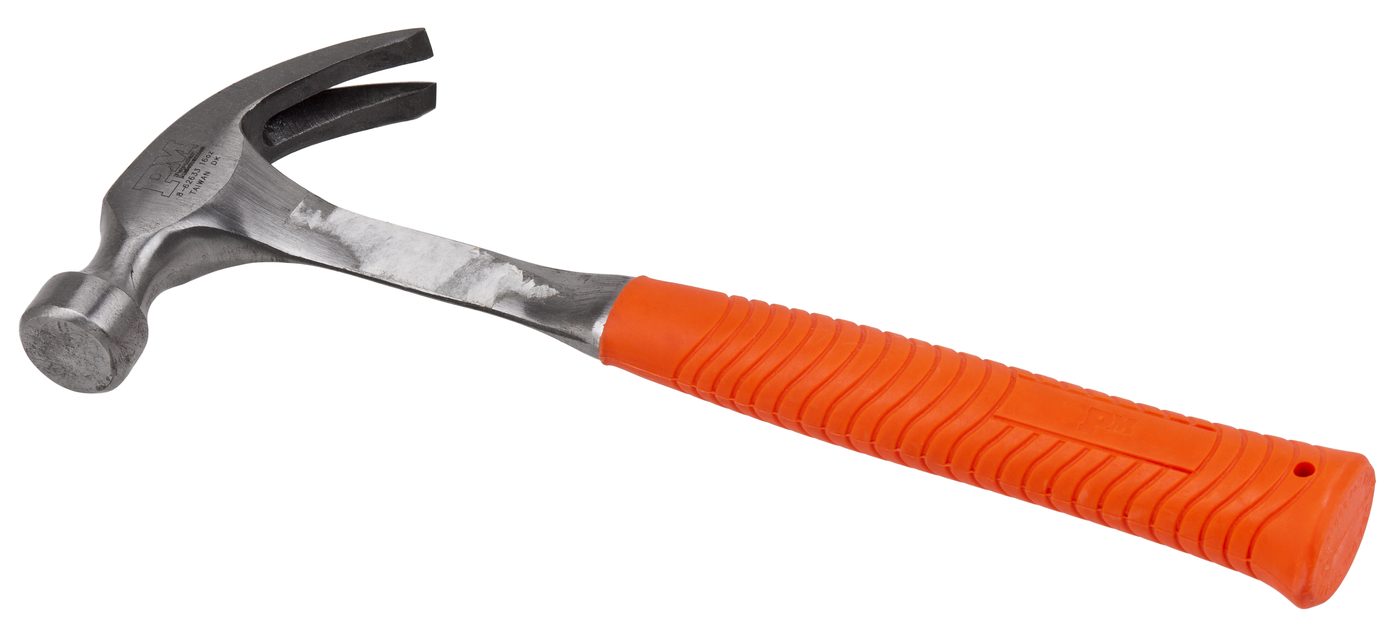
Claw hammer with orange handle (Source: Wikimedia Commons)
Screwdrivers fix hinges, latches, door hasps and roofing screws. The blade must fit the screw head exactly, a flat blade for a slotted screw and a cross-head blade for a cross-head screw, or the head is damaged and the screw cannot be removed later.
A tape measure sets out the length and width of pens, the spacing of posts and the height of walls. It also checks that the corners are square: a triangle with sides of 3 m, 4 m and 5 m has a right angle between the two shorter sides. Pull the tape straight and read it at eye level.
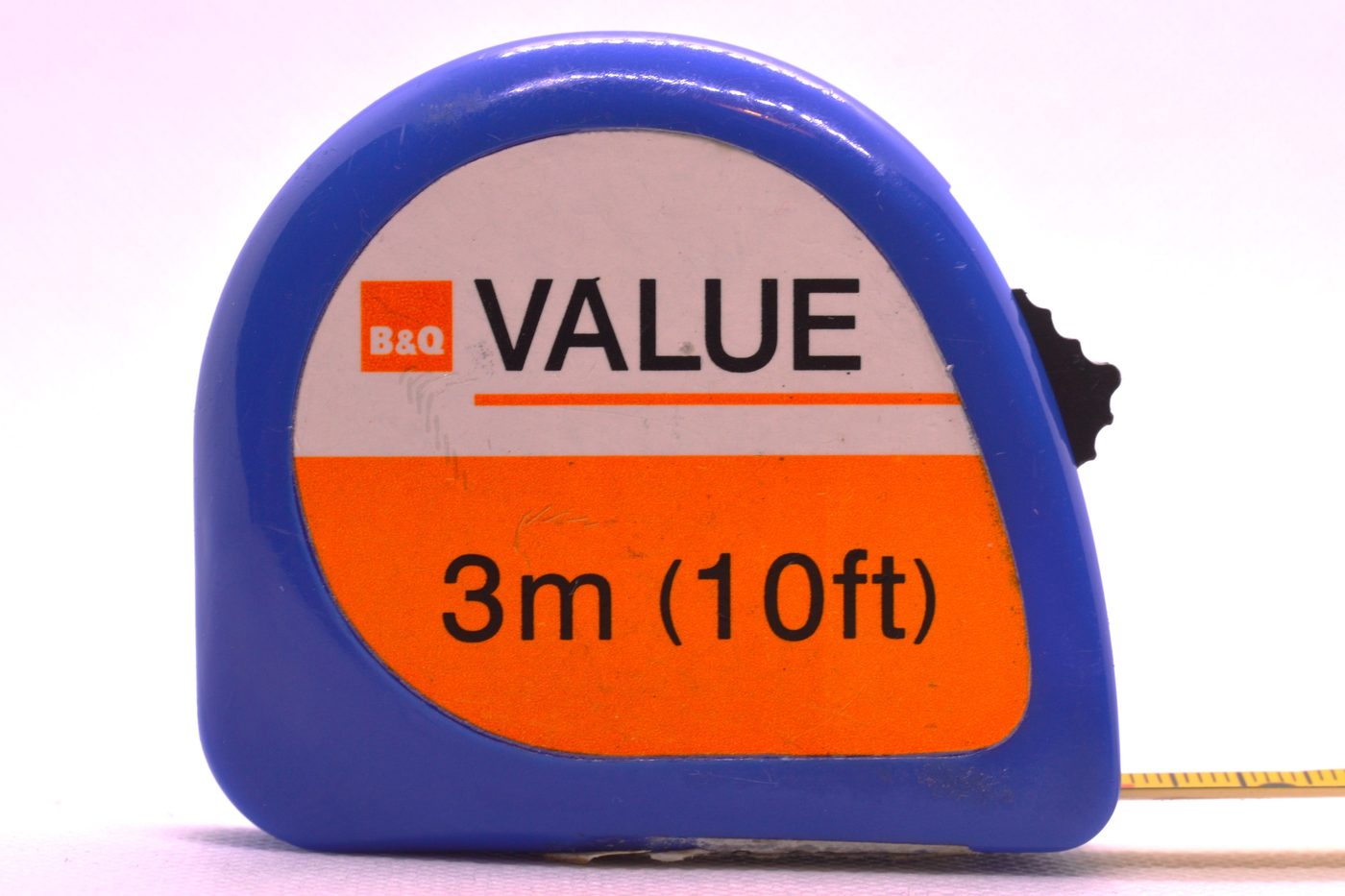
A measuring tape with metric and imperial units (Source: Wikimedia Commons)
A spirit level shows whether a surface is horizontal or a post is upright by the position of the bubble in the vial. It is used on foundations, floors, trough rims and door frames. A floor that is level in one direction and has a slight fall toward the drain keeps the pen dry.
A hand saw cuts posts, rafters, planks and slats to length. Mark the cut line with a pencil and square, support the timber firmly and let the teeth do the work without forcing the blade. Slatted goat floors need many cuts of the same length, so the first piece is used as a pattern for the rest.
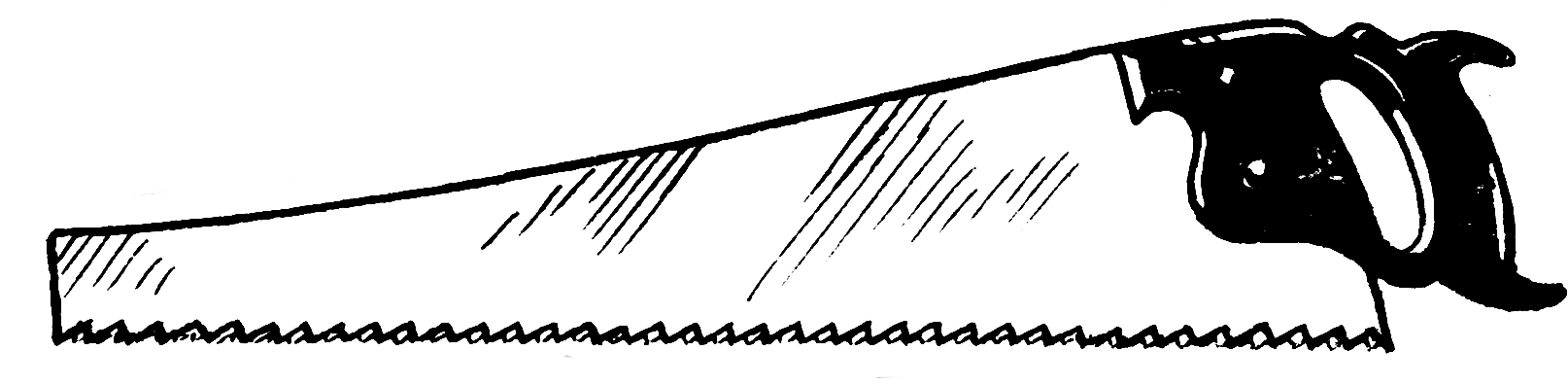
Hand saw with handle and serrated blade (Source: Wikimedia Commons)
A drill makes pilot holes so that timber does not split when it is nailed or screwed, and makes holes for bolts in frames and for wire in fence posts. A masonry bit is used to drill blocks and concrete. Fit the bit that matches the material, hold the drill square to the surface and wear eye protection.
Pliers grip and bend wire, cut wire mesh and pull out nails. They are used for fixing wire mesh to the pen frame and for twisting binding wire. Cut the wire close to the post and bend the sharp end inward so that it cannot injure a goat.
A chisel shapes timber for joints and for recesses in which hinges sit. Keep both hands behind the cutting edge, secure the work in a vice or clamp and cut away from the body. A dull chisel slips and is more dangerous than a sharp one.
Equipment is heavier plant that does work a person cannot do by hand. Most small goat houses are built with hand tools alone, but a large unit, or one on rough or bushy ground, may need some of the machines below, usually hired for the job.
| Name | Specification | Use |
|---|---|---|
| Bulldozer | Tracked machine with a front blade | Clearing bush and levelling the site |
| Cranes | Mobile or lorry-mounted lifting machine | Lifting heavy beams, roof trusses and tanks |
| Dump trucks | Tipping body for hauling loose materials | Carrying sand, ballast, quarry dust and soil |
| Mixer | Portable drum mixer, petrol or electric | Mixing concrete and mortar evenly |
| Forklifts | Wheeled machine with lifting forks | Moving pallets of blocks and bagged cement |
A bulldozer pushes soil and clears vegetation and stumps. On a sloping or uneven site it makes a level building platform and forms drainage channels around the pens. It is hired for the work because a single goat house rarely justifies owning one.
A crane lifts loads that are too heavy or too high for workers, such as steel roof trusses, tanks for water or the precast parts of a large unit. The crane operator and the person guiding the load must agree on signals before lifting, and nobody stands under the load.
A dump truck hauls sand, ballast, quarry dust and hardcore to the site and tips the load where it is needed. A site close to a road saves transport cost, which is one reason for the access considered when the site is chosen.
A mixer turns cement, sand, ballast and water into concrete that is the same throughout, which is stronger than concrete mixed by shovel. A small portable mixer is enough for a goat house. Load the water and ballast first, then the cement and sand, and wash the drum at once after use before the concrete hardens.
A forklift lifts pallets of blocks, bags of cement and roofing sheets and moves them close to where the work is going on. It reduces back injuries and saves time on a large site.
A wheelbarrow carries mortar, concrete and blocks over short distances, and a hired power saw or nail gun speeds up work on large timber frames. Operators of any power equipment should be trained, and guards must be in place.
Materials make up the structure of the goat house. They are chosen for strength, durability, cost, local availability and suitability for goats, and they must not have sharp edges or toxic coatings that could harm the animals.
Cement is the binder that holds sand and stones together in concrete, mortar and plaster. It is bought in bags, kept dry and stacked off the ground, because moisture makes it set in the bag. It is used for foundations, floors, trough bases and the mortar between blocks. A common concrete mix for floors and foundations is 1 part cement, 2 parts sand and 4 parts ballast by volume.
Sand is the fine aggregate in concrete and mortar. It should be clean, sharp and free from soil, clay, organic matter and salt, because dirt weakens the bond with the cement. Coarse and medium grains give a stronger mix than very fine sand.
Blocks form the walls of permanent goat houses. Concrete blocks, burnt bricks and dressed stone are common types. Blocks give a solid base wall that resists damage by goats and does not rot or burn, and they are laid with mortar in a staggered pattern. The upper part of the wall is often left open or covered with mesh for ventilation.
Quarry dust is the fine waste from crushing stone. When it is clean and well graded, it can replace part of the sand in concrete, mortar and blocks and lowers cost. It also makes a firm, compacted bed under a floor. Quarry dust that is dirty or mixed with soil weakens concrete and should not be used.

corrugated iron sheet with brand marking (Source: Wikimedia Commons)
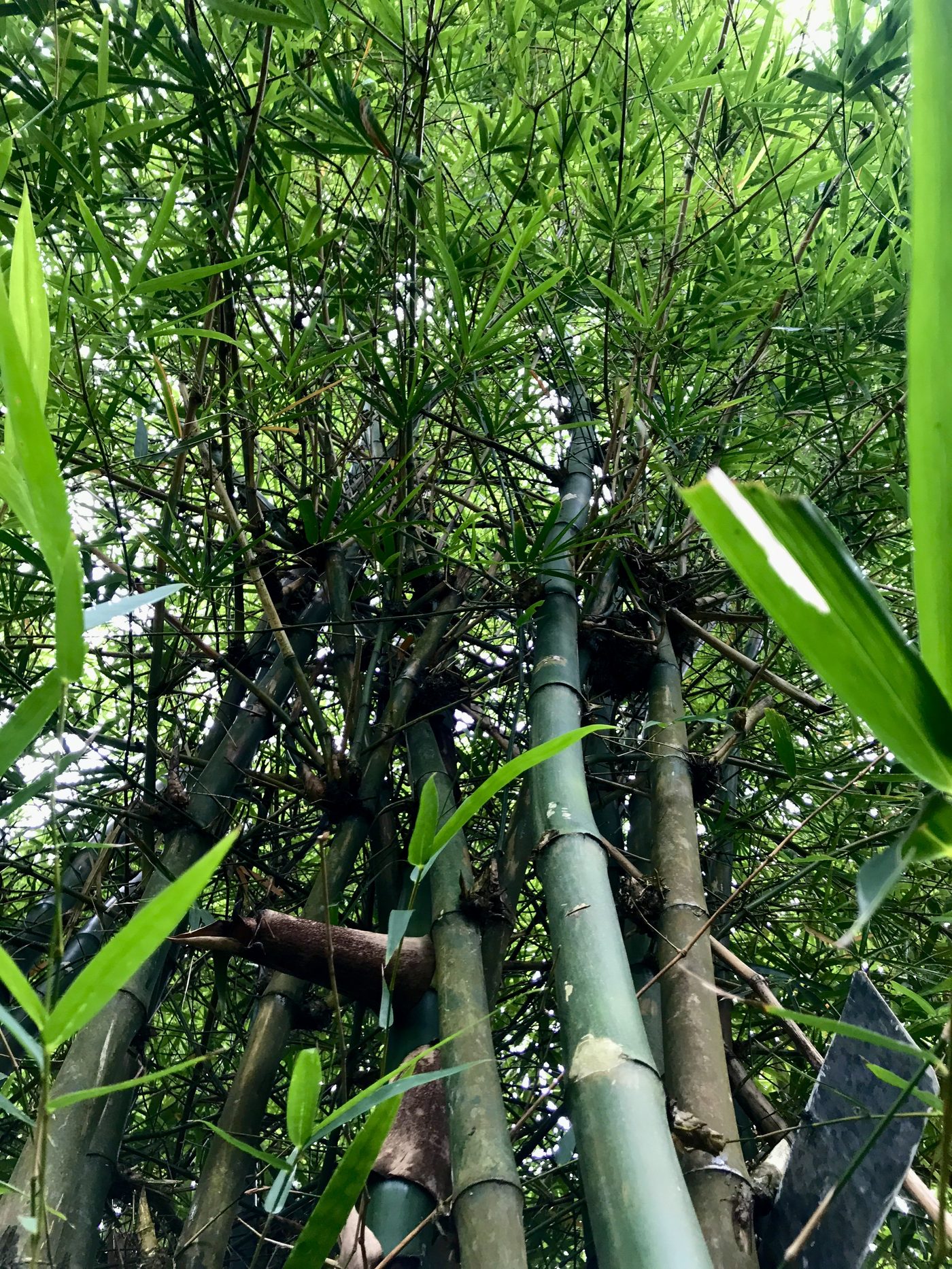
Cluster of bamboo stems and leaves (Source: Wikimedia Commons)
Create a free account to open more of this chapter.
Free: practical guides, quick cards, workplace scenarios and more.
Create a free accountThis chapter covered the essential tools, equipment, and materials required for constructing goat structures, detailing their specific roles and applications. It emphasized the importance of selecting an appropriate site for the goat structure, considering factors such as drainage, accessibility, and protection from harsh weather. The process of constructing goat structures was explained, highlighting key steps to ensure durability and functionality. Maintenance practices were discussed to prolong the lifespan of the structures and ensure a safe environment for the goats. The chapter also addressed the importance of keeping accurate records related to the construction and maintenance activities, which support effective management and future planning. Finally, it explored waste management strategies to maintain hygiene and prevent environmental contamination around the goat housing.
At the start of this chapter we promised you would be able to:
Tick each one you can genuinely do.
So, are you there yet?
You're competent when you can confidently do 50% or more of what this chapter promised.
Sign in to record how you're doing.