Livestock forage production is a critical component of animal husbandry, directly impacting the health and productivity of livestock. Efficient forage production depends on the appropriate use of tools and equipment, which facilitate land preparation, planting, irrigation, harvesting, and storage. In Kenya, professionals involved in agriculture, cooperative management, and even county government agricultural departments rely on these implements to ensure a steady supply of high-quality feed. This chapter examines essential forage production tools and equipment, their specifications, and their practical applications across diverse Kenyan sectors.
1.1 Forage Production Tools and Forage Equipment
1.1.1 Grass Cutters
| Name |
Specification |
Use |
| Grass Cutter |
Petrol or electric powered, blade size 30-40 cm |
Cutting grass and forage crops efficiently |
- Grass cutters are primarily used to harvest forage grasses such as Napier grass and Rhodes grass, which are common in Kenyan dairy farms and county livestock projects.
- Operators must ensure blades are sharp to provide clean cuts, which promote quick regrowth of forage plants.
- Regular cleaning and oiling of the blade and engine parts prevent rust and mechanical failure.
- Petrol-powered grass cutters offer portability for use in remote grazing areas, while electric models suit farms with reliable electricity supply, such as agricultural training institutions.
- Safety precautions include wearing protective clothing and ensuring the cutter is turned off during blade maintenance.
1.1.2 Generator
Generators provide a reliable power source for electrical forage equipment in locations where grid electricity is unavailable or unreliable. They support operations such as irrigation pumps and electric grass cutters.
| Name |
Specification |
Use |
| Generator |
Diesel or petrol engine, 5-10 kVA power output |
Power supply for field equipment and irrigation systems |
- Generators enable continuous operation of water pumps critical for irrigating forage crops during dry spells, vital for farms in arid and semi-arid Kenyan counties.
- They are also essential for powering electric grass cutters and other small machinery in rural agricultural training centres.
- Proper maintenance includes regular oil changes, fuel checks, and air filter cleaning to ensure operational efficiency.
- Generators should be housed in well-ventilated areas to prevent overheating and accumulation of exhaust fumes.
- Operators must be trained to manage load capacity to avoid damage and ensure prolonged generator lifespan.
1.1.3 Water Pump with Hose
Water pumps are crucial for irrigation, ensuring that forage crops receive adequate moisture to grow optimally, especially in Kenya’s dry regions. The pump’s efficiency directly affects forage yield and quality.
| Name |
Specification |
Use |
| Water Pump |
Petrol or electric, flow rate 3000-5000 L/hr |
Irrigation of forage crops |
| Hose |
Diameter 1-2 inches, length varies |
Water delivery from pump to forage fields |
- Water pumps facilitate the transfer of water from sources such as rivers, boreholes, or dams to forage fields.
- The hoses must be durable and flexible to withstand rough terrain and frequent repositioning on farms and agricultural colleges.
- Proper installation of the pump and hose system prevents water wastage and ensures uniform irrigation.
- Routine checks for leaks, hose blockages, and pump wear extend the equipment's service life.
- In institutions like county agricultural offices, portable water pumps enable quick response to forage irrigation needs during dry seasons.
1.1.4 Tractors (Optional)
Tractors are powerful agricultural machines that enhance the efficiency of land preparation, planting, and harvesting in forage production. While not mandatory for all farms, they are invaluable assets for large-scale operations.
| Name |
Specification |
Use |
| Tractor |
40-80 HP, 4WD, with attachments |
Land preparation, planting, and transport |
- Tractors equipped with ploughs and harrows prepare large forage fields quickly, saving time and labour.
- They can also tow planting implements and transport harvested forage to storage or feeding sites.
- Maintenance includes regular servicing of the engine, hydraulic systems, and tyres to prevent breakdowns.
- Training operators in safe handling and efficient use maximises productivity and reduces accidents on farms.
- For example, a cooperative dairy farm in Nakuru County uses tractors to prepare multiple hectares of pasture, ensuring timely planting and harvesting.
1.1.5 Plough and Harrow
Ploughs and harrows are essential implements for soil preparation, facilitating the establishment of healthy forage crops by improving soil aeration and weed control.
| Name |
Specification |
Use |
| Plough |
Mouldboard or disc, size varies |
Breaking and turning soil before planting |
| Harrow |
Disc or tine harrow, width 1-3 m |
Soil levelling and weed control after ploughing |
- Ploughing breaks compacted soil layers, allowing roots of forage plants to penetrate deeply and access nutrients.
- Harrowing follows ploughing to crush soil clods and create a fine seedbed, essential for uniform seed germination.
- Both tools are used by county government farms and agricultural training centres to maintain productive forage plots.
- Their effectiveness depends on correct depth and speed settings during operation, which vary with soil type.
- Regular cleaning and inspection prevent rust and mechanical damage, prolonging the lifespan of these implements.
1.1.6 Shovel
Shovels are versatile hand tools used in various stages of forage production, including planting, soil management, and transporting materials.
| Name |
Specification |
Use |
| Shovel |
Steel blade, wooden or metal handle, blade size 20-30 cm |
Digging, planting, and moving soil or manure |
- Shovels assist in preparing planting holes for forage seeds or seedlings, especially in smallholder farms and school demonstration plots.
- They are used to mix soil amendments such as manure or fertilizers into the soil to enhance forage growth.
- Transporting harvested forage or manure in small quantities can also be facilitated using shovels along with wheelbarrows.
- Proper handling reduces the risk of injury and improves work efficiency.
- Maintaining sharpness of the blade and checking the handle for cracks ensures safe and effective use.
1.1.7 Hoe
Hoes are traditional agricultural tools vital for weed control and soil aeration in forage fields, especially in small-scale and subsistence farms.
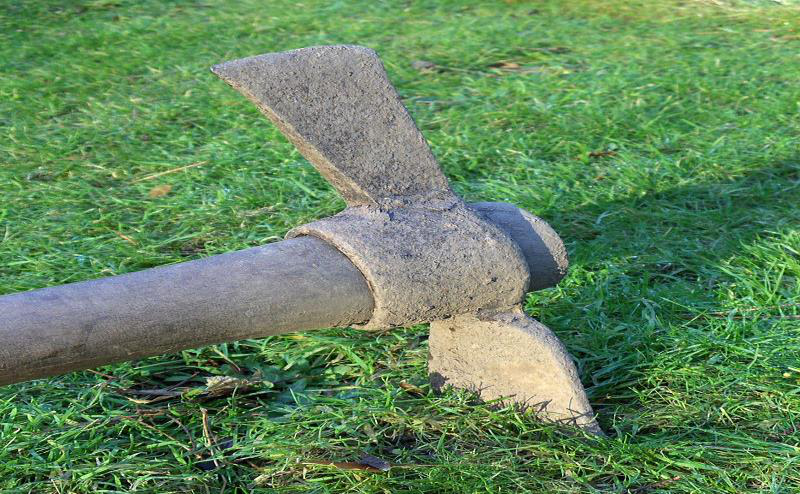
A traditional hoe (Source: site_preliminary (1))
| Name |
Specification |
Use |
| Hoe |
Flat blade or pointed tip, wooden or metal handle |
Weed removal, soil loosening |
- Regular hoeing prevents weeds from competing with forage crops for nutrients and water, thus improving yield.
- Hoes break the soil surface, enhancing water infiltration and root development.
- They are widely used in community-based farms and agricultural schools where mechanised equipment is limited.
- Proper technique in hoeing reduces soil erosion and damage to forage plants.
- Cleaning after use and storing in dry conditions prevents rust and prolongs tool life.
1.1.8 Water Sprinklers
Water sprinklers are irrigation devices that distribute water evenly over forage fields, improving water use efficiency and crop growth.
| Name |
Specification |
Use |
| Water Sprinkler |
Rotary or fixed, coverage area 100-500 m² |
Uniform irrigation of forage crops |
- Sprinklers are ideal for irrigating forage in institutions such as universities and livestock research centres where water conservation is prioritized.
- They reduce labour requirements compared to manual watering and allow for scheduled irrigation.
- Installation requires adequate water pressure and appropriate placement to cover the entire forage area.
- Regular maintenance includes checking for clogged nozzles and ensuring pipes and fittings are secure.
- Using sprinklers can mitigate the effects of drought by maintaining forage growth during dry spells.
1.1.9 Planter
Planters facilitate the accurate and efficient sowing of forage seeds, improving germination rates and crop uniformity.
| Name |
Specification |
Use |
| Planter |
Manual or tractor-mounted, seed metering system |
Precise planting of forage seeds |
- Manual planters are commonly used in small farms and agricultural training centres, allowing controlled seed placement.
- Tractor-mounted planters increase planting speed on larger forage fields managed by cooperatives or county farms.
- Proper calibration of the seed metering system ensures the correct seed rate, preventing overcrowding or sparse growth.
- Maintenance includes cleaning seed boxes and lubricating moving parts to avoid blockages.
- Accurate planting reduces seed wastage and promotes uniform forage establishment.
1.1.10 Wheelbarrow
Wheelbarrows are essential for transporting materials such as soil, manure, seedlings, and harvested forage within the farm or facility.
| Name |
Specification |
Use |
| Wheelbarrow |
Steel tray, pneumatic tyre, single or dual wheel |
Transporting materials and harvested forage |
- They improve labour efficiency by reducing the physical effort required to move heavy or bulky loads.
- Wheelbarrows are widely used in school farms and smallholder livestock enterprises where mechanised transport is limited.
- Proper loading avoids imbalance and tipping, ensuring safety during transport.
- Maintenance involves checking tyre pressure and greasing the wheel axle for smooth movement.
- Storing wheelbarrows under shelter prevents rust and prolongs usability.
1.1.11 Hole Digger
Hole diggers are tools designed to create planting holes for forage seedlings or trees, facilitating proper plant establishment.
| Name |
Specification |
Use |
| Hole Digger |
Manual or powered, auger diameter 10-30 cm |
Digging planting holes for seedlings or trees |
- Manual hole diggers are common in community projects and small farms, allowing precise hole depth and spacing.
- Powered augers increase efficiency on larger farms or demonstration plots managed by county agricultural offices.
- Correct hole size and depth are critical to ensure adequate root space and water retention for forage plants.
- Cleaning the tool after use prevents soil buildup and mechanical damage.
- Proper ergonomic use reduces strain and injury risks during planting operations.
1.1.12 Fencing Materials
Fencing is vital for protecting forage fields from livestock grazing prematurely and from wildlife damage, thereby securing the forage investment.
| Name |
Specification |
Use |
| Fencing Wire |
Galvanized steel wire, 12-14 gauge |
Creating boundary and protection fences |
| Fence Posts |
Wooden, metal, or concrete posts |
Supporting fencing wire |
| Gates |
Steel or wooden gates, various sizes |
Controlled access to forage fields |
- Fencing materials must be durable to withstand weather conditions and animal pressure, especially in areas near game reserves or communal grazing lands.
- Proper installation includes setting posts firmly and tensioning wires to prevent sagging.
- In county livestock projects, well-maintained fencing reduces feed losses and controls grazing patterns.
- Maintenance involves repairing broken wires and replacing damaged posts promptly.
- Using electric fencing can enhance security and reduce fence maintenance on farms with limited labour.
Practice Questions
- Explain the importance of using grass cutters in forage production and describe their maintenance requirements. (10 marks)
- Describe how water pumps and hoses contribute to forage crop irrigation and list five maintenance practices to ensure their longevity. (12 marks)
- Compare and contrast the uses of ploughs and harrows in land preparation for forage production. (10 marks)
- Outline six steps involved in the safe operation and maintenance of a tractor used for forage production. (12 marks)
- Discuss the role of fencing materials in protecting forage crops and list five characteristics of effective fencing. (10 marks)
The rest of this chapter
🔒Create a free account to open more of this chapter.
Free: practical guides, quick cards, workplace scenarios and more.
Create a free account 🔒1.2 Propagation Materials
In livestock forage production, selecting appropriate propagation materials is essential for establishing healthy and productive forage crops. Propagation materials refer to the plant parts or seeds used to reproduce forage plants, ensuring the continuity of d…
🔒1.3 Land Preparation
Land preparation is a fundamental step in producing quality livestock forage. It involves preparing the soil to create a conducive environment for seed germination and plant growth. In Kenya, where livestock farming is a key economic activity across counties s…
🔒1.4 Establishing Propagation Materials
Establishing propagation materials is critical in forage production because it determines the initial plant population and ultimately affects the forage stand's vigor and yield. Kenyan farmers and agricultural extension officers emphasize selecting appropriate…
🔒1.5 Forage Management
Forage management is a critical aspect of livestock feeds production that directly influences the quantity and quality of feed available to animals throughout the year. Effective management ensures sustainable pasture and fodder crop productivity, which suppor…
🔒1.6 Harvesting of Forage
Harvesting forage at the right time and using appropriate methods is essential to preserve its nutritional value and maximize feed availability for livestock. In Kenya, where feed scarcity during dry seasons is common, timely harvesting and proper handling of…
Chapter Summary
This chapter covered the essential tools and equipment required for effective forage production, including grass cutters, generators, water pumps, and various hand tools such as hoes and shovels. It also examined the different propagation materials used to establish forage crops, such as seeds, seedlings, cuttings, splits, and tubers. The importance of thorough land preparation was emphasized, highlighting Good Agricultural Practices like liming and mulching to improve soil health and crop productivity. Various methods of establishing propagation materials were discussed, including direct sowing, broadcasting, and transplanting techniques. The chapter then explored the management of forage, focusing on the maintenance of pastures and cultivation of fodder crops to ensure sustainable livestock feed supply. Finally, it addressed the harvesting of forage, outlining the practices necessary to maximize yield and maintain feed quality for livestock nutrition.
Self-Assessment
🔒 PDFDownload this self-assessment, with answers
A. Written Assessment
-
Which of the following tools is primarily used for cutting grass in forage production?
a) Hoe
b) Grass cutter
c) Plough
d) Shovel
(2 marks)
-
Explain the role of a water pump with hose in forage production. (3 marks)
🔒20 more in this section.
Chapter Examination Questions
🔒 PDFDownload these examination questions, with worked answers
SECTION A (40 Marks) - Answer ALL Questions
- Describe the role of a grass cutter in forage production and explain how it improves efficiency on a dairy farm in Kiambu County. (4 marks)
- Explain why liming is an important Good Agricultural Practice (GAP) in land preparation for forage crops. (4 marks)
🔒18 more in this section.
