Farm structures are essential components of modern agricultural systems in Kenya, facilitating efficient crop production, livestock management, and resource conservation. Their use directly influences productivity, sustainability, and profitability on farms of all sizes, from smallholder plots to large commercial enterprises. Understanding how to properly utilize these structures enables extension professionals to advise farmers and stakeholders effectively, enhancing food security and rural livelihoods. This chapter explores the practical applications of farm structures in diverse agricultural settings.
5.1 Use of farm structures
Farm structures serve multiple roles across agricultural activities, providing physical support, protection, and environmental control necessary for optimal production. In Kenya, where climatic variability and resource constraints challenge farming operations, appropriate use of farm structures can mitigate risks and improve output quality. This section delves into the various ways farm structures are employed to enhance crop and livestock productivity, safeguard assets, and support farm management.
5.1.1 Protection and storage functions of farm structures
Farm structures are crucial for protecting crops, equipment, and livestock from environmental hazards and pests, while also providing secure storage that preserves quality and reduces losses. In Kenya’s varied agro-ecological zones, structures such as granaries, silos, and animal shelters help maintain farm inputs and outputs in good condition.
Protection of crops and livestock
- Weather shielding: Structures like greenhouses and shade nets protect crops from excessive sunlight, wind, and heavy rains, promoting stable growth conditions. For example, at a horticultural farm in Naivasha, shade nets reduce heat stress on tomatoes, improving yield quality.
- Pest and disease control: Properly constructed storage facilities prevent pest infestation and fungal contamination in harvested produce, reducing post-harvest losses. At a maize cooperative in Uasin Gishu, elevated granaries with tight-fitting doors minimize rodent access.
- Livestock shelter: Animal housing protects livestock from extreme temperatures, rain, and predators, which reduces stress and disease incidence. Dairy farmers in Kiambu use well-ventilated cowsheds to enhance milk production by maintaining comfortable conditions.
- Equipment protection: Farm machinery and tools require covered storage to prevent rust and mechanical damage, extending their lifespan. A commercial farm near Eldoret uses secure tool sheds to safeguard tractors and sprayers.
- Fire prevention: Some farm structures incorporate fire-resistant materials and design features to reduce the risk of devastating fires, which is critical in dry areas such as parts of Eastern Kenya.
Storage of inputs and outputs
- Seed storage: Controlled environments in seed stores maintain viability by regulating moisture and temperature, ensuring good germination rates. Agricultural extension officers advise farmers in Meru to use airtight containers for seed preservation.
- Fertilizer and chemical storage: Dedicated structures with proper ventilation and security prevent contamination and unauthorized access to agrochemicals, safeguarding human health and the environment.
- Harvested crop storage: Silos and granaries store grains in bulk under conditions that minimize spoilage and insect infestation, facilitating market timing and price optimization.
- Feed storage: Animal feeds stored in clean, dry structures maintain nutritional value and prevent mold growth, supporting livestock health.
- Water storage: Tanks and reservoirs constructed on farms store water for irrigation and livestock, ensuring availability during dry spells.
5.1.2 Facilitation of farm operations and management
Farm structures contribute significantly to the efficiency and organization of daily agricultural activities by providing designated spaces and infrastructure that streamline work processes. This improves labour productivity and resource use on Kenyan farms.
Enhancing operational efficiency
- Workshops and repair sheds: These structures allow on-site maintenance of farm machinery, reducing downtime and transport costs. For instance, at a large dairy farm in Nakuru, a well-equipped workshop ensures prompt tractor repairs.
- Sorting and grading areas: Covered platforms facilitate post-harvest handling by providing clean, organized spaces for sorting produce according to quality, which enhances marketability.
- Packing and storage rooms: These enable farmers to prepare products for sale or storage under hygienic conditions, meeting market and regulatory standards.
- Livestock handling facilities: Structures such as crush pens and milking parlours improve animal management by enabling safe restraining and efficient milking processes. Dairy cooperatives in Kiambu have adopted modern milking parlours to boost milk hygiene.
- Irrigation infrastructure housing: Pump houses and control rooms protect irrigation equipment from weather and theft, ensuring reliable water delivery for crop production.
Supporting farm management
- Office and record-keeping spaces: Farm offices located within the farm compound provide secure environments for managing farm records, planning, and communication with suppliers and buyers.
- Training and demonstration facilities: Structures such as classrooms and demonstration plots enable extension services to educate farmers on best practices and new technologies.
- Quarantine and isolation units: These are vital for controlling disease outbreaks in livestock by isolating sick animals, thus protecting herd health.
- Greenhouses and nurseries: These controlled environments allow for the propagation of high-quality seedlings and experimental crop varieties, supporting diversification and innovation.
- Composting and waste management sites: Dedicated areas for organic waste processing improve nutrient recycling and environmental sustainability on farms.
5.1.3 Environmental control and resource conservation
Farm structures play a pivotal role in managing environmental factors and conserving natural resources, which is critical for sustainable agriculture in Kenya’s often fragile ecosystems. Through design and material selection, these structures help regulate microclimates and reduce resource wastage.
Microclimate regulation
- Greenhouses: By controlling temperature, humidity, and light, greenhouses extend growing seasons and protect sensitive crops from adverse weather. For example, flower farms in Naivasha rely on greenhouses to meet export quality standards.
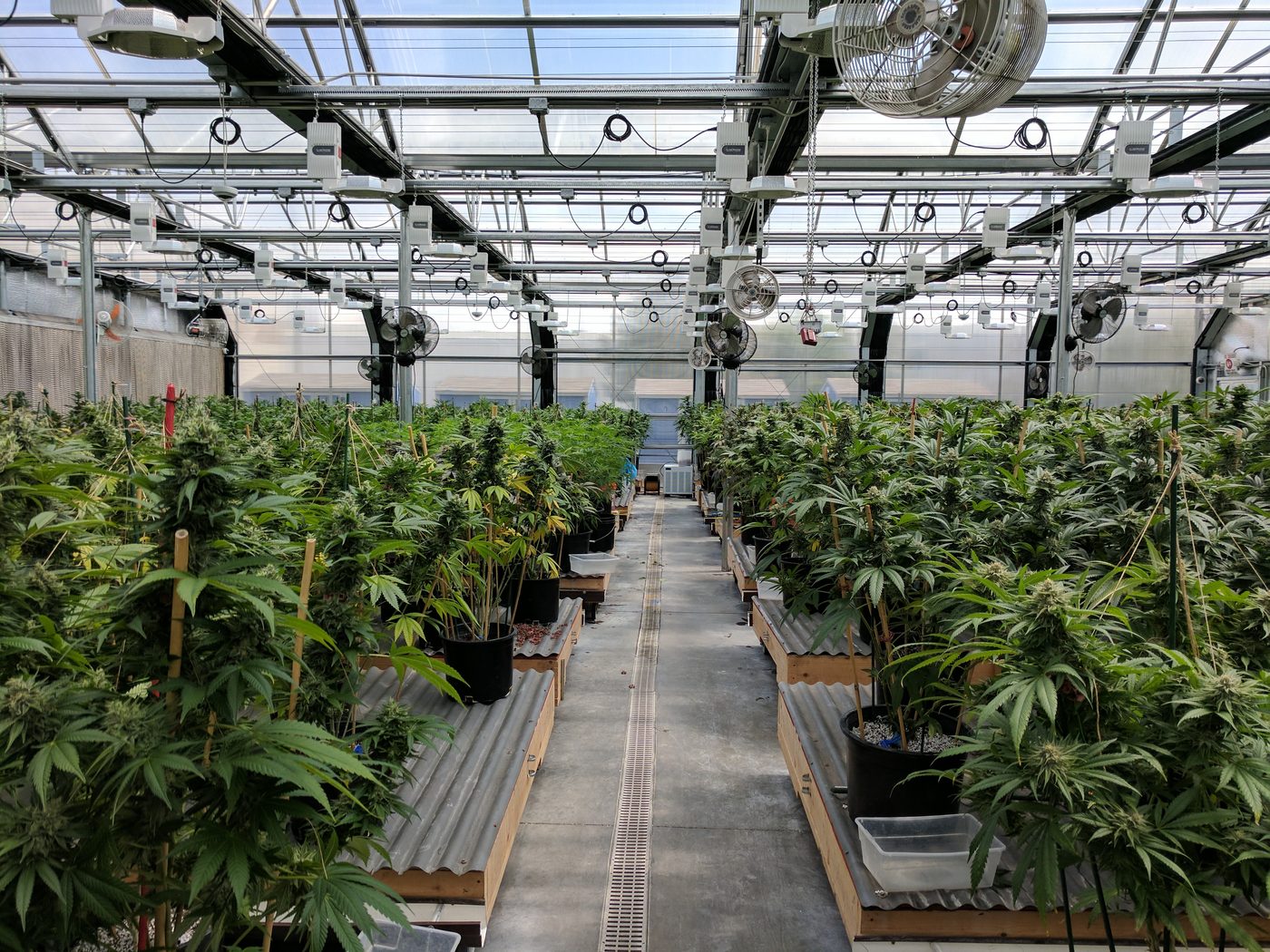
Interior of a modern greenhouse structure (Source: Wikimedia Commons)
- Shade structures: Trees and constructed shade nets reduce heat stress on crops and livestock, enhancing productivity and welfare.
- Windbreaks: Strategically placed barriers reduce wind speed, minimizing soil erosion and crop damage on exposed farms in arid and semi-arid areas.
- Mulching shelters: Structures that support mulching materials help retain soil moisture and regulate temperature, improving water use efficiency.
- Ventilation systems: Properly designed ventilation in animal houses controls humidity and ammonia levels, improving air quality and animal health.
Resource conservation
- Rainwater harvesting structures: Roof catchments and storage tanks collect and store rainwater, supplementing irrigation and livestock water needs during dry periods.
- Solar-powered farm buildings: Incorporating solar panels reduces reliance on grid electricity and fossil fuels, lowering operational costs and environmental impact.
- Composting facilities: Structures that enable aerobic decomposition of organic waste produce valuable soil amendments, reducing the need for chemical fertilizers.
- Insulation and thermal mass: Use of insulating materials and thermal mass in farm buildings reduces energy consumption for heating or cooling.
- Water storage and recycling: Tanks and ponds designed for water reuse support sustainable irrigation practices and reduce water wastage.
5.1.4 Safety, hygiene, and compliance in farm structure use
The use of farm structures must align with safety standards, hygiene protocols, and regulatory requirements to protect workers, consumers, and the environment. Extension professionals play a key role in ensuring these standards are understood and implemented on Kenyan farms.
Safety considerations
- Structural integrity: Buildings must be constructed to withstand local weather conditions, preventing collapse and injuries. For example, livestock shelters in Kisumu are designed to resist heavy rains.
- Fire safety: Use of fire-retardant materials and provision of fire extinguishers reduce risks in storage areas containing flammable inputs like fertilizers.
- Safe chemical storage: Segregated and ventilated chemical stores prevent accidental poisonings and environmental contamination.
- Ergonomics and accessibility: Design of workspaces should minimize physical strain and accommodate workers with disabilities.
- Electrical safety: Proper wiring and grounding in farm buildings prevent electrical hazards.
Hygiene and sanitation
- Cleanable surfaces: Floors and walls in animal houses and processing areas should be easy to clean to prevent disease spread.
- Waste disposal: Provision of waste bins and drainage systems prevents contamination of soil and water sources.
- Water supply: Farm structures must have access to clean water for drinking, cleaning, and irrigation.
- Pest control: Regular maintenance and sealing of buildings reduce pest infestations.
- Personal protective equipment (PPE) storage: Designated areas for PPE encourage their proper use and maintenance.
Regulatory compliance
- Building permits: Farms must obtain necessary approvals from county governments before erecting structures.
- Environmental impact assessments: Some farm structures require assessment to ensure minimal environmental harm.
- Animal welfare standards: Livestock housing must meet guidelines on space, ventilation, and comfort.
- Food safety regulations: Storage and processing structures should comply with Kenya Bureau of Standards (KEBS) requirements.
- Occupational health and safety: Farms must adhere to the Occupational Safety and Health Act provisions to protect workers.
Practice Questions
- Explain five ways in which farm structures protect crops and livestock from environmental hazards. (10 marks)
- Describe six types of farm operations that are facilitated by specific farm structures and how they improve efficiency. (12 marks)
- Discuss five methods by which farm structures contribute to environmental control and resource conservation on Kenyan farms. (10 marks)
- Identify five safety and hygiene considerations that must be observed in the use of farm structures to comply with Kenyan regulations. (10 marks)
The rest of this chapter
🔒Create a free account to open more of this chapter.
Free: practical guides, quick cards, workplace scenarios and more.
Create a free account 🔒5.2 Types of Farm Structures Uses
Crop production structures are specialized constructions designed to create optimal growing conditions, protect crops from environmental stresses, and facilitate efficient farming practices. These structures are integral in intensifying production, especially…
🔒5.3 Safety in use of farm structures
Safety in farm structures is critical to protect workers, livestock, and property from accidents and hazards. In Kenya, where agriculture employs a significant portion of the population, ensuring safe use of structures such as storage facilities, animal shelte…
Chapter Summary
This chapter explored the use of farm structures, emphasizing their role in supporting efficient agricultural activities and protecting resources. It detailed the various types of farm structures, explaining how each serves specific purposes such as storage, shelter, and processing to enhance productivity. The discussion highlighted structures like silos, barns, and irrigation channels, illustrating their practical applications on different farms. Safety considerations were also addressed, focusing on the importance of proper maintenance, correct operation, and awareness of potential hazards to prevent accidents and injuries. The chapter underscored the need for users to follow safety protocols and regularly inspect structures to ensure their integrity. Overall, understanding the use, types, and safety of farm structures is essential for sustainable farm management and the wellbeing of those working on the farm.
Self-Assessment
🔒 PDFDownload this self-assessment, with answers
A. Written Assessment
- Define the term "farm structures" and explain their role in agricultural productivity. (4 marks)
- Identify five common types of farm structures used in Kenyan small-scale farms and describe one use for each. (5 marks)
🔒20 more in this section.
Chapter Examination Questions
🔒 PDFDownload these examination questions, with worked answers
SECTION A (40 Marks) - Answer ALL Questions
- Explain the primary reasons for using farm structures in agricultural production in Kenya. (4 marks)
- Identify four types of farm structures commonly used in Kenyan small-scale farms and state one use for each. (4 marks)
🔒18 more in this section.
Chapter Practical Activities
Practical 1: Identify and select appropriate farm structures for various uses
Agriculture And Extension · Level 6
Farm Structures
PRACTICAL ASSESSMENT
TIME: 4 HOURS
⬇ PDFCandidate Instructions (Candidate Tool)
Type: Individual
INSTRUCTIONS TO CANDIDATE:
1. You are required to perform the following task:
i. Inspect and select appropriate farm structures for specific farm uses and record their suitability in a report.
2. You have been provided with the following resources for the practical task:
| Tools & Equipment | Materials |
|---|
| Measuring tape | Farm Structures Identification Chart |
| Notebook | Sample farm structure models or pictures |
| Pen | |
| Camera or Smartphone | |
⬇ PDFResources Required (Cutting List)
| S/N | Item | Quantity |
|---|
| 1 | Measuring tape | 1 Pc per 5 Candidates |
| 2 | Farm Structures Identification Chart | 1 Pc per Candidate |
| 3 | Notebook | 1 Pc per Candidate |
| 4 | Pen | 1 Pc per Candidate |
| 5 | Camera or Smartphone for photo documentation | 1 Pc per Candidate |
| 6 | Sample farm structure models or pictures (e.g. animal shelter, granary, water tank) | 1 set per Candidate |
| 7 | Personal Protective Equipment (PPE) - Gumboots | 1 Pair per Candidate |
| 8 | Personal Protective Equipment (PPE) - Dustcoat/Overall | 1 Pc per Candidate |
⬇ PDFAssessor Guide
| Items to be Evaluated | Marks Available | Marks Obtained | Comments |
|---|
| TASK 1: Inspection and Selection of Farm Structures |
Wore appropriate PPEs (Gumboots, Dustcoat/Overall)
(Award 1 mark each or zero) | 2 | | |
Assembled all tools and materials required for the task
(Award 0.5 mark each or zero 0.5x4) | 2 | | |
Measured dimensions of at least three different farm structures accurately using measuring tape
(Award 2 marks for each correctly measured structure or zero 2x3) | 6 | | |
Identified the type of each farm structure (e.g. animal shelter, granary, water tank)
(Award 2 marks for each correct identification or zero 2x3) | 6 | | |
Described the intended use of each farm structure according to farm needs
(Award 2 marks for each appropriate use described or zero 2x3) | 6 | | |
Selected the most appropriate farm structure for given farm activities based on inspection
(Award 1 mark for each correct selection or zero 1x4) | 4 | | |
Recorded observations and selections clearly and legibly in the notebook
(Award 3 marks for complete and clear recording or zero) | 3 | | |
Took photographic evidence of inspected farm structures
(Award 3 marks for clear photos or zero) | 3 | | |
| Sub-Total | 32 | | |
| PRODUCT CHECKLIST |
Report includes measurements of three farm structures matching measuring tape readings (e.g. length, width, height)
(Award 4 marks if all three measurements match or zero) | 4 | | |
Correct classification of farm structures as per standard types
(Award 3 marks for correct classification of all or zero) | 3 | | |
Appropriate matching of structures to farm uses with justification
(Award 5 marks for all correct matches with justification or zero) | 5 | | |
Report is well organized, legible and complete
(Award 3 marks for neat, complete report or zero) | 3 | | |
| Sub-Total | 15 | | |
| GRAND TOTAL | 47 | | |
ASSESSMENT OUTCOME: ☐ Competent ☐ Not Yet Competent (competent if at least 50%)
Practical 2: Erect a simple farm storage shed 3m x 2m x 2.5m
Agriculture And Extension · Level 6
Farm Structures
PRACTICAL ASSESSMENT
TIME: 5 HOURS
⬇ PDFCandidate Instructions (Candidate Tool)
Type: Individual
INSTRUCTIONS TO CANDIDATE:
1. You are required to perform the following task:
i. Erect a simple farm storage shed measuring 3000mm length x 2000mm width x 2500mm height.
2. You have been provided with the following resources for the practical task:
| Tools & Equipment | Materials |
|---|
| Hammer | Timber posts (treated) |
| Measuring tape | Timber wall framing |
| Spirit level | Corrugated iron sheets |
| Hand saw | Nails 75mm |
| Sisal twine | Door hinges |
| Door latch |
⬇ PDFResources Required (Cutting List)
| S/N | Item | Quantity |
|---|
| 1 | Timber posts (treated) 2.5m length | 6 pcs per Candidate |
| 2 | Timber wall framing 3m lengths | 6 pcs per Candidate |
| 3 | Corrugated iron sheets (roofing) | 6 pcs per Candidate |
| 4 | Nails 75mm | 1/4 kg per Candidate |
| 5 | Door hinges | 2 pcs per Candidate |
| 6 | Door latch | 1 pc per Candidate |
| 7 | Sisal twine | 5 m per Candidate |
| 8 | Hammer | 1 pc per Candidate |
| 9 | Measuring tape (5m) | 1 pc per Candidate |
| 10 | Spirit level | 1 pc per Candidate |
| 11 | Hand saw | 1 pc per Candidate |
| 12 | PPE (Dustcoat/Overall) | 1 pc per Candidate |
| 13 | PPE (Gumboots) | 1 pair per Candidate |
| 14 | PPE (Gloves) | 1 pair per Candidate |
⬇ PDFAssessor Guide
| Items to be Evaluated | Marks Available | Marks Obtained | Comments |
|---|
| TASK 1: ERECT THE STORAGE SHED |
Wore appropriate PPE (Dustcoat/Overall, Gumboots, Gloves)
(Award 1 mark each or zero) | 3 | | |
Assembled all required tools and materials as per the task
(Award 2 marks or zero) | 2 | | |
Selected and cleared a suitable site for erection
(Award 2 marks or zero) | 2 | | |
Measured and marked the shed layout 3m x 2m using measuring tape and sisal twine
(Award 1 mark for each correct measurement or zero x4) | 4 | | |
Fixed the timber posts vertically at marked points ensuring plumbness using spirit level
(Award 1 mark per correctly fixed post or zero x5) | 5 | | |
Constructed wall framing by fixing horizontal timber members between posts
(Award 1 mark per side framed or zero x5) | 5 | | |
Fixed corrugated iron sheets on the roof framing securely using nails
(Award 1 mark per correctly fixed sheet or zero x5) | 5 | | |
Constructed and fixed a door with hinges and latch ensuring proper fit
(Award 2 marks for door construction and 2 marks for fitting or zero) | 4 | | |
Used hammer and nails correctly and safely throughout the erection process
(Award 3 marks or zero) | 3 | | |
Observed safety and cleanliness during and after the task
(Award 2 marks or zero) | 2 | | |
| Sub-Total | 35 | | |
| PRODUCT CHECKLIST |
Shed dimensions are 3000mm length x 2000mm width x 2500mm height within ±20mm tolerance
(Award 5 marks for correct dimensions or zero) | 5 | | |
Shed is plumb and level as verified with spirit level
(Award 4 marks for plumbness and level or zero) | 4 | | |
Wall framing is uniformly fixed with no gaps or loose joints
(Award 4 marks for uniform joints or zero) | 4 | | |
Roof sheets are securely fixed with no loose or missing nails
(Award 3 marks or zero) | 3 | | |
Door is functional with properly fixed hinges and latch
(Award 4 marks or zero) | 4 | | |
| Sub-Total | 20 | | |
| GRAND TOTAL | 55 | | |
ASSESSMENT OUTCOME: ☐ Competent ☐ Not Yet Competent (competent if at least 50%)
🔒Construct a Livestock Pen 4m x 3m x 1.5m HighPractical 3
🔒Install a water trough structure 2m x 1m x 0.75m on farmPractical 4
🔒Build a compost bin measuring 1.2m x 1.2m x 1mPractical 5
🔒Set up perimeter fencing for crop protection measuring 10m x 5mPractical 6
🔒Demonstrate safe handling and use of farm structuresPractical 7
🔒Inspect and Maintain a Farm Storage Shed for SafetyPractical 8
🔒Construct a simple irrigation channel 3m long x 0.5m wide x 0.3m deepPractical 9
🔒Set out and build a simple farm gate 1200mm x 1000mmPractical 10
