
By the end of this chapter, you will be able to:
Mastering these skills helps you work safely and effectively, setting a strong foundation for successful crop production in real farming.
Compiled by: Harun Kimani
Preparing planting materials is a fundamental step in annual crop production, directly influencing crop establishment and yield quality. In the Kenyan agricultural context, where smallholder farmers and extension officers play a vital role, understanding the preparation and selection of planting materials ensures sustainable productivity and resource efficiency. This chapter focuses on defining key terms related to planting materials, assembling the necessary land preparation tools and equipment, and understanding their uses. Practical competence in these areas supports effective crop establishment in diverse Kenyan agro-ecological zones.
Preparing planting materials means choosing, treating and organising seeds or vegetative parts so that they establish quickly and grow into an even crop. It also means getting the land ready for them, because even the best seed performs poorly in a cloddy, weedy or compacted seedbed. A farmer who plans to plant maize and beans on a plot cleared from grass therefore has two jobs before planting day: sort and treat the planting materials, and assemble the right tools and equipment to clear, dig, level and ridge the plot.
Technical terms give extension workers, farmers and input suppliers a common language. The terms below are used throughout this unit.
A seed is the mature fertilised ovule of a plant. It contains an embryo and stored food and can develop into a new plant. It is the main planting material for annual crops such as maize, beans, sorghum and sunflower. Seed of a good variety, sold as certified seed, germinates more reliably and gives a more uniform crop than grain kept from an unknown source.
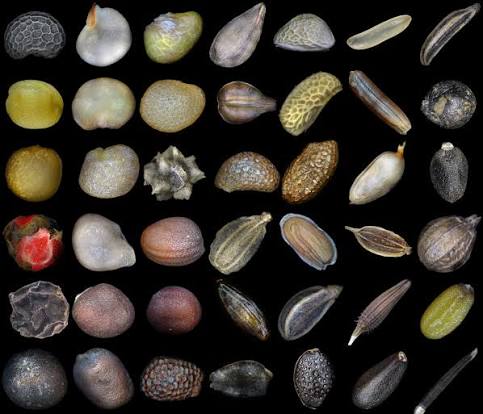
Figure: examples of what seeds looks alike.
A seedling is a young plant that has emerged from a seed and is in its early growth stage. Crops such as tomatoes, cabbages and onions are usually raised as seedlings in a nursery bed and transplanted to the field later.
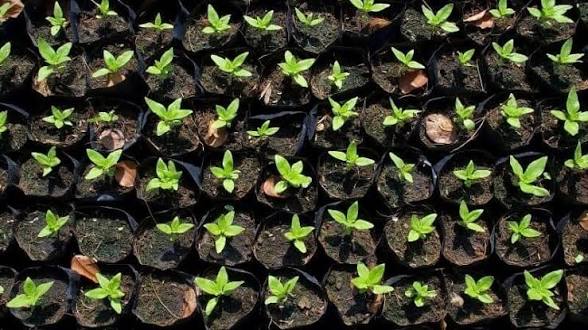
Figure: image of sleeved seedlings.
A propagule is any plant material used to propagate a new plant, including seeds, cuttings, tubers, bulbs and grafts. Sweet potato vine cuttings, for example, serve as propagules because each one roots and grows into a new plant.
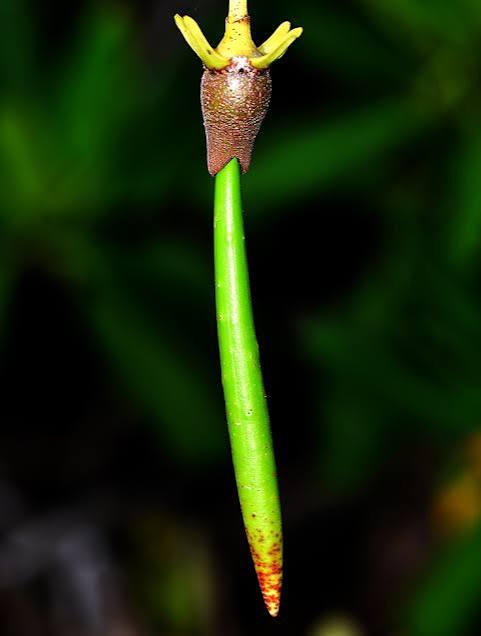
Figure: propagule as a planting material.
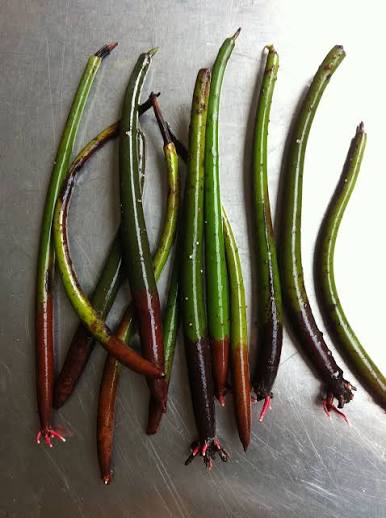
Figure(example2): propagule planting materials.
Germination is the process by which a seed develops into a seedling. The radicle (the first root) and then the plumule (the first shoot) emerge. It needs moisture, a suitable temperature and oxygen, and the seed must be viable. A seed that is cold, dry or waterlogged germinates poorly or not at all.
Viability is the ability of a seed or propagule to germinate and grow into a healthy plant. Extension officers and seed inspectors test viability by sowing a sample of seed under good conditions and counting how many germinate, so that planting materials meet the quality standard before they are sold or distributed.
Planting material is any biological material used to establish a crop, including seeds, seedlings, cuttings, tubers and bulbs. The choice of planting material affects the crop's performance and how easily pests and diseases are managed, because infected material carries disease into the field.
Certified seed is seed that has been officially inspected and found to meet set standards of purity, germination and health. In Kenya, seed certification is carried out by the Kenya Plant Health Inspectorate Service (KEPHIS), and certified seed is sold in sealed, labelled packs.
Seed treatment is the application of a chemical or biological agent to seed before planting to protect it and the young seedling from soil-borne pests and diseases. Dressing maize seed with a registered fungicide, for example, helps protect seedlings from seed rots and seedling blights, and an insecticide dressing protects germinating seed from soil insects such as termites. Treated seed is poisonous: wear gloves when handling it, never use it for food or feed, and keep it away from children and animals.
A nursery is a controlled place where seedlings are raised before they are transplanted to the field. A nursery lets a grower give small seedlings shade, water and protection in their first weeks, and produce healthy seedlings of crops such as onions, tomatoes and peppers.
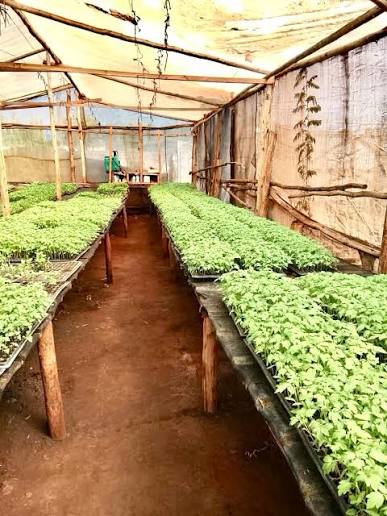
Figure: This is an outlook of a nursery structure.
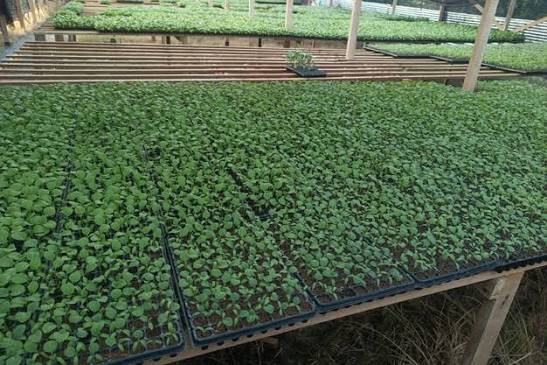
Figure: vegetable nursery.
Cuttings are sections of stems, roots or leaves used as vegetative planting material. Cassava, for example, is multiplied by stem cuttings, and each cutting grows into a plant identical to the one it came from.
Land preparation is the group of operations that turn cleared land into a seedbed: digging or ploughing, breaking clods, levelling and forming ridges or beds.
An implement is a tool or machine that does the work on the soil, such as a hoe, a plough or a harrow. A hand tool is worked by the operator's own muscle power, while an implement may also be drawn by animals or by a tractor.
Assembling means gathering the tools and equipment needed for the planned operations, checking that each is complete, safe and sharp, and fitting any parts that come separately, such as handles, blades or hitch pins. Working through a checklist before leaving the store saves time in the field, keeps work in step with the onset of the rains, and prevents accidents caused by loose heads, worn blades or flat tyres. Faults are found in the store and not in the field, and labour or hired machinery, both charged by the hour, is not wasted. The choice of tools also affects crop establishment: a plough or rotavator leaves a seedbed that is deeper and finer than hand digging can achieve over a large area, and a blunt hoe or the wrong tool for a heavy soil leaves clods that reduce seed contact with moist soil and make germination uneven.
| Name | Specification | Use |
|---|---|---|
| Axe | Forged steel head fixed in a wooden handle | Felling trees, cutting roots, splitting stumps |
| Panga | Single-edged steel blade, wooden or plastic handle | Cutting bush and tall grass |
| Rake | Row of steel tines on a wooden handle | Levelling soil, removing debris |
| Slasher | Light curved or straight steel blade on a long handle | Cutting grass, weeds and old stalks |
| Fork jembe | Strong steel tines on a wooden handle | Digging, turning soil, breaking clods |
| Harrows | Frame with tines, spikes, springs or discs, hand, animal or tractor drawn | Breaking clods, levelling |
| Hoe | Flat steel blade on a wooden handle | Digging, weeding, making furrows |
| Tractor | Wheeled engine unit with drawbar, hydraulic arms and power take-off | Pulling and powering implements |
| Mower | Rotary or cutter-bar blades, powered by an engine or a tractor | Cutting grass and cover |
| Rotavator | Shaft with curved blades inside a hood, driven by the tractor power take-off | Pulverising soil in one pass |
| Wheelbarrow | One wheel, steel or plastic tray, two handles | Carrying soil, manure, materials |
| Ridgers | Frame carrying two mouldboards or wings | Forming ridges and furrows |
| Mouldboard plough | Share, mouldboard and landside on a beam | Cutting and inverting soil |
| Disc plough | Large concave steel discs on a frame | Ploughing hard, dry or stony soil |
| Disc harrow | Gangs of concave steel discs on axles | Cutting clods, secondary tillage |
Protective equipment is assembled with the tools, because every operation in this group can cause cuts, eye injury, dust inhalation or foot injury. Issue it before work starts and check that it fits.
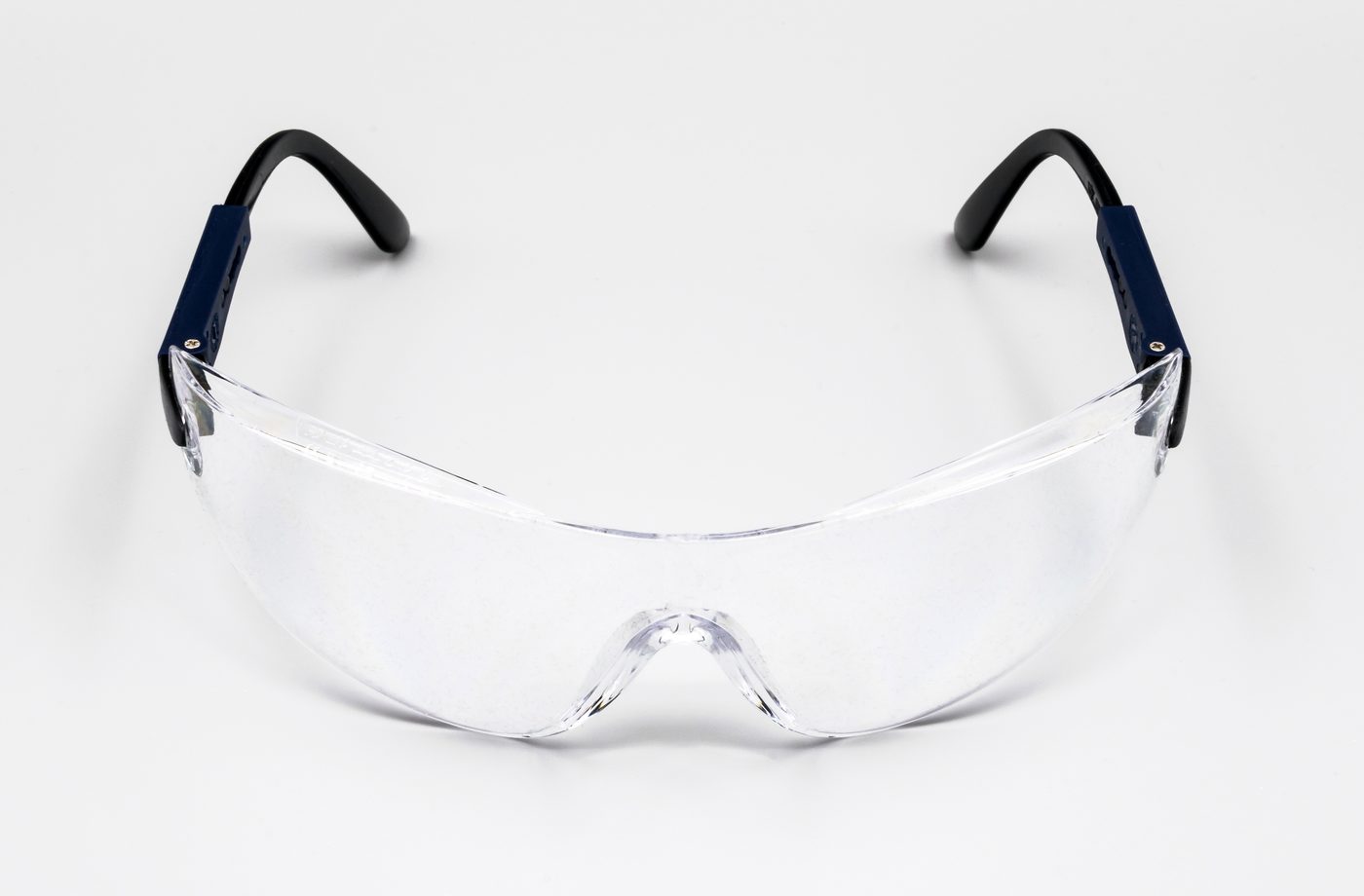
clear safety glasses for eye protection (Source: Wikimedia Commons)
An axe has a forged steel head with a sharpened cutting edge and a wooden handle that passes through an eye in the head and is held tight by a wedge. To assemble it, fit the head onto the handle, drive the wedge in and trim the protruding wood. Before use, check that the head cannot move on the handle, the edge is sharp and free from chips, and the handle is straight without cracks. A farmer clearing a plot of scrub uses the axe for stems and roots too thick for a panga.
A panga is a broad steel blade with one cutting edge, fixed to a short wooden or plastic handle by rivets or bolts. It is a widely used bush-clearing hand tool on Kenyan farms, used for bushes, tall grass and weeds, for cutting saplings and for opening small furrows. Before use, check that the rivets are tight, the handle has no splits and the edge is sharp and free from deep nicks. Keep a sheath or cover on it when carrying it to the field so that nobody is cut on the way.
A rake is a steel head carrying a row of short tines, fixed to a long wooden handle. The farm rake used for seedbeds has strong, evenly spaced tines. Before use, check that no tine is bent or broken and that the head is firm on the handle. A rake is picked up at the end of land preparation, when the plot has been dug and the farmer needs to remove stones, roots and stubble, break small clods and smooth the surface.
A slasher is a long-handled cutting tool with a light blade, either straight or slightly curved, swung from side to side close to the ground to cut thick grass, soft weeds and old crop stalks where machinery cannot reach. It is lighter than a panga and cuts a wider swath with each swing. Check that the blade is sharp, firmly fixed and not bent, and that the handle is long enough for the operator to stand upright.
Tillage tools are the tools and machines that cut, loosen, turn or crumble the soil. They are grouped by the source of power that drives them. Hand tools are driven by the operator and include the hoe, the fork jembe, the spade and the mattock. Animal-drawn implements are pulled by oxen or donkeys and include a single-furrow plough, a ridger and a tined harrow. Tractor-drawn and tractor-mounted machinery includes multi-furrow ploughs, disc harrows and rotavators. The choice depends on farm size, soil type, the money and labour available, and the stage of land preparation. Each tool of the three groups is described in the sections that follow.
A fork jembe is a heavy hand tool with a head of strong flat tines, usually three or four, fixed to a wooden handle at the angle of a hoe. It is swung down into the soil, pulled back to lift and turn it, and used to break clods, dig planting holes and work in manure or compost. It works well in heavy, sticky clay where a flat-bladed hoe sticks, and it aerates the soil without inverting it. Check that the tines are straight and of equal length, and that the head is secure on the handle.
A harrow is a frame carrying tines, spikes, springs or discs that is dragged over ploughed land to break clods and level the surface. This section covers the tined types: the spike-tooth harrow with rigid tines, the spring-tooth harrow whose tines flex and vibrate to shake out roots, and the drag harrow made of a simple frame with tines or chains. Small versions are drawn by oxen and larger versions by a tractor. Before use, check that the tines are tight and not bent, the frame is not cracked, and the hitch point and chains are sound. The disc type is described under Disc harrow.
The hoe, known in Kenya as the jembe, is a widely used hand tool on small farms. It has a flat or slightly curved steel blade fixed to a wooden handle, and it is used for digging, breaking clods and making shallow furrows. Assemble it by fitting the handle into the socket or tang of the blade and fixing it with a rivet or wedge. Check that the blade is firm and the edge is sharp, and that the handle length suits the operator, so that digging does not cause back strain.
A mattock is a heavy hand tool with a pointed head on one side and a flat adze blade on the other. It is chosen where the soil is compacted or stony or where roots must be cut, and is used to break hard ground and dig planting holes. Check that the head cannot slip along the handle.
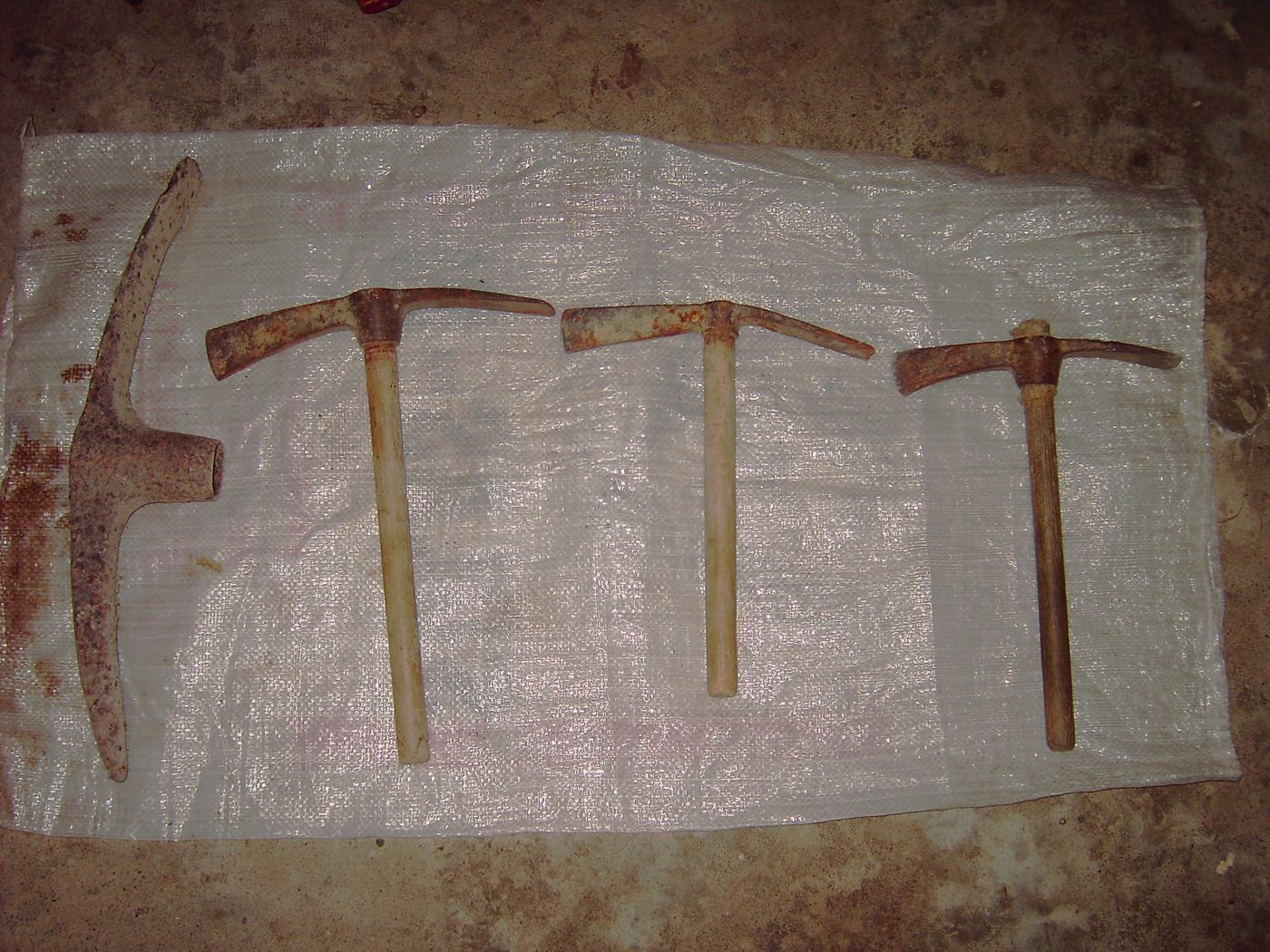
Four mattocks laid out on a white sheet (Source: Wikimedia Commons)
A spade has a flat, straight-edged steel blade on a short or long handle. It is used for digging and turning soil, especially when preparing nursery beds, and for shaping the edges of beds. Check that the blade is not bent and that the handle is sound.
A tractor is the power unit of mechanised land preparation. It pulls trailed implements from its drawbar, lifts and carries mounted implements on its three-point hitch, and drives rotary machines through the power take-off shaft. It supplies the power for ploughs, harrows, rotavators and ridgers and hauls trailers, which makes it the usual choice for large maize and wheat fields. Before the tractor leaves the shed, check these items:
Never carry passengers on the tractor or implement, and always lower mounted implements to the ground when the tractor is parked.
The equipment in this group is everything that supports an implement in the field, as distinct from the cutting parts themselves. It includes hitch pins, top and lower links, drawbars and chains used to connect implements to a tractor or to animals, power take-off shafts and their shields, the spanners and grease gun that adjust and lubricate the machine, spare shear bolts, and the pegs, ropes and measuring tape used to mark out plots and ridge lines. Assemble this kit with the implement and check it before leaving the store. A hitch that is not pinned or a missing shear bolt can stop work in the middle of a field or injure the operator.
A mower cuts grass, weeds and cover crops close to the ground, and shreds tall grass and crop residues before tillage. Rotary mowers have blades that spin horizontally, cutter-bar mowers have a reciprocating blade that works like a pair of scissors, and flail mowers have swinging blades that chop and shred. Small mowers are pushed by hand and driven by an engine, while larger ones are mounted on or pulled by a tractor. Before use, check the blades for sharpness and tightness, ensure the guards and deflector flaps are in place, and check engine oil and fuel. Remove stones and wire from the area first.
A rotavator, also called a rotary tiller, has a horizontal shaft fitted with curved blades enclosed in a hood. It is driven by the tractor power take-off, or by its own engine in the walk-behind version known as a power tiller. As the blades turn they cut and throw the soil, breaking it into a fine tilth in one pass, which suits small-seeded crops. Before use, check that all blades are tight and the right way round, that the gearbox and chain case are filled with the correct oil, and that the power take-off shaft and its guard are secure. Running it too long or too fast can pulverise the soil into a dust that crusts after rain.
A wheelbarrow has one wheel at the front, a tray of steel or plastic and two handles with legs at the rear. It carries manure, compost, cleared stones and debris, seed and tools around the plot. Check the tyre pressure or, if the wheel is solid, check that it turns freely. Inspect the tray for holes, the frame for cracks, and the axle and bolts for tightness. Grease the axle so that the wheel spins without squeaking.
A ridger, also called a hiller, has two mouldboards, or wings, set on a frame that push soil outwards on both sides as it moves, forming a ridge between two furrows. Oxen or a tractor pull it, and the distance between the wings can be adjusted to give the required ridge width. Ridges are used for crops such as potatoes, sweet potatoes and groundnuts, for drainage in wet fields and for furrow irrigation. Before use, check that the wings are tight and set at the same angle, that the frame is straight, and that the hitch and depth adjustments move freely.
The mouldboard plough is the standard implement for primary tillage. Its main parts are the share, which cuts the soil horizontally, the mouldboard, which lifts and turns the furrow slice, the landside, which presses against the furrow wall to keep the plough steady, and the frog and beam, which join these parts to the hitch. Ox-drawn types usually have a single bottom, while tractor-mounted ploughs have two or more bottoms. Before use, check that the share is sharp and not worn short, that bolts are tight, and that the mouldboard surface is smooth and free from rust, because soil sticks to rough metal. Set the working width and depth according to the maker's instructions and the soil.
A disc plough has large concave steel discs, set at an angle to the line of travel and free to turn on bearings. The discs roll over the soil and cut into it rather than slicing a furrow, which makes this plough suitable for hard, dry, stony or root-filled ground and for sticky soils where a mouldboard plough clogs. Scrapers clean the discs as they rotate. Before use, check disc sharpness, bearing lubrication, scraper position and bolt tightness, and set the disc angle and tilt for the working depth required.
A disc harrow has gangs of concave steel discs mounted on axles, with two or four gangs on the frame depending on the model. It is drawn by a tractor after ploughing to cut clods, partly bury residues, level and pulverise the surface and mix in fertiliser. The angle of the gangs controls how aggressively the discs cut: a wider angle gives deeper, more vigorous work. Before use, grease the bearings, check that the discs are tight on the axle and not cracked, confirm that the scrapers touch the discs, and set the gang angle.
Define the following terms: seed, propagule, and certified seed. (6 marks)
Explain the importance of assembling land preparation tools before starting fieldwork. (5 marks)
Describe three types of land preparation equipment used by Kenyan smallholder farmers and their primary uses. (9 marks)
Discuss safety precautions farmers should take when using land preparation tools. (5 marks)
Create a free account to open more of this chapter.
Free: practical guides, quick cards, workplace scenarios and more.
Create a free accountThis chapter focused on the preparation of planting materials essential for successful annual crop production. It began with defining key terms related to planting material preparation and proceeded to detail the various land preparation tools and equipment, including axes, pangas, rakes, slashers, and machinery such as tractors and rotavators. The chapter explained the specific uses of each tool and equipment in preparing the land for planting and emphasized the importance of their proper maintenance to ensure longevity and efficiency. It then described the different types of planting materials, ranging from seeds and seedlings to cuttings, slips, and tubers, highlighting their roles in crop establishment. The discussion extended to critical field management practices such as mulching, gapping, thinning, training, fertilizer application-pruning, and trellising, which support crop growth and yield. Finally, the chapter underscored the integration of these practices in carrying out effective field management for annual crops.
Type: Individual
| Tools & Equipment | Materials |
|---|---|
| Cutting tools | Fresh healthy seeds |
| Measuring cylinder | Clean water |
| Sieve | Planting trays or seedbeds |
| Pen | Labels |
| Clean cloth or paper towels |
| S/N | Item | Quantity |
|---|---|---|
| 1 | Fresh healthy seeds (maize, beans, or similar) | 200 g per Candidate |
| 2 | Cutting tools (sharp knife or secateurs) | 1 Pc per Candidate |
| 3 | Clean water | Enough for all Candidates |
| 4 | Planting trays or seedbeds | 1 Pc per Candidate |
| 5 | Labels | 2 Pcs per Candidate |
| 6 | Pen | 1 Pc per Candidate |
| 7 | Measuring cylinder (100 ml capacity) | 1 Pc per 5 Candidates |
| 8 | Personal protective equipment (gloves, dustcoat, gumboots) | 1 Set per Candidate |
| 9 | Sieve for seed cleaning | 1 Pc per 5 Candidates |
| 10 | Clean cloth or paper towels | 2 Pcs per Candidate |
| Items to be Evaluated | Marks Available | Marks Obtained | Comments |
|---|---|---|---|
| TASK 1: Identification and Definition of Planting Material Terms | |||
| Wore personal protective equipment (gloves, dustcoat, gumboots) (Award 1 mark for each correctly worn PPE or zero) | 2 | ||
| Assembled required tools and materials (cutting tools, seeds, water, measuring cylinder, sieve, labels, pen) (Award 0.5 marks each for correct identification or zero 0.5x6) | 3 | ||
| Correctly identified and defined five planting material terms (e.g., seed, cutting, graft, tuber, seedling) (Award 1 mark per correctly defined term or zero) | 5 | ||
| Sub-Total | 10 | ||
| TASK 2: Preparation of Planting Materials | |||
| Sorted seeds to remove damaged or immature seeds (Award 2 marks for proper sorting or zero) | 2 | ||
| Cleaned seeds using sieve and removed debris (Award 2 marks for thorough cleaning or zero) | 2 | ||
| Measured 200g of seeds accurately using weighing scale or estimation (Award 2 marks for correct quantity or zero) | 2 | ||
| Prepared seedbed/tray of size approximately 1m x 0.5m and moistened with measured water (approx. 100ml) (Award 3 marks for correct seedbed preparation and watering or zero) | 3 | ||
| Planted seeds uniformly in seedbed/tray (Award 3 marks for uniform seed placement or zero) | 3 | ||
| Labeled the seedbed with correct identification details (Award 2 marks for clear and accurate labeling or zero) | 2 | ||
| Maintained cleanliness and good housekeeping during and after preparation (Award 2 marks for good housekeeping or zero) | 2 | ||
| Sub-Total | 16 | ||
| PRODUCT CHECKLIST | |||
| Prepared seedbed/tray approximately 1m x 0.5m in size (Award 3 marks for correct dimensions or zero) | 3 | ||
| Seed quantity approximately 200g and uniformly placed in seedbed (Award 3 marks for correct quantity and uniformity or zero) | 3 | ||
| Labels correctly attached with clear identification (Award 2 marks for properly attached and legible labels or zero) | 2 | ||
| Clean and organized work area after completion (Award 2 marks for cleanliness and organization or zero) | 2 | ||
| Sub-Total | 10 | ||
| GRAND TOTAL | 36 | ||
Type: Individual
| Tools & Equipment | Materials |
|---|---|
| Panga | Work Gloves |
| Axe | Gumboots |
| Rake | Dustcoat/Overall |
| Slasher | Face Mask |
| Measuring Tape 5m | |
| Sisal Twine 20m |
| S/N | Item | Quantity |
|---|---|---|
| 1 | Panga | 1 Pc per Candidate |
| 2 | Axe | 1 Pc per Candidate |
| 3 | Rake | 1 Pc per Candidate |
| 4 | Slasher | 1 Pc per Candidate |
| 5 | Measuring Tape 5m | 1 Pc per 5 Candidates |
| 6 | Sisal Twine 20m | 1 Roll per 10 Candidates |
| 7 | Work Gloves | 1 Pair per Candidate |
| 8 | Gumboots | 1 Pair per Candidate |
| 9 | Dustcoat/Overall | 1 Pc per Candidate |
| 10 | Face Mask | 1 Pc per Candidate |
| Items to be Evaluated | Marks Available | Marks Obtained | Comments |
|---|---|---|---|
| TASK 1: Assemble Hand Tools for Land Preparation | |||
| Worn all required PPE correctly (Gumboots, Dustcoat/Overall, Work Gloves, Face Mask) (Award 1 mark each for Gumboots, Dustcoat/Overall, Gloves, Face Mask; max 3 marks) | 3 | ||
| Identified and selected the correct hand tools: Panga, Axe, Rake, Slasher (Award 1 mark per tool correctly identified and selected x4) | 4 | ||
| Checked tools for serviceability (sharpness, handle condition, no damage) (Award 3 marks for checking all tools or zero) | 3 | ||
| Measured and marked a 5m x 5m plot using measuring tape and sisal twine (Award 2 marks for correct measurement, 2 marks for proper pegging and marking with twine) | 4 | ||
| Arranged the tools neatly and safely ready for use (Award 2 marks for neat and safe arrangement or zero) | 2 | ||
| Sub-Total | 16 | ||
| PRODUCT CHECKLIST | |||
| All four hand tools assembled and ready for use with no visible defects (Award 4 marks if all tools are assembled and serviceable or zero) | 4 | ||
| The 5m x 5m plot is accurately measured and correctly pegged with sisal twine (Award 5 marks if plot dimensions are accurate within 5cm tolerance and properly marked or zero) | 5 | ||
| Sub-Total | 9 | ||
| GRAND TOTAL | 25 | ||
At the start of this chapter we promised you would be able to:
Tick each one you can genuinely do.
So, are you there yet?
You're competent when you can confidently do 50% or more of what this chapter promised.
Sign in to record how you're doing.